Cardano Enters New Phase, Hoskinson Touts ‘ChatGPT For Privacy’

bitcoinistОпубликовано 2025-12-19Обновлено 2025-12-19

Введение

Charles Hoskinson announced that Cardano is entering a new phase centered on Midnight, a project he describes as a "ChatGPT for privacy." Midnight is positioned as a cross-ecosystem application layer designed to make advanced cryptography usable at scale, enabling privacy-first hybrid applications that can integrate with Ethereum, Solana, Bitcoin, and other chains. Hoskinson emphasized that Midnight is not merely a privacy coin but a platform for selective disclosure, intents, dual tokenomics, and multi-resource consensus, targeting real-world applications capable of handling trillions in transactions. He highlighted Midnight's early traction, citing a $1 billion market cap and $1.8 billion trading volume, attributing this success to a fair distribution model that allocated tokens to 1.5 million users rather than venture capitalists. Hoskinson argued that Cardano can differentiate itself by prioritizing privacy-enabled financial primitives like private DEXs and prediction markets, rather than competing solely on transaction cost. He outlined plans to roll out Midnight across major ecosystems in 2026, aiming to unify crypto markets and eliminate the distinction between DeFi and TradFi.

Charles Hoskinson says Cardano is entering a new phase centered on what he described as a “ChatGPT for privacy,” positioning the Midnight project as a cross-ecosystem application layer designed to make advanced cryptography usable at scale.

Cardano Is Entering A New Phase

Speaking in a Dec. 18 livestream titled “Rays of Sunshine in 2026,” the Cardano founder argued that Midnight marks a shift away from incremental performance battles toward privacy-first, hybrid applications that can plug into Ethereum, Solana, Bitcoin, and beyond.

“I wanted to make a video to talk about the good stuff and talk about the fact that we’re leading the market for the first time in a long time,” Hoskinson said. “And it feels right. This time really does.”

The heart of the pitch was that Midnight’s early traction is not just a hype spike, but a sign the market is tired of the usual crypto incentive loop and looking for a new “paradigm.” “People deep down inside, they know that a new generation is starting,” he said. “We need a new paradigm and we have to have a reset and we have to launch things and do things differently. And they’re just tired of the way things have happened before. They’re tired of it.”

Hoskinson spent time distinguishing Midnight from the category it will inevitably be filed under. “When you looked at Midnight, Midnight is not a privacy coin,” he said. “Midnight is what will enable rational privacy and selective disclosure, but it’s so much more. It’s the platform for intents. It’s the platform for hybrid applications. It’s the platform for capacity exchange, for dual tokenomics. It’s the platform for multi-resource consensus.”

He acknowledged the underlying toolkit—“snarks,” “roll-ups,” “recursion and folding”—but argued those buzzwords miss the point. “It’s never been about roll-ups, recursion, folding, snarks from a scalability perspective,” he said. “It’s about real world applications.” The claim, in his telling, is that Midnight is one of the few projects positioned to handle “trillions of dollars worth of transactions,” precisely because it targets applications where selective disclosure and privacy are features, not trade-offs.

To make the case that Midnight is already outperforming comparable narratives, Hoskinson cited market-cap and volume figures for other ZK and privacy-adjacent projects and contrasted them with Midnight’s reported activity. He cited Starkware at $410 million market cap with $72 million volume, zkSync at $279 million market cap with $29 million volume, and Mina at $97 million market cap—before highlighting his own project: “Midnight, $1 billion market cap, $1.8 billion trading. It doesn’t even have Binance Spot yet.”

A major reason he believes the market has leaned in, Hoskinson argued, is launch structure—specifically, avoiding the standard fear that insiders will overwhelm liquidity. “And they said, well, can I believe in it? Is there an ICO? Is there an insider? Who the f*** is going to dump on me?” he said. “They just gave it away. Eight different ecosystems, seven chains. All the VCs wanted in, they got nothing. They didn’t get in. We gave it to the people.”

He later tied distribution directly to observed trading intensity. “We have about 1.5 million people that got night tokens,” he said. “That’s why the volume is so f***ing high.”

Midnight Is The ‘ChatGPT For Privacy’

For Cardano itself, Hoskinson’s most pointed strategic claim was that “better, faster, cheaper” is not a durable wedge—even if upcoming upgrades land. “Let’s say Leios ships and Hydra ships and we’re better, faster, and cheaper. Great,” he said. “What reason does someone have to leave Solana? And what reason does someone have to leave Ethereum? Because the transaction fee is 3% less. Okay.”

Instead, he argued Cardano can win by being first to build hybrid applications that route through Midnight and unlock privacy-first financial primitives. “They could go through midnight to Cardano and they get privacy,” he said. “They do something new and different [...] private prediction markets, private DEXs, private stablecoins.”

He extended that thinking to Bitcoin-adjacent flows: “Maybe just maybe all those Bitcoin people are going to want to trade on a private DEX instead of a public DEX,” he said. “And maybe we’ll have volumes in the billions of dollars of turnaround every single day.”

Hoskinson repeatedly returned to a simplifying metaphor: Midnight as an abstraction layer that makes heavy cryptography usable. “Everybody else gets jealous. So they’ll go use Midnight too because it’s the ChatGPT of privacy,” he said. “Just send stuff and stuff comes out.” He later described a product-like cadence of improvement: “You basically just have this API. You send something in, you get something back. And every six months it gets better.”

He also framed 2026 as an execution year, sketching an outward-facing expansion plan where Midnight is integrated across major ecosystems in tight succession: “We’re going to do Cardano Midnight. Show them how it’s done. Then we’re gonna do Midnight Ethereum. Two months later, three months later, Midnight Solana... Midnight Avalanche... Midnight Bitcoin.”

The broader ambition, he said, is to move crypto past siloed tribal finance toward one interoperable market. “This is the last generation,” Hoskinson said. “It’s gonna unify the marketplaces and it’s gonna get rid of DeFi and TradFi. And there’s just going to be Fi.”

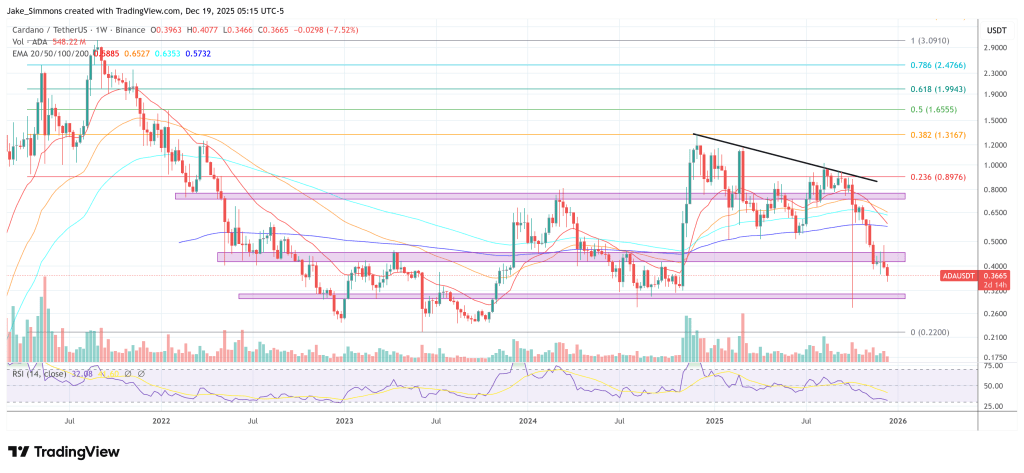
At press time, Cardano traded at $0.36.

Cardano falls below key support, 1-week chart | Source: ADAUSDT on TradingView.com

Связанные с этим вопросы

QWhat is the main focus of Cardano's new phase as announced by Charles Hoskinson?

AThe main focus is on the Midnight project, described as a 'ChatGPT for privacy,' which serves as a cross-ecosystem application layer designed to make advanced cryptography usable at scale.

QHow does Hoskinson distinguish Midnight from being categorized as a privacy coin?

AHoskinson states that Midnight is not a privacy coin but a platform that enables rational privacy and selective disclosure, supporting intents, hybrid applications, capacity exchange, dual tokenomics, and multi-resource consensus.

QWhat market cap and trading volume did Hoskinson cite for Midnight compared to other ZK and privacy-adjacent projects?

AHoskinson cited Midnight with a $1 billion market cap and $1.8 billion trading volume, contrasting it with Starkware ($410M market cap, $72M volume), zkSync ($279M market cap, $29M volume), and Mina ($97M market cap).

QWhy does Hoskinson believe the market has responded positively to Midnight's launch structure?

AHe attributes the positive response to the distribution model, where tokens were given away to 1.5 million people across eight ecosystems and seven chains, avoiding insider advantages and VC allocations, which built trust and liquidity.

QWhat is the broader ambition Hoskinson envisions for Midnight and the crypto market?

AThe broader ambition is to unify the marketplaces by integrating Midnight across major ecosystems like Ethereum, Solana, Bitcoin, and Avalanche, moving beyond siloed tribal finance to create one interoperable market, eliminating the distinction between DeFi and TradFi.

Похожее

The Gold Buy-on-the-Dip Guide: Watch Interest Rates, Not Just War

"Gold Buying Guide: Focus on Interest Rates, Not Just War" Four months ago, gold buyers likely didn't anticipate buying at a peak that even a war couldn't sustain. After hitting a record high of $5,596 on January 29, gold entered a bear market just 91 days later, its fastest decline since 2008. A key trigger was the Fed's hawkish shift, highlighting that monetary policy, not geopolitics, is the primary driver. The article argues that the traditional "buy gold in turmoil" script has changed. While the US-Iran conflict initially boosted prices, the sustained rally in oil prices heightened inflation fears, forcing central banks to maintain or consider tighter policy. Since gold yields no interest, higher rates increase its opportunity cost, eroding its appeal. This dynamic was evident when gold fell sharply on May 18 despite positive peace talks, as lower oil prices eased inflation and thus rate hike pressures. The recent sell-off is also part of a broader market deleveraging. Correlations between gold, Nasdaq, and Bitcoin spiked as leveraged investors sold liquid assets to cover losses, creating a synchronized downturn. Historically, gold bottoms align with policy shifts, not conflict resolutions. The 2008 and 2022 bear markets ended with shifts to extreme easing and peak inflation expectations, respectively. For potential buyers, the author suggests monitoring three signals: 1) Peak interest rate hike expectations, 2) Reopening of the Strait of Hormuz (to ease oil/inflation pressure), and 3) A return to net inflows for Gold ETFs, indicating the end of forced selling. While predicting the exact bottom is impossible, the author's personal strategy involves scaling into a position across price levels like $4000, $3700, and $3500, committing no more than 30% of the intended total allocation initially, and adding the remainder only if key signals emerge. The core conclusion: In turbulent times, watching interest rates is more crucial than watching wars.

marsbit7 мин. назад

The Gold Buy-on-the-Dip Guide: Watch Interest Rates, Not Just War

marsbit7 мин. назад

Recent On-Chain Review: No Clear Narrative Under U.S. Stock Market Pressure, Just Hype

This article analyzes the current state of the Solana meme coin and community token ecosystem, highlighting a market caught between two dominant forces: attention-based PvP and a gradual return to community-centric projects. The first part explores the "Attention PvP" dynamic, where success is driven by celebrity endorsements, viral events, and speed. Examples include $JOTCHUA, which surged after its meme creator's social media activity, and $WORLDCUP, which outperformed a similar Base chain project ($PITCH) largely due to influencer support. The recent "pump.fun GO" feature, allowing bounty tasks for token promotion, is critiqued for fostering sensationalist and often negative stunts—like people getting token tickers tattooed on their bodies for rewards—reminiscent of old internet shock content. In contrast, the article points to a resurgence of organic, community-driven tokens that survive market volatility through strong holder bases and shared ideology, not just hype. Influencer Ansem is cited, arguing that durable meme coins rely on communities willing to endure losses and promote their core message daily. Examples given are older tokens like $neet (anti-work ethos), $troll, $buttcoin, and $triplet, which have maintained relative price stability. A prime example of this community-build model is the new project $KINS, the token for the browser-based MMORPG Kintara. Its success stems not from advanced graphics but from consistently delivering updates, fostering player trust, and creating genuine engagement (e.g., in-game economies, events, property auctions). It has attracted a growing player base and even notable KOLs as participants, demonstrating that sustainable growth can come from building trust rather than orchestrating pumps. The article concludes by questioning whether the market is ultimately a game of mutual trust or mutual deception, expressing hope that such reflection might lead to a healthier ecosystem.

marsbit7 мин. назад

Recent On-Chain Review: No Clear Narrative Under U.S. Stock Market Pressure, Just Hype

marsbit7 мин. назад

On-Chain Scene on Opening Day: $20 Billion Already Staked, How Do On-Chain Contracts Know Who Wins?

On the opening day of the 2026 World Cup, over $2 billion had already been wagered on just the "tournament winner" contracts on platforms like Polymarket and Kalshi. This article explores how these blockchain-based prediction markets actually function once the games begin. It breaks down the massive volume and explains how single-game and tournament-long contracts are priced, with values moving between 1-99 cents to reflect implied probabilities. A key mechanism highlighted is "elimination zeroing," where a team's "champion yes" contract immediately settles to zero once they are mathematically eliminated. The core technical question answered is: how does a smart contract "know" who won a real-world match? The answer lies in oracles. The article details two primary paradigms: UMA's "optimistic oracle" (used by most of Polymarket), which allows a challenge period after a proposed result, and Chainlink's multi-source data aggregation (used by FIFA partners like ADI Predictstreet), which automates settlement with minimal dispute windows. Finally, the article injects a note of caution, citing research estimating that a significant portion of historical trading volume on these platforms might be "wash trading" to inflate numbers. It concludes by contrasting the legal status of these "event contracts" under CFTC rules in the U.S. versus traditional, state-regulated sports betting. As the tournament progresses, the real-time operation of this multi-billion dollar machine—its settlements, eliminations, and underlying mechanisms—becomes a story as compelling as the football itself.

marsbit22 мин. назад

On-Chain Scene on Opening Day: $20 Billion Already Staked, How Do On-Chain Contracts Know Who Wins?

marsbit22 мин. назад

Sequoia Dialogue with Jensen Huang: Computing Model Undergoes a 60-Year Transformation; You Won't Be Replaced by AI, But You Will Be Dimensionality-Reduced by 'Those Who Master AI'

NVIDIA founder and CEO Jensen Huang, in a conversation with Sequoia Capital's Konstantine Buhler, argues that we are witnessing the most significant computing shift in 60 years—from retrieval-based to generative computing. Instead of just storing and retrieving data, future systems will generate highly personalized content (text, images, video) on demand, powered by massive "AI factories." Huang envisions a global "intelligence network" that will envelop the planet, following the historical patterns of energy and communication grids. He outlines a five-layer investment framework: 1) Energy, 2) Chips/Computers, 3) Infrastructure (data centers), 4) AI Models, and 5) Applications. He predicts this ecosystem will reach a scale of $20 trillion annually. Crucially, Huang pushes back against fears of AI-driven job loss. He distinguishes between specific "tasks" (e.g., typing, analyzing images) and overall "jobs" (e.g., CEO, radiologist). While AI automates tasks, it increases efficiency and demand for the higher-value problem-solving aspects of professions, thus creating more jobs and "up-leveling" careers. The real risk, he asserts, is not being replaced by AI, but being outperformed by someone who effectively leverages it. He urges everyone to embrace AI as a tool for augmented capability and innovation.

marsbit1 ч. назад

Sequoia Dialogue with Jensen Huang: Computing Model Undergoes a 60-Year Transformation; You Won't Be Replaced by AI, But You Will Be Dimensionality-Reduced by 'Those Who Master AI'

marsbit1 ч. назад

Торговля

Спот
Фьючерсы

Популярные статьи

Как купить ADA

Добро пожаловать на HTX.com! Мы сделали приобретение Cardano (ADA) простым и удобным. Следуйте нашему пошаговому руководству и отправляйтесь в свое крипто-путешествие.Шаг 1: Создайте аккаунт на HTXИспользуйте свой адрес электронной почты или номер телефона, чтобы зарегистрироваться и бесплатно создать аккаунт на HTX. Пройдите удобную регистрацию и откройте для себя весь функционал.Создать аккаунтШаг 2: Перейдите в Купить криптовалюту и выберите свой способ оплатыКредитная/Дебетовая Карта: Используйте свою карту Visa или Mastercard для мгновенной покупки Cardano (ADA).Баланс: Используйте средства с баланса вашего аккаунта HTX для простой торговли.Третьи Лица: Мы добавили популярные способы оплаты, такие как Google Pay и Apple Pay, для повышения удобства.P2P: Торгуйте напрямую с другими пользователями на HTX.Внебиржевая Торговля (OTC): Мы предлагаем индивидуальные услуги и конкурентоспособные обменные курсы для трейдеров.Шаг 3: Хранение Cardano (ADA)После приобретения вами Cardano (ADA) храните их в своем аккаунте на HTX. В качестве альтернативы вы можете отправить их куда-либо с помощью перевода в блокчейне или использовать для торговли с другими криптовалютами.Шаг 4: Торговля Cardano (ADA)С легкостью торгуйте Cardano (ADA) на спотовом рынке HTX. Просто зайдите в свой аккаунт, выберите торговую пару, совершайте сделки и следите за ними в режиме реального времени. Мы предлагаем удобный интерфейс как для начинающих, так и для опытных трейдеров.

2.3k просмотров всегоОпубликовано 2024.03.29Обновлено 2026.06.02

Как купить ADA

SNEK: ведущий мемкоин на блокчейне Cardano, открывающий новую эпоху для экосистемы Cardano

SNEK - это дефляционный мемкоин, выпущенный на блокчейне Cardano. Он создаёт децентрализованную культурную и развлекательную ценность за счёт участия глобального сообщества.

2.1k просмотров всегоОпубликовано 2025.10.15Обновлено 2025.10.15

SNEK: ведущий мемкоин на блокчейне Cardano, открывающий новую эпоху для экосистемы Cardano

Неделя обучения по популярным токенам 8: запуск основной сети Ouroboros Leios для ADA ожидается в 2026 году

Основная сеть Ouroboros Leios для ADA, как ожидается, будет запущена в 2026 году, а хардфорк до версии протокола 11 запланирован на I квартал 2026 года.

2.0k просмотров всегоОпубликовано 2026.02.10Обновлено 2026.02.12

Неделя обучения по популярным токенам 8: запуск основной сети Ouroboros Leios для ADA ожидается в 2026 году

Обсуждения

Добро пожаловать в Сообщество HTX. Здесь вы сможете быть в курсе последних новостей о развитии платформы и получить доступ к профессиональной аналитической информации о рынке. Мнения пользователей о цене на ADA (ADA) представлены ниже.

活动图片