Building a Cross-AI Large Model "Privacy Memory Layer", ZetaChain Shapes New AI Experience with Multi-Model Aggregation Application Anuma

marsbitОпубликовано 2026-01-29Обновлено 2026-01-29

Введение

ZetaChain has launched its 2.0 upgrade, introducing a privacy-focused "Private Memory Layer" designed to unify AI interactions across multiple models. This layer allows users to retain, encrypt, and carry over conversation context seamlessly between different AI platforms, such as ChatGPT and Claude, without losing history or compromising privacy. Accompanying the upgrade is Anuma, a multi-model AI application currently in private beta, which leverages ZetaChain’s decentralized infrastructure to offer end-to-end encrypted, user-controlled conversations. By combining blockchain-based security with AI interoperability, ZetaChain aims to solve issues of data fragmentation and centralization in current generative AI services, offering users greater control, continuity, and privacy.

Author: Zen, PANews

In today's generative AI applications, users often face a fragmented conversational experience. When switching between different models, the context of previous conversations often cannot be continued, forcing users to start over and repeat information each time. For example, details of a project discussed on ChatGPT cannot be directly inherited when switching to Claude or other models, severely impacting efficiency.

Moreover, the conversational data from these large models is typically stored on the platforms' servers, leaving users with little privacy protection and control over their own data. "These real-world issues not only create a disjointed user experience but also raise concerns about user data sovereignty and security.

Addressing this pain point, the industry has begun exploring the concept of a "migratable, user-controlled memory layer," and blockchain technology may be the key to achieving this goal.

Leveraging the open interoperability of blockchain, it might be possible to create a privacy memory layer that saves AI context as a digital asset, allowing seamless transfer across multiple AI platforms. This would eliminate the worry of "forgetting" past interactions every time a tool is changed, while ensuring data privacy and sovereignty.

ZetaChain 2.0 Released, Building a Universal Layer for AI and Web3

Addressing the above needs, ZetaChain, a public chain project focused on cross-chain interoperability, seized the opportunity presented by the convergence of AI and Web3. In its roadmap review at the end of 2025, ZetaChain announced its "2.0" version plan, introducing new features for the AI era on top of its existing universal cross-chain architecture.
On January 27, 2026, ZetaChain 2.0 officially launched, alongside its first AI product—Anuma, a privacy-centric large model aggregation application. According to official introductions, ZetaChain 2.0 revolves around the following three core capabilities:

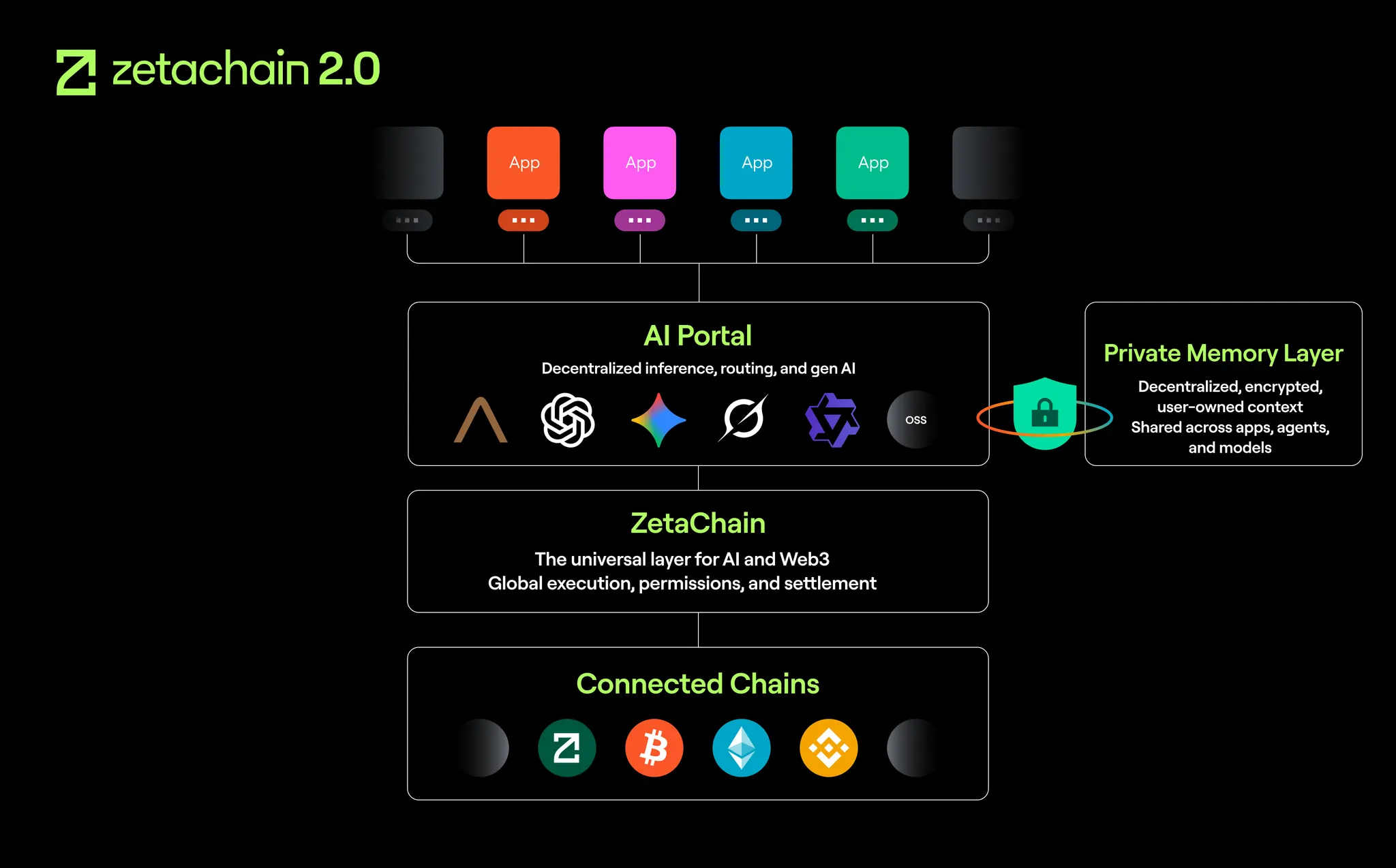
Private Memory Layer is a protocol-level memory system specifically designed for AI interactions, aiming to bridge the contextual gap between AI tools, turning users' digital memories into assets they truly control. Based on the privacy memory layer, all user conversation content is stored encrypted, with only the user holding the key; even the platform itself cannot view it. Valuable information generated across different models and at different times will be controlled by the user, allowing for continuous accumulation and随时 migration to new conversations, without being monopolized by any single AI service.

AI Portal is a unified routing and execution layer, enabling applications to access multiple AI model providers without being locked in, with built-in support for availability, fallback, and cost/performance optimization. The AI Portal handles the underlying model routing and context bridging. Users can freely choose different models like ChatGPT, Anthropic Claude, Google Gemini, etc., to get answers, with previous conversational memories supported by the privacy memory layer.

Beyond the protocol itself, ZetaChain 2.0 also packages its key capabilities into a Software Development Kit (SDK). Developers can directly integrate privacy-persistent memory, cross-model switching, and monetization components into their products. This SDK allows applications or AI Agents to maintain continuous context across different models and call upon different model capabilities on demand, significantly reducing the cost and complexity for teams to build their own infrastructure.

In terms of mechanism design, the three core modules complement each other. The Private Memory Layer provides privacy-first user memory and data support, the AI Portal enables continuous interaction across mainstream large models, and the SDK ecosystem facilitates efficient and rapid participation and expansion by third-party developers. This also allows ZetaChain to expand from a底层 cross-chain protocol to a universal platform serving both Web3 and AI.

Focusing on Privacy and User Sovereignty, Anuma Launches and Opens Applications

Alongside the official launch of ZetaChain 2.0, the project team's other highlight is its first consumer-grade AI product on the platform, Anuma. Currently, Anuma is in a private beta phase, gradually opening up trial access through an invitation-based waitlist; users can apply for early access via the public waitlist.

As a large model aggregation application, Anuma integrates with multiple mainstream large models, allowing users to invoke different AI engines within a single conversation. It offers the convenience of聚合 tools like Poe, while supporting models such as OpenAI's GPT series and Anthropic's Claude.

When a user asks a question, they can specify or change the model used for the response. Switching between engines requires just a click, without needing to migrate to another application. Users can flexibly choose the most suitable model on Anuma to get answers based on the question type, while the entire conversation process continues seamlessly in the same window.

Technically, thanks to ZetaChain's Private Memory Layer, every segment of a user's conversation in Anuma is encrypted and stored as personal memory, seamlessly migrating to new models or new sessions. When a user starts a new conversation or switches AI models within an existing conversation, Anuma can securely inject the relevant context into the target model, enabling it to understand the prior background and user intent. This eliminates the need for users to repeat the same background information across different AIs, greatly improving the efficiency of cross-model collaboration.
Traditional Web2 enterprises exploiting their centralized advantage to misuse user data has long been deeply resented. Practices like platform-based price discrimination and data selling are repeatedly prohibited yet persist. This user vigilance and concern towards centralized platforms has also extended to the rapidly developing AI field.

Anuma places great emphasis on the confidentiality of conversation content and user sovereignty. The entire platform employs an end-to-end encryption scheme to protect user data. From the moment a user inputs a message on the front end, the content is encrypted using the user's key before being passed to the privacy memory layer for storage. When context needs to be provided to an AI model, it is decrypted by the user's client or a trusted execution environment before being sent to the model. Throughout this process, conversation records are always stored on-chain or in transit in ciphertext form; even ZetaChain's nodes or servers cannot窥视 the content.

This stands in stark contrast to traditional AI chat services, where chat logs are typically stored in plain text on servers, posing risks of being viewed by operators or leaked. Anuma, through blockchain and encryption technology, achieves a level of security similar to Web3 wallet private key management—only the user can interpret their data. It can provide a more reassuring choice for sensitive AI applications in fields like law and medicine, encouraging users to engage in more private exchanges.

In fact, even before Anuma's launch, there were already some multi-model aggregated AI conversation products on the market, notably Poe from the "American Quora" Quora, and TypingMind from the open-source community.

Compared to the cloud service model of these two platforms and local deployment, Anuma's on-chain encrypted storage balances privacy and sovereignty. In terms of ease of use and model richness, Anuma eliminates the cumbersome configuration process of the TypingMind model, offering direct access to the convenient multi-model conversation experience similar to Poe.

Behind the Move into AI: ZetaChain's Technical Logic and Natural Evolution

ZetaChain's decision to launch version 2.0 and Anuma at this time is backed by solid technical accumulation and a clear evolutionary logic.

As the first universal L1 blockchain project, ZetaChain has focused on solving the fragmentation problem in the blockchain领域 since its launch in 2021,致力于 building an underlying network connecting all public chains. Built based on Cosmos SDK, it natively supports interoperability with heterogeneous chains like Ethereum, Bitcoin, and Cosmos.

Through innovations like CAF, ZetaChain simplifies traditional cross-chain operations that require bridges and wrapping into a single contract call on one chain, providing users with unified liquidity and user experience. By the end of 2025, the ZetaChain mainnet had integrated ten major mainstream blockchain networks, including Bitcoin, covering tens of millions of users, with累计 on-chain transactions reaching 225 million.

At the ecosystem and capital level, ZetaChain has also gained broad recognition. According to public data, the project raised $27 million in funding from知名 institutions including Blockchain.com, Jane Street, and Sky9 Capital. In 2024-2025, global tech and infrastructure giants like Google Cloud, Deutsche Telekom, and Alibaba Cloud successively joined the network as validator nodes, endorsing its security and compliance.

Entering the second half of 2025, with the explosion of generative AI, the ZetaChain team keenly realized that the industry's multi-chain ecosystem and multi-model AI actually share similar pain points—both involve fragmentation across multiple platforms and systems, requiring a universal layer for integration. Thus, they proposed the strategic concept of an "AI Universal Platform," introducing blockchain's trusted computing and storage into the AI field to build blockchain infrastructure for the AI era.

ZetaChain 2.0 is the realization of this vision. It retains and strengthens the original cross-chain functions while adding new AI privacy memory and interaction capabilities. This aligns with ZetaChain's consistent vision of making Web3 friendly to both humans and AI. The natural evolution from a "Universal Blockchain" to an "AI Universal Platform" is both顺应 the trend of technological convergence and an extension of the project's mission.

"ZetaChain has already achieved scaled unification at the blockchain experience level." As Ankur Nandwani, a core contributor to ZetaChain, stated, "ZetaChain 2.0 extends the same approach to AI, enabling the next generation of applications and Agents to operate between models and blockchains,默认 equipped with private, authorizable memory capabilities and global monetization channels."

New Paradigm of Deep Integration of Blockchain and AI, What are the Prospects?

The launch of ZetaChain 2.0 and its debut product Anuma represents a significant attempt at the deep integration of blockchain and AI. Within this system, we see a new paradigm for multi-model AI applications: privacy-first, user-controlled, cross-platform portability.

Of course, it must be objectively noted that Anuma is currently in a very early Private Beta stage, and the overall ecosystem is also in its initial construction phase. Many features and details await feedback from广大 testers for refinement, such as support for more models, optimization of memory layer capacity and performance, and enrichment of third-party developer tools. This means that in the short term, Anuma is far from replacing the experience of mature individual platforms, and some users will need time to adapt to this new interaction mode.

However, it cannot be ignored that the direction represented by Anuma is pioneering. In the track of multi-model aggregation experience, Anuma offers a different approach from the solutions of large companies. Instead of monopolizing data and model invocation rights by a centralized platform, it returns choice and memory to the user, achieving trust-minimized coordination through blockchain technology.

As Anuma's public beta opens and features iterate, perhaps more innovative applications will emerge on this platform, such as privacy-guaranteed AI advisors, cross-domain intelligent search assistants, and so on. How far this new trend of privacy-first multi-model experience can go remains to be tested by time.


Трендовые криптовалюты

Связанные с этим вопросы

QWhat is the main problem that ZetaChain's Anuma application aims to solve in the AI space?

AAnuma addresses the fragmented user experience where switching between different AI models (like ChatGPT and Claude) causes loss of conversation context, requiring users to repeatedly provide the same information. It also tackles privacy concerns and lack of user control over data stored on centralized platforms.

QWhat are the three core capabilities introduced in ZetaChain 2.0 to support AI integration?

AThe three core capabilities are: 1) Private Memory Layer - a protocol-level memory system for encrypted, user-controlled storage of AI conversation context; 2) AI Portal - a unified routing and execution layer for accessing multiple AI models without platform lock-in; 3) SDK - a developer toolkit for integrating privacy, cross-model switching, and monetization features into third-party applications.

QHow does Anuma ensure user privacy and data control compared to traditional AI chat services?

AAnuma uses end-to-end encryption where user messages are encrypted with user-held keys before storage or transmission. Conversations are stored encrypted on-chain, and only the user can decrypt them. This contrasts with traditional AI services where data is often stored in plain text on central servers, exposing it to potential viewing or leakage by operators.

QWhat technical background does ZetaChain have that supports its expansion into AI infrastructure?

AZetaChain has built a universal L1 blockchain focused on interoperability, connecting major chains like Bitcoin, Ethereum, and Cosmos. It uses innovations like CAF to simplify cross-chain operations. With over 225 million transactions and integration with 10+ blockchains by end-2025, plus backing from major investors and infrastructure providers like Google Cloud and Deutsche Telekom, it has the technical and ecosystem foundation to expand into AI as a universal layer.

QHow does Anuma differentiate itself from existing multi-model AI platforms like Poe or TypingMind?

AAnuma combines the convenience of multi-model aggregation (like Poe) with blockchain-based encrypted storage for privacy and user sovereignty. Unlike Poe's cloud service model, Anuma gives users control over their data through encryption. Compared to locally-deployed solutions like TypingMind, Anuma offers easier setup without complex configurations while maintaining similar multi-model flexibility.

Похожее

Криптовалюта USCR стабилизируется на отметке $0,0022: Сможет ли мемкоин отыграть потери второго квартала?

Криптовалюта USCR, мемкоин, отслеживающий тему официальных крипторезервов США, пытается восстановиться после падения до двухмесячного минимума в $0.0022. В мае цена выросла на 65%, но в июне упала на 37%. Сейчас наблюдается потенциальный отскок, и если быкам удастся закрепиться выше ключевых скользящих средних, возможен рост до $0.0028 (уровень Фибоначчи) и далее до майского пика в $0.0036, что означает потенциал роста на 30-60%. Динамика USCR тесно связана с новостями о создании стратегического резерва биткойна в США. Майский рост совпал с увеличением вероятности этого события и внесением соответствующего законопроекта. Однако его рассмотрение застопорилось, а шансы на создание резерва к 2027 году, по данным Polymarket, упали до 18%, что давит на настроения. Несмотря на неопределённость, база держателей USCR остаётся значительной: 48 тысяч, сократившись лишь на 4 тысячи с начала 2026 года. Восстановление цены будет зависеть от позитивных новостей по законопроекту о биткойн-резерве.

ambcrypto18 мин. назад

Криптовалюта USCR стабилизируется на отметке $0,0022: Сможет ли мемкоин отыграть потери второго квартала?

ambcrypto18 мин. назад

«Богиня благотворительности» с 3 млн подписчиков целиком создана ИИ, поддельный детский дом, международный «фальшивый фонд» рухнул за одну ночь

**Шокирующий разоблачение: Астролябка «благотворительности» с 300 000 подписчиков оказалась масштабной аферой на основе ИИ** Австралийская инфлюенсерша Лили Джей, имевшая почти 3 миллиона подписчиков в Instagram, создала тщательно продуманную мошенническую схему под прикрытием своего «Фонда Лили Джей». Используя искусственный интеллект, она и ее команда генерировали фальшивые изображения и видео, изображающие строительство мечетей, раздачу хлеба в Газе и даже открытие детского дома в Уганде для привлечения пожертвований от преимущественно мусульманской аудитории. Расследование ABC News Verify выявило многочисленные подделки: видео с «открытием» детского дома полностью сгенерировано ИИ (включая детей, саму Лили и фонды), «награда» за гуманитарную деятельность оказалась фальшивкой с цифровым водяным знаком ИИ, а заявленные благотворительные проекты в Уганде и Газе не существуют. Фонд не зарегистрирован как официальная благотворительная организация, что позволяло избегать финансовой отчетности. После запросов ABC сайт фонда стал скрывать кнопки для пожертвований и предупреждения о своем неблаготворительном статусе для посетителей из Австралии, но оставил их для иностранных пользователей. Эксперты предупреждают, что эта афера — тревожный прецедент, демонстрирующий, как ИИ может эксплуатировать человеческое доверие и желание творить добро, создавая убедительные, но полностью вымышленные нарративы.

marsbit38 мин. назад

«Богиня благотворительности» с 3 млн подписчиков целиком создана ИИ, поддельный детский дом, международный «фальшивый фонд» рухнул за одну ночь

marsbit38 мин. назад

L2 «рекалибровка»: когда L1 становится собственным ролл-апом, каков финал Ethereum?

«L2 перекалибровка»: когда L1 становится собственным роллапом, каков финал Ethereum? Первоначально, роллапы (L2) рассматривались как основной путь масштабирования Ethereum, обеспечивая дешёвое и быстрое исполнение транзакций. Однако, с развитием самого L1 (повышение лимита газа, внедрение безсостоятельности и zkEVM) и объединением задач масштабирования, традиционное разделение между L1 как безопасным, но медленным «слоем урегулирования» и L2 как дешёвым «слоем исполнения» меняется. Вопрос теперь не только в увеличении пространства блоков, а в перераспределении ролей в системе с множеством исполняющих сред. Будущая роль L2 смещается от простого предоставления дешёвого газа к обеспечению уникальных функций, таких как оптимизация для конкретных приложений, приватность и гибкие модели управления. Таким образом, L2 станет скорее спектром исполняющих сред с разной степенью наследования безопасности Ethereum, чем единым техническим классом. Ключевой задачей становится решение фрагментации. Разделённая ликвидность и состояние пользователя ухудшают опыт. Усилия концентрируются на улучшении взаимодействия (интероперабельности) через системы на основе намерений (intents) и нативные протоколы, такие как Ethereum Interoperability Layer (EIL), чтобы Ethereum вновь «ощущался как единая цепь». Сокращение времени до финальности транзакций L1 также имеет решающее значение для доверия между цепями. Ещё более радикальная идея — с появлением систем доказательств (zkEVM) внутри L1 сама Ethereum может стать своего рода «собственным роллапом», где высокопроизводительные узлы исполняют транзакции, а валидаторы проверяют криптографические доказательства. Это размывает классические границы между слоями и открывает путь к архитектуре, где множество исполняющих доменов (специализированных L2) сосуществуют, разделяя общую безопасность, ликвидность и систему урегулирования Ethereum. В итоге, будущее Ethereum видится не как победа L1 над L2 или наоборот, а как экосистема взаимосвязанных исполняющих сред, которые, будучи «разобранными» для масштабирования, вновь объединяются в единое, безопасное и удобное для пользователя целое.

marsbit40 мин. назад

L2 «рекалибровка»: когда L1 становится собственным ролл-апом, каков финал Ethereum?

marsbit40 мин. назад

Grayscale подает первую заявку на спотовый ETF Worldcoin в SEC под тикером GWLD

Компания Grayscale Investments подала заявку в Комиссию по ценным бумагам и биржам США (SEC) на запуск биржевого фонда (ETF), ориентированного на криптовалюту Worldcoin (WLD), под тикером GWLD. Заявка подана в момент, когда WLD торгуется на исторически низких уровнях, но новость вызвала рост его цены более чем на 8%. В документах подчеркиваются потенциальные риски для инвесторов, включая высокую концентрацию токенов (около 90% предложения в руках 100 крупнейших кошельков) и плановую разблокировку токенов командами проекта до 2028 года, что может оказывать давление на курс. Также отмечены регуляторные вопросы, связанные с биометрическим сбором данных через сканирование сетчатки глаза в проекте Worldcoin. Несмотря на то, что запуск ETF на бирже запланирован только на конец 2026 года, Grayscale активно расширяет линейку регулируемых криптовалютных продуктов, стремясь укрепить свои позиции на зарождающемся рынке ETF.

TheNewsCrypto53 мин. назад

Grayscale подает первую заявку на спотовый ETF Worldcoin в SEC под тикером GWLD

TheNewsCrypto53 мин. назад

Вечные фрагменты денег: У третьих сторон нет первоосновы в платежах

**Автор: Зоя Вебсан** В статье рассматривается текущее состояние и будущее индустрии платежей через призму возможного поглощения PayPal компанией Stripe. Автор отмечает, что Stripe, упустив окно для IPO во время бума на рынке, теперь стремится к росту за счет приобретений, пытаясь дополнить свои сильные стороны в работе с разработчиками (B2B) клиентской базой PayPal (C2C). Однако основная проблема PayPal видится не в отставании от новых трендов, а в структурной устарелости всей организации. В статье подчеркиваются две ключевые особенности, ограничивающие рост в платежной сфере: крайняя фрагментация рынка (можно выжить, обслуживая узкую нишу) и зависимость от традиционной банковской системы. Попытки Stripe выйти на рынок стейблкоинов (через покупки таких компаний, как Bridge, Privy, Tempo и OpenUSD) и занять нишу в зарождающейся «экономике агентов» (AI-агентов) пока не принесли прорыва. Стейблкоины еще не стали повседневным платежным средством, а агенты в основном используются для накрутки объемов и не интегрированы в основную бизнес-среду. Автор предполагает, что для Stripe поглощение PayPal — это способ расширить масштаб и нарратив перед возможным IPO. Компания представлена как своего рода опцион: ее максимальная оценка в $100 млрд возможна только в случае успеха ее стратегии со стейблкоинами и агентами. В противном случае она останется в рамках разумной оценки финтех-компании (~$50 млрд). В заключительной части прогнозируется возможное будущее для таких игроков, как Stripe и Circle. После этапа конкуренции через разделение доходов от стейблкоинов следующим логическим шагом и источником прибыли могут стать высокоэффективные клиринговые сети на базе их собственных блокчейнов (Tempo, Arc). Получив банковские лицензии, эти компании потенциально смогут частично обойти традиционную банковскую систему, оставляя прибыль от расчетов себе. Таким образом, война в сфере платежей превращается в позиционную «битву за Верден», где невозможно быстро уничтожить всех мелких игроков, а будущее за теми, кто сможет монетизировать инфраструктуру расчетов нового поколения.

marsbit1 ч. назад

Вечные фрагменты денег: У третьих сторон нет первоосновы в платежах

marsbit1 ч. назад

Торговля

Спот

Популярные статьи

Как купить LAYER

Добро пожаловать на HTX.com! Мы сделали приобретение Solayer (LAYER) простым и удобным. Следуйте нашему пошаговому руководству и отправляйтесь в свое крипто-путешествие.Шаг 1: Создайте аккаунт на HTXИспользуйте свой адрес электронной почты или номер телефона, чтобы зарегистрироваться и бесплатно создать аккаунт на HTX. Пройдите удобную регистрацию и откройте для себя весь функционал.Создать аккаунтШаг 2: Перейдите в Купить криптовалюту и выберите свой способ оплатыКредитная/Дебетовая Карта: Используйте свою карту Visa или Mastercard для мгновенной покупки Solayer (LAYER).Баланс: Используйте средства с баланса вашего аккаунта HTX для простой торговли.Третьи Лица: Мы добавили популярные способы оплаты, такие как Google Pay и Apple Pay, для повышения удобства.P2P: Торгуйте напрямую с другими пользователями на HTX.Внебиржевая Торговля (OTC): Мы предлагаем индивидуальные услуги и конкурентоспособные обменные курсы для трейдеров.Шаг 3: Хранение Solayer (LAYER)После приобретения вами Solayer (LAYER) храните их в своем аккаунте на HTX. В качестве альтернативы вы можете отправить их куда-либо с помощью перевода в блокчейне или использовать для торговли с другими криптовалютами.Шаг 4: Торговля Solayer (LAYER)С легкостью торгуйте Solayer (LAYER) на спотовом рынке HTX. Просто зайдите в свой аккаунт, выберите торговую пару, совершайте сделки и следите за ними в режиме реального времени. Мы предлагаем удобный интерфейс как для начинающих, так и для опытных трейдеров.

752 просмотров всегоОпубликовано 2025.02.11Обновлено 2026.06.02

Как купить LAYER

Обсуждения

Добро пожаловать в Сообщество HTX. Здесь вы сможете быть в курсе последних новостей о развитии платформы и получить доступ к профессиональной аналитической информации о рынке. Мнения пользователей о цене на LAYER (LAYER) представлены ниже.

活动图片