BTC/ETF ETF "Bleeding" VS XRP "Sucking In" Nearly 900 Million: Market Rotation or Shift in Sentiment? | MyToken AMA Recap

金色财经Опубликовано 2025-12-12Обновлено 2025-12-12

Введение

Recent cryptocurrency ETF markets have shown significant divergence, with Bitcoin and Ethereum ETFs experiencing substantial net outflows, while altcoin ETFs—particularly XRP—have attracted nearly $900 million in institutional inflows. Analysts from a MyToken AMA discussion suggest this shift reflects short-term market rotation and year-end profit-taking rather than a fundamental change in institutional strategy. Experts emphasize that while Bitcoin and Ethereum remain core holdings due to their macro sensitivity and liquidity, funds are temporarily shifting to narrative-driven assets like XRP, which benefits from regulatory progress and niche use cases. Retail investors are advised to maintain a majority allocation in major cryptocurrencies, use data tools to track flows, and avoid impulsive trading. Promising sectors include payment solutions, real-world assets (RWA), and AI-related crypto applications. The muted price reaction to XRP ETF inflows may stem from reduced narrative sensitivity, institutional position reshuffling, and existing sell pressure. Overall, the market is transitioning from broad bull trends to structured, rotation-driven opportunities.

Recently, the cryptocurrency ETF market has shown significant divergence: Bitcoin and Ethereum-related products experienced substantial net outflows, while various altcoin ETFs, particularly the XRP ETF, continued to attract institutional capital, indicating a notable adjustment in fund structure. Outflows from mainstream assets were pronounced:

Bitcoin spot ETFs saw a net outflow of approximately $195 million on December 5th, marking one of the weakest performances in weeks. Ethereum ETFs also recorded significant net outflows at the time. In contrast to the pressure on BTC and ETH, the XRP ETF maintained net inflows for several consecutive weeks, with total inflows approaching $900 million, demonstrating sustained and growing institutional confidence in its relative value and potential regulatory benefits.

Is this phenomenon a short-term risk-off behavior or a fundamental shift in institutional allocation logic? How should retail investors respond?
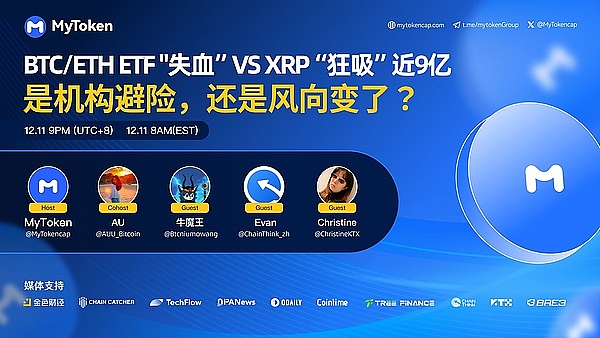
MyToken recently hosted a thematic AMA, inviting several industry experts to provide an in-depth interpretation. Below is a recap of the core viewpoints from the discussion.

Guest Introductions

  • Niu Mowang (@Btcniumowang): Senior crypto analyst and KOL, focused on primary and secondary market investment research, with unique insights into market structure and fund flows.

  • Christina (@ChristineKTX): CMO of KTX Exchange. KTX Exchange recently launched on-chain trading tools, committed to providing data empowerment for retail investors.

  • Evan(@ChainThink_zh): Researcher at ChainThink blockchain media, specializing in market data analysis and industry trend interpretation, skilled at dissecting fund movements from macro and on-chain perspectives.

Viewpoint Summary

1. Diverging Fund Flows: Short-Term Rotation or Long-Term Shift?

The three guests unanimously agreed that the recent flow of funds from mainstream coin ETFs to altcoin ETFs like XRP is more a result of short-term market rotation and macro risk-off sentiment combined, rather than a fundamental change in institutional logic for crypto asset allocation.

  • Niu Mowang pointed out that institutions tend to lock in profits and rebalance their portfolios at year-end. Bitcoin and Ethereum, being highly liquid assets with strong macro correlations, naturally become targets for adjustment. Simultaneously, the market is searching for the next potential ETF hotspot, with assets like XRP attracting capital allocation due to regulatory progress and independent narratives.

  • Christina, representing an exchange focused on user experience and transparency, added that institutions, amid macro uncertainty, choose assets with stronger narratives and regulatory backing. Dynamics in the payments and DeFi sectors have made XRP a recent focus for funds.

  • Evan analyzed from a market cycle perspective, noting that Bitcoin's gains in this cycle are relatively full, and its volatility has decreased year by year. Some profit-taking funds are转向 (turning to) lower-valued altcoins with fundamental support seeking higher alpha returns. However, this remains a "tactical rotation," and the benchmark status of Bitcoin and Ethereum remains unchanged.

2. Will This Become the Norm? What Impact on Market Structure?

The guests generally believe that the model of "exiting mainstream, not exiting the market" fund rotation may become more normalized in the future and will further promote a stratified market valuation system.

  • Niu Mowang analogized that Bitcoin is like the "S&P 500," more influenced by macro factors, while XRP, Solana, etc., are like "growth stocks," more reliant on project fundamentals and narratives. The market will become more structured, with more precise and shorter sector rotation cycles.

  • Christina stated that as the market matures and institutions delve deeper, funds will continuously seek the next growth point. She is optimistic about directions with real business models, such as payments, on-chain credit scoring, and RWA (Real World Assets).

  • Evan pointed out that the total cryptocurrency market capitalization is already massive, making it difficult for funds to support a broad-based rally. Future institutional allocation will focus more on a "mainstream coins + quality altcoins" portfolio to balance risk and return.

3. How Should Retail Investors Respond?

Facing institution-led fund rotation, how should retail investors rationally view and utilize this rotation? Should they follow the flow and quickly switch positions, or stick to core allocations and ignore short-term noise? What aspects need attention? The guests shared their views on this.

  • Niu Mowang advised retail investors should remain rational and avoid blindly following trends. Maintain 70%-80% core allocation in mainstream assets like Bitcoin and Ethereum, and use the remainder for small allocations to promising narrative tracks. Avoid emotional chasing of pumps and dumping.

  • Christina emphasized that retail investors are at a disadvantage regarding information and data. They can use tools (like the on-chain signal product KTX is about to launch) to track fund flows. Allocations should be based on mainstream assets, with a small portion of funds invested in potential sectors after thorough research.

  • Evan used a vivid example of a friend following Duan Yongping to illustrate the vast differences in capital size and risk tolerance between retail investors and institutions. He noted that institutional ETF flows might just be置换 (replacement/swapping) behavior. Therefore, position management is crucial. Avoid high-frequency switching, be wary of high-yield traps, and value the long-term worth and fundamentals of projects.

4. Which Sectors Continue to Attract Institutional Attention?

The guests' favored sectors concentrate on areas with genuine demand, clear business models, and compliance prospects:

  • Niu Mowang: Bullish on Solana (active ecosystem, payment potential), RWA (asset tokenization, stable yields), and AI (combination of computing demand and payment scenarios).

  • Evan: Payment scenarios (like U-card applications) and RWA (improving efficiency of illiquid assets) are important directions.

  • Christina: Besides payment chains, also关注 (pays attention to) on-chain credit scoring and mature DeFi protocols.

5. Why Significant XRP ETF Inflows But Muted Price Reaction?

Furthermore, during the community Q&A session, a listener asked why XRP ETF data shows continuous inflows, yet the XRP price remains relatively unaffected. Evan and Niu Mowang pointed out this is mainly due to:

  • Reduced market sensitivity to the ETF narrative, with effects diminishing after multiple ETFs;

  • Some inflows might be institutional position置换 (swapping/replacement) (converting spot holdings into compliant ETF products);

  • Existence of unlock selling pressure and historical bag holders, suppressing rapid price appreciation.

Conclusion

This AMA revealed the complexity of current cryptocurrency market fund flows: institutional operations are becoming increasingly refined, there is a game between institutions and retail investors, and the market is shifting from a "broad bull market" to a "structural bull market." For investors, understanding the logic of rotation, maintaining core allocations, and rationally participating in trends might be the key to navigating the future market.

MyToken, as a neutral and comprehensive data platform, continuously provides in-depth data such as ETF fund flows and on-chain signals to aid investment decisions, market insight, and tool support. This article is compiled based on the MyToken AMA content; guest opinions are for reference only and do not constitute investment advice.

Связанные с этим вопросы

QAccording to the article, what is the main reason for the significant outflow from Bitcoin and Ethereum ETFs and the inflow into XRP ETFs?

AThe experts in the AMA concluded that this is primarily a result of short-term market rotation and macro risk aversion, not a fundamental shift in institutional allocation logic. Year-end profit-taking, portfolio rebalancing, and the search for the next potential ETF narrative (like XRP's regulatory progress) are key factors.

QWhat analogy did analyst 'Bull Demon King' use to describe the difference between Bitcoin and assets like XRP?

AHe compared Bitcoin to the 'S&P 500,' which is more influenced by macro factors, while comparing XRP and Solana to 'growth stocks,' which are more dependent on project fundamentals and specific narratives.

QWhat was the common advice from the experts on how retail investors should respond to this institutional fund rotation?

AThe consensus advice was for retail investors to maintain a core portfolio (70-80%) of major assets like Bitcoin and Ethereum, use a small portion to invest in promising narrative sectors after research, avoid emotional buying high and selling low, and be cautious of high-yield traps.

QName three sectors that the AMA嘉宾 (guests) are optimistic about for continued institutional interest.

AThe sectors highlighted were Solana (for its active ecosystem and payment potential), RWA - Real World Assets (for asset tokenization and stable yields), and payment scenarios (such as U-card applications and the combination of AI with payment scenarios).

QWhy might significant inflows into the XRP ETF not be causing a strong positive reaction in the price of XRP itself?

AThe reasons include decreased market sensitivity to the ETF narrative (diminishing effects after multiple ETFs), the possibility that some inflows represent institutional position swaps (converting spot holdings into compliant ETF products), and existing unlock selling pressure and historical sell walls that suppress rapid price appreciation.

Похожее

Торговля

Спот
Фьючерсы

Популярные статьи

Тест по Bitcoin Биткоина

HTX Learn: Изучите Bitcoin halving и Заработаете Токены USDT

3.0k просмотров всегоОпубликовано 2024.04.16Обновлено 2024.04.16

Тест по Bitcoin  Биткоина

Что такое $BITCOIN

ЦИФРОВОЕ ЗОЛОТО ($BITCOIN): Комплексный анализ Введение в ЦИФРОВОЕ ЗОЛОТО ($BITCOIN) ЦИФРОВОЕ ЗОЛОТО ($BITCOIN) — это проект на основе блокчейна, работающий в сети Solana, который стремится объединить характеристики традиционных драгоценных металлов с инновациями децентрализованных технологий. Хотя он носит имя Биткойн, часто называемого “цифровым золотом” из-за его восприятия как средства хранения ценности, ЦИФРОВОЕ ЗОЛОТО является отдельным токеном, предназначенным для создания уникальной экосистемы в ландшафте Web3. Его цель — позиционировать себя как жизнеспособный альтернативный цифровой актив, хотя детали его применения и функциональности все еще развиваются. Что такое ЦИФРОВОЕ ЗОЛОТО ($BITCOIN)? ЦИФРОВОЕ ЗОЛОТО ($BITCOIN) — это токен криптовалюты, специально разработанный для использования в блокчейне Solana. В отличие от Биткойна, который выполняет широко признанную роль хранения ценности, этот токен, похоже, сосредоточен на более широких приложениях и характеристиках. Примечательные аспекты включают: Инфраструктура блокчейна: Токен построен на блокчейне Solana, известном своей способностью обрабатывать высокоскоростные и недорогие транзакции. Динамика предложения: ЦИФРОВОЕ ЗОЛОТО имеет максимальное предложение, ограниченное 100 квадриллионами токенов (100P $BITCOIN), хотя детали о его обращающемся предложении в настоящее время не раскрыты. Утилита: Хотя точные функциональные возможности не описаны, есть указания на то, что токен может быть использован для различных приложений, потенциально связанных с децентрализованными приложениями (dApps) или стратегиями токенизации активов. Кто создатель ЦИФРОВОГО ЗОЛОТА ($BITCOIN)? На данный момент личность создателей и команды разработчиков, стоящих за ЦИФРОВЫМ ЗОЛОТОМ ($BITCOIN), остается неизвестной. Эта ситуация типична для многих инновационных проектов в области блокчейна, особенно тех, которые связаны с децентрализованными финансами и феноменом мем-криптовалют. Хотя такая анонимность может способствовать культуре, ориентированной на сообщество, она усиливает опасения по поводу управления и ответственности. Кто инвесторы ЦИФРОВОГО ЗОЛОТА ($BITCOIN)? Доступная информация указывает на то, что у ЦИФРОВОГО ЗОЛОТА ($BITCOIN) нет известных институциональных спонсоров или значительных венчурных капиталовложений. Проект, похоже, функционирует по модели пирингового взаимодействия, сосредоточенной на поддержке и принятии сообществом, а не на традиционных путях финансирования. Его активность и ликвидность в основном сосредоточены на децентрализованных биржах (DEX), таких как PumpSwap, а не на устоявшихся централизованных торговых платформах, что еще больше подчеркивает его подход, ориентированный на grassroots. Как работает ЦИФРОВОЕ ЗОЛОТО ($BITCOIN) Операционные механизмы ЦИФРОВОГО ЗОЛОТА ($BITCOIN) можно подробно описать на основе его дизайна блокчейна и характеристик сети: Механизм консенсуса: Используя уникальный механизм доказательства истории (PoH) Solana в сочетании с моделью доказательства доли (PoS), проект обеспечивает эффективную валидацию транзакций, что способствует высокой производительности сети. Токеномика: Хотя конкретные дефляционные механизмы не были подробно описаны, большое максимальное предложение токенов подразумевает, что оно может быть предназначено для микротранзакций или нишевых случаев использования, которые еще предстоит определить. Интероперабельность: Существует потенциал для интеграции с более широкой экосистемой Solana, включая различные платформы децентрализованных финансов (DeFi). Однако детали относительно конкретных интеграций остаются неуточненными. Хронология ключевых событий Вот хронология, которая подчеркивает значимые вехи, касающиеся ЦИФРОВОГО ЗОЛОТА ($BITCOIN): 2023: Первоначальное развертывание токена происходит в блокчейне Solana, отмеченное его адресом контракта. 2024: ЦИФРОВОЕ ЗОЛОТО приобретает видимость, когда оно становится доступным для торговли на децентрализованных биржах, таких как PumpSwap, позволяя пользователям обменивать его на SOL. 2025: Проект наблюдает спорадическую торговую активность и потенциальный интерес к инициативам, возглавляемым сообществом, хотя на данный момент не зафиксировано никаких значительных партнерств или технических достижений. Критический анализ Сильные стороны Масштабируемость: Основная инфраструктура Solana поддерживает высокие объемы транзакций, что может повысить полезность $BITCOIN в различных сценариях транзакций. Доступность: Потенциально низкая цена торговли за токен может привлечь розничных инвесторов, способствуя более широкому участию благодаря возможностям дробного владения. Риски Отсутствие прозрачности: Отсутствие публично известных спонсоров, разработчиков или процесса аудита может вызвать скептицизм относительно устойчивости и надежности проекта. Волатильность рынка: Торговая активность сильно зависит от спекулятивного поведения, что может привести к значительной волатильности цен и неопределенности для инвесторов. Заключение ЦИФРОВОЕ ЗОЛОТО ($BITCOIN) является интригующим, но неоднозначным проектом в быстро развивающейся экосистеме Solana. Хотя он пытается использовать нарратив “цифрового золота”, его отход от установленной роли Биткойна как средства хранения ценности подчеркивает необходимость более четкого различения его предполагаемой утилиты и структуры управления. Будущее принятие и усвоение, вероятно, будут зависеть от решения текущей непрозрачности и более четкого определения его операционных и экономических стратегий. Примечание: Этот отчет охватывает синтезированную информацию, доступную на октябрь 2023 года, и с тех пор могут произойти события.

99 просмотров всегоОпубликовано 2025.05.13Обновлено 2025.05.13

Что такое $BITCOIN

Fractal Bitcoin: масштабирование Биткоина с помощью рекурсивной системы

Fractal Bitcoin — масштабное Layer-1-решнение, созданное на базе кода Биткоина, позволяющего достигать бесконечного масштабирования с помощью рекурсивного подхода.

2.2k просмотров всегоОпубликовано 2025.06.30Обновлено 2025.06.30

Fractal Bitcoin: масштабирование Биткоина с помощью рекурсивной системы

Обсуждения

Добро пожаловать в Сообщество HTX. Здесь вы сможете быть в курсе последних новостей о развитии платформы и получить доступ к профессиональной аналитической информации о рынке. Мнения пользователей о цене на BTC (BTC) представлены ниже.

活动图片