Brokerage Giant Charles Schwab Rolls Out Spot Crypto Trading To Retail Investors

bitcoinistОпубликовано 2026-05-14Обновлено 2026-05-14

Введение

Charles Schwab has officially launched its spot crypto trading platform, Schwab Crypto, to a select group of retail investors in the US, excluding New York and Louisiana. The service allows direct trading of Bitcoin (BTC) and Ethereum (ETH) with a 75-basis-point fee, linked to clients' brokerage accounts. Schwab Premier Bank will serve as custodian, with Paxos handling trade execution. The firm plans to add more assets and transfer capabilities. This move expands Schwab's offerings beyond indirect crypto investment products. It follows a trend of major institutions entering the space, as Morgan Stanley also recently launched a crypto trading pilot on its E*Trade platform with a 50-basis-point fee, aiming for wider rollout later this year.

Brokerage and banking firm Charles Schwab officially began rolling out its crypto trading platform to retail clients in the US, joining the list of traditional financial institutions expanding their digital asset offering.

Schwab Launches Spot Trading For BTC, ETH

On Tuesday, the $11.7 trillion brokerage giant Charles Schwab revealed that it officially launched its spot digital asset trading platform, Schwab Crypto, to a select group of retail customers.

According to the X announcement, the first group of clients can trade Bitcoin (BTC) and Ethereum (ETH) directly on its platform alongside their other digital asset-related investment products.

The crypto trading platform is available in all US states, excluding New York and Louisiana, and will charge a 75-basis-point fee on the dollar value of each trade, which is among the lowest in the industry.

Last month, the firm revealed the platform would be introduced in phases, starting with an internal employee pilot, moving to a client waitlist, and then opening to eligible customers throughout the rest of 2026.

As reported by Bitcoinist, the company explained that Schwab clients will maintain separate accounts under the new platform, which will be linked directly to their brokerage accounts.

Notably, Charles Schwab Premier Bank (CSPB) will serve as the custodian for customers’ assets, handling safekeeping and record-keeping. Meanwhile, blockchain infrastructure provider Paxos will handle trade execution and sub-custody, using a federally overseen trust model and enterprise-grade technology

The brokerage giant also revealed plans to add additional digital assets to the platform and introduce transfer capabilities for both deposits and withdrawals, allowing clients with existing digital asset investments to bring them to Schwab alongside their other accounts.

Jonathan Craig, Head of Retail Investing at Charles Schwab, previously noted that with Schwab Crypto, the firm seeks to allow clients who want direct access to the asset class to benefit from the service, educational resources, and research tools they expect from the company.

Traditional Institutions Expand Crypto Offerings

This move marks a major expansion from Schwab’s previous digital asset-related offerings, which included indirect exposure to investments through spot crypto Exchange-traded products (ETPs), futures, options on spot crypto ETPs, crypto-related ETFs, and mutual funds that invest in the broader digital asset ecosystem. Schwab clients hold approximately 20% of spot crypto ETPs, the firm noted.

Moreover, the launch comes as major banks and brokerages race to add digital‐asset products and integrate crypto into mainstream investing, with several firms expanding retail digital asset offerings in recent years.

Last week, Wall Street behemoth Morgan Stanley also launched a crypto trading pilot on its E*Trade platform to a limited number of users, seeking to challenge major players, including Schwab, with competitive pricing.

The banking giant is charging E*Trade users a 50-basis-point fee on the transaction value, placing its prices below Robinhood’s 95 basis points, Coinbase’s 60 basis points, and Schwab’s 75 basis points.

While the pilot is currently available only to a limited group, Morgan Stanley expects to expand access to all of E*Trade’s 8.6 million clients later this year. The bank’s executives are reportedly preparing an offering to directly convert digital assets into shares of ETPs without selling the assets, and planning to add the ability to trade tokenized equities in the second half of 2026.

Jed Finn, Morgan Stanley’s head of wealth management, affirmed that the launch is “much bigger than trading crypto at a cheaper rate,” explaining that their strategy is “disintermediating the disintermediators.”

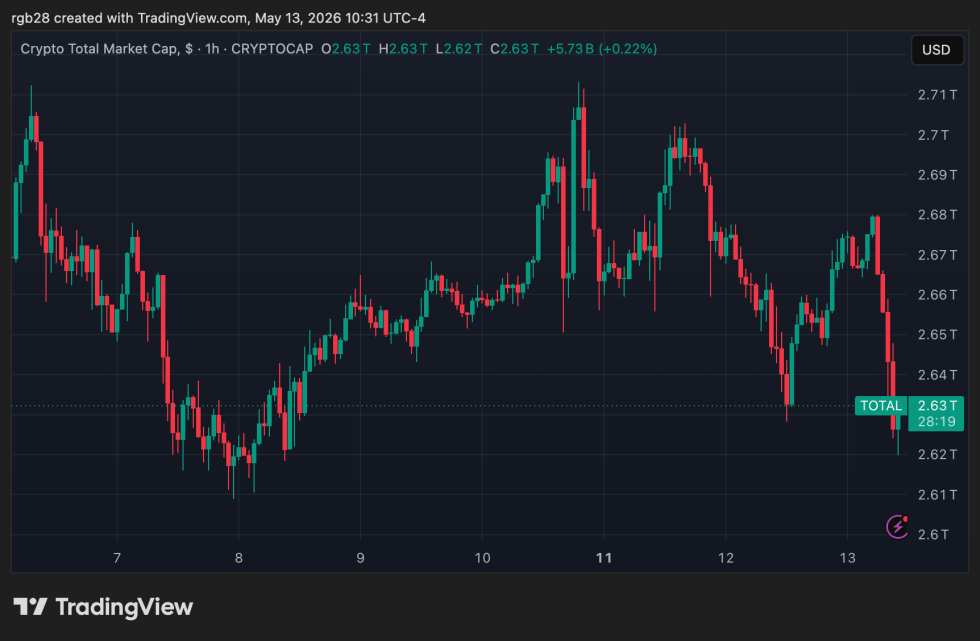
The total crypto market capitalization is at $2.63 trillion in the one-week chart. Source: TOTAL on TradingView

Связанные с этим вопросы

QWhat is the name of the new crypto trading platform launched by Charles Schwab and which two major cryptocurrencies can users trade on it?

AThe new platform is called Schwab Crypto. Users can trade Bitcoin (BTC) and Ethereum (ETH) directly on the platform.

QWhat is the trading fee charged by Charles Schwab on its Schwab Crypto platform, and how does it compare to competitors like Coinbase and Morgan Stanley?

ACharles Schwab charges a 75-basis-point (0.75%) fee on the dollar value of each trade on Schwab Crypto. This is higher than Morgan Stanley's 50 basis points but lower than Coinbase's 60 basis points for its users.

QWhat two US states are currently excluded from accessing the Schwab Crypto platform?

AThe Schwab Crypto platform is available in all US states, excluding New York and Louisiana.

QWhat are the roles of Charles Schwab Premier Bank (CSPB) and Paxos in the operation of the Schwab Crypto platform?

ACharles Schwab Premier Bank (CSPB) serves as the custodian for customers' assets, handling safekeeping and record-keeping. Blockchain infrastructure provider Paxos handles trade execution and sub-custody.

QWhat is the stated strategic goal of Morgan Stanley's crypto launch on E*Trade, according to Jed Finn, its head of wealth management?

AJed Finn stated that the launch is 'much bigger than trading crypto at a cheaper rate,' explaining that their strategy is 'disintermediating the disintermediators.'

Похожее

Winter for Crypto IPOs: Consensys and Ledger Withdraw Applications

The crypto IPO window is tightening significantly in 2026, marked by prominent companies delaying or pausing their public listing plans. Following a successful 2025 "harvest year" that saw Circle, Bullish, and Gemini go public amidst a bull market, the tide has turned. Consensys, developer of MetaMask, recently postponed its IPO until at least fall 2026. Hardware wallet leader Ledger also suspended its planned US listing due to unfavorable market conditions, with Kraken having previously delayed its own plans. This shift is driven by a cooling market in 2026, characterized by a significant Bitcoin price correction, declining trading volumes, and reduced investor risk appetite for crypto stocks. The poor post-IPO performance of 2025 listings like Circle and Bullish, which saw major share price declines, has heightened investor caution. This contrasts sharply with the current AI sector, where companies like SpaceX, OpenAI, and Anthropic are commanding massive valuations and investor enthusiasm based on narratives of stable, exponential growth. Crypto companies now face pressure to transition from hype-driven models to demonstrating reliable cash flows and robust compliance. While the paused IPO plans may lead to valuation resets and affect ecosystem liquidity, they also accelerate industry consolidation toward stronger, more compliant infrastructure players. A potential recovery in Bitcoin's price and clearer regulations could reopen the IPO window in the latter half of 2026.

marsbit53 мин. назад

Winter for Crypto IPOs: Consensys and Ledger Withdraw Applications

marsbit53 мин. назад

ChatGPT Can Manage Your Money for You. Would You Trust It with Your Bank Account?

OpenAI has launched a personal finance tool for ChatGPT, currently in preview for US-based ChatGPT Pro users. This feature allows users to connect their bank and investment accounts (via Plaid, supporting over 12,000 institutions) directly to ChatGPT. It analyzes transactions, generates visual dashboards, and offers conversational financial advice—such as budgeting or planning for major purchases—based on the user's actual data. This move follows OpenAI's acquisitions of fintech startups Roi and Hiro Finance, signaling a strategic push into vertical "super assistant" applications, similar to its earlier health-focused feature. However, the launch has sparked significant privacy concerns. Critics question the safety of granting such sensitive financial access to an AI, especially amid ongoing lawsuits alleging OpenAI shared user chat data with third parties like Meta and Google. OpenAI emphasizes that ChatGPT only reads data (no transaction capabilities), deletes it within 30 days if disconnected, and offers opt-out options for model training. Yet, trust remains a major hurdle. The trend reflects a broader industry shift: AI companies like Anthropic and Perplexity are also targeting high-value, data-rich domains like finance and health. While technically promising, the tool operates in a regulatory gray area—it provides personalized guidance but disclaims formal financial advice or liability. Ultimately, OpenAI's challenge is convincing users to trust an AI with their most private financial information.

marsbit54 мин. назад

ChatGPT Can Manage Your Money for You. Would You Trust It with Your Bank Account?

marsbit54 мин. назад

Торговля

Спот
Фьючерсы
活动图片