Blockchain Is South Korea’s New Fiscal Weapon — A Blow To Privacy?

bitcoinistОпубликовано 2026-04-16Обновлено 2026-04-16

Введение

South Korea is launching a pilot program to replace government expense credit cards with blockchain-based deposit tokens for treasury fund execution. This initiative, led by the Ministry of Finance and Economy, builds on a previous project with the Ministry of Environment. Deposit tokens are digital representations of bank deposits on permissioned blockchains, enabling programmable settlement, transparent tracking, and real-time reporting. Unlike CBDCs, they are issued by commercial banks. The pilot aims to enhance spending transparency, reduce intermediaries, and eliminate card-processing fees for small merchants. While improving efficiency, it raises privacy concerns. If successful, South Korea could become a model for blockchain-based fiscal systems.

South Korea is kicking off a pilot that will replace government expense credit cards with blockchain‐based deposit tokens.

Blockchain Goes TradFi?

The Ministry of Finance and Economy announced on an official press release that the pilot project for the execution of national treasury funds using blockchain‐based digital currency has been approved.

This new official venture marks the second time in which South Korea’s government uses digital currency and deposit tokens for the execution of national treasury funds, following another pilot project for building electric‐vehicle charging facilities and paying national subsidies together with the Ministry of Environment.

Deposit tokens are digital claims on commercial bank deposits, issued on permissioned blockchain rails, spendable by citizens and companies at participating merchants and service providers.

In simpler words, deposit tokens are digital versions of the money already kept in a normal bank account. The bank “wraps” those deposits into tokens on a private (permissioned) blockchain, and you can then spend those tokens at approved shops or service providers, just like using a card or mobile wallet.

In contrast with Central Bank Digital Currencies (CBDCs), that are digital versions of a country’s official money, created and managed directly by its central bank, deposit tokens have programmable settlement, transparent tracking of public money, and real‐time reporting for the state.

Pilot Details

The press release states that under the current National Treasury Funds Management Act, business promotion costs and related operating expenses are required to be paid with government purchase cards, effectively blocking the use of deposit tokens. Thanks to the new regulatory sandbox, those same payments can now be made with deposit tokens, creating a real‐world testbed for a new government payment and settlement method.

The new pilot is expected to serve as an opportunity to put blockchain‐based fiscal execution on a full footing and eliminate frictions in the current card‐payment setup by using blockchain’s built‐in transparency.

Quoting the press release, translated by Bitcoinist:

This pilot will allow us to preset and manage in advance the spending time and permitted business categories when business promotion expenses are executed using deposit tokens that leverage blockchain technology. This is not only expected to improve the transparency of spending but, by eliminating intermediaries in the payment structure, completely remove card‐processing fees borne by small merchants.

A Trade-Off For Traders

South Korea continues moving ahead with its Digital Asset Basic Act, a broad crypto rulebook that will set standards for stablecoins, tokenized real‐world assets, and crypto ETFs in the local market. A few weeks ago, the National Policy Committee of Korea pushed the “second‐phase” of the debate until after the June 3 local elections.

The trade‐off for South Korean traders is evident: they gain efficiency and control vs. losing some privacy and risking potential overreach. It is safe to expect tailwind for bank‐chain infrastructure, permissioned blockchain providers, and tokenization narratives.

Future “state money on chain” flows may favor bank‐issued tokens over fully open stablecoins, which could reshape liquidity, FX corridors, and on‐chain yield strategies.

If the pilot scales, South Korea could become the reference model for how blockchains handle real‐world fiscal flows.

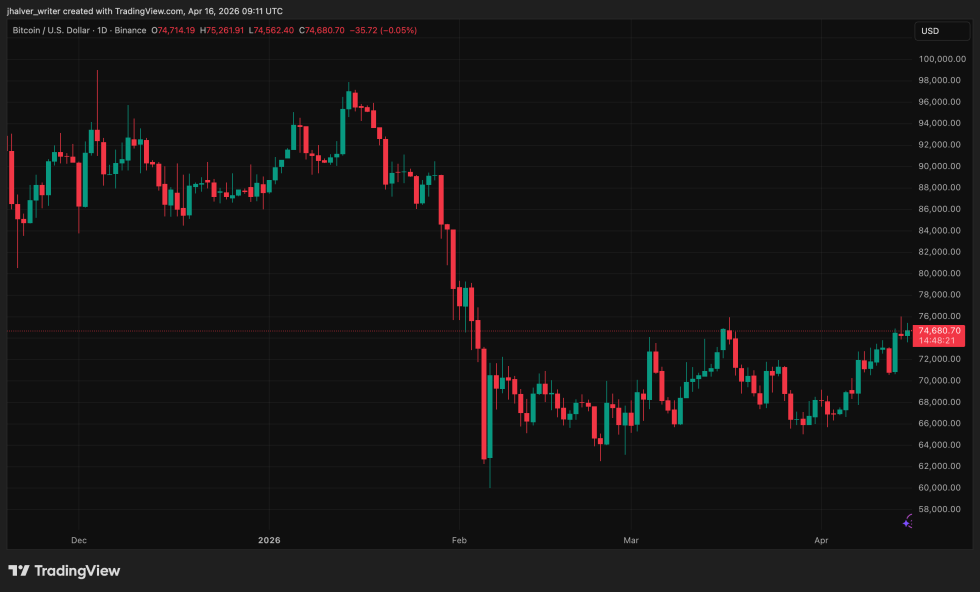
At the moment of writing, BTC trades for the highs $74ks on the daily chart. Source: BTCUSD on Tradingview.

Cover image from Perplexity. BTCUSD chart from Tradingview.

Связанные с этим вопросы

QWhat is the South Korean government piloting to replace government expense credit cards?

AThe South Korean government is piloting the use of blockchain-based deposit tokens to replace government expense credit cards.

QHow do deposit tokens differ from Central Bank Digital Currencies (CBDCs)?

ADeposit tokens are digital claims on commercial bank deposits issued on permissioned blockchains, while CBDCs are digital versions of a country's official money created and managed directly by its central bank. Deposit tokens offer programmable settlement, transparent tracking, and real-time reporting.

QWhat are the expected benefits of using blockchain-based deposit tokens for government spending according to the press release?

AThe benefits include improved spending transparency by allowing preset management of spending time and permitted business categories, and the elimination of card-processing fees for small merchants by removing intermediaries.

QWhat is the potential trade-off mentioned for South Korean traders in adopting this system?

AThe trade-off is that traders gain efficiency and control but may lose some privacy and risk potential government overreach.

QWhat broader legislative framework is South Korea advancing alongside this pilot project?

ASouth Korea is advancing the Digital Asset Basic Act, a comprehensive crypto rulebook that will set standards for stablecoins, tokenized real-world assets, and crypto ETFs in the local market.

Похожее

70% of the Public Opposes AI, Americans Hope the U.S. Loses the AI War

70% of Americans believe AI development is moving too fast, with growing public resistance evolving from online criticism to real-world protests and violence. This widespread anti-AI sentiment stems from fears of job losses, rising utility costs, environmental damage, threats to democracy, and financial instability. Key incidents illustrate the backlash: Google's former CEO Eric Schmidt was loudly booed at a graduation for promoting AI; AI company ads are vandalized; protests and even violent attacks target AI firms and data centers. Polls show deep public pessimism and strong local opposition to data center construction, often surpassing resistance to nuclear power plants. The core grievances are economic and practical: AI is seen as automating jobs, concentrating wealth, and increasing household electricity and water bills due to massive data center resource demands. Environmentalists also oppose AI's high energy use and carbon emissions. This opposition has turned AI into a major political issue in the US. While the Trump administration prioritizes AI innovation for global competition, bipartisan pushback is growing. Democrats and factions within the MAGA movement are forming temporary alliances to support stricter regulations and local bans on new data centers, pressuring the administration to choose between its tech industry backers and its voter base. The situation highlights a profound national divide over AI's future.

marsbit21 мин. назад

70% of the Public Opposes AI, Americans Hope the U.S. Loses the AI War

marsbit21 мин. назад

Agents Take Over Traffic Distribution Power: What Are Tencent, ByteDance, and Alibaba Competing For?

In the race to dominate the AI era's entry point, China's tech giants—Tencent, ByteDance, and Alibaba—are aggressively deploying AI Agents to control the future of traffic distribution. Alibaba is pursuing a dual-track "closed loop + openness" strategy. Its Qianwen app is evolving into a super-Agent integrated across its ecosystem (Taobao, Alipay, etc.) to handle complex tasks like travel planning. Concurrently, it is opening its platform to external brands (Luckin Coffee, KFC) and has launched a B2B Agent platform, "Wukong," targeting enterprise automation. Its other flagship, Quark, aims to be an "AI super search box" for information and tasks. ByteDance is executing an omnipresent "sprawl strategy." Its Doubao app boasts over 300 million monthly active users and is evolving into a default AI entry point for daily life, with plans for paid versions and e-commerce integration. Its core weapon is the Kouzi platform, a visual "AI assembly factory" for developers to build custom Agents. ByteDance is also pushing hardware integration, collaborating on AI phones and developing smart glasses to embed Doubao everywhere. Tencent is playing its long-held "ultimate card" by quietly embedding an AI Agent directly into WeChat. This Agent, accessible via a swipe, can understand user commands and automatically execute tasks by calling upon WeChat's millions of mini-programs (e.g., finding and ordering coffee). This leverages WeChat's unparalleled 1.4-billion-user ecosystem to position the app as an AI-powered "service operating system," a move that could dramatically reshape the competitive landscape. The core battleground is shifting from competing for "user screen time" to competing to be the "default execution layer" for user intent. The business model is evolving from an "attention economy" to an "intent economy," where the Agent that can most efficiently fulfill a user's need gains control over service access and token flow. This represents a fundamental change in how users connect with digital services, making the fight for the Agent入口 (entry point) a pivotal moment for redefining industry leadership in the AI age.

marsbit2 ч. назад

Agents Take Over Traffic Distribution Power: What Are Tencent, ByteDance, and Alibaba Competing For?

marsbit2 ч. назад

Торговля

Спот
Фьючерсы
活动图片