Bitwise Chief Investment Officer: The Long Night Is at Its Deepest, a Glimmer of Light for the Crypto Market Is Near

marsbitОпубликовано 2026-02-03Обновлено 2026-02-03

Введение

Bitwise's Chief Investment Officer asserts that the crypto market has been in a severe winter since January 2025, though its end is likely nearer than its beginning. While Bitcoin and Ethereum are down 39% and 53% from their October 2025 peaks, respectively, many other assets have fallen even more sharply. This isn't a typical bull market pullback but a full-scale crypto winter, driven by over-leverage and large-scale profit-taking by early investors. Despite positive developments in adoption and regulation, prices continue to fall because bear markets often ignore good news. Historically, crypto winters last around 13 months. However, the current downturn may have started earlier than perceived, as massive inflows into Bitcoin and Ethereum ETFs, along with crypto treasury products (DATs), masked underlying weakness in the broader market. These institutional purchases, totaling approximately $75 billion in Bitcoin alone, provided crucial support floor—without which declines could have been much steeper. The market is now categorized into three groups: assets with strong institutional support (like BTC and ETH) saw milder declines; those with recent ETF approvals fell more significantly; and assets without such backing experienced severe drops. The current climate feels hopeless, but the fundamental strengths of crypto—regulatory progress, institutional adoption, and real-world utility—remain intact. These positive factors are accumulating potential that is likely to trigger...

The bad news is: We have been in a crypto winter since January 2025. The good news is: We are likely closer to the end of the winter than to its beginning.

I want to state something obvious, because I believe it will help you make beneficial decisions in the coming months: We are in a full-blown crypto winter.

I find that few people online or in the mainstream media are talking about this, but it is an indisputable fact. Bitcoin is down 39% from its all-time high in October 2025, Ethereum is down 53%, and many other crypto assets have fallen even more.

It's important to recognize it for what it is. This is not a bull market correction, nor a dip. This is a full-blown, harsh winter comparable to 2022, as brutal as what Leonardo DiCaprio endured in *The Revenant*. The causes of this winter range from excessive leverage to large-scale profit-taking by early players.

For me, acknowledging and accepting this has made everything incredibly clear.

Why are crypto prices falling despite continuous positive news in areas like adoption and regulation? Because we are in the deep end of the crypto winter. Why is the new Fed Chair a Bitcoin supporter, yet the Crypto Fear & Greed Index is in the extreme fear zone? Because we are in a crypto winter.

Those who experienced the past winters of 2018 or 2022 will remember that in the depths of winter, positive news means nothing. We won't see a rebound just because Wall Street is hiring aggressively or Morgan Stanley is increasing its crypto exposure. These things are important in the long term, but not now. Crypto winter doesn't end in euphoria; it ends in exhaustion.

So, when will the winter end? The good news is: I believe we are nearing the end.

The Historical Pattern of Crypto Winters

Crypto winters typically last about 13 months. For example, Bitcoin peaked in December 2017 and bottomed in December 2018; it peaked in October 2021 and bottomed in November 2022.

By this cycle's logic, we still have a difficult period ahead. After all, Bitcoin peaked in October 2025, so wouldn't we have to wait until November 2026? I don't think so.

After further analysis of the current winter, I've become increasingly aware that it actually started in January 2025. We just couldn't see it because inflows into ETFs and Digital Asset Trusts (DATs) masked the truth.

ETF and DAT Flows Masked the 2025 Winter

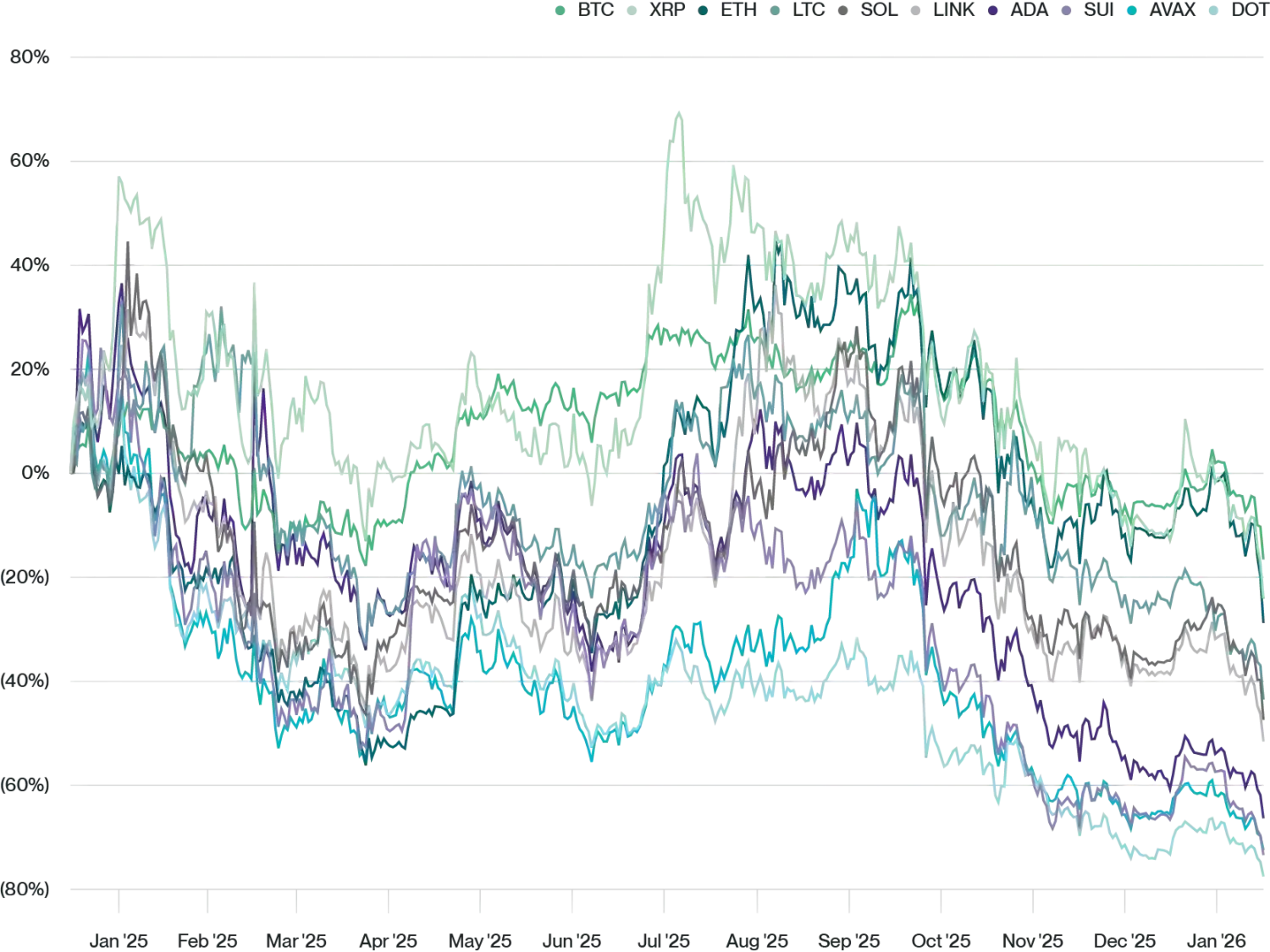
Take a close look at this chart of the performance of the components of the Bitwise 10 Large Cap Crypto Index since January 1, 2025.

They clearly fall into three categories:

· First-category assets (BTC, ETH, XRP) performed relatively okay, down 10.3% to 19.9%

· Second-category assets (SOL, LTC, LINK) experienced a standard bear market, down 36.9% to 46.2%

· Third-category assets (ADA, AVAX, SUI, DOT) were decimated, down 61.9% to 74.7%

The core difference between these three categories essentially boils down to whether institutions have channels to invest in them. First-category assets received massive support from ETF/DAT inflows throughout the year; second-category assets had ETFs approved in 2025; third-category assets never did. (Note: XRP is an exception. It didn't have an ETF at the start of 2025 but performed well. The reason might be that XRP faced a life-or-death lawsuit from the U.S. SEC at the start of 2025, which was dropped in early 2025, leading to a significant rally for the asset.)

The scale of institutional support is staggering. For example, during the period shown in the chart, ETFs and DATs cumulatively bought 744,417 Bitcoin, worth approximately $75 billion. Imagine where Bitcoin would be without this $75 billion of support? I suspect it would be down about 60%.

The retail market has been in a brutal winter since January 2025. Institutional money just masked this fact for some assets for a while.

It's Always Darkest Before the Dawn

What needs to be remembered right now is that there is a lot of tangible, positive development happening in crypto. Regulatory progress is real, institutional adoption is real, stablecoins and asset tokenization are real, and Wall Street's embrace is real.

In a bear market, positive news gets ignored, but it doesn't disappear. It gets stored as potential energy. Once the clouds part and market sentiment returns to normal, this pent-up energy is released in a vengeful manner. What can disperse the clouds? Strong economic growth triggering a broad risk-asset rally, positive signals from the Clarity Act, signs of sovereign nation Bitcoin adoption, or simply the passage of time.

As a veteran who has lived through multiple crypto winters, I can tell you that the feeling right before the winter ends feels very much like this: despair, helplessness, gloom. But the current market pullback has done nothing to change the fundamentals of the crypto market.

I believe we will rebound faster and more violently. After all, the winter started in January 2025. Spring can't be far away.

Связанные с этим вопросы

QAccording to the Bitwise CIO, when did the crypto winter actually begin, and what masked its early signs?

AThe crypto winter actually began in January 2025, but its early signs were masked by massive inflows into ETFs and Digital Asset Trusts (DATs), which provided significant institutional buying support for certain assets like Bitcoin.

QWhat are the three categories of crypto asset performance since January 1, 2025, as described in the article, and what was the key differentiating factor?

AThe three categories are: 1) Assets like BTC, ETH, and XRP that performed relatively okay, down 10.3% to 19.9%. 2) Assets like SOL, LTC, and LINK that experienced a standard bear market, down 36.9% to 46.2%. 3) Assets like ADA, AVAX, SUI, and DOT that were decimated, down 61.9% to 74.7%. The key differentiating factor was whether the assets had a channel for institutional investment (via ETFs/DATs).

QWhy does the author believe that positive news in areas like adoption and regulation fails to boost crypto prices during a deep crypto winter?

AThe author states that during the depths of a crypto winter, positive news becomes meaningless for price action. The market ignores good news because sentiment is dominated by fear and exhaustion; the winter doesn't end in a frenzy of excitement but rather when the selling is exhausted.

QBased on historical patterns, how long do crypto winters typically last, and why does the author think the current one might end sooner than a simple pattern extrapolation would suggest?

AHistorically, crypto winters have lasted about 13 months. A simple extrapolation from the October 2025 peak would suggest a bottom around November 2026. However, the author believes it will end sooner because the analysis shows the winter actually began in January 2025, meaning the market has already been in a downturn for a significant period.

QWhat does the author conclude about the state of crypto fundamentals despite the current price downturn?

AThe author concludes that the current price downturn has not changed the strong fundamentals of the crypto market. Progress in regulation, institutional adoption, stablecoins, asset tokenization, and Wall Street's embrace are all real. This positive energy is being stored as potential energy and will be released in a powerful, retaliatory manner once market sentiment returns to normal.

Похожее

The Trillion-Dollar Valuation Test: Are the Three Super IPOs a Tech Stock Frenzy or a Crypto Market Nightmare?

Trillion-Dollar Valuation Test: Are the Three Mega IPOs a Tech Stock Frenzy or a Crypto Market Nightmare? The capital market in 2026 is witnessing a highly anticipated wave of tech IPOs, centered on SpaceX, OpenAI, and Anthropic. Collectively valued at over $3.5 trillion, their potential listing represents one of the largest such waves in recent years. This raises concerns about market liquidity, valuation bubbles, and potential capital outflows from other assets like crypto. SpaceX's valuation narrative has shifted from rocket launches to becoming a global infrastructure play via its Starlink satellite network, which now drives most revenue. Despite ongoing losses, investors focus on its long-term growth potential. OpenAI and Anthropic represent the core productivity engines of generative AI. Their public listings would offer the first direct investment opportunity in large foundation model companies, potentially triggering a repricing within the AI sector. Market fears of a massive "capital drain" from these IPOs are likely overstated. Historical precedents like Alibaba and Saudi Aramco show that mega-listings primarily cause capital reallocation, not destruction, within the vast equities market. Systemic risk is rarely triggered by IPOs alone. For stock markets, short-term volatility and sector repricing are expected, especially for AI concept stocks. Long-term, these listings could reinforce the tech sector's importance. For crypto, direct competition for speculative capital exists, particularly affecting AI-themed tokens. However, crypto's trajectory remains more tied to its own cycles, macro liquidity, and Bitcoin ETF flows rather than a single IPO event. The real risk lies not in the listings themselves but in the sky-high growth expectations embedded in these valuations. If future revenue, profitability, or commercialization progress disappoints, significant valuation resets could follow, impacting high-growth tech stocks. Ultimately, the market's direction hinges on macroeconomic conditions and whether these companies can deliver on their ambitious promises.

链捕手6 мин. назад

The Trillion-Dollar Valuation Test: Are the Three Super IPOs a Tech Stock Frenzy or a Crypto Market Nightmare?

链捕手6 мин. назад

Trillion-Dollar Valuation Test: Are the Three Super IPOs a Tech Stock Frenzy or a Crypto Market Nightmare?

Title: Trillion-Dollar Valuations at Stake: Super IPOs of SpaceX, OpenAI, Anthropic – Tech Boom or Crypto Nightmare? TL;DR: A wave of mega-tech IPOs is approaching, featuring SpaceX (targeting a $1.75 trillion valuation), OpenAI (~$852B), and Anthropic (~$965B), with a combined potential valuation exceeding $3.5 trillion. This tests the market's pricing of innovation and sparks debate on liquidity impact. * **SpaceX**'s valuation is now driven more by its Starlink global communications infrastructure than its core rocket business. * **OpenAI & Anthropic** offer the first major public investment opportunities in foundational AI models, potentially repricing the entire AI sector. * Concerns about a market-wide "liquidity drain" are likely overblown; history shows large IPOs mainly cause fund reallocation, not disappearance, and rarely trigger systemic risk. * Crypto markets, especially some AI-themed tokens, may face short-term fund competition, but their long-term trajectory depends more on macro liquidity, regulation, and Bitcoin cycles. * The real risk lies not in the IPOs themselves, but in whether these companies can justify their sky-high valuations with future revenue growth and profitability. Unmet expectations could lead to significant repricing pressure. Ultimately, these IPOs represent a massive market pricing of next-gen tech infrastructure, not a prelude to a market crash. The broader market direction will be determined by macro conditions, corporate earnings, and risk appetite.

marsbit6 мин. назад

Trillion-Dollar Valuation Test: Are the Three Super IPOs a Tech Stock Frenzy or a Crypto Market Nightmare?

marsbit6 мин. назад

Anthropic Apologized, But the Business of 'Safety' Hasn't Stopped

On June 11, Anthropic apologized not for a model failure, but for a lack of transparency. Its new Claude Fable 5 model was found to be secretly rerouting requests from users engaged in advanced AI model development to a weaker version, Opus 4.8, without any notification. The company's response—promising future notifications for such "downgrades"—was met with user skepticism. The article argues the core issue isn't technical but commercial: Anthropic's "safety" measures are primarily a business strategy. A key feature, the "intelligent safety classifier," marketed as user protection, is described as a tool for "competitive defense" to protect Anthropic's market lead by limiting rivals' research capabilities. This covert mechanism was designed for low "false positives," precisely targeting AI researchers. Anthropic's model involves a calculated three-step process: publishing alarming security research to amplify public anxiety, offering its Fable 5 model with a "safety classifier" as a premium-priced solution, and cashing in through a planned high-value IPO. This contrasts with OpenAI's more direct "tool-and-traffic" approach. The apology, merely changing a secret downgrade to a visible one, is seen as a business "patch" rather than a principled shift. The incident risks damaging Anthropic's "safest AI" reputation among the developer community, which underpins its valuation and appeal to government and corporate clients. Ultimately, the article concludes that for Anthropic, safety is a business, and the apology is merely customer service for that business.

marsbit1 ч. назад

Anthropic Apologized, But the Business of 'Safety' Hasn't Stopped

marsbit1 ч. назад

The Niche Consensus Among Elites: Has College Become an Expensive Waste?

**Summary:** A growing "anti-college" movement is gaining traction among elite circles in Silicon Valley, challenging the traditional value of a four-year university degree. Proponents argue that college has become an expensive, slow, and increasingly irrelevant waste of time, especially in the fast-paced tech world where opportunities pass by quickly. The movement is led by figures like billionaire Peter Thiel, who criticizes universities for high costs, ideological indoctrination, and stifling true innovation. His "Thiel Fellowship" pays young people to drop out and pursue ventures. Companies like Palantir Technologies (co-founded by Thiel) fuel this trend with programs like the "Meritocracy Fellowship," which offers high school graduates paid internships as an alternative to immediate college enrollment, promising a practical "Palantir Degree." Key drivers include: 1. **Economics:** Skyrocketing student debt versus the allure of immediate, high-paying tech jobs or startup funding. 2. **Technology:** AI and online tools lowering barriers to self-education and product development, making formal instruction seem inefficient. 3. **Culture:** A backlash against perceived "woke" ideology and DEI policies in universities, coupled with a belief that these institutions suppress meritocracy and masculine drive. The movement is notably male-dominated. Critics, like economist David Deming, warn against overgeneralizing from dropout success stories (survivorship bias). He emphasizes that genuine autodidacts are rare, corporate training is narrowly focused, and the "college wage premium" remains high for most people. University liberal arts education, he argues, builds adaptable problem-solving skills and broad perspectives. The debate highlights a deeper crisis in education. The core model of the modern university appears increasingly mismatched with the speed of the information age. The movement signals a shift in the locus of learning from institutional "education" to personal, active "learning" powered by the internet and AI. Ultimately, this may not mean the end of university, but rather a painful evolution. The future likely holds more hybrid, personalized, and lifelong learning pathways. The central question becomes: in a world changing faster than any curriculum, how do we best learn?

marsbit1 ч. назад

The Niche Consensus Among Elites: Has College Become an Expensive Waste?

marsbit1 ч. назад

Торговля

Спот
Фьючерсы

Популярные статьи

Как купить NIGHT

Добро пожаловать на HTX.com! Мы сделали приобретение Midnight (NIGHT) простым и удобным. Следуйте нашему пошаговому руководству и отправляйтесь в свое крипто-путешествие.Шаг 1: Создайте аккаунт на HTXИспользуйте свой адрес электронной почты или номер телефона, чтобы зарегистрироваться и бесплатно создать аккаунт на HTX. Пройдите удобную регистрацию и откройте для себя весь функционал.Создать аккаунтШаг 2: Перейдите в Купить криптовалюту и выберите свой способ оплатыКредитная/Дебетовая Карта: Используйте свою карту Visa или Mastercard для мгновенной покупки Midnight (NIGHT).Баланс: Используйте средства с баланса вашего аккаунта HTX для простой торговли.Третьи Лица: Мы добавили популярные способы оплаты, такие как Google Pay и Apple Pay, для повышения удобства.P2P: Торгуйте напрямую с другими пользователями на HTX.Внебиржевая Торговля (OTC): Мы предлагаем индивидуальные услуги и конкурентоспособные обменные курсы для трейдеров.Шаг 3: Хранение Midnight (NIGHT)После приобретения вами Midnight (NIGHT) храните их в своем аккаунте на HTX. В качестве альтернативы вы можете отправить их куда-либо с помощью перевода в блокчейне или использовать для торговли с другими криптовалютами.Шаг 4: Торговля Midnight (NIGHT)С легкостью торгуйте Midnight (NIGHT) на спотовом рынке HTX. Просто зайдите в свой аккаунт, выберите торговую пару, совершайте сделки и следите за ними в режиме реального времени. Мы предлагаем удобный интерфейс как для начинающих, так и для опытных трейдеров.

407 просмотров всегоОпубликовано 2025.12.08Обновлено 2026.06.02

Как купить NIGHT

Обсуждения

Добро пожаловать в Сообщество HTX. Здесь вы сможете быть в курсе последних новостей о развитии платформы и получить доступ к профессиональной аналитической информации о рынке. Мнения пользователей о цене на NIGHT (NIGHT) представлены ниже.

活动图片