Bitdeer Liquidates 943.1 BTC Reserves: Is It a 'Winter Is Coming' for Mining Giants or a 'Breakthrough Rebirth' in the AI Sector?

marsbitОпубликовано 2026-02-23Обновлено 2026-02-23

Введение

Bitdeer, a major Bitcoin mining company, has completely liquidated its Bitcoin reserves, selling off 943.1 BTC despite recently becoming the world's largest publicly traded mining firm by self-mining hash rate (63.2 EH/s). This move reflects severe pressure from plummeting mining profitability, driven by a sharp 14.72% increase in Bitcoin network difficulty and a collapse in Hashprice to under $30/PH/s/day—pushing many miners toward unprofitability. Rather than holding volatile Bitcoin assets, Bitdeer is prioritizing cash flow and strategic financial maneuvering. The company raised $325 million via convertible senior notes, partly to restructure debt and hedge against equity dilution, signaling a shift toward sophisticated corporate finance practices. The core strategy involves pivoting from Bitcoin mining to high-performance computing (HPC) and AI cloud services. Bitdeer aims to leverage its energy infrastructure and data center expertise to capture opportunities in the high-demand AI compute market, where long-term contracts offer more stable revenue compared to Bitcoin's volatility. This transition marks a broader industry trend where large miners evolve into diversified energy and compute infrastructure providers, prioritizing capital efficiency and new high-margin opportunities over traditional "HODL" strategies.

On February 21, 2026, Singapore-based Bitcoin mining company Bitdeer (also known as Bitdeer) released an unconventional weekly report on its official social media channels. The data revealed that as of February 20, 2026, Bitdeer's self-held Bitcoin balance (excluding customer deposits) had dropped to zero. During the reporting period, the company produced 189.8 BTC and sold all of them, while also net reducing its holdings by a substantial 943.1 BTC, completely emptying its Bitcoin reserves.

This "all-out" liquidation sent shockwaves through the cryptocurrency mining industry. Particularly noteworthy is the timing of this move: according to the latest data, Bitdeer's proprietary hash rate had just reached 63.2 EH/s, officially surpassing the 60.4 EH/s of the established giant Marathon Digital, making it the world's largest publicly traded self-mining company by hash rate.
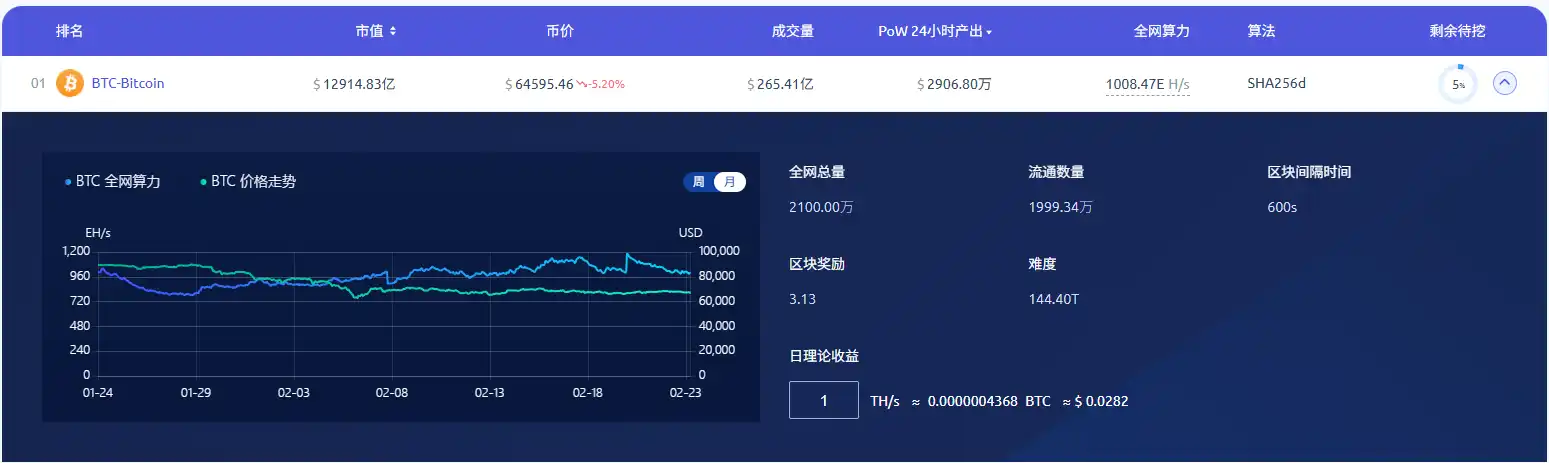
Possessing the world's highest hash rate yet choosing not to hold a single Bitcoin. This seemingly paradoxical strategic choice not only declares the demise of the traditional mining industry's "mining is hoarding" (HODL) belief but also reflects that under the extreme pressure of hash rate economics, leading mining companies are accelerating their transformation towards Wall Street-standard corporate financial operations and AI computing infrastructure provision.

Bitdeer's decision to empty its Bitcoin reserves is not due to a bearish outlook on the market but is compelled by the severely deteriorating fundamentals of the current mining industry. To understand the inevitability of this move, one must examine the underlying data of the current Bitcoin network.

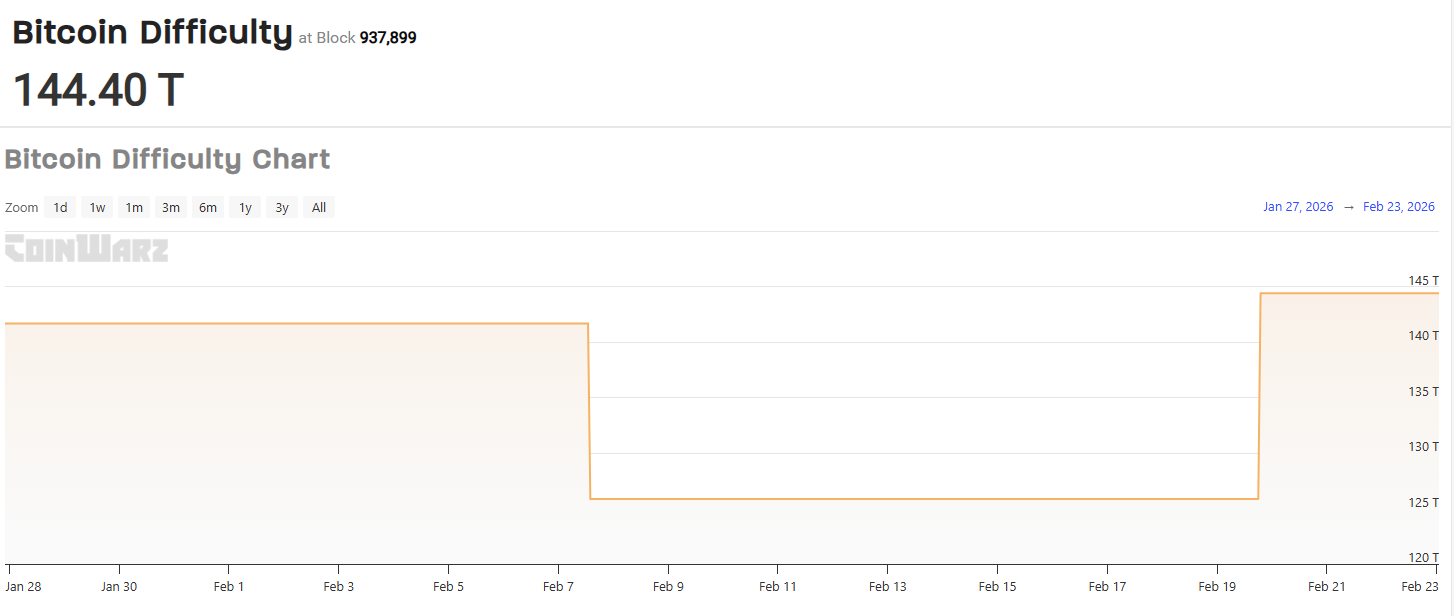
According to recent data, the Bitcoin network difficulty surged from 125.86T to 144.39T on February 19, representing a 14.72% increase. This is the largest single upward adjustment since May 2021. This difficulty adjustment directly erased all the operational breathing room miners had gained earlier in the year. The sharp increase in network difficulty means mining companies need to invest more hash rate and power costs to maintain their original output share.
Even more致命的是 the collapse of the Hashprice. Hashprice is the most core quantitative indicator measuring miner profitability, representing the expected fiat revenue generated per unit of hash rate (typically 1 PH/s) in one day. Caught between the dual pressures of soaring network difficulty and Bitcoin price volatility, the global Hashprice has plummeted to less than $30/PH/s/day. This figure is approaching historical lows.

With the Hashprice falling below the $30 mark, the vast majority of miners using older models or with electricity costs higher than $0.06/kWh are already on the brink of shutdown price, or even in a state of negative gross profit. For a giant like Bitdeer, although it benefits from economies of scale and certain energy cost advantages, the severely compressed profit margin makes it impossible to continue bearing the risk of anchoring assets to a single, highly volatile cryptocurrency.

In today's environment of high capital costs, holding Bitcoin represents a decision with huge implicit opportunity costs for mining companies. Every BTC hoarded means less cash flow available for expanding reproduction, upgrading equipment, or repaying debt. In a cycle of极度 compressed profit margins, "cash is king" has replaced "HODL is king." Liquidating holdings is the most direct defensive move against liquidity constraints.

Wall Street Financial Engineering: Convertible Bonds and Defensive Debt Restructuring

Facing the decline in hash rate returns, Bitdeer's solution is not limited to selling Bitcoin. Its actions in the capital market demonstrate highly sophisticated financial engineering capabilities. On February 20, Bitdeer announced an increase in the size of its private placement of Convertible Senior Notes to $325 million. The transaction is expected to settle on February 24, and the initial purchasers also have an option to buy an additional $50 million in notes.

This financing of up to $375 million is meticulously designed in its use of funds, representing a textbook example of defensive balance sheet restructuring:

Debt Extension and Replacement ($138.2 million): Bitdeer will use $138.2 million to repurchase its existing 5.25% Convertible Senior Notes due in 2029. This "refinancing" operation, in the current complex interest rate environment, essentially aims to optimize the capital structure, extend the debt duration, and secure a longer cash flow runway for the company's future strategic transformation. During a period of low Hashprice, reducing short-term debt repayment pressure is core to maintaining corporate survival.

Capped Call Transactions ($29.2 million): Bitdeer allocated $29.2 million for Capped Call Transactions. This is a highly specialized derivative hedging strategy. Convertible bonds, because they include a conversion option, can lead to significant dilution of existing shareholders' equity if the bondholders exercise their options when Bitdeer's stock price rises substantially in the future.

The Capped Call acts as a form of "anti-dilution insurance." By purchasing a combination of call options, the company can offset the dilutive effect of bond conversion through option gains when the stock price rises within a specific range. This sends a clear signal to the market: management is confident in the company's long-term market value and is极力 protecting the interests of existing shareholders.
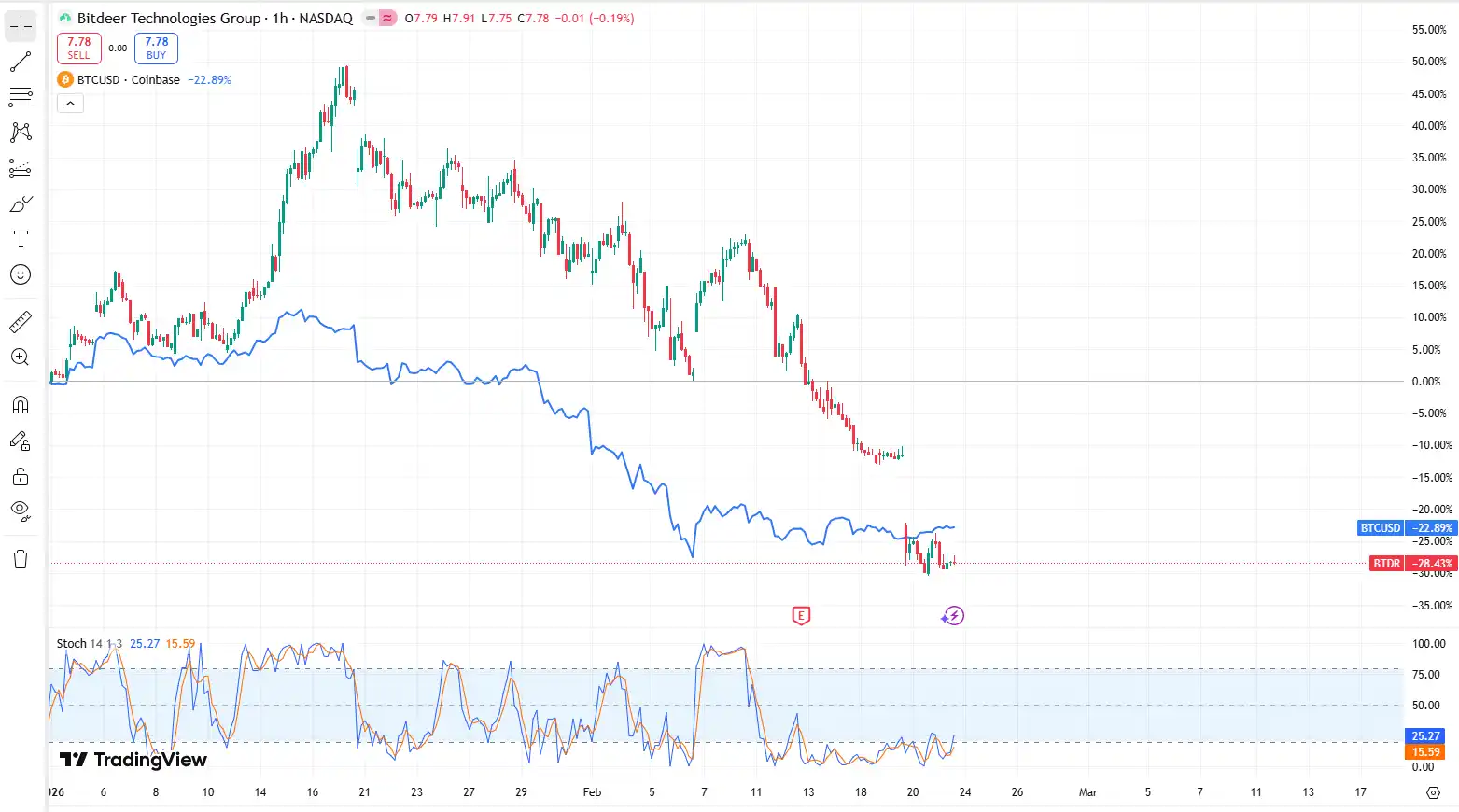
This complex combination of moves indicates that Bitdeer's financial strategy has moved beyond the early rough-and-tumble stage of the crypto industry and entered a period of refined capital operation on par with top-tier tech companies on Nasdaq.

After deducting the costs of debt restructuring and option hedging, the remaining hundreds of millions of dollars in raised capital, plus the cash obtained from liquidating Bitcoin, reveal Bitdeer's true ambition: to shed the label of a "pure Bitcoin miner" and fully enter the fields of High-Performance Computing (HPC) and Artificial Intelligence (AI) cloud services.

Amid the wave of generative AI explosion, the global computing power market is facing an unprecedented supply-demand imbalance. The training and inference of AI large models require massive computing power clusters, which in turn demand enormous throughput capacity for energy infrastructure (electricity and data center cooling).

Bitcoin mining companies possess a unique arbitrage advantage in this macro context. Miners are essentially energy arbitrageurs; they control some of the world's cheapest, largest-scale power resources and highly scalable data center land. Bitdeer explicitly stated that the new funds will be used for:

  • Expanding the scale of HPC and AI cloud business.
  • Developing proprietary ASIC mining equipment (achieving vertical integration of the hardware supply chain, reducing Capital Expenditure Capex).
  • Expanding high-standard data centers.

Transforming or upgrading low-margin Bitcoin mining infrastructure into high-margin, high-stability cash flow AI data centers is currently the core transformation narrative for large mining companies. AI customers typically sign long-term, fixed-rate service contracts (like PPAs), which stand in stark contrast to the Bitcoin mining revenue model that fluctuates violently daily with the Hashprice.

By liquidating Bitcoin and issuing convertible bonds, Bitdeer is essentially investing its inefficient past (hoarding coins) into a future with higher certainty (AI infrastructure).

Bitdeer reached the global top with 63.2 EH/s of hash rate, yet simultaneously set a record of "zero coin holdings." This phenomenon marks a fundamental divergence in the business models of publicly traded mining companies worldwide.

Under this logic, having the world's largest hash rate does not mean hoarding the most coins; it means possessing the largest cash flow generator and the most massive energy load capacity. When the profit generated by this machine falls below a threshold,毫不犹豫地 investing capital into the AI sector, which offers higher returns and greater era-specific dividends, becomes the most rational choice aligned with quantitative and capital allocation principles.

In the challenging post-halving cycle of 2026, blind hoarding is no longer a universal panacea. For investors in financial markets, this is no longer a story about "mining" but will be a hardcore narrative about energy, computing power调度, and Wall Street capital efficiency.


Связанные с этим вопросы

QWhy did Bitdeer completely sell off its Bitcoin reserves despite becoming the world's largest public mining company by self-mining hash rate?

ABitdeer sold off its Bitcoin reserves due to the severely deteriorating fundamentals of the mining industry, including a sharp increase in Bitcoin network difficulty and the collapse of Hashprice, which made holding Bitcoin a high-risk asset with significant opportunity costs. The move was a defensive strategy to prioritize cash flow for debt restructuring and strategic transformation into AI and high-performance computing (HPC) infrastructure.

QWhat is Hashprice and why is it critical for Bitcoin mining profitability?

AHashprice is a core quantitative metric that measures the expected fiat revenue generated per unit of computing power (typically 1 PH/s) per day. It is critical for mining profitability because it directly indicates the economic viability of mining operations. A collapse in Hashprice, as seen with values below $30/PH/s/day, pushes many miners to the brink of shutdown or negative margins, especially those with high energy costs or outdated equipment.

QHow did Bitdeer use financial engineering to address its liquidity and debt challenges?

ABitdeer employed sophisticated financial strategies, including issuing $325 million in convertible senior notes to raise capital. The funds were allocated to repurchase existing debt (extending maturity and optimizing capital structure) and execute capped call transactions to hedge against potential equity dilution from note conversions. This approach reflects a mature, Wall Street-style defensive restructuring to secure liquidity and protect shareholder value.

QWhat strategic shift is Bitdeer making with the proceeds from its Bitcoin sales and convertible note issuance?

ABitdeer is pivoting from being a pure Bitcoin miner to becoming a high-performance computing (HPC) and AI cloud services provider. The capital will be used to expand AI cloud business规模, develop proprietary ASIC mining hardware, and build high-standard data centers, leveraging its energy infrastructure to tap into the high-demand, stable-revenue AI compute market.

QWhat does Bitdeer's zero-Bitcoin reserve strategy signify for the broader mining industry?

ABitdeer's strategy signifies a fundamental shift in the business model of major mining companies, moving away from the traditional 'HODL' philosophy toward prioritizing cash flow, capital efficiency, and diversification into adjacent high-growth sectors like AI. It highlights the industry's adaptation to extreme economic pressures by embracing financial sophistication and infrastructure repurposing for more predictable returns.

Похожее

Arbitrum Pretends to Be the Hacker, 'Steals' Back the Money Lost by KelpDAO

Title: Arbitrum Poses as Hacker to Recover Stolen Funds from KelpDAO Last week, KelpDAO suffered a hack resulting in nearly $300 million in losses, marking the largest DeFi security incident this year. Approximately 30,765 ETH (worth over $70 million) remained on an Arbitrum address controlled by the attacker. In an unprecedented move, Arbitrum’s Security Council utilized its emergency authority to upgrade the Inbox bridge contract, adding a function that allowed them to impersonate the hacker’s address and initiate a transfer without access to its private key. The council’s action, approved by 9 of its 12 members, moved the stolen ETH to a frozen address in a single transaction before reverting the contract to its original state. The operation was coordinated with law enforcement, which attributed the attack to North Korea’s Lazarus Group. Community reactions are divided: some praise the recovery of funds, while others question the centralization of power, as the council can upgrade core contracts without governance votes. However, such emergency mechanisms are common among major L2s. Despite the partial recovery, over $292 million was stolen in total, with more than $100 million in bad debt on Aave and remaining funds scattered across other chains. The incident highlights escalating security challenges in DeFi, with state-sponsored hackers employing advanced tactics and L2s responding with elevated countermeasures.

marsbit3 мин. назад

Arbitrum Pretends to Be the Hacker, 'Steals' Back the Money Lost by KelpDAO

marsbit3 мин. назад

iQiyi Is Too Impatient

The article "iQiyi Is Too Impatient" discusses the controversy surrounding the Chinese streaming platform IQiyi's recent announcement of an "AI Actor Library" during its 2026 World Conference. IQiyi claimed over 100 actors, including well-known names like Zhang Ruoyun and Yu Hewei, had joined the initiative. CEO Gong Yu suggested AI could enable actors to "star in 14 dramas a year instead of 4" and that "live-action filming might become a world cultural heritage." The announcement quickly sparked backlash. Multiple actors named in the list issued urgent statements denying they had signed any AI-related authorization agreements. This forced IQiyi to clarify that inclusion in the library only indicated a willingness to *consider* AI projects, with separate negotiations required for any specific role. The incident, which trended on social media with hashtags like "IQiyi is crazy," is presented as a sign of the company's growing desperation. Facing intense competition from short-video platforms like Douyin and Kuaishou, as well as Bilibili and Xiaohongshu, IQiyi's financial performance has weakened, with revenues declining for two consecutive years. The author argues that IQiyi is "too impatient" to tell a compelling AI story to reassure the market, especially as it pursues a listing on the Hong Kong stock exchange. The piece concludes by outlining three key "AI questions" IQiyi must answer: defining its role as a tool provider versus a content creator, balancing the "coldness" of AI with the human element audiences desire, and properly managing the interests of platforms, actors, and viewers. The core dilemma is that while AI can reduce costs and increase efficiency, it risks creating homogenized, formulaic content and devaluing human performers.

marsbit57 мин. назад

iQiyi Is Too Impatient

marsbit57 мин. назад

Торговля

Спот
Фьючерсы

Популярные статьи

Тест по Bitcoin Биткоина

HTX Learn: Изучите Bitcoin halving и Заработаете Токены USDT

3.0k просмотров всегоОпубликовано 2024.04.16Обновлено 2024.04.16

Тест по Bitcoin  Биткоина

Что такое $BITCOIN

ЦИФРОВОЕ ЗОЛОТО ($BITCOIN): Комплексный анализ Введение в ЦИФРОВОЕ ЗОЛОТО ($BITCOIN) ЦИФРОВОЕ ЗОЛОТО ($BITCOIN) — это проект на основе блокчейна, работающий в сети Solana, который стремится объединить характеристики традиционных драгоценных металлов с инновациями децентрализованных технологий. Хотя он носит имя Биткойн, часто называемого “цифровым золотом” из-за его восприятия как средства хранения ценности, ЦИФРОВОЕ ЗОЛОТО является отдельным токеном, предназначенным для создания уникальной экосистемы в ландшафте Web3. Его цель — позиционировать себя как жизнеспособный альтернативный цифровой актив, хотя детали его применения и функциональности все еще развиваются. Что такое ЦИФРОВОЕ ЗОЛОТО ($BITCOIN)? ЦИФРОВОЕ ЗОЛОТО ($BITCOIN) — это токен криптовалюты, специально разработанный для использования в блокчейне Solana. В отличие от Биткойна, который выполняет широко признанную роль хранения ценности, этот токен, похоже, сосредоточен на более широких приложениях и характеристиках. Примечательные аспекты включают: Инфраструктура блокчейна: Токен построен на блокчейне Solana, известном своей способностью обрабатывать высокоскоростные и недорогие транзакции. Динамика предложения: ЦИФРОВОЕ ЗОЛОТО имеет максимальное предложение, ограниченное 100 квадриллионами токенов (100P $BITCOIN), хотя детали о его обращающемся предложении в настоящее время не раскрыты. Утилита: Хотя точные функциональные возможности не описаны, есть указания на то, что токен может быть использован для различных приложений, потенциально связанных с децентрализованными приложениями (dApps) или стратегиями токенизации активов. Кто создатель ЦИФРОВОГО ЗОЛОТА ($BITCOIN)? На данный момент личность создателей и команды разработчиков, стоящих за ЦИФРОВЫМ ЗОЛОТОМ ($BITCOIN), остается неизвестной. Эта ситуация типична для многих инновационных проектов в области блокчейна, особенно тех, которые связаны с децентрализованными финансами и феноменом мем-криптовалют. Хотя такая анонимность может способствовать культуре, ориентированной на сообщество, она усиливает опасения по поводу управления и ответственности. Кто инвесторы ЦИФРОВОГО ЗОЛОТА ($BITCOIN)? Доступная информация указывает на то, что у ЦИФРОВОГО ЗОЛОТА ($BITCOIN) нет известных институциональных спонсоров или значительных венчурных капиталовложений. Проект, похоже, функционирует по модели пирингового взаимодействия, сосредоточенной на поддержке и принятии сообществом, а не на традиционных путях финансирования. Его активность и ликвидность в основном сосредоточены на децентрализованных биржах (DEX), таких как PumpSwap, а не на устоявшихся централизованных торговых платформах, что еще больше подчеркивает его подход, ориентированный на grassroots. Как работает ЦИФРОВОЕ ЗОЛОТО ($BITCOIN) Операционные механизмы ЦИФРОВОГО ЗОЛОТА ($BITCOIN) можно подробно описать на основе его дизайна блокчейна и характеристик сети: Механизм консенсуса: Используя уникальный механизм доказательства истории (PoH) Solana в сочетании с моделью доказательства доли (PoS), проект обеспечивает эффективную валидацию транзакций, что способствует высокой производительности сети. Токеномика: Хотя конкретные дефляционные механизмы не были подробно описаны, большое максимальное предложение токенов подразумевает, что оно может быть предназначено для микротранзакций или нишевых случаев использования, которые еще предстоит определить. Интероперабельность: Существует потенциал для интеграции с более широкой экосистемой Solana, включая различные платформы децентрализованных финансов (DeFi). Однако детали относительно конкретных интеграций остаются неуточненными. Хронология ключевых событий Вот хронология, которая подчеркивает значимые вехи, касающиеся ЦИФРОВОГО ЗОЛОТА ($BITCOIN): 2023: Первоначальное развертывание токена происходит в блокчейне Solana, отмеченное его адресом контракта. 2024: ЦИФРОВОЕ ЗОЛОТО приобретает видимость, когда оно становится доступным для торговли на децентрализованных биржах, таких как PumpSwap, позволяя пользователям обменивать его на SOL. 2025: Проект наблюдает спорадическую торговую активность и потенциальный интерес к инициативам, возглавляемым сообществом, хотя на данный момент не зафиксировано никаких значительных партнерств или технических достижений. Критический анализ Сильные стороны Масштабируемость: Основная инфраструктура Solana поддерживает высокие объемы транзакций, что может повысить полезность $BITCOIN в различных сценариях транзакций. Доступность: Потенциально низкая цена торговли за токен может привлечь розничных инвесторов, способствуя более широкому участию благодаря возможностям дробного владения. Риски Отсутствие прозрачности: Отсутствие публично известных спонсоров, разработчиков или процесса аудита может вызвать скептицизм относительно устойчивости и надежности проекта. Волатильность рынка: Торговая активность сильно зависит от спекулятивного поведения, что может привести к значительной волатильности цен и неопределенности для инвесторов. Заключение ЦИФРОВОЕ ЗОЛОТО ($BITCOIN) является интригующим, но неоднозначным проектом в быстро развивающейся экосистеме Solana. Хотя он пытается использовать нарратив “цифрового золота”, его отход от установленной роли Биткойна как средства хранения ценности подчеркивает необходимость более четкого различения его предполагаемой утилиты и структуры управления. Будущее принятие и усвоение, вероятно, будут зависеть от решения текущей непрозрачности и более четкого определения его операционных и экономических стратегий. Примечание: Этот отчет охватывает синтезированную информацию, доступную на октябрь 2023 года, и с тех пор могут произойти события.

99 просмотров всегоОпубликовано 2025.05.13Обновлено 2025.05.13

Что такое $BITCOIN

Fractal Bitcoin: масштабирование Биткоина с помощью рекурсивной системы

Fractal Bitcoin — масштабное Layer-1-решнение, созданное на базе кода Биткоина, позволяющего достигать бесконечного масштабирования с помощью рекурсивного подхода.

2.2k просмотров всегоОпубликовано 2025.06.30Обновлено 2025.06.30

Fractal Bitcoin: масштабирование Биткоина с помощью рекурсивной системы

Обсуждения

Добро пожаловать в Сообщество HTX. Здесь вы сможете быть в курсе последних новостей о развитии платформы и получить доступ к профессиональной аналитической информации о рынке. Мнения пользователей о цене на BTC (BTC) представлены ниже.

活动图片