Bitcoin Rallies, But Traders Still Realizing $479M In Losses Daily

bitcoinistОпубликовано 2026-05-08Обновлено 2026-05-08

Введение

Despite Bitcoin's recent rally to around $80,100, on-chain data reveals that investors are still realizing significant losses. The Bitcoin Realized Loss indicator, which measures the total loss from coins sold below their previous purchase price, has remained elevated at approximately $479 million per day. This level is about 140% above the typical baseline of $200 million seen in stable market periods. Notably, this spike in realized losses occurred even as Bitcoin's price increased, contrasting with previous loss spikes that happened during major price crashes. This pattern suggests that some investors are choosing to exit their positions at a loss during the rally, possibly due to a lack of confidence in its sustainability. Analysts suggest that for a healthier market regime to be confirmed, the daily realized loss would need to compress and sustain below the $200 million level, indicating selling exhaustion and a shift towards stronger underlying demand.

On-chain data shows the Bitcoin Realized Loss indicator has remained elevated even after the latest surge in the cryptocurrency’s price.

Bitcoin Realized Loss Has Stood At $479M Per Day Recently

In its latest weekly report, on-chain analytics firm Glassnode has discussed the latest trend in the Realized Loss for the Bitcoin network. The “Realized Loss” here refers to an indicator that measures, as its name suggests, the total amount of loss that BTC investors as a whole are realizing through their transactions.

The metric works by going through the transfer history of each token being moved to see what price it was transacted at prior to this. If the last selling price was less than the latest one for any token, then that particular token’s sale can be considered to be leading to the realization of some net loss.

The exact degree of loss involved in the transfer is equal to the difference between the two prices. The Realized Loss calculates the sum of this difference for all loss transactions occurring on the blockchain. A counterpart indicator called the Realized Profit takes care of the transfers of the opposite type.

Now, here is the chart shared by Glassnode that shows the trend in the 14-day simple moving average (SMA) of the Bitcoin Realized Loss over the last few years:
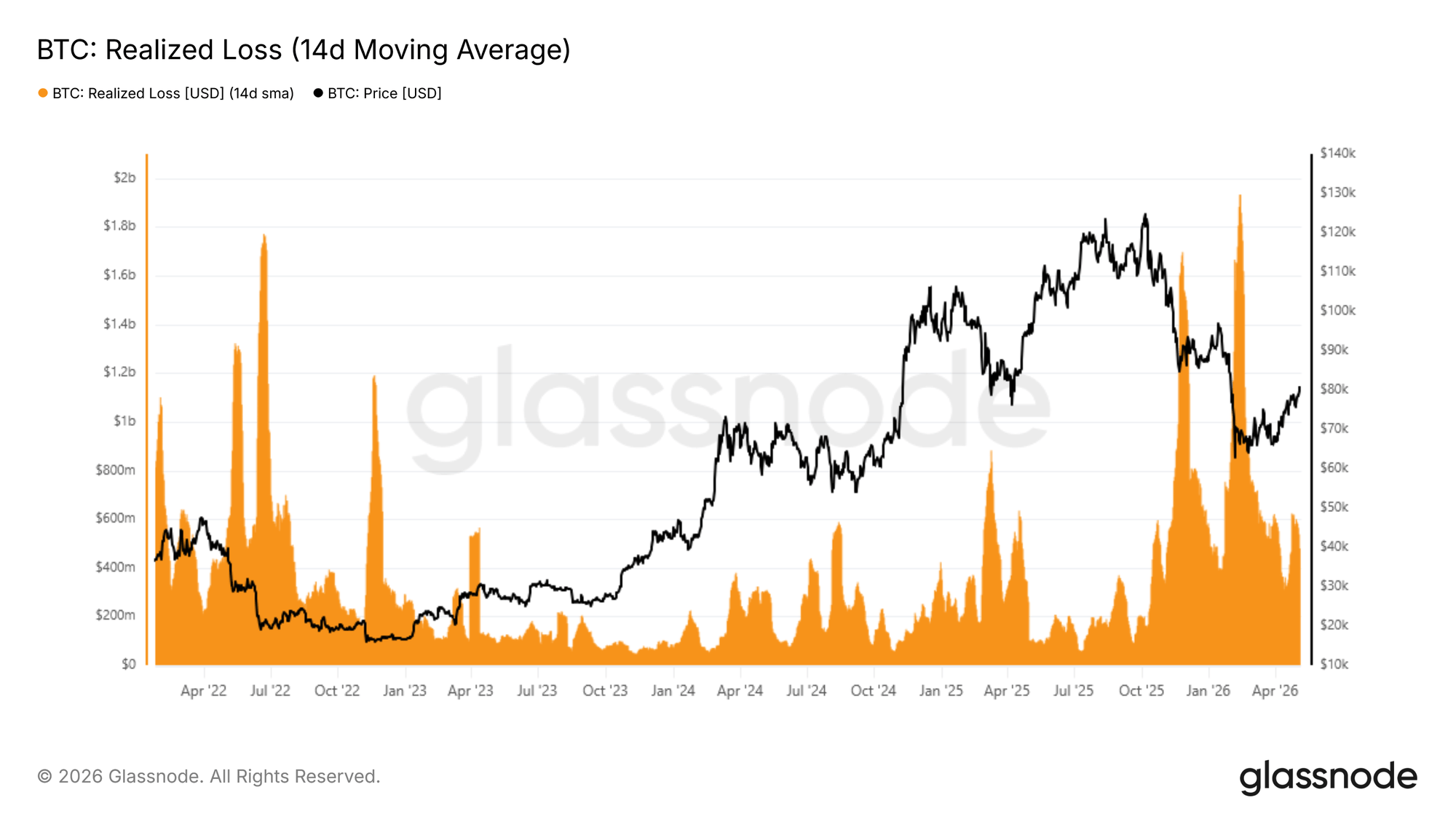
The value of the metric appears to have registered a spike in recent days | Source: Glassnode's The Week Onchain - Week 18, 2026

As displayed in the above graph, the 14-day SMA of the Bitcoin Realized Loss witnessed massive spikes as the cryptocurrency saw price crashes in November and February.

These spikes weren’t anything unusual, as price drawdowns tend to accompany panic selling from top buyers. Interestingly, however, another spike has just recently appeared in the indicator, despite the fact that BTC has been rallying.

The spike is nowhere near of a scale similar to the earlier capitulation events, but it’s nonetheless an indication that there has been a greater push to exit below cost basis alongside the price surge. This may suggest that investors don’t believe that the price rally would last, hence why they have decided to exit at this lower-loss opportunity.

Currently, the Realized Profit is sitting at $479 million per day, approximately 140% above the $200 million baseline that has generally been seen during stable phases in this Bitcoin cycle.

The analytics firm explained:

A sustained compression of this indicator back below $200M per day would serve as a strong on-chain confirmation that selling exhaustion is taking hold, and that the market is genuinely transitioning toward a healthier demand regime.

BTC Price

At the time of writing, Bitcoin is trading around $80,100, up 5% over the past week.

Looks like the price of the coin has retraced from its latest high | Source: BTCUSDT on TradingView


Связанные с этим вопросы

QWhat is the Bitcoin Realized Loss indicator and what does it measure?

AThe Bitcoin Realized Loss indicator measures the total amount of loss that BTC investors as a whole are realizing through their transactions by calculating the sum of losses from all tokens sold at a price lower than their last transaction price.

QWhat is the current daily value of the Bitcoin Realized Loss indicator mentioned in the article, and how does it compare to its baseline?

AThe current daily Bitcoin Realized Loss is approximately $479 million per day, which is about 140% above the $200 million baseline typically seen during stable phases in this Bitcoin cycle.

QAccording to the article, what event is unusual about the recent spike in the Realized Loss indicator?

AThe unusual event is that a spike in the Realized Loss indicator has occurred recently despite Bitcoin's price rallying, whereas previous major spikes were associated with price crashes and panic selling.

QWhat would signal a strong on-chain confirmation of selling exhaustion and a transition to a healthier demand regime, according to Glassnode?

AA sustained compression of the Realized Loss indicator back below $200 million per day would serve as a strong on-chain confirmation that selling exhaustion is taking hold and that the market is genuinely transitioning toward a healthier demand regime.

QWhat was Bitcoin's approximate price and weekly percentage change at the time of writing?

AAt the time of writing, Bitcoin was trading around $80,100, representing an increase of 5% over the past week.

Похожее

Standing in the Light: A Comprehensive Guide to the Optical Module and CPO Supply Chain

"Standing in the Light: Understanding the Optical Module and CPO Industry Chain" This article analyzes the critical role of optical communication technology, specifically optical modules and Co-Packaged Optics (CPO), as the "nervous system" for modern AI data centers. With exponential growth in AI computational demands (e.g., NVIDIA's Vera Rubin architecture), traditional electrical interconnects using copper cables face severe bottlenecks in bandwidth, power consumption, and signal integrity over distance. The core function of an optical module is to act as a "translator," converting electrical signals from chips into optical signals for transmission over fiber (and vice-versa). Key internal components include lasers, modulators, photodetectors, drivers, and DSP chips. The industry is currently transitioning from 800G to 1.6T modules. However, the future lies in CPO. This next-generation technology integrates the optical engine directly with the switch ASIC/XPU on the same package substrate, drastically reducing power consumption (by ~3.5x according to NVIDIA), overcoming bandwidth density limits, and minimizing signal attenuation compared to traditional pluggable modules. Key challenges for CPO include advanced packaging capacity (dominated by TSMC), thermal management, repairability, and standardization. The article details the broader technology landscape, including Near-Packaged Optics (NPO, a pragmatic intermediate step), Linear-drive Pluggable Optics (LPO), Optical I/O (OIO for chip-level integration), and Optical Circuit Switches (OCS). A comprehensive CPO industry chain is mapped, highlighting shifting power dynamics: * **Architecture Definers:** NVIDIA, Broadcom, and Marvell now hold greater influence. * **Advanced Packaging & Manufacturing:** TSMC is central; Fabrinet is a key EMS player. * **Lasers ("The Heart"):** A strategic bottleneck. EML lasers are led by Lumentum and Coherent (both receiving major NVIDIA investments). CW lasers, favored for CPO/silicon photonics, see strong Chinese players like Source Photonics and Sicoya. * **Silicon Photonics Chips:** The mainstream path for CPO engines, with key players like Broadcom, Intel, Marvell, and China's Accelink. * **Fiber Connectivity Components:** A major new, high-growth market created by CPO, including Fiber Array Units (FAU), Polarization-Maintaining Fiber (PMF), and MPO connectors. Companies like Tianfu Communication and US Conec are leaders. * **Fiber & Cable:** Experiencing a super-cycle (e.g., Corning, Yangtze Optical Fiber). * **PCB/Substrates:** Requiring advanced materials (e.g., Shengyi Tech). * **DSP & SerDes:** Functions are integrated into switch ASICs in the CPO era (e.g., Broadcom, Astera Labs). * **Optical Module Makers:** Transitioning from standalone module suppliers to providers of optical engines and NPO/LPO solutions while riding the current pluggable boom (e.g., Zhongji Innolight, Eoptolink). The investment timeline is segmented: Short-term (2026-2027) features the "last feast" for pluggable modules and CPO's initial rollout. Medium-term (2027-2029) will see CPO expand and NPO peak. Long-term (2029-2032+) involves CPO/OIO penetration into intra-rack scaling. In conclusion, optical interconnects are fundamental to AI infrastructure. The competitive landscape sees US firms leading in architecture and high-end chips, TSMC in advanced packaging, and Chinese firms holding strong positions in modules, connectivity components, CW lasers, and fiber/cable. The future belongs to companies that can navigate the technological shift from "selling shovels" (modules) to "building highways" (CPO/OIO infrastructure).

marsbit3 мин. назад

Standing in the Light: A Comprehensive Guide to the Optical Module and CPO Supply Chain

marsbit3 мин. назад

Торговля

Спот
Фьючерсы

Популярные статьи

Тест по Bitcoin Биткоина

HTX Learn: Изучите Bitcoin halving и Заработаете Токены USDT

3.1k просмотров всегоОпубликовано 2024.04.16Обновлено 2024.04.16

Тест по Bitcoin  Биткоина

Что такое $BITCOIN

ЦИФРОВОЕ ЗОЛОТО ($BITCOIN): Комплексный анализ Введение в ЦИФРОВОЕ ЗОЛОТО ($BITCOIN) ЦИФРОВОЕ ЗОЛОТО ($BITCOIN) — это проект на основе блокчейна, работающий в сети Solana, который стремится объединить характеристики традиционных драгоценных металлов с инновациями децентрализованных технологий. Хотя он носит имя Биткойн, часто называемого “цифровым золотом” из-за его восприятия как средства хранения ценности, ЦИФРОВОЕ ЗОЛОТО является отдельным токеном, предназначенным для создания уникальной экосистемы в ландшафте Web3. Его цель — позиционировать себя как жизнеспособный альтернативный цифровой актив, хотя детали его применения и функциональности все еще развиваются. Что такое ЦИФРОВОЕ ЗОЛОТО ($BITCOIN)? ЦИФРОВОЕ ЗОЛОТО ($BITCOIN) — это токен криптовалюты, специально разработанный для использования в блокчейне Solana. В отличие от Биткойна, который выполняет широко признанную роль хранения ценности, этот токен, похоже, сосредоточен на более широких приложениях и характеристиках. Примечательные аспекты включают: Инфраструктура блокчейна: Токен построен на блокчейне Solana, известном своей способностью обрабатывать высокоскоростные и недорогие транзакции. Динамика предложения: ЦИФРОВОЕ ЗОЛОТО имеет максимальное предложение, ограниченное 100 квадриллионами токенов (100P $BITCOIN), хотя детали о его обращающемся предложении в настоящее время не раскрыты. Утилита: Хотя точные функциональные возможности не описаны, есть указания на то, что токен может быть использован для различных приложений, потенциально связанных с децентрализованными приложениями (dApps) или стратегиями токенизации активов. Кто создатель ЦИФРОВОГО ЗОЛОТА ($BITCOIN)? На данный момент личность создателей и команды разработчиков, стоящих за ЦИФРОВЫМ ЗОЛОТОМ ($BITCOIN), остается неизвестной. Эта ситуация типична для многих инновационных проектов в области блокчейна, особенно тех, которые связаны с децентрализованными финансами и феноменом мем-криптовалют. Хотя такая анонимность может способствовать культуре, ориентированной на сообщество, она усиливает опасения по поводу управления и ответственности. Кто инвесторы ЦИФРОВОГО ЗОЛОТА ($BITCOIN)? Доступная информация указывает на то, что у ЦИФРОВОГО ЗОЛОТА ($BITCOIN) нет известных институциональных спонсоров или значительных венчурных капиталовложений. Проект, похоже, функционирует по модели пирингового взаимодействия, сосредоточенной на поддержке и принятии сообществом, а не на традиционных путях финансирования. Его активность и ликвидность в основном сосредоточены на децентрализованных биржах (DEX), таких как PumpSwap, а не на устоявшихся централизованных торговых платформах, что еще больше подчеркивает его подход, ориентированный на grassroots. Как работает ЦИФРОВОЕ ЗОЛОТО ($BITCOIN) Операционные механизмы ЦИФРОВОГО ЗОЛОТА ($BITCOIN) можно подробно описать на основе его дизайна блокчейна и характеристик сети: Механизм консенсуса: Используя уникальный механизм доказательства истории (PoH) Solana в сочетании с моделью доказательства доли (PoS), проект обеспечивает эффективную валидацию транзакций, что способствует высокой производительности сети. Токеномика: Хотя конкретные дефляционные механизмы не были подробно описаны, большое максимальное предложение токенов подразумевает, что оно может быть предназначено для микротранзакций или нишевых случаев использования, которые еще предстоит определить. Интероперабельность: Существует потенциал для интеграции с более широкой экосистемой Solana, включая различные платформы децентрализованных финансов (DeFi). Однако детали относительно конкретных интеграций остаются неуточненными. Хронология ключевых событий Вот хронология, которая подчеркивает значимые вехи, касающиеся ЦИФРОВОГО ЗОЛОТА ($BITCOIN): 2023: Первоначальное развертывание токена происходит в блокчейне Solana, отмеченное его адресом контракта. 2024: ЦИФРОВОЕ ЗОЛОТО приобретает видимость, когда оно становится доступным для торговли на децентрализованных биржах, таких как PumpSwap, позволяя пользователям обменивать его на SOL. 2025: Проект наблюдает спорадическую торговую активность и потенциальный интерес к инициативам, возглавляемым сообществом, хотя на данный момент не зафиксировано никаких значительных партнерств или технических достижений. Критический анализ Сильные стороны Масштабируемость: Основная инфраструктура Solana поддерживает высокие объемы транзакций, что может повысить полезность $BITCOIN в различных сценариях транзакций. Доступность: Потенциально низкая цена торговли за токен может привлечь розничных инвесторов, способствуя более широкому участию благодаря возможностям дробного владения. Риски Отсутствие прозрачности: Отсутствие публично известных спонсоров, разработчиков или процесса аудита может вызвать скептицизм относительно устойчивости и надежности проекта. Волатильность рынка: Торговая активность сильно зависит от спекулятивного поведения, что может привести к значительной волатильности цен и неопределенности для инвесторов. Заключение ЦИФРОВОЕ ЗОЛОТО ($BITCOIN) является интригующим, но неоднозначным проектом в быстро развивающейся экосистеме Solana. Хотя он пытается использовать нарратив “цифрового золота”, его отход от установленной роли Биткойна как средства хранения ценности подчеркивает необходимость более четкого различения его предполагаемой утилиты и структуры управления. Будущее принятие и усвоение, вероятно, будут зависеть от решения текущей непрозрачности и более четкого определения его операционных и экономических стратегий. Примечание: Этот отчет охватывает синтезированную информацию, доступную на октябрь 2023 года, и с тех пор могут произойти события.

99 просмотров всегоОпубликовано 2025.05.13Обновлено 2025.05.13

Что такое $BITCOIN

Fractal Bitcoin: масштабирование Биткоина с помощью рекурсивной системы

Fractal Bitcoin — масштабное Layer-1-решнение, созданное на базе кода Биткоина, позволяющего достигать бесконечного масштабирования с помощью рекурсивного подхода.

2.3k просмотров всегоОпубликовано 2025.06.30Обновлено 2025.06.30

Fractal Bitcoin: масштабирование Биткоина с помощью рекурсивной системы

Обсуждения

Добро пожаловать в Сообщество HTX. Здесь вы сможете быть в курсе последних новостей о развитии платформы и получить доступ к профессиональной аналитической информации о рынке. Мнения пользователей о цене на BTC (BTC) представлены ниже.

活动图片