Bitcoin dips below $85K as DATs face ‘mNAV rollercoaster’: Finance Redefined

cointelegraphОпубликовано 2025-12-19Обновлено 2025-12-19

Введение

Cryptocurrency markets faced a week of declines, with Bitcoin dropping over 5% to a low of $84,398 before recovering slightly. Solmate CEO Marco Santori warned that digital asset treasury (DAT) companies face sustainability risks due to volatility in their token holdings, which impacts their market-cap-to-net-asset-value (mNAV) ratios. In regulatory news, the SEC ended its four-year investigation into Aave, prompting founder Stani Kulechov to unveil a 2026 "master plan" targeting $1 billion in real-world asset deposits through Aave v4 and new products. Elsewhere, Hyperliquid proposed a governance vote to treat $1 billion in tokens as burned, ETHGas raised $12 million for Ethereum blockspace trading, and the SEC issued guidance requiring tokenized securities to comply with traditional custody rules. Most top cryptocurrencies closed the week in negative territory.

Cryptocurrency markets experienced another week of downside as investor activity gradually wound down ahead of the holiday period.

Bitcoin (BTC) fell over 5% during the past week, dipping to a weekly low of $84,398 on Thursday, before recovering to trade above $87,769 on Friday, TradingView data shows.

Crypto market volatility continues to threaten the sustainability of digital asset treasury (DAT) companies, as their longevity now depends on avoiding the multiple-to-net-asset-value (mNAV) “roller coaster,” making these firms subject to the value swings of the tokens held on their balance sheet, according to Solmate CEO Marco Santori.

In the wider cryptocurrency space, the US Securities and Exchange Commission (SEC) dropped its four-year investigation into Aave, marking a significant regulatory win for the industry.

Following the development, Stani Kulechov, the founder of Aave, unveiled the 2026 “master plan” for the decentralized lending platform, aiming to capture $1 billion worth of value through real-world asset deposits by launching Aave v4, Horizon, and the Aave App.
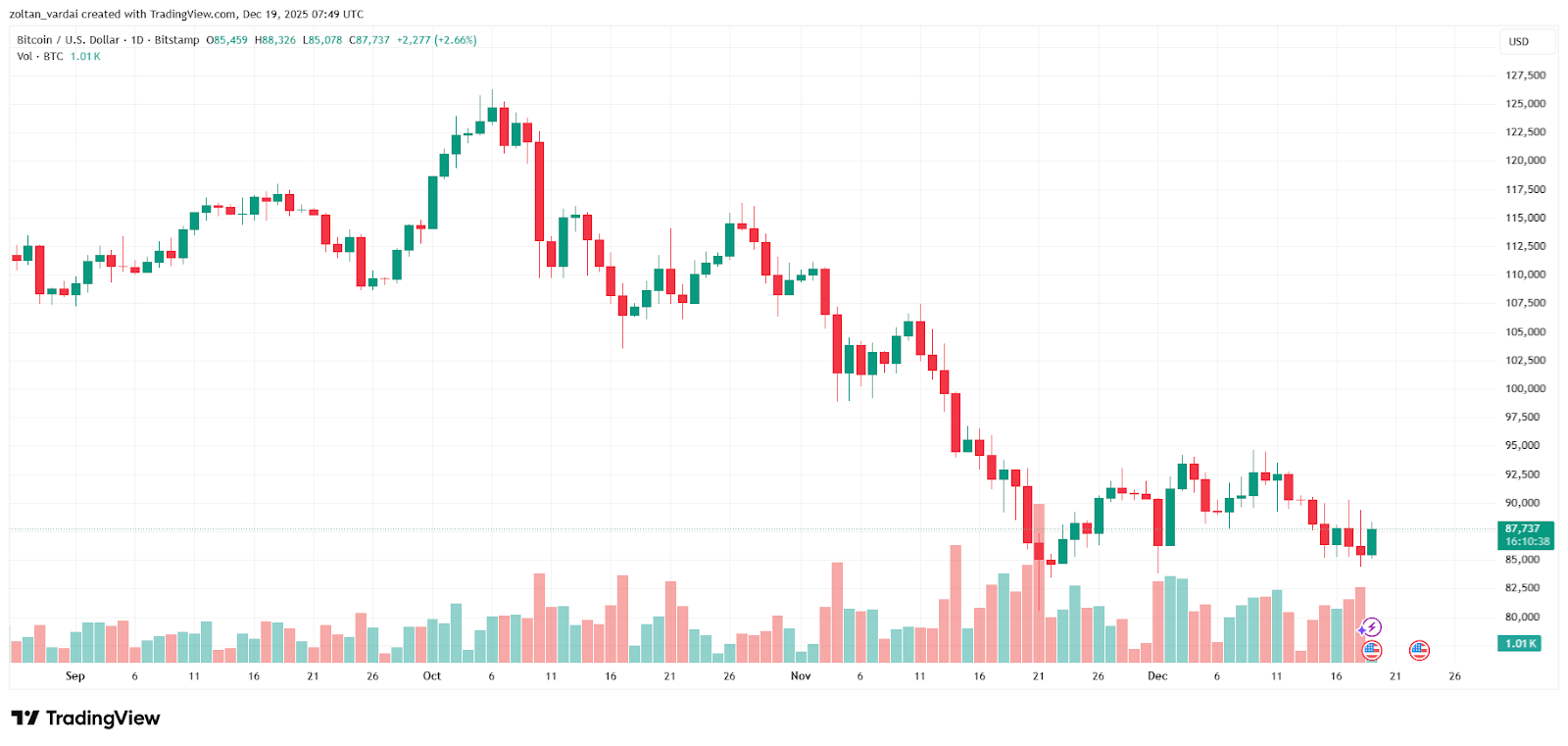
BTC/USD, 3-month chart. Source: Cointelegraph/TradingView

DAT longevity hinges on avoiding “mNAV roller coaster”: Solmate CEO

The rise of digital asset treasury companies will go down as a meta-narrative of 2025, but the longevity of the movement will be decided by capital management and sound business strategies.

According to Solmate CEO Marco Santori, all DATs have to contend with the value of the underlying token they hold on their balance sheets. This shouldn’t be a problem for revenue-generating businesses, but pure-play DATs will be in for a bumpy ride.

“The multiple-to-net-asset value is how a lot of these treasury companies survive. If they’re trading at a high mNAV, meaning their market cap is bigger than the value of the coins they have on the balance sheet, then they can sell stock in an accretive way,” Santori said on Cointelegraph’s Chain Reaction X show.

“Every dollar of stock they sell, they take that and go out and buy the underlying coin with, and that increases their net asset value. So long as they can maintain the premium, they can just keep doing that. And that is the pure play treasury model. I actually think that has a future.”

But the issue is that mNAV will dwindle when the interest in the underlying token of a DAT wanes. Santori explained that falling token prices result in lower mNAVs.

“That means a lot of the treasury companies are kind of idle because they can’t grow efficiently and effectively. I didn’t want to be subject to that. I didn’t want that for our investors. I want to give them exposure to SOL and to the growth of the Solana network, but I didn’t want them riding an mNAV roller coaster,” Santori said.

Continue reading

Aave founder outlines 2026 “master plan” after end to SEC probe

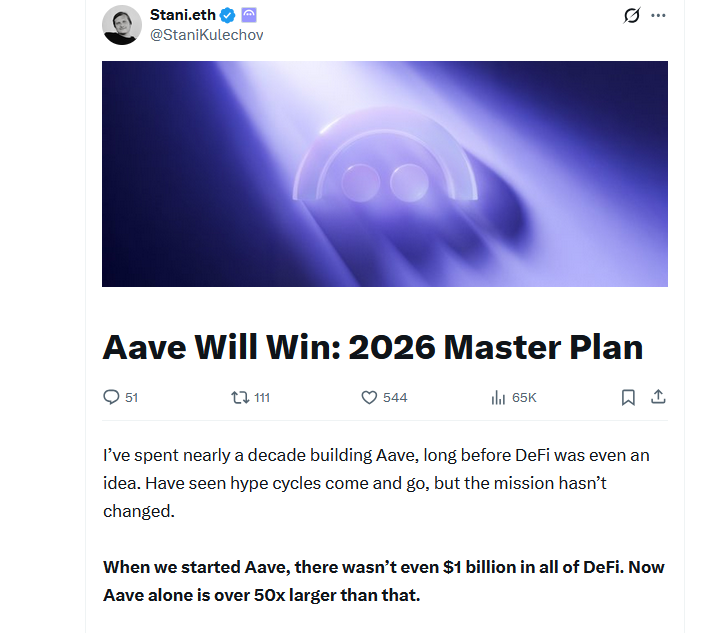
Aave founder Stani Kulechov has unveiled his decentralized protocol’s “master plan” for 2026, shortly after revealing the US Securities and Exchange Commission has dropped its four-year investigation into the platform.

In a post to X on Tuesday, Kulechov said despite 2025 marking the most “successful year” for the platform to date, he still feels that Aave is on “day zero compared to what lies ahead.”

Pointing to 2026, the CEO outlined a master plan that places significant focus on scaling the DeFi platform and achieving specific usage metrics, such as $1 billion in real-world asset (RWA) deposits.

“As it stands, our strategy going into next year has three main pillars: Aave v4, Horizon, and Aave App,” he said.
Source: Stani Kulechov

Aave v4 is a major upgrade touted to bring significant enhancements to the platform’s borrowing and lending pools, user interface and liquidation parameters, among other things.

In his post, Kulechov said v4 will be the “backbone of all finance,” as he pointed to the tailored lending markets that the v4’s Hub and Spoke model will provide.

Under this model, the hub refers to a single unified crosschain liquidity pool that functions as the central location for all assets on the protocol, while the spokes refer to highly customizable markets that tap into hub liquidity.

“This will allow Aave to handle trillions of dollars in assets, making it the go-to choice for any institution, fintech, or company looking to access Aave’s deep, reliable liquidity,” he said, adding:

“In 2026, Aave will be home to new markets, new assets, and new integrations that have never existed before in DeFi. We’ll continue engaging with fintechs and work closely with the DAO and our partners on the rollout to progressively scale TVL throughout the year.”

Looking at the next pillar in Horizon, Aave’s decentralized real-world asset market, the CEO outlined intentions to onboard “many top financial institutions” to become a central player in the RWA space.

Continue reading

Hyperliquid governance vote aims to permanently sideline $1 billion Assistance Fund

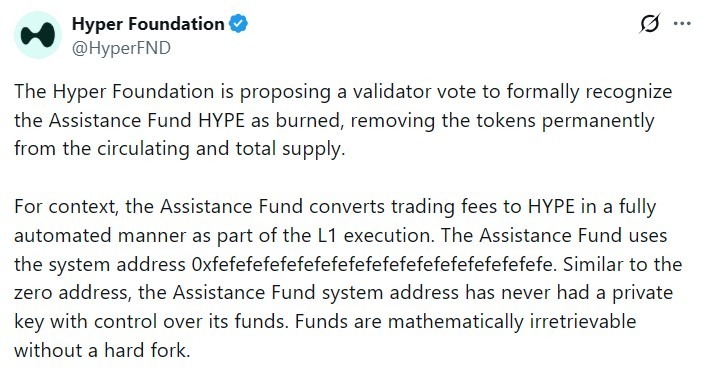
The Hyper Foundation proposed a validator vote to formally recognize HYPE tokens held in the Hyperliquid protocol’s Assistance Fund system address as permanently inaccessible, excluding them from the asset’s circulating and total supply.

According to the foundation, the Assistance Fund is a protocol-level mechanism embedded in the layer-1 network’s execution. It automatically converts trading fees into HYPE tokens and routes them to a designated system address. At the time of writing, the wallet contains about $1 billion in tokens.

The system address was designed without control mechanisms, making the funds irretrievable without a hard fork. “By voting ‘Yes,’ validators agree to treat the Assistance Fund HYPE as burned,” Hyper Foundation wrote.

Native Markets, the issuer of the Hyperliquid-native stablecoin USDH, reminded users that 50% of the stablecoin’s reserve yield is routed to the Assistance Fund and converted into HYPE tokens. “Should this validator vote pass, these contributions will then be formally recognized as burned,” the company wrote.
Source: Hyper Foundation

Continue reading

ETHGas raises $12 million as Buterin revives gas futures debate

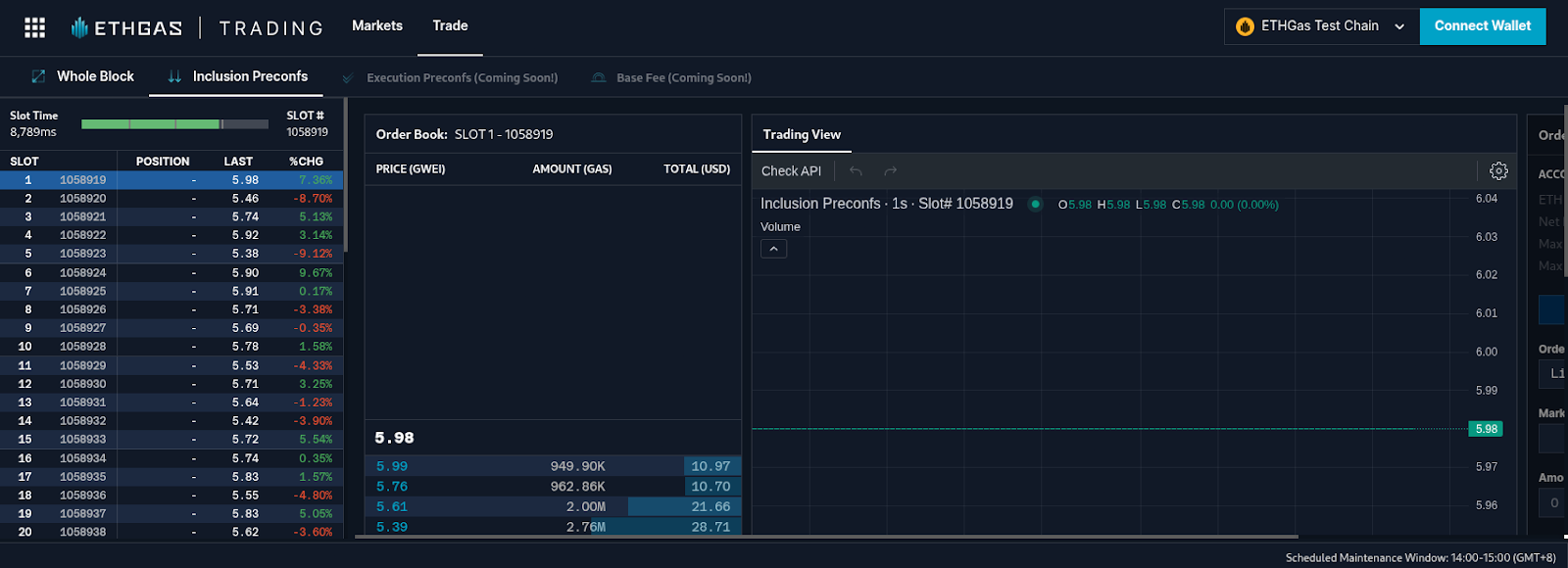
Ethereum blockspace trading platform ETHGas announced it has raised $12 million in a seed round led by Polychain Capital.

The funding announcement comes after Ethereum co-founder Vitalik Buterin recently discussed the idea of an onchain “gas futures” market, arguing that such a product could give users a clearer signal of expected fees and let them hedge future costs.

ETHGas argues that Ethereum needs “a reimagination of the way blockspace is allocated on the network” and claims that its newly-launched blockspace trading platform is a step in that direction. The company said the market launched with $800 million in commitments from validators, builders and other participants.
ETHGas' Ethereum blockspace trading platform. Source: ETHGas

Continue reading

Tokenized stocks may be onchain, but the SEC still wants the keys

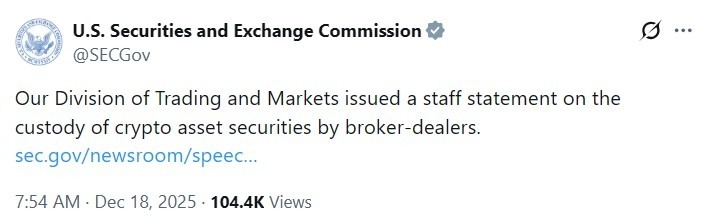
The US Securities and Exchange Commission’s Trading and Markets Division on Wednesday laid out how broker-dealers can custody tokenized stocks and bonds under existing customer protection rules, signaling that blockchain-based crypto asset securities will be slotted into traditional securities safeguards rather than treated as a new category.

The division said it would not object to broker-dealers deeming themselves in possession of crypto asset securities under existing customer protection rules, as long as they meet a set of operational, security and governance conditions. This applies only to crypto securities, including tokenized stocks or bonds.

While the statement is not a rule, it provides clarity on how US regulators expect tokenized securities to fit within traditional market safeguards.

The guidance suggests that tokenized securities are not treated as a new asset class with unique rules. Instead, they are being placed into existing broker-dealer frameworks, even if they settle within blockchain networks.
Source: US SEC

Continue reading

DeFi market overview

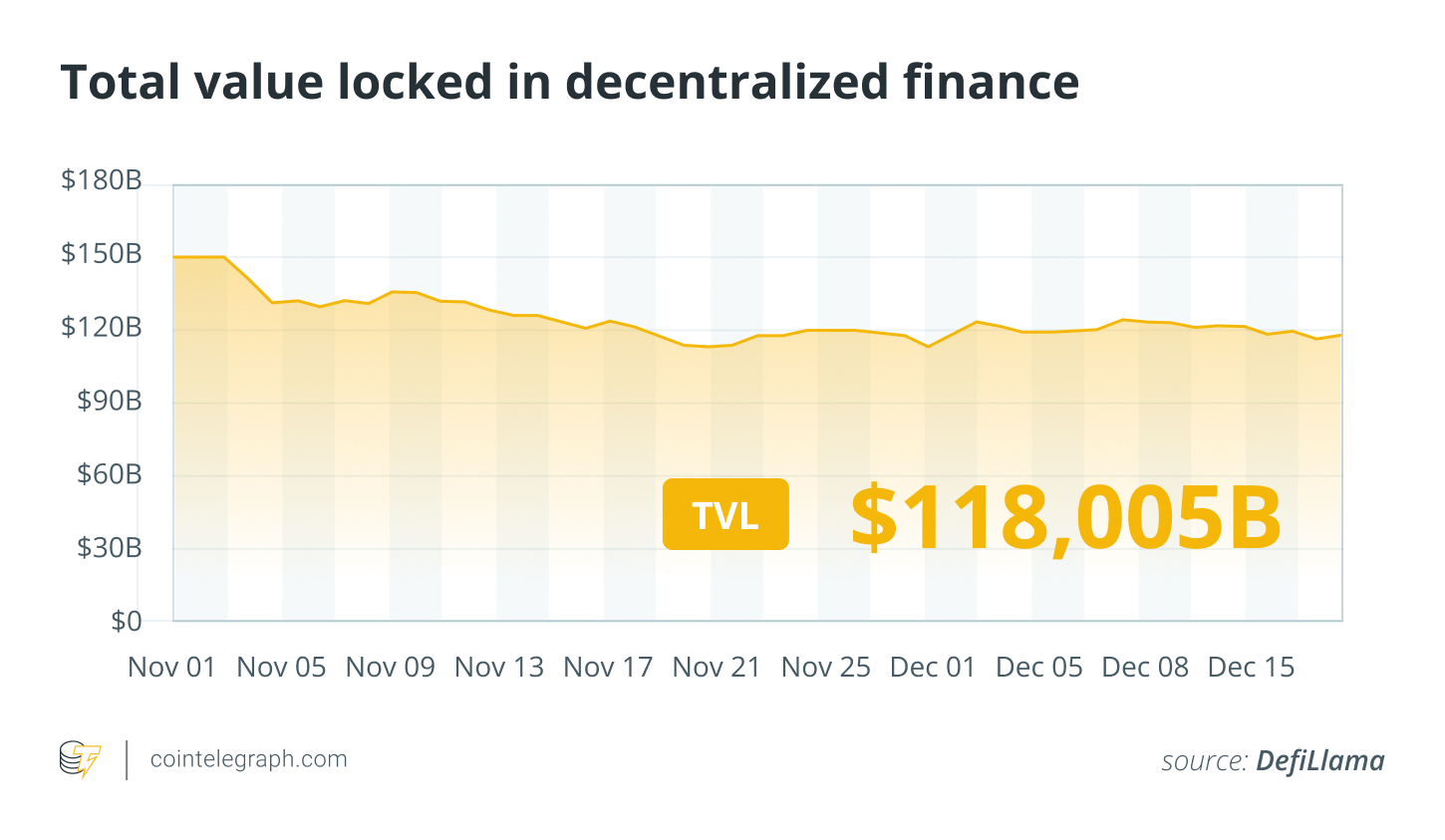
According to data from Cointelegraph Markets Pro and TradingView, most of the 100 largest cryptocurrencies by market capitalization ended the week in the red.

Memecoin launchpad Pump.fun’s (PUMP) token fell 32% marking the week’s biggest decline in the top 100, followed by decentralized exchange Aster’s (ASTER) token, down over 27% during the past week.
Total value locked in DeFi. Source: DefiLlama

Thanks for reading our summary of this week’s most impactful DeFi developments. Join us next Friday for more stories, insights and education regarding this dynamically advancing space.

Связанные с этим вопросы

QWhat was the main challenge for Digital Asset Treasury (DAT) companies according to Solmate CEO Marco Santori?

AThe main challenge for DAT companies is avoiding the 'mNAV rollercoaster,' as their longevity depends on managing the multiple-to-net-asset-value, which fluctuates with the value of the underlying tokens they hold on their balance sheets.

QWhat significant regulatory development occurred for Aave, and what was the founder's subsequent announcement?

AThe U.S. Securities and Exchange Commission (SEC) dropped its four-year investigation into Aave. Following this, founder Stani Kulechov unveiled a 2026 'master plan' aiming to capture $1 billion in real-world asset deposits through Aave v4, Horizon, and the Aave App.

QWhat was the purpose of the Hyper Foundation's validator vote regarding the Assistance Fund?

AThe Hyper Foundation proposed a validator vote to formally recognize the HYPE tokens held in the Assistance Fund system address as permanently inaccessible, effectively excluding them from the token's circulating and total supply, which would treat them as burned.

QWhat problem in the Ethereum network does ETHGas aim to solve, and how much funding did it recently raise?

AETHGas aims to reimagine the way blockspace is allocated on the Ethereum network. The company recently raised $12 million in a seed round led by Polychain Capital to support its blockspace trading platform.

QHow did the SEC's recent guidance treat tokenized stocks and bonds in terms of custody rules?

AThe SEC's guidance indicated that tokenized stocks and bonds would be slotted into existing customer protection rules for broker-dealers rather than being treated as a new asset class, requiring them to meet traditional operational, security, and governance conditions.

Похожее

Day 6 of the rsETH Incident: DeFi United Secures Approximately $100 Million in Intentional Commitments, but a $50 Million Gap Remains

On April 18, Kelp DAO’s rsETH LayerZero bridge was exploited, resulting in the unauthorized minting of 116.5k rsETH (approx. $292M). The attacker borrowed around $190M on Aave V3. The Arbitrum Security Council froze 30,766 ETH linked to the incident. DeFi United, a cross-protocol rescue initiative led by Awe, was formed to cover a total shortfall of 112.2k rsETH ($258M). As of April 24, several protocols have pledged around $100M in support, though most commitments are still under DAO voting or discussion. Key pledges include: - Golem: 1,000 ETH ($2.3M) - Aave founder Stani Kulechov: 5,000 ETH ($11.5M) - EtherFi: up to 5,000 ETH ($11.5M) - Lido: up to 2,500 stETH ($5.75M), contingent on full coverage - Mantle: proposed a $69M loan to Aave DAO under specific terms The remaining shortfall is estimated at $50M. Aave’s treasury and safety module (~$236M combined) can cover the worst-case bad debt scenario ($230M). Three potential loss distribution paths were outlined by DefiLlama’s 0xngmi: 1. Uniform 18.5% haircut for all rsETH holders: Aave bad debt ~$216M 2. Only protect Mainnet, abandon L2: bad debt up to $341M 3. Repay only pre-attack holders: technically difficult, ~$91M net loss KelpDAO has not yet announced a specific plan. The success of DeFi United depends heavily on KelpDAO’s final decision on loss allocation.

marsbit25 мин. назад

Day 6 of the rsETH Incident: DeFi United Secures Approximately $100 Million in Intentional Commitments, but a $50 Million Gap Remains

marsbit25 мин. назад

Kicked Out of PayPal, Musk Aims for a Comeback in the Crypto Market

Elon Musk's X (formerly Twitter) has launched its "Smart Cashtags" feature, generating approximately $1 billion in trading volume within days of its April 2026 pilot launch. The feature allows users to click on stock or crypto tickers (or even full Solana token contract addresses) in posts to view real-time price charts and discussions without leaving the app. Initially available to iPhone users in the US and Canada, with a partnership in Canada enabling direct trading via the Wealthsimple app. This move is part of Musk's broader "Everything App" vision, spearheaded by the upcoming X Money platform. Analysts, such as Mizuho's Dan Dolev, see this as a potential disruptor to the US payments market, even prompting a downgrade of PayPal's stock. X Money's beta offers services like 6% APY on deposits, cashback, and P2P transfers, with speculation it may later incorporate crypto trading and stablecoin settlements for faster transactions. However, the ambitious plan faces significant regulatory scrutiny. Senator Elizabeth Warren has questioned the sustainability of the high 6% yield and raised concerns over X's banking partner, Cross River Bank, which has a history of regulatory violations. Additional risks involve the "GENIUS Act," which may create loopholes for stablecoin issuance without full FDIC insurance coverage, potentially leaving users unprotected. The integration of social trading on a platform with over 500 million users could inject new liquidity and retail interest into the crypto market. Yet, it also amplifies risks like herd mentality and the blurring of lines between entertainment and financial speculation. Musk's return to finance, after his ouster from PayPal, hinges on balancing innovation with regulatory compliance.

marsbit2 ч. назад

Kicked Out of PayPal, Musk Aims for a Comeback in the Crypto Market

marsbit2 ч. назад

Торговля

Спот
Фьючерсы

Популярные статьи

Тест по Bitcoin Биткоина

HTX Learn: Изучите Bitcoin halving и Заработаете Токены USDT

3.0k просмотров всегоОпубликовано 2024.04.16Обновлено 2024.04.16

Тест по Bitcoin  Биткоина

Что такое $BITCOIN

ЦИФРОВОЕ ЗОЛОТО ($BITCOIN): Комплексный анализ Введение в ЦИФРОВОЕ ЗОЛОТО ($BITCOIN) ЦИФРОВОЕ ЗОЛОТО ($BITCOIN) — это проект на основе блокчейна, работающий в сети Solana, который стремится объединить характеристики традиционных драгоценных металлов с инновациями децентрализованных технологий. Хотя он носит имя Биткойн, часто называемого “цифровым золотом” из-за его восприятия как средства хранения ценности, ЦИФРОВОЕ ЗОЛОТО является отдельным токеном, предназначенным для создания уникальной экосистемы в ландшафте Web3. Его цель — позиционировать себя как жизнеспособный альтернативный цифровой актив, хотя детали его применения и функциональности все еще развиваются. Что такое ЦИФРОВОЕ ЗОЛОТО ($BITCOIN)? ЦИФРОВОЕ ЗОЛОТО ($BITCOIN) — это токен криптовалюты, специально разработанный для использования в блокчейне Solana. В отличие от Биткойна, который выполняет широко признанную роль хранения ценности, этот токен, похоже, сосредоточен на более широких приложениях и характеристиках. Примечательные аспекты включают: Инфраструктура блокчейна: Токен построен на блокчейне Solana, известном своей способностью обрабатывать высокоскоростные и недорогие транзакции. Динамика предложения: ЦИФРОВОЕ ЗОЛОТО имеет максимальное предложение, ограниченное 100 квадриллионами токенов (100P $BITCOIN), хотя детали о его обращающемся предложении в настоящее время не раскрыты. Утилита: Хотя точные функциональные возможности не описаны, есть указания на то, что токен может быть использован для различных приложений, потенциально связанных с децентрализованными приложениями (dApps) или стратегиями токенизации активов. Кто создатель ЦИФРОВОГО ЗОЛОТА ($BITCOIN)? На данный момент личность создателей и команды разработчиков, стоящих за ЦИФРОВЫМ ЗОЛОТОМ ($BITCOIN), остается неизвестной. Эта ситуация типична для многих инновационных проектов в области блокчейна, особенно тех, которые связаны с децентрализованными финансами и феноменом мем-криптовалют. Хотя такая анонимность может способствовать культуре, ориентированной на сообщество, она усиливает опасения по поводу управления и ответственности. Кто инвесторы ЦИФРОВОГО ЗОЛОТА ($BITCOIN)? Доступная информация указывает на то, что у ЦИФРОВОГО ЗОЛОТА ($BITCOIN) нет известных институциональных спонсоров или значительных венчурных капиталовложений. Проект, похоже, функционирует по модели пирингового взаимодействия, сосредоточенной на поддержке и принятии сообществом, а не на традиционных путях финансирования. Его активность и ликвидность в основном сосредоточены на децентрализованных биржах (DEX), таких как PumpSwap, а не на устоявшихся централизованных торговых платформах, что еще больше подчеркивает его подход, ориентированный на grassroots. Как работает ЦИФРОВОЕ ЗОЛОТО ($BITCOIN) Операционные механизмы ЦИФРОВОГО ЗОЛОТА ($BITCOIN) можно подробно описать на основе его дизайна блокчейна и характеристик сети: Механизм консенсуса: Используя уникальный механизм доказательства истории (PoH) Solana в сочетании с моделью доказательства доли (PoS), проект обеспечивает эффективную валидацию транзакций, что способствует высокой производительности сети. Токеномика: Хотя конкретные дефляционные механизмы не были подробно описаны, большое максимальное предложение токенов подразумевает, что оно может быть предназначено для микротранзакций или нишевых случаев использования, которые еще предстоит определить. Интероперабельность: Существует потенциал для интеграции с более широкой экосистемой Solana, включая различные платформы децентрализованных финансов (DeFi). Однако детали относительно конкретных интеграций остаются неуточненными. Хронология ключевых событий Вот хронология, которая подчеркивает значимые вехи, касающиеся ЦИФРОВОГО ЗОЛОТА ($BITCOIN): 2023: Первоначальное развертывание токена происходит в блокчейне Solana, отмеченное его адресом контракта. 2024: ЦИФРОВОЕ ЗОЛОТО приобретает видимость, когда оно становится доступным для торговли на децентрализованных биржах, таких как PumpSwap, позволяя пользователям обменивать его на SOL. 2025: Проект наблюдает спорадическую торговую активность и потенциальный интерес к инициативам, возглавляемым сообществом, хотя на данный момент не зафиксировано никаких значительных партнерств или технических достижений. Критический анализ Сильные стороны Масштабируемость: Основная инфраструктура Solana поддерживает высокие объемы транзакций, что может повысить полезность $BITCOIN в различных сценариях транзакций. Доступность: Потенциально низкая цена торговли за токен может привлечь розничных инвесторов, способствуя более широкому участию благодаря возможностям дробного владения. Риски Отсутствие прозрачности: Отсутствие публично известных спонсоров, разработчиков или процесса аудита может вызвать скептицизм относительно устойчивости и надежности проекта. Волатильность рынка: Торговая активность сильно зависит от спекулятивного поведения, что может привести к значительной волатильности цен и неопределенности для инвесторов. Заключение ЦИФРОВОЕ ЗОЛОТО ($BITCOIN) является интригующим, но неоднозначным проектом в быстро развивающейся экосистеме Solana. Хотя он пытается использовать нарратив “цифрового золота”, его отход от установленной роли Биткойна как средства хранения ценности подчеркивает необходимость более четкого различения его предполагаемой утилиты и структуры управления. Будущее принятие и усвоение, вероятно, будут зависеть от решения текущей непрозрачности и более четкого определения его операционных и экономических стратегий. Примечание: Этот отчет охватывает синтезированную информацию, доступную на октябрь 2023 года, и с тех пор могут произойти события.

99 просмотров всегоОпубликовано 2025.05.13Обновлено 2025.05.13

Что такое $BITCOIN

Fractal Bitcoin: масштабирование Биткоина с помощью рекурсивной системы

Fractal Bitcoin — масштабное Layer-1-решнение, созданное на базе кода Биткоина, позволяющего достигать бесконечного масштабирования с помощью рекурсивного подхода.

2.2k просмотров всегоОпубликовано 2025.06.30Обновлено 2025.06.30

Fractal Bitcoin: масштабирование Биткоина с помощью рекурсивной системы

Обсуждения

Добро пожаловать в Сообщество HTX. Здесь вы сможете быть в курсе последних новостей о развитии платформы и получить доступ к профессиональной аналитической информации о рынке. Мнения пользователей о цене на BTC (BTC) представлены ниже.

活动图片