Binance Alpha Cools Down: User Count Drops 60%, Is No One Claiming 'Eggs' Anymore?

marsbitОпубликовано 2026-01-28Обновлено 2026-01-28

Введение

Binance Alpha, once hailed as a lucrative platform for earning token airdrops, has seen a significant decline in user engagement and profitability. According to data from Alpha123, the number of users dropped by over 60%, from nearly 500,000 in November 2025 to around 200,000 by January 2026. Monthly earnings per account have also fallen sharply, with the theoretical maximum for January estimated at approximately $715.7—far below the $2,000 monthly profits seen in mid-2025. The platform’s become more challenging due to rising积分门槛 (score thresholds), which recently reached as high as 257 points. In some cases, users cannot meet the threshold through daily activities alone. For example, earning 15 points requires approximately $32,700 in trading volume, which—for retail traders—could mean around 100 trades per day. This results in high transaction costs, including fees and potential slippage, especially when trading volatile tokens. While some early participants earned significant returns from a few high-value airdrops, such opportunities are now rare. Most airdrops now yield below $50, and increased competition—including automated trading by studios—has made it harder for ordinary users to profit. Many are now questioning whether the effort and risk remain worthwhile, especially as platform incentives appear to be shifting away from high-frequency rewards toward more measured engagement.

"Every generation has its eggs to claim, and perhaps for our generation, it's Binance Alpha," said He Yi, Co-CEO of Binance, in late December 2025.

However, over time, according to data statistics from the Alpha123 platform, the number of Binance Alpha users has dropped from nearly 500,000 in November 2025 to about 200,000 today, a decline of over 60%.

At the same time, overall returns have significantly decreased. The "farming" sector, which once generated monthly earnings of over $2,000 per account in mid-2025, is no longer as prosperous.

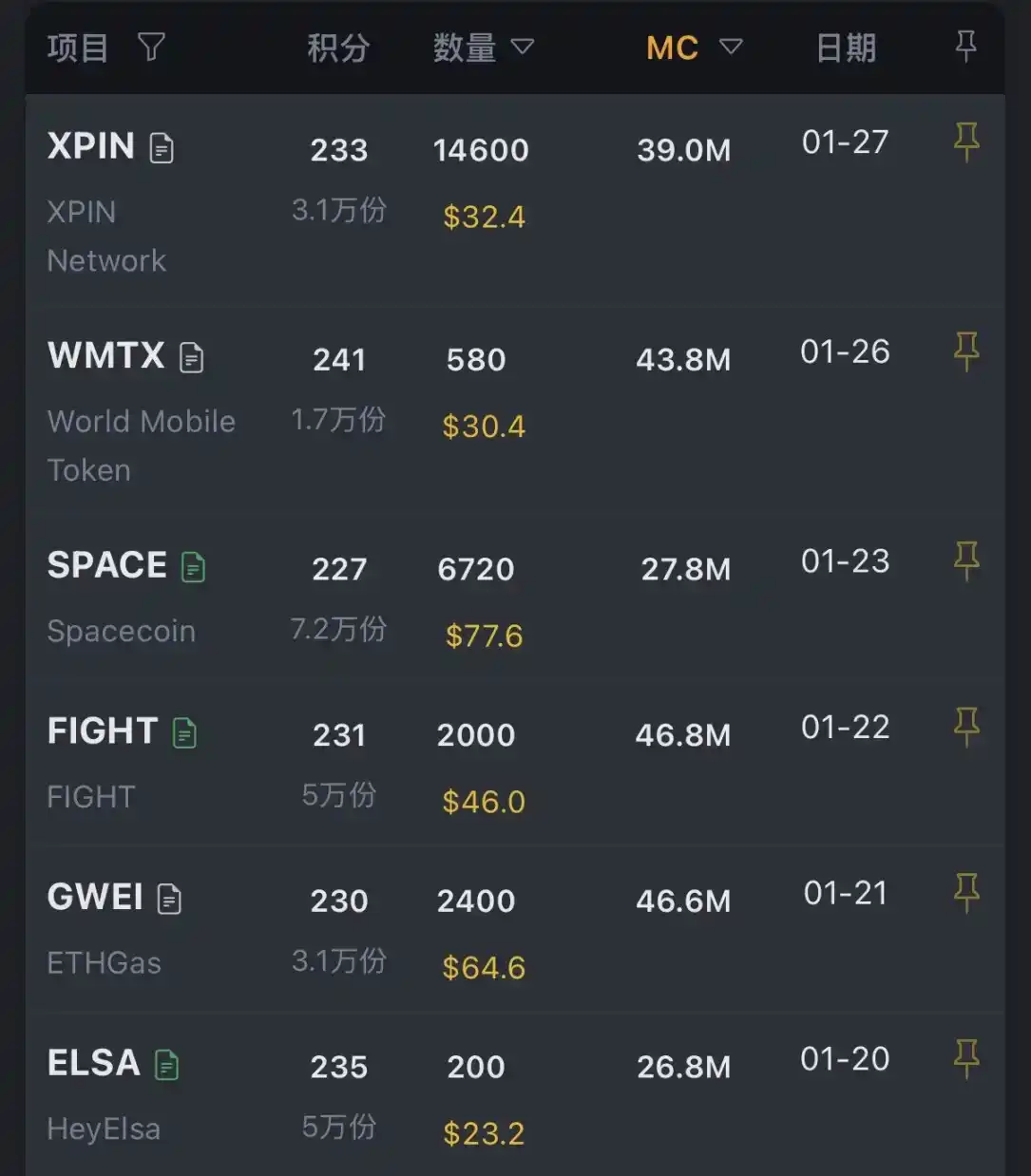
According to Alpha123 platform statistics, the current daily active users of Binance Alpha are approximately 203,000. As of January 28, a total of 18 airdrops were distributed this month, with claimable shares ranging from 13,000 to 72,000. The average number of claimable shares is about 33,000, accounting for roughly 16.2% of the average daily active users.

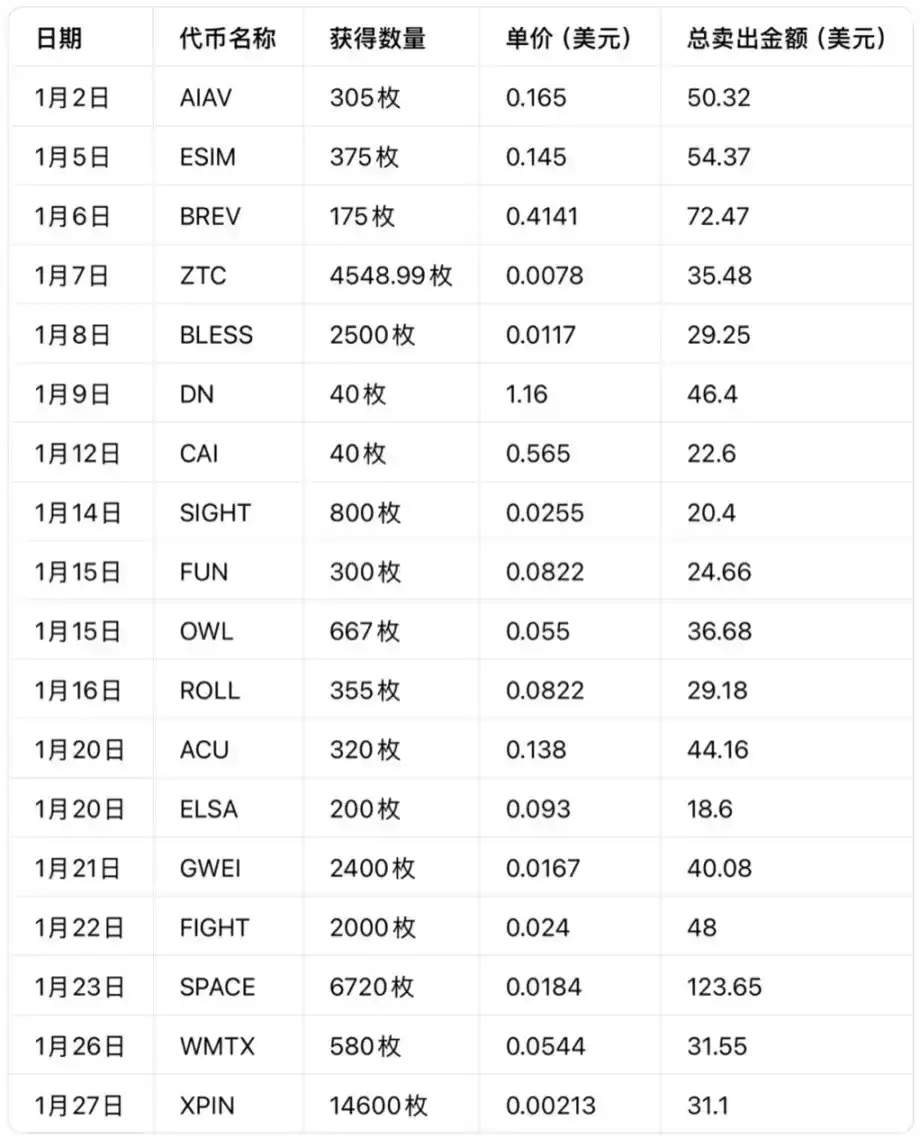
As of January 28, only one of the 18 Alpha rounds this month had a single-round return exceeding $100, which was SPACE at $123.65 (calculated based on the latest opening price 10 minutes after trading began). Meanwhile, 14 rounds had returns below $50, with the lowest round, ELSA, yielding only $18.60.

This month, the minimum Alpha points threshold was 230, while the highest reached 257 points. On January 26, the claim threshold for the Alpha token WMTX was as high as 241 points, but the single-round return was only $31.55. If a user earns 16 points per day, since Alpha points reset every 15 days, theoretically, 240 points can be accumulated in 15 days. Once the threshold exceeds 240 points, it becomes impossible to meet the requirement within a single cycle. For example, the 241 points required for WMTX mean that relying solely on stable daily point accumulation cannot meet the threshold within one cycle.

Compared to the period in mid-2025 when single-account monthly income approached $2,000, the theoretical cumulative return for the first 18 rounds this January is approximately $715.70. This figure is based on the premise that "the points threshold is met for every round, and the maximum number of rounds is successfully claimed." However, if a user earns 16 points per day, the maximum number of rounds that can actually be claimed is 5, with returns of about $261.43.

Taking SPACE, which had a return of over $100 in a previous round, as an example, the claim threshold was 227 points, and each claim required 15 points. If a user automatically earns 1 point per day through account balance, the remaining points must be obtained through trading. According to the current relationship between points and trading volume, earning 15 points requires completing approximately $32,700 in trading volume. For mainstream participants with a single trade size of about $330, this equates to completing 100 trades per day.

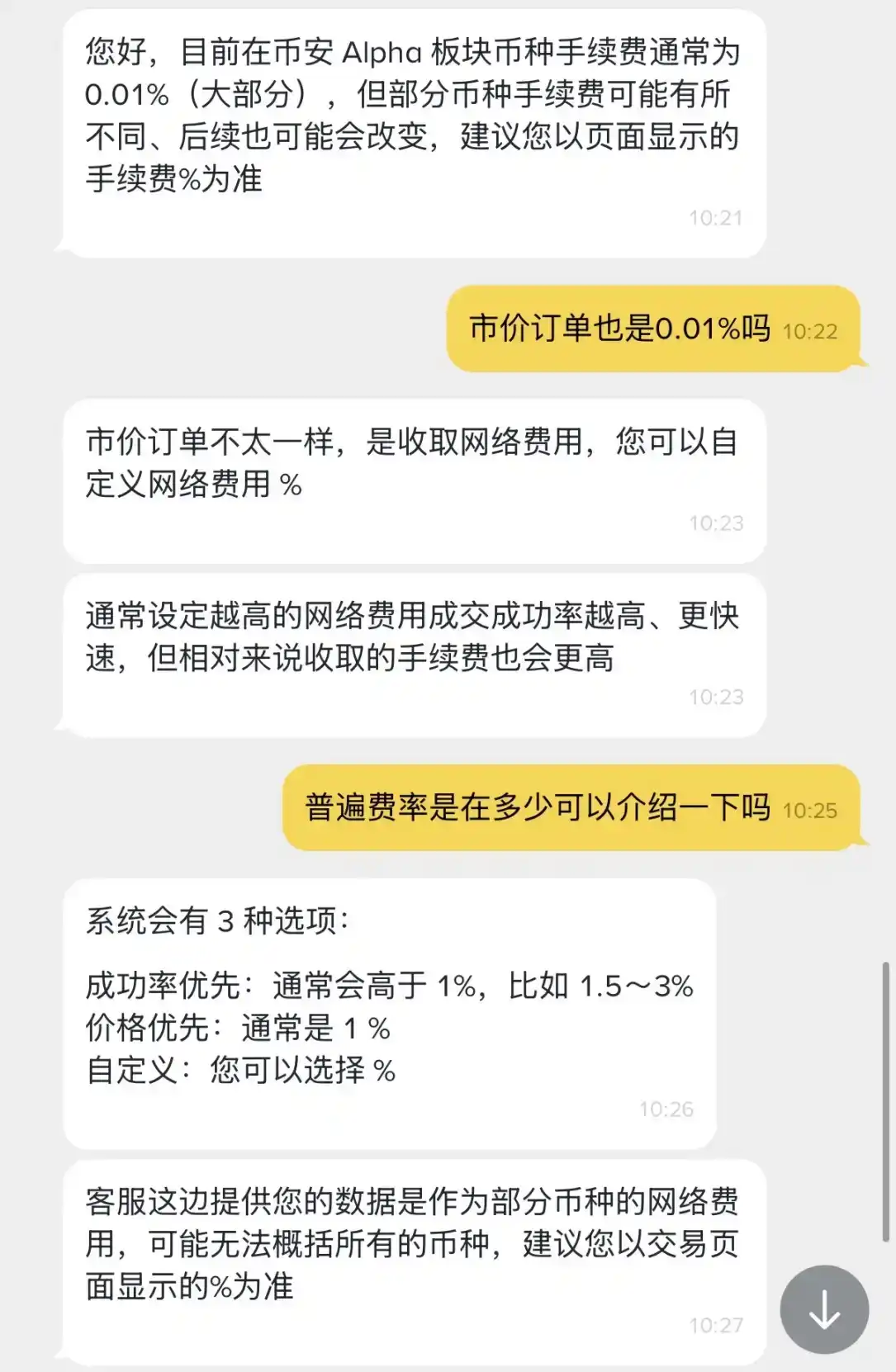
According to the author's investigation, the current limit order fee for the Binance Alpha sector is 0.01%, while the market order fee is typically 1%. If market orders are used to achieve $32,700 in trading volume, at least $327 in fees must be paid daily, excluding price slippage. If trading Alpha sector tokens in the Binance wallet, each transaction incurs a 0.01% service fee and a 0.01% trading fee, with a network fee of about $0.10 per transaction. For a daily trading volume of $32,700, approximately $17 in fees must be paid. If points are accumulated continuously for 15 days to reach 240 points, the minimum cost is $255. Additionally, claiming one Alpha round requires consuming 15 points, which equates to a cost of $17.

To reduce the pressure of the number of trades, the platform occasionally launches multiplier point events, which lower the "number of trades threshold" to some extent but simultaneously amplify price risks. Under a 4x points mechanism, theoretically, only about 25 trades of $330 each are needed daily to earn 15 points. However, such tokens typically experience more剧烈 volatility and have limited liquidity depth, meaning price slippage and short-term fluctuations can quickly erode potential returns.

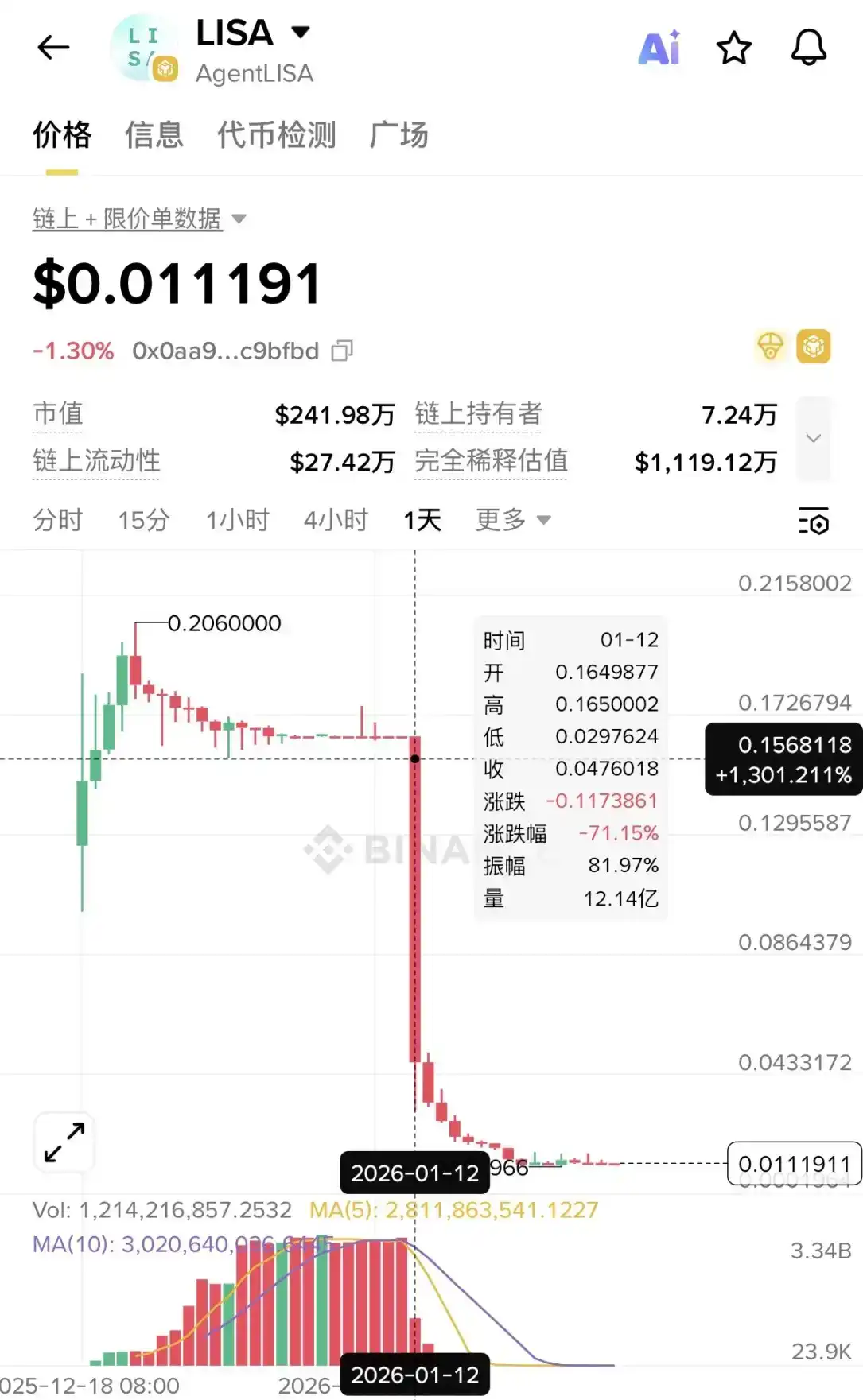
The case of LISA on January 12 became a typical example. The token attracted a large amount of刷量资金 due to its 4x Alpha points incentive, but it experienced concentrated selling within a short period, with a maximum drop of over 80% within 24 hours. The sharp price decline caused some users to incur trading losses far exceeding the airdrop value while earning points.

For users who continue to participate in Alpha, the most direct question is often not "can I still make money" but "is it worth continuing to farm."

Some early participants achieved returns far above the average on certain projects. For example, the 59.82 RIVER tokens obtained on September 19, 2025, if held until now, would be worth about $3,200 at current prices. The 644 MYX tokens obtained on May 6, 2025, are worth about $3,870 at current prices, and if sold at the historical high, the returns would exceed $11,000.

However, such "rare diamond-level big catches" are not consistently replicable. In the current environment of shrinking single-round returns, rising thresholds, and increased volatility, most rounds are closer to small,分散, and uncertain returns. Users are more likely to focus on the overall input-output ratio rather than个别极端收益案例.

The Alpha model本质上 involves exchanging real trading behavior for early token distribution opportunities from projects. Its sustainability relies on the continuous emergence of projects with market performance. When the market enters a stage of存量博弈, the number of high-quality projects is limited, while the number of participants continues to grow, naturally diluting the expected returns for individual users.

At the same time, the core purpose of Alpha in its early stages was to attract traffic for new projects, activate on-chain interactions, and increase user engagement with the Binance wallet ecosystem. During the early high-incentive phase, this goal was clearly achieved, and Alpha一度 became a significant source of user activity and trading volume.

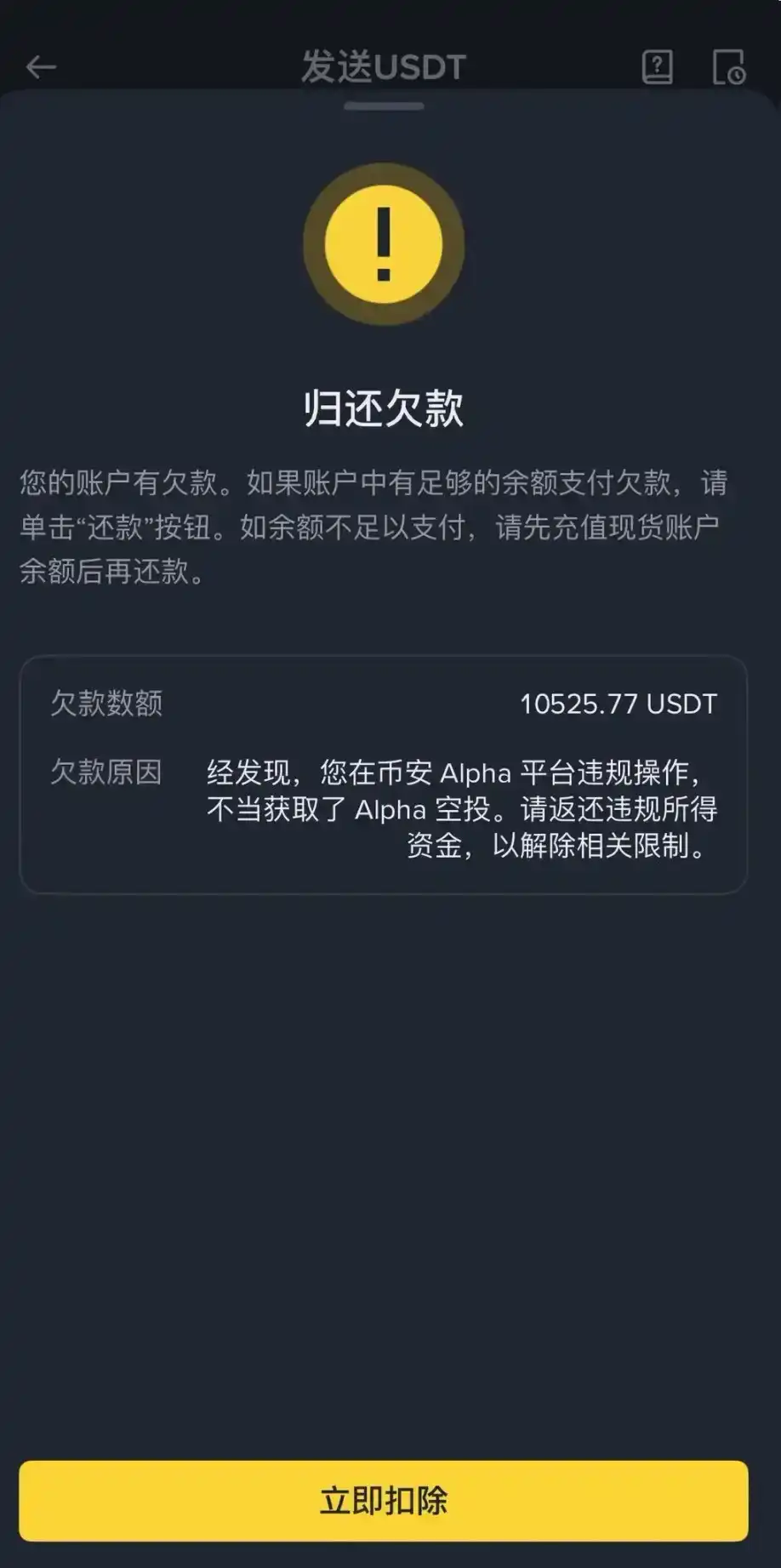
However, as刷量行为, batch operations by studios, and high-frequency gaming intensified, the incentives gradually became套利化. In November 2025, Binance imposed restrictions on some accounts identified as batch-operated by studios and required the return of related earnings. This move showed the platform's effort to压缩异常行为空间, but the community generally believes that automated tools have advantages in efficiency and cost control, putting manual普通用户 at a growing disadvantage in the points competition. Some participants反馈 that in the current environment of high points thresholds and market volatility, continued participation not only yields unstable returns but may also result in net losses due to price fluctuations of the刷量代币, leading them to reduce frequency or even withdraw.

For ordinary users, Alpha is no longer a channel where stable returns can be obtained simply through frequency. Instead, it has become more of a strategic choice requiring careful calculation of costs and risks.

Связанные с этим вопросы

QWhat is the main reason for the decline in Binance Alpha's user base according to the article?

AThe decline is attributed to decreased overall returns, higher participation thresholds, increased volatility, and the platform's crackdown on batch operations by studios, making it less profitable and more risky for ordinary users.

QHow much has the user count of Binance Alpha dropped from its peak?

AThe user count has dropped by over 60%, from nearly 500,000 in November 2025 to about 200,000 currently.

QWhat was the highest single-account monthly income during Binance Alpha's peak period in mid-2025?

ADuring the peak period in mid-2025, a single account could earn nearly $2000 per month.

QWhat challenges do users face in earning enough Alpha points to qualify for airdrops?

AUsers face challenges such as high transaction volumes required to earn points (e.g., $32,700 in trading volume for 15 points), high fees, price slippage, and increased volatility, especially during multiplier events.

QHow did Binance address the issue of batch operations by studios on Alpha?

ABinance imposed restrictions on accounts identified as batch operations by studios in November 2025 and required the return of related earnings to combat abusive practices.

Похожее

55TB to 28TB? The Rumor and Panic Behind Rubin's Memory Being Halved

Title: 55TB to 28TB? The Rumor and Panic Behind the Potential Halving of Rubin's Memory. On June 4th, a report from SemiAnalysis suggested NVIDIA's next-gen Vera Rubin NVL72 AI rack may ship with roughly 28TB of SOCAMM DRAM per rack instead of the anticipated 55TB, primarily using 96GB modules. This sparked a market panic, causing Micron's stock to drop over 10% on fears of halved memory demand. However, the article argues this panic is misguided for several key reasons. First, SOCAMM modules are socketed and upgradeable, not soldered. Lower initial configuration doesn't mean permanent demand loss. Second, the primary driver is a severe 2026 LPDDR5X supply shortage, not diminished need. NVIDIA is likely prioritizing rack shipments with available components. Third, with fixed total LPDDR5X supply, using less per rack could allow NVIDIA to ship *more* racks, not necessarily reducing overall memory orders. Micron's sharp drop was also attributed to a broader semiconductor sell-off triggered by Broadcom's earnings, with the SemiAnalysis report providing a convenient narrative for profit-taking after Micron's massive rally. In summary: the report on lower default configurations is likely accurate, but interpreting it as a demand collapse is wrong. The real risk for Micron lies in its reportedly minimal HBM4 share for Rubin, not in potentially flexible SOCAMM demand. The sell-off appears more like a correction amplified by coinciding negative catalysts.

marsbit12 мин. назад

55TB to 28TB? The Rumor and Panic Behind Rubin's Memory Being Halved

marsbit12 мин. назад

Exclusive from Yingke | Tang Wenbin's 'Yuanli Lingji' Merges with Logistics Robotics Company, and Secures Investment from Zhipu, SenseTime, Jieyue, and Others

Exclusive report: Embodied AI company "Yuanli Lingji" recently completed a new round of financing from major AI model firms including Zhipu AI, Stepfun, and SenseTime, alongside continued investments from industrial backers like Huaqin and SAIC Hengxu. Founded in March 2025 by Tang Wenbin, former co-founder and CTO of Megvii, Yuanli Lingji is a general-purpose embodied AI model company. In a notable move, the company has merged with logistics robotics firm "Atomix" (formerly known as Yuanli Juhe) through a share acquisition. Atomix, which originated from Megvii's logistics robotics business led by Tang in 2016 and was spun off in July 2024, has grown to become the world's second-largest supplier of pallet shuttle robots, with annual revenue nearing 1 billion RMB and over 500 projects globally for clients like Uniqlo and CATL. This merger aims to break the industry's "data deadlock" by combining Atomix's extensive real-world operational data from more than 20 countries with Yuanli Lingji's model training capabilities. The company's embodied AI model "DM0" utilizes a cross-domain training approach, integrating internet semantics, autonomous driving rules, and robotics data to achieve hardware-agnostic, precise manipulation even with a compact 2.4B parameter size. The collective investment from key AI players and the strategic merger signal a shift in the competitive landscape, as major model companies pivot from language tokens to physical actions ("from Token to Action"). The industry is entering a consolidation phase where hardware, AI models, data, and application scenarios converge to scale embodied intelligence, a trend mirrored by recent moves from giants like ByteDance and Skild AI.

marsbit20 мин. назад

Exclusive from Yingke | Tang Wenbin's 'Yuanli Lingji' Merges with Logistics Robotics Company, and Secures Investment from Zhipu, SenseTime, Jieyue, and Others

marsbit20 мин. назад

U.S. Stock Market Trends: Dow Hits New High, Nasdaq Falls, Whom Did Broadcom's Slap Wake Up?

U.S. Stocks Split: Dow Hits Record High as Nasdaq Slips; Broadcom's Plunge Sparks Rotation On June 4, the U.S. stock market saw a sharp divergence. The Dow Jones surged 875 points (+1.73%) to a record high of 51,561.93, while the Nasdaq Composite edged down 0.09%. The S&P 500 rose 0.41%. The primary catalyst was a sharp sell-off in AI-related chip stocks, led by Broadcom (AVGO). Despite reporting a 143% year-over-year jump in AI semiconductor revenue to $10.8 billion, the company's shares plunged about 14%. This was triggered by its maintained long-term AI revenue target, which failed to meet heightened expectations for a stock that had gained 55% this quarter and traded at a high P/E ratio. The slide dragged down the broader semiconductor sector and the technology板块. Conversely, money rotated into sectors like Healthcare (+3.14%), Financials (+2.67%), and Real Estate (+1.87%). UnitedHealth and Goldman Sachs were major contributors to the Dow's gains. The rotation was attributed to a search for value outside overheated tech names and a slight dip in Treasury yields. In other major news, SpaceX confirmed its IPO for June 12, targeting a record $75 billion raise at a ~$1.75 trillion valuation. Additionally, initial jobless claims rose to a four-month high, adding nuance to the labor market narrative ahead of the key May non-farm payrolls report. The day's action signaled that while the AI growth story remains intact, excessive valuations are prompting a market reassessment. Funds are moving, at least temporarily, from high-flying tech to more defensive and value-oriented sectors. The sustainability of this rotation hinges on upcoming economic data, particularly the jobs report, and the market's absorption of the massive SpaceX IPO.

marsbit23 мин. назад

U.S. Stock Market Trends: Dow Hits New High, Nasdaq Falls, Whom Did Broadcom's Slap Wake Up?

marsbit23 мин. назад

From 'Old Dogs' to 'New Darlings': How AI is Revaluing Old Infrastructure, from Dell to Nokia

"Old Dogs" Become AI's New Darlings: Revaluing Legacy Infrastructure The AI investment narrative is shifting. Beyond the spotlight on core chipmakers like Nvidia, a new wave of interest is rising for legacy tech companies—Dell, HPE, Nokia, Cisco, Corning, Western Digital—once labeled as slow-growth, outdated stories. This resurgence stems from AI's evolution from model development to real-world deployment, creating massive demand for physical infrastructure. As AI moves into data center construction and enterprise adoption, the focus turns to who can actually build and deliver complex systems. These established players hold decades of experience in supply chains, integration, networking, and enterprise delivery—assets now critical for scaling AI. The revaluation can be grouped into three key infrastructure areas: 1. **Servers & Integration (e.g., Dell, HPE):** They are becoming essential system integrators, transforming GPUs into full-scale AI servers with networking, power, and cooling, then delivering them to clients. Strong recent earnings and AI-specific revenue/order growth for Dell and HPE underscore this shift. 2. **Networking & Connectivity (e.g., Corning, Nokia, Cisco):** As AI clusters grow, high-speed data transfer becomes paramount. Corning benefits from fiber demand for data center links, Nokia is exploring AI-integrated wireless networks (AI-RAN), and Cisco sees surging orders for data center switches—all critical for efficient AI operations. 3. **Storage (e.g., Western Digital, Seagate):** The AI data explosion requires vast capacity. Beyond high-speed memory (HBM), there's growing need for high-capacity HDDs to store training data, logs, video, and cold/archival data cost-effectively. This revaluation, however, is not a blanket endorsement. True reassessment requires concrete proof: AI-driven orders and revenue growth, upward revisions to company guidance, and sustainable improvements in profit quality, not just top-line sales. In essence, AI is not turning all old tech firms into high-growth stocks; it is selectively re-pricing the "old assets" of companies that are mission-critical for building the new AI infrastructure, transforming their legacy capabilities into renewed growth engines.

marsbit32 мин. назад

From 'Old Dogs' to 'New Darlings': How AI is Revaluing Old Infrastructure, from Dell to Nokia

marsbit32 мин. назад

Торговля

Спот
Фьючерсы

Популярные статьи

Как купить ONE

Добро пожаловать на HTX.com! Мы сделали приобретение Harmony (ONE) простым и удобным. Следуйте нашему пошаговому руководству и отправляйтесь в свое крипто-путешествие.Шаг 1: Создайте аккаунт на HTXИспользуйте свой адрес электронной почты или номер телефона, чтобы зарегистрироваться и бесплатно создать аккаунт на HTX. Пройдите удобную регистрацию и откройте для себя весь функционал.Создать аккаунтШаг 2: Перейдите в Купить криптовалюту и выберите свой способ оплатыКредитная/Дебетовая Карта: Используйте свою карту Visa или Mastercard для мгновенной покупки Harmony (ONE).Баланс: Используйте средства с баланса вашего аккаунта HTX для простой торговли.Третьи Лица: Мы добавили популярные способы оплаты, такие как Google Pay и Apple Pay, для повышения удобства.P2P: Торгуйте напрямую с другими пользователями на HTX.Внебиржевая Торговля (OTC): Мы предлагаем индивидуальные услуги и конкурентоспособные обменные курсы для трейдеров.Шаг 3: Хранение Harmony (ONE)После приобретения вами Harmony (ONE) храните их в своем аккаунте на HTX. В качестве альтернативы вы можете отправить их куда-либо с помощью перевода в блокчейне или использовать для торговли с другими криптовалютами.Шаг 4: Торговля Harmony (ONE)С легкостью торгуйте Harmony (ONE) на спотовом рынке HTX. Просто зайдите в свой аккаунт, выберите торговую пару, совершайте сделки и следите за ними в режиме реального времени. Мы предлагаем удобный интерфейс как для начинающих, так и для опытных трейдеров.

712 просмотров всегоОпубликовано 2024.04.12Обновлено 2026.06.02

Как купить ONE

Обсуждения

Добро пожаловать в Сообщество HTX. Здесь вы сможете быть в курсе последних новостей о развитии платформы и получить доступ к профессиональной аналитической информации о рынке. Мнения пользователей о цене на ONE (ONE) представлены ниже.

活动图片