Base MCP, The Next Step for x402

marsbitОпубликовано 2026-05-28Обновлено 2026-05-28

Введение

Base has officially launched Base MCP, allowing users to connect their Base Account to AI Agents to perform actions like swaps, transfers, portfolio tracking, and transaction history queries through conversational commands. This move aligns with Base's strategic focus on AI, driven by the broader competition in the emerging Agent-to-Agent payment sector. The evolution of Agent payments has accelerated. In late 2024, the primary method involved insecure browser automation. By 2025, solutions like Coinbase's x402 (providing crypto wallets for Agents), Google's AP2, and Visa's token-based system emerged. x402 has since processed 176 million transactions totaling over $70 million, with a median value between $0.01 and $0.10. Stablecoins, particularly USDC, dominate these settlements due to their negligible transaction costs compared to traditional payment fees, which are prohibitive for micro-payments. Coinbase faces competition from Stripe, which has built a comparable infrastructure for Agent payments with its Tempo blockchain, Privy wallets, Bridge routing (acquired for $1.1B), and the recently launched MPP protocol. Both companies are now competing at the application layer. The core reason AI is central to Base's strategy is to expand the scenarios for Agent payments, ensuring more transactions occur on its network. By securing a dominant position and scale advantage in this nascent field, Coinbase aims to capture the future commercial potential of Agent-driven payments. T...

Yesterday, Base officially launched Base MCP. By connecting Base Account to AI Agent through Base MCP, you can use colloquial language, like chatting, to have the Agent perform operations such as Swap, transfers, position tracking, and transaction history queries.

Players familiar with Base know that the main focus on the Base chain right now is AI, so such an update from Base doesn't come as a surprise. Some players even anticipate new gameplay on the Base chain, similar to the AI meme coin $SHIT on Ethereum before, where they could directly use Base MCP to let an Agent participate in chain-based token launches through chat.

But if we step back from the perspective of a chain degen and look at the competition in Agent-to-Agent payments, we might find a new answer as to why AI has become the main focus for Base.

Rapidly Developing Agent Payments

Let's rewind to September 2024. Back then, if you wanted an AI Agent to complete a payment for something, humans basically had only one choice: use browser automation tools (like headless browsers such as Playwright, Selenium) to let the AI Agent simulate human actions and complete the checkout process on a webpage.

Since this required providing payment credentials (like full credit/debit card numbers, CVV, expiration dates, etc.) to the AI Agent, this sole option was not secure.

By May 2025, Coinbase launched x402, providing an AI Agent with a crypto wallet and solving this problem in a crypto-native way. But Coinbase wasn't the only one to recognize this as a potential market, and the solutions weren't limited to just crypto-native ones. In 2025, Google launched AP2, allowing users to authorize spending permissions to an Agent. Visa expanded its existing card payment channels, launching Visa Intelligent Commerce, which doesn't give the Agent sensitive information like credit card numbers or CVV, but instead provides the Agent with specific, limited tokens to complete payments.

Today, x402 has processed 176 million transactions from AI Agents, with a total transaction volume exceeding $70 million. This amount might not seem huge, but neither Coinbase nor the traditional giants are taking this emerging payment competition lightly:

- On January 22, 2026, Capital One, the sixth-largest bank in the US with $470 billion in assets, $330 billion in deposits, and the third-largest credit card issuer in the nation, announced the acquisition of Brex for $5.15 billion to enhance AI payment capabilities.

- In March 2026, Mastercard acquired the stablecoin infrastructure company BVNK for $1.8 billion.

- In February 2025, Stripe acquired the stablecoin payment platform Bridge for $1.1 billion.

While they haven't explicitly stated it, acquiring stablecoin-related companies is likely a move to prepare for the upcoming era of Agent payments. Stablecoins are indeed crucial for Agent payments.

Why Are Stablecoins Important for Agent Payments?

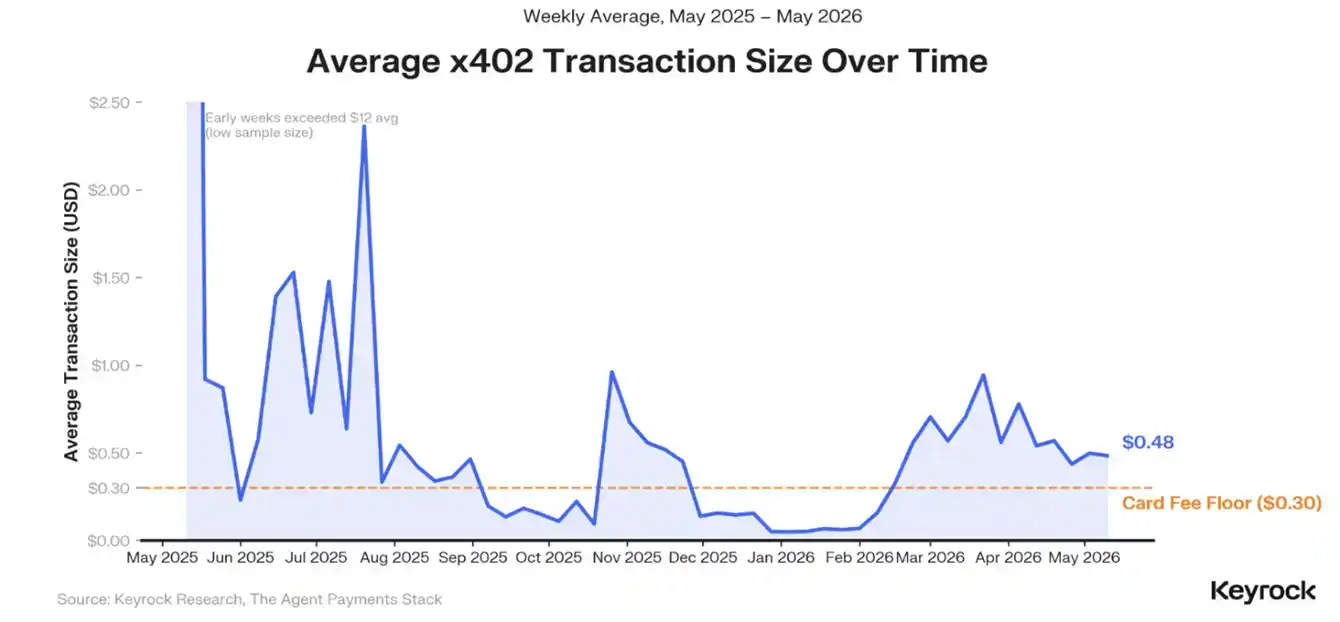
According to data statistics from Keyrock, the median transaction amount for Agent transactions processed on x402 so far is between $0.01 and $0.10, with 76% of transactions being under $0.30.

$0.30 is the most common flat fee per transaction in the US and many major markets. This fee is like a wall, making micropayments under $1 very uneconomical. For example, for a 3-cent API call, a $0.30 fee is 10 times the call cost; if an Agent pays with a credit card, the cumulative cost would be prohibitively high.

Blockchain solves this problem well. On Base, the transaction settlement cost is $0.0001. With this immense advantage, stablecoins have almost naturally won the competition against traditional payment giants in the realm of Agent payments.

Of the 176 million Agent transactions processed by x402, 98.6% were settled in USDC. Given the close relationship between Coinbase and Circle, it's fair to say Coinbase is also a big winner at the settlement layer.

But the settlement layer is just one layer in Agent payments. In the track of solving Agent payments via crypto-native means, Coinbase has a competitor—Stripe.

The Challenge from Stripe

This March, Stripe launched the Agent Payment Protocol MPP, which has brought Stripe's architecture map for Agent payments almost on par with Coinbase's.

- From the settlement layer: Coinbase has Base, Stripe has Tempo.

- From the wallet layer: Coinbase has Agent Wallet, Stripe has Privy.

- From the routing layer: Coinbase has built-in routing facilities, Stripe has Bridge, acquired for $1.1 billion.

- From the payment protocol: Coinbase has x402, Stripe has MPP.

Now let's return to the Base MCP mentioned at the beginning of the article. Since both competing sides now have these four layers of supporting infrastructure, the next battlefront is naturally the application layer.

This is the core reason why AI can become Base's main focus—Base needs to ensure that AI (at least in the cryptocurrency space) happens on Base. This is not actually about providing a perspective for degens on the Base chain, but about broadening the scenarios for Agent payments, enabling more Agents to conduct more transactions for more applications, thereby securing its leading position in the Agent payment track.

Once a dominant scale advantage is established, when Agent payments enter the commercial domain in the future, Coinbase stands to win even bigger.

Looking at the launch of Base MCP from this angle, one can sense that this is just a small step in Coinbase's grand ambition.

Связанные с этим вопросы

QWhat is Base MCP and what key functionality does it enable for AI Agents?

ABase MCP is a protocol recently launched by Base. It allows users to connect their Base Account to an AI Agent. Once connected, users can use natural, conversational language to instruct the Agent to perform actions such as executing token swaps, making transfers, tracking portfolio positions, and querying transaction history.

QAccording to the article, why are stablecoins considered crucial for Agent payments?

AStablecoins are crucial for Agent payments because they enable micro-transactions economically. Traditional payment methods often have fixed fees around $0.30 per transaction, which makes small payments (e.g., a few cents for an API call) prohibitively expensive. In contrast, settlement costs on Base are around $0.0001, allowing stablecoins like USDC to facilitate vast numbers of small-value transactions efficiently, as evidenced by 98.6% of x402 transactions being settled in USDC.

QHow does the article contrast Coinbase's and Stripe's approaches to the Agent payment infrastructure?

AThe article contrasts their approaches by outlining the similar four-layer infrastructure both companies have built: Settlement Layer (Coinbase has Base, Stripe has Tempo), Wallet Layer (Coinbase has Agent Wallet, Stripe has Privy), Routing Layer (Coinbase has internal routing, Stripe acquired Bridge), and Payment Protocol Layer (Coinbase has x402, Stripe has MPP). This positions them as direct competitors in the Agent payment space.

QWhat strategic reason does the article suggest is behind Base making AI its main narrative?

AThe article suggests that Base's strategic focus on AI is not primarily for on-chain 'degen' activities but to expand the scenarios for Agent payments. By ensuring more AI activity (at least in the crypto space) happens on Base, Coinbase aims to generate more Agent-driven transactions across more applications. This builds a dominant scale advantage, securing Coinbase's leading position in the emerging Agent payment competition for future commercial applications.

QWhat does the median transaction amount on x402 indicate about the nature of Agent payments?

AThe median transaction amount on x402 falls between $0.01 and $0.10, with 76% of transactions being under $0.30. This data indicates that Agent payments are predominantly micro-transactions, involving very small sums of money per transaction.

Похожее

End of the 'Gray Era' for Hong Kong and US Stock Trading Accounts: Where Can Your Money Go Now?

Hong Kong and US stock “grey account opening era” ends, where can your money go? In a coordinated regulatory crackdown starting May 22nd, Hong Kong's SFC and China's securities regulator have targeted the previously common but legally ambiguous practice of mainland Chinese investors opening accounts with Hong Kong brokers to trade Hong Kong and US stocks. The SFC issued a stern circular after a review of 12 brokerages, citing major deficiencies including inadequate due diligence, acceptance of suspicious or forged documents, and weak management of cross-border relationships. New requirements mandate mainland clients to submit a written declaration confirming their investment funds originate from *outside* mainland China, the account has never been closed for using suspicious documents, and agreeing to information disclosure. Brokers must immediately close accounts opened with suspicious documents and dormant accounts. Simultaneously, Chinese authorities launched a two-year campaign to rectify illegal cross-border securities activities. Key internet brokers like Futu, Tiger Brokers, and Longbridge are facing penalties, with existing accounts allowed only to sell/withdraw funds, not add new ones. The impact is immediate. Reports from social media and financial news outlets confirm that individuals traveling to Hong Kong to open accounts are now required to sign the new declaration. However, even after signing, applications are frequently rejected. The declaration shifts compliance responsibility to the client and acts as a filter, as most mainland investors' funds do not legally meet the "from outside China" criterion. Major brokers like Futu and Tiger have stopped accepting new mainland clients. A few, such as uSmart Securities, Fosun Wealth, and Cheerful Investment, still offer limited channels, but approvals have tightened significantly. Crucially, funding must now come exclusively from the investor's own bank account in Hong Kong or a qualified jurisdiction, blocking previous workarounds like using money changers or stablecoins. For mainland investors, compliant pathways still exist but are narrower. Individuals with overseas status (students, work visa holders) and verifiable offshore funds may still qualify. Official channels like Stock Connect, QDII, and the Cross-boundary Wealth Management Connect remain fully compliant options, albeit with product and quota limitations. On-chain alternatives exist but carry their own regulatory uncertainties and often exclude mainland users. The crackdown signals the end of the lax expansion period for Hong Kong brokers targeting mainland clients. While investment opportunities persist, the era of easy, low-compliance access is over. Investors must now carefully assess their eligibility and understand that signing the new declaration carries personal legal liability.

Odaily星球日报17 мин. назад

End of the 'Gray Era' for Hong Kong and US Stock Trading Accounts: Where Can Your Money Go Now?

Odaily星球日报17 мин. назад

SpaceX's $1.75 Trillion IPO: A Quick Guide to 17 Related Stocks

**Title: SpaceX's $1.75 Trillion IPO: Analysis of 17 Related Stocks** SpaceX is set to IPO on Nasdaq with a $1.75 trillion valuation. The real value driver is Starlink, contributing 61% of Q1 revenue with high margins. Its valuation heavily depends on future execution, including user growth despite falling ARPU. Key stocks have already surged pre-IPO. Tesla (TSLA, +10%) is a primary beneficiary due to deep integration with SpaceX in chip design and AI. Rocket Lab (RKLB, +89%) is seen as a "mini-SpaceX," but faces risk from potential Neutron rocket delays. AST SpaceMobile (ASTS) competes in the same satellite-to-phone market as Starlink. Firefly (FLY, +70%) is a strong government contractor in lunar services. Partners like EchoStar (SATS), Planet Labs (PL), and T-Mobile (TMUS) will see revaluation. Suppliers like Qualcomm (QCOM, +57%) are critical ecosystem "picks and shovels." Investment vehicles like DXYZ (+80%) hold significant SpaceX stakes but trade at high premiums, which may collapse post-IPO. Redwire (RDW) is highlighted as an under-the-radar "pick and shovel" play in space components, with growth in defense contracts and microgravity pharmaceuticals. The article warns that much of the positive news is already priced in, and a post-IPO sell-off is possible. Large IPOs often underperform initially. Key risks include Starship delays, ARPU decline, and unforeseen black swan events affecting Elon Musk or space operations. Investors are advised to focus on companies with solid fundamentals and manage overall sector exposure carefully.

marsbit19 мин. назад

SpaceX's $1.75 Trillion IPO: A Quick Guide to 17 Related Stocks

marsbit19 мин. назад

Conversation with VanEck CEO: Memory Chip Stocks Are a Bubble, Bitcoin Will Stay but Token Ecosystems Will Disappear

In this podcast, VanEck CEO Jan van Eck discusses his investment outlook centered on three key long-term ("10-year macro") themes: AI-driven compute demand, India's economic rise, and excessive government debt in developed nations. Regarding AI and semiconductors, van Eck believes Nvidia has transformed into a foundational "host" for AI infrastructure, possessing deep moats in software, scale, and power efficiency, making it a core holding. However, he views the recent surge in memory chip stocks as a bubble driven by temporary supply-demand imbalances and pricing power, lacking Nvidia's competitive durability. On asset management, he emphasizes that while ETFs are scale-driven tools, the decisions on which ETFs to own and how to allocate remain highly active. He expresses greatest concern over fixed-income market illiquidity and the risk of a loss of confidence in government debt sustainability. Van Eck is bullish on gold's long-term role as a global monetary alternative and highlights the dramatic policy-driven growth in nuclear energy investment. He is strongly positive on India due to its demographic trends and pro-business reforms. Discussing crypto, he labels 2026 the "year of the corporate-controlled chain," where traditional finance adopts blockchain's best features (like 24/7 operation and programmability) but retains control. He predicts a permanent "crypto winter" for many projects, with only Bitcoin, stablecoins, and the core blockchain concept surviving long-term. He sees the U.S. stablecoin bill as marginally impactful, enabling tech firms to compete with, but not replace, banks. Finally, he views the upcoming SpaceX IPO as a significant, positive liquidity event for markets and advises investors to maintain a long-term, macro perspective when making asset allocation decisions.

marsbit30 мин. назад

Conversation with VanEck CEO: Memory Chip Stocks Are a Bubble, Bitcoin Will Stay but Token Ecosystems Will Disappear

marsbit30 мин. назад

In the Era of Agent Users, Where Does Crypto Value Flow?

Title: Who Makes Money from Agents? The rise of AI Agents as potential blockchain users raises a crucial question: if they become the next billion users, who will capture the value? Traditional crypto value capture theories—like "fat protocols" (where value accrues to the base layer) and "fat applications" (where value accrues to user-facing apps)—assume human users who value UX, brand, and convenience. Agents, however, operate differently: they interact via APIs, have no brand loyalty, and can switch services with near-zero cost. This shift could disrupt existing value flows. Applications might become "headless," offering their routing and infrastructure as APIs to Agents. Alternatively, Agents might bypass intermediaries entirely, allowing protocols to regain value capture ("fat protocols" reborn). A more extreme scenario is that Agents, being purely rational and cost-sensitive, could commoditize the entire stack, compressing margins toward marginal cost and turning crypto into a low-margin utility. However, Agents may not just amplify existing activities; they could enable entirely new ones—like continuous, sub-penny portfolio rebalancing, machine-to-machine commerce, and new market types only viable at automated speeds. This expands the economic pie rather than just redistributing it. Ultimately, the key question for builders is: what will make an Agent return to your service instead of a cheaper alternative? The answer may not be UX but factors like liquidity, latency, settlement guarantees, or a yet-unnamed business model. As humans and Agents will coexist as users, value capture may split: "fat apps" for human-facing services, and a new, evolving model for the Agent-dominated layer.

marsbit1 ч. назад

In the Era of Agent Users, Where Does Crypto Value Flow?

marsbit1 ч. назад

Торговля

Спот
Фьючерсы
活动图片