Attack on MM 2: Market Maker Order Book and Order Flow

深潮Опубликовано 2025-12-28Обновлено 2025-12-28

Введение

"Attack of the MM 2: Market Maker Order Books and Order Flow" by Dave explores the dynamics of market making in crypto, focusing on the Limit Order Book (LOB) and order flow. The LOB is the market maker's battlefield, defined by depth, tick size, and the concept of price improvement—providing better prices than the current best bid/ask to create market value. Market makers profit from the bid-ask spread, which covers order processing costs, inventory risk (holding assets amid price fluctuations), and adverse selection risk (being exploited by informed "toxic" traders). The spread types include quoted, effective, and realized spread, with the latter factoring in future mid-prices to measure true profitability. Order flow involves managing incoming trades, with a focus on identifying "toxic flow" from informed traders who can cause losses. Market makers use metrics like VPIN (Volume-weighted Probability of Informed Trading) to detect one-sided pressure and respond by pulling quotes, widening spreads, or reducing order sizes to mitigate risk. The article hints at deeper institutional strategies in future installments.

Author: Dave

Why do I always have bad luck shortly after buying altcoins? Why couldn't the seemingly invincible market makers handle the sell orders on 10/11?

Why did every market maker I talked to after 10/11 casually say they didn't lose much / even made money that day? This article will introduce you to the market maker's order book and order flow.

1. Limit Order Book (LOB)

The market maker's battlefield is not the candlestick chart, but the LOB.

Core concepts:

  • Depth: The volume of orders at each price level.

  • Tick Size: The minimum unit of price movement. In a high-frequency environment, tick size is crucial for queuing strategies.

  • Price Improvement: When you provide a price better than the current National Best Bid and Offer (NBBO), you create value for the market.

For example, if the current BTC bid is 100k and the ask is 110k, if you offer a price of 101k, you narrow the spread and create value for the market.

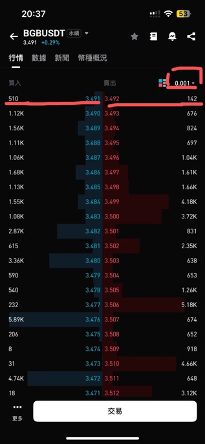
While writing this article, I was thinking about how to explain this section to you all. Later, I felt that nothing would be clearer than showing a real order book. Let me do a little promotion for a friend at BG. Using BGB as an example:

The above is the BGB order book at the minimum tick size. We see the minimum is 0.001. The current depth is only a little over $1000, the spread is controlled to be very small, hitting the minimum tick size. Simultaneously, the depth is distributed in a "Christmas tree" shape—the further from the spread, the larger the order size. However, when we increase the tick size a bit, we find that the depth should be distributed in a horn shape: the closer to the spread, the larger the order size and the more liquidity; the further away, the fewer the orders (one of the reasons for the liquidity vacuum on 10/11).

Speaking of Christmas trees, this article's scheduled release time is 12.24, Christmas Eve. Merry Christmas to everyone!

2. Market Maker Profit Source: Spread

The spread is not just profit; it is primarily composed of three costs:

  1. Order Processing Cost: Exchange fees, hardware latency, manpower.

  2. Inventory Risk: The risk of price moving against you while holding a position, which we covered in the previous episode.

  3. Adverse Selection Cost: This is the core—when you trade, the counterparty might have information you don't. This means you might get tricked by an insider.

  4. There are also three types of spreads: Quoted Spread, Effective Spread, and Realized Spread. The Quoted Spread is the easiest to understand: the ask-bid difference. The Realized Spread measures the actual profit the market maker keeps after price adjustments: 2 x (P_trade – P_futuremid), which includes the future mid-price, somewhat like considering opportunity cost.

3. Order Flow

Order flow is the stream of orders received by the market maker. This is a deep topic. Market makers perform various operations on order flow, such as hedging, matching, adjusting quotes, etc., in order to manage their book (ledger?). This involves many professional concepts and operational techniques, and can even involve legal issues, such as agency trades not being able to be counterparties to principal trades due to conflict of interest. This article will only introduce the concepts of Order Flow Toxicity and VPIN. If any MM boss hires me, I'll update my followers on professional order flow management.

Toxic Flow refers to orders from informed traders who know the price is about to move, thus causing realized spread losses because they know P_futuremid through insider information. So, as market makers, we also need to be careful not to be tricked by toxic insiders.

Noise/Retail Flow comes from retail investors or funds passively adjusting their weights. This is the market maker's favorite "food".

To protect themselves, market makers' anti-toxicity mechanisms adjust quotes. A simple way to prevent "toxicity" is to assume all aggressive orders are toxic. Assuming a buy order, the MM immediately lowers the reservation price, shifting the entire quote down. This also answers the question left in the previous chapter: why do we always buy at the high? Because market makers adjust their quotes for risk control. But the smart you will surely ask another question: what if an insider buys a large amount? What if they rely on their information advantage and stubbornly impact the spread head-on? Yes, this might be what happened on 10/11, and it's also the reason why a large MM with billions in assets couldn't hold the line.

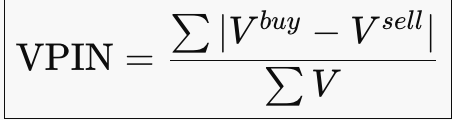
Core metric: VPIN (Volume-weighted Probability of Informed Trading).

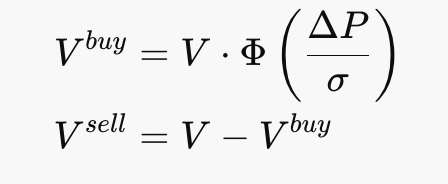
VPIN ≈ The probability that the market maker is currently being "continuously hit by one-sided flow" in the market. When significant one-sided pressure appears, MM inventory accumulates one-sidedly, and the mean reversion assumption fails. At this time, the MM will pull quotes (withdraw orders), temporarily stopping providing liquidity to wait for the order flow to return to symmetry. But what if the order flow doesn't return to symmetry? Or if the order flow deviation is too extreme and directly causes a blow-up? This is the 10/11 disaster. I'm thinking about doing an episode on how exchanges made money on 10/11. We'll see.

Back on topic, after a VPIN anomaly, MMs will pull quotes (withdraw orders) or widen the spread (to earn more service fees to compensate for price losses), and also reduce size to control the speed of inventory accumulation.

This episode is the end of the first part of our market maker story. From a retail perspective, the truth behind the legendary market manipulation by "whales" has been revealed. Next, I will introduce some more "institutional" topics from the MM's perspective. Hold on tight.

Anime episodes often end with a preview for the next episode, so let's do one for this article: If we entered the world of Jujutsu Kaisen, and order flow is "cursed energy," and quote operations are "cursed techniques," then in the next part, we will look at the "Domain Expansion" in market making.

To find out what happens next, stay tuned for the next episode.

Связанные с этим вопросы

QWhat is the three main components that constitute the bid-ask spread for a market maker?

AThe bid-ask spread is primarily composed of three costs: Order Processing costs (exchange fees, hardware latency, manpower), Inventory Risk (the risk of holding a position while the price moves against you), and Adverse Selection cost (the risk of trading against an informed, or 'toxic', trader who has superior information).

QWhat is 'Order Flow Toxicity' and how do market makers typically protect themselves from it?

A'Order Flow Toxicity' refers to orders coming from informed traders who know the price is about to move, causing losses for the market maker. To protect themselves, market makers employ anti-toxicity mechanisms such as adjusting their reservation price (e.g., lowering quotes after a buy order), pulling their quotes (withdrawing liquidity), widening the spread, or reducing order size to control inventory accumulation.

QWhat does the VPIN metric measure and what action does a high VPIN value trigger for a market maker?

AVPIN (Volume-weighted Probability of Informed Trading) approximates the probability that a market maker is being hit by persistent one-sided order flow from informed traders. A high or abnormal VPIN value triggers risk management actions such as pulling quotes (withdrawing liquidity temporarily), widening the bid-ask spread, or reducing order size to manage the speed of inventory accumulation.

QAccording to the article, what is the key difference between 'Quoted Spread' and 'Realized Spread'?

AThe Quoted Spread is the simple difference between the best ask and bid prices (ask - bid). The Realized Spread is a more advanced metric that measures the profit a market maker actually keeps after price adjustments, calculated as 2 x (P_trade – P_futuremid), and it incorporates the future mid-price, resembling an opportunity cost.

QIn the context of a Limit Order Book (LOB), what is 'Price Improvement' and how is it created?

A'Price Improvement' occurs when a market participant provides a price that is better than the current best available price (the NBBO - National Best Bid and Offer). For example, if the best bid is 100,000 and the best ask is 110,000, a trader who places a bid at 101,000 provides price improvement by narrowing the spread, thus creating value for the market.

Похожее

Should You Buy SpaceX Stock at $1.7 Trillion? Here's What the Market Is Worried About

SpaceX is preparing for a massive IPO aiming to raise around $75 billion at a valuation of approximately $1.75 trillion. While its achievements in reusable rockets and the profitable Starlink satellite internet service are clear, the market is concerned about the aggressive valuation. Key issues include: the current $1.75 trillion valuation, which is about 94 times 2025 revenue, seems to price in not just existing businesses but also unproven future ventures like AI infrastructure and orbital data centers. Financially, while Starlink is profitable, the AI division, bolstered by the acquisition of xAI, is incurring massive losses and consuming the majority of capital expenditures. This acquisition also introduced complex related-party financing arrangements and debt onto SpaceX's balance sheet. Furthermore, corporate governance poses a challenge. SpaceX's dual-class share structure ensures founder Elon Musk retains absolute control, limiting ordinary shareholders' influence over high-risk, long-term strategic decisions. The future success of ambitious projects like the Starship rocket—critical for lowering costs and enabling new services—remains a significant variable for the valuation. In summary, the market's apprehension (FUD) centers not on doubting SpaceX's past technological triumphs but on questioning how much premium public investors should pay for a future that combines proven profits with highly speculative and capital-intensive new ventures, all under a governance structure that offers limited shareholder oversight.

marsbit40 мин. назад

Should You Buy SpaceX Stock at $1.7 Trillion? Here's What the Market Is Worried About

marsbit40 мин. назад

Breaking the DeFi Cascading Liquidation Curse: Vitalik Proposes a New Solution

Vitalik Buterin has proposed a new DeFi design to eliminate the automatic liquidation mechanism that causes market instability during sharp downturns. The current system, used by protocols like Aave, triggers forced sales when collateral value falls below a threshold, often exacerbating price drops and creating systemic selling pressure. Buterin's alternative model is based on splitting an asset like ETH into two synthetic option-like tokens, P and N, pegged to a price index. Their combined value always equals one ETH. Instead of sudden liquidation, a position's value gradually drifts from its target peg if the market moves. Users must proactively rebalance their holdings to maintain their desired exposure, transferring the management burden from the protocol to the user or automated tools. A key advantage is the reduced reliance on real-time oracles. Pricing decisions are deferred until contract expiry, allowing for more robust, fault-tolerant oracle designs. This removes a clear liquidation threshold that speculators can target for manipulation or MEV extraction. However, significant challenges remain. Frequent rebalancing could incur high slippage and transaction costs, necessitating new liquidity provider models. The design is better suited for hedging instruments than for stablecoins requiring a rigid 1:1 peg. While not an immediate replacement for existing systems, the proposal challenges the foundational assumption that instantaneous forced liquidation is an unavoidable necessity in DeFi, opening the door for fundamentally different risk management architectures.

marsbit44 мин. назад

Breaking the DeFi Cascading Liquidation Curse: Vitalik Proposes a New Solution

marsbit44 мин. назад

The End of Single-Factor Cryptography

The article "The End of Single-Factor Crypto" posits a fundamental shift in the cryptocurrency ecosystem. It argues the era where crypto asset valuations were predominantly driven by, and correlated with, Bitcoin's price is ending. The space is bifurcating into two distinct economies: endogenous and exogenous. The endogenous economy represents traditional crypto, where token and project values are directly tied to crypto market prices. The emerging exogenous economy comprises projects and businesses that may utilize blockchain technology or tokens but derive their fundamental value from external, non-crypto factors like consumer demand, subscription revenue, or real-world utility. Examples include AI inference platforms like Venice, fintech lenders using blockchain for efficiency, and stablecoin/payment infrastructure companies acquired by giants like Mastercard and Stripe. This shift means investment analysis must change. For exogenous assets, evaluating traditional business fundamentals—such as revenue streams, unit economics, and competitive moats—becomes more critical than tracking Bitcoin charts. While endogenous assets like Bitcoin remain relevant, the growth of the exogenous category is driven by measurable demand independent of crypto price cycles, paving the way for a new, more diversified market phase. Consequently, crypto is evolving from a single-factor, reflexive asset class into a multifaceted ecosystem with varied drivers and investment theses.

marsbit45 мин. назад

The End of Single-Factor Cryptography

marsbit45 мин. назад

Morning Post | Bitmine Plans to Raise $300 Million Through Preferred Stock Issuance; Polymarket Accuses Kalshi of Commercial Espionage

ChainCatcher's Daily Crypto Brief: Key developments from the past 24 hours include significant funding moves, regulatory actions, and market predictions. Bitmine announced a $300 million preferred stock fundraising. Polymarket accused rival prediction platform Kalshi of corporate espionage, citing numerous suspicious coincidences in product launches, a claim Kalshi strongly denied. The U.S. Department of Justice, in a joint "Disruption Week" anti-fraud operation with companies like Coinbase and Meta, froze over $3.8 million in cryptocurrency linked to scams. In infrastructure news, Macau completed its integration with the multi-central bank digital currency bridge, mBridge, aiming to build efficient cross-border payment channels. Cosmos Labs acquired the block explorer Mintscan. Market-wise, Geoffrey Kendrick, Standard Chartered's Head of Digital Assets Research, stated Bitcoin is nearing a bottom around $63,000, maintaining a year-end target of $100,000. He noted stability in U.S. spot Bitcoin ETF holdings. Ahead of SpaceX's anticipated IPO, internal insiders at Rocket Lab (RKLB) sold over $18.41 million in stock. In tokenization, Goldman Sachs partnered with Apex and Archax to launch a tokenized real estate fund. The meme token tracker GMGN reported the top trending tokens: on Ethereum, HEX, SHIB, LINK, PEPE, mUSD; on Solana, TROLL, swarms, WORLDCUP, neet, Buttcoin; and on Base, PEPE, toby, ODDS, ELSA, SKI.

链捕手59 мин. назад

Morning Post | Bitmine Plans to Raise $300 Million Through Preferred Stock Issuance; Polymarket Accuses Kalshi of Commercial Espionage

链捕手59 мин. назад

Торговля

Спот
Фьючерсы

Популярные статьи

Как купить FLOW

Добро пожаловать на HTX.com! Мы сделали приобретение Flow (FLOW) простым и удобным. Следуйте нашему пошаговому руководству и отправляйтесь в свое крипто-путешествие.Шаг 1: Создайте аккаунт на HTXИспользуйте свой адрес электронной почты или номер телефона, чтобы зарегистрироваться и бесплатно создать аккаунт на HTX. Пройдите удобную регистрацию и откройте для себя весь функционал.Создать аккаунтШаг 2: Перейдите в Купить криптовалюту и выберите свой способ оплатыКредитная/Дебетовая Карта: Используйте свою карту Visa или Mastercard для мгновенной покупки Flow (FLOW).Баланс: Используйте средства с баланса вашего аккаунта HTX для простой торговли.Третьи Лица: Мы добавили популярные способы оплаты, такие как Google Pay и Apple Pay, для повышения удобства.P2P: Торгуйте напрямую с другими пользователями на HTX.Внебиржевая Торговля (OTC): Мы предлагаем индивидуальные услуги и конкурентоспособные обменные курсы для трейдеров.Шаг 3: Хранение Flow (FLOW)После приобретения вами Flow (FLOW) храните их в своем аккаунте на HTX. В качестве альтернативы вы можете отправить их куда-либо с помощью перевода в блокчейне или использовать для торговли с другими криптовалютами.Шаг 4: Торговля Flow (FLOW)С легкостью торгуйте Flow (FLOW) на спотовом рынке HTX. Просто зайдите в свой аккаунт, выберите торговую пару, совершайте сделки и следите за ними в режиме реального времени. Мы предлагаем удобный интерфейс как для начинающих, так и для опытных трейдеров.

506 просмотров всегоОпубликовано 2024.03.29Обновлено 2026.06.02

Как купить FLOW

Обсуждения

Добро пожаловать в Сообщество HTX. Здесь вы сможете быть в курсе последних новостей о развитии платформы и получить доступ к профессиональной аналитической информации о рынке. Мнения пользователей о цене на FLOW (FLOW) представлены ниже.

活动图片