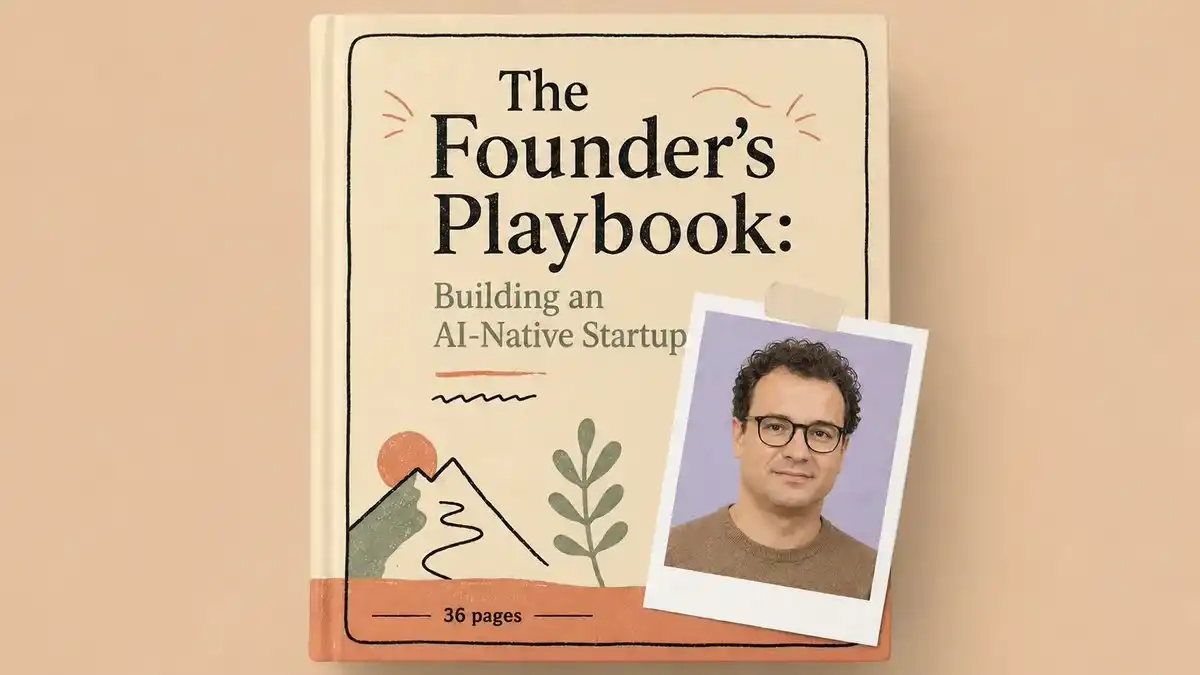
Anthropic Major Release: "The Founder's Playbook" - All 4 Stages of Entrepreneurship, Completely Reimagined with AI

marsbitОпубликовано 2026-05-22Обновлено 2026-05-22

Введение

**Anthropic Releases "The Founder's Playbook," Reimagining the Four Stages of Startups with AI** The logic of entrepreneurship is being fundamentally reshaped by AI. Anthropic's new handbook, "The Founder's Playbook: Building an AI-Native Startup," defines the AI-native startup as a new species: not a traditional company with AI tools, but a venture driven by AI from day one. The founder's role is transforming from a hands-on builder to a conductor or architect, orchestrating AI agents for execution while focusing on high-level judgment and strategy. Anthropic outlines a product matrix of Claude tools for different tasks: Claude Chat for interactive research, Claude Code for generating production-ready code, and Claude Cowork for automating knowledge-intensive workflows. The handbook structures the startup lifecycle into four stages, detailing core goals, pitfalls, and AI applications for each: 1. **Idea Stage**: Focuses on validating a real problem. The core challenge is avoiding confirmation bias. AI practices include using Claude as a "structured devil's advocate" to challenge assumptions and for automated market/competitor research. 2. **MVP Stage**: Aims to gather early signals of Product-Market Fit (PMF). Key risks are technical debt and scope creep due to rapid AI-assisted development. Recommended AI uses include maintaining project memory documents (e.g., CLAUDE.md), using Claude Code for structured coding, and automating user feedback analysis. 3. **Launch Sta...

The logic of entrepreneurship is being fundamentally reshaped by AI.

On May 14th, Anthropic released a significant publication titled "The Founder's Playbook: Building an AI-Native Startup," targeting entrepreneurs who aim to integrate AI as the company's foundational infrastructure.

The playbook defines an AI-native startup as a completely new species: not a traditional company with a few AI tools tacked on, but one that is driven by AI in its operations from day one.

In Anthropic's description, AI is now capable of writing production-grade code, conducting market research, drafting fundraising materials, and automating operational processes. A lean team of 10 people can independently deliver production-ready applications with the aid of AI.

The founder's role is also transforming accordingly: becoming more like a conductor, orchestrating AI Agents to handle execution-layer work, while the founder focuses on higher-order judgment and decision-making.

The playbook divides the startup lifecycle into four stages: Idea → MVP → Launch → Scale, and provides a detailed showcase of AI applications at each stage, offering practical implementation guidance and best practices for entrepreneurs.

TinTinLand has compiled the key takeaways to help you grasp the core logic of AI-native entrepreneurship.

📖 Original Playbook: https://claude.com/blog/the-founders-playbook

The Evolving Role of the Founder

The playbook emphasizes that in 2026, AI large models and AI Agents have completely dismantled the high wall between the "code builder" and the "idea generator."

In the past, technical founders handled coding, while business founders managed operations; now, even those without an engineering background can productize ideas using AI. Founders no longer need to micromanage everything. Instead, they design solutions, make product direction decisions, and delegate repetitive tasks to AI.

👉 This implies: In the AI era, experience and business judgment will be more valuable than pure technical skills. Founders will increasingly take on the roles of system architects and curators.

Claude's Three Core AI Tools

Anthropic presents a three-tier productivity product matrix for Claude:

  • Claude Chat: Used for interactive dialogue and research-style queries. It responds instantly to natural language questions, suitable for quick Q&A, brainstorming, and knowledge retrieval.

  • Claude Code: Used for automatically generating and iterating on production-grade code. It supports codebase access, Git integration, and plan mode, suitable for implementing and testing business features.

  • Claude Cowork: Focuses on automating knowledge-intensive workflows, such as document processing, cross-system integration, and team collaboration. It can be used for automating operational tasks, information organization, etc.

These tools are based on the same underlying model and function through different workspaces and process designs.

Founders can choose the appropriate tool based on the needs of each stage: for example, mainly using Chat during the research phase, Code during the coding phase, and Cowork when building operational systems.

The Four-Stage Startup Lifecycle

The playbook segments the entrepreneurial process into four stages (Idea, MVP, Launch, Scale), and for each stage defines core objectives, exit criteria, common pitfalls, and AI practice recommendations.

1️⃣ The Idea Stage

Core Question

Is this product worth building? Before writing the first line of code, one must validate whether the problem is real, not just validate their own ability to develop a solution.

Stage Success Criterion

Problem-Solution Fit.

The founder needs to answer key questions: Is the problem specific and widespread? Who is experiencing this problem? How do existing solutions perform? Does your solution genuinely address the validated problem?

Common Challenges

AI makes prototyping extremely easy, but a functioning prototype does not equate to genuine market demand.

The playbook points out that even before AI's emergence, 42% of startup failures were due to "building something nobody wants"; AI will further amplify this risk. Another trap is confirmation bias: asking AI to "prove" your idea—it will always find supporting evidence.

AI Practices

Use Claude as a "structured devil's advocate": Have the AI challenge your assumptions and help refine your problem statement.

Utilize Claude Chat or Cowork for market and competitor research: Map the competitive landscape (including why competitors only solve half the problem), distill insights from industry reports and user interviews.

Use Claude Cowork to aggregate user interview transcripts and extract key insights, compare supporting and opposing evidence to uncover real needs or refine the solution.

2️⃣ The MVP Stage

Core Question

What should be built? The core objective is still gathering evidence, but the focus shifts from the problem to the solution: Are there clear users willing to use the product, retain, pay, or recommend it?

Stage Success Criterion

Early signals of Product-Market Fit (PMF).

The "40% rule" by Sean Ellis can be applied: If over 40% of active users say they would be "very disappointed" without the product, PMF may be achieved.

Common Challenges

Technical debt and scope creep. AI-accelerated development can lead founders to neglect architectural design and specifications: unstructured AI-generated code might collapse as user numbers grow. The playbook stresses designing the architecture first before coding, not generating the entire codebase at once.

Additionally, the "zero friction" of feature development makes founders prone to scope creep, constantly adding features.

AI Practices

Establish persistent project "memory" documents (e.g., CLAUDE.md): Use Claude to record architectural principles, design trade-offs, and to-do items, providing context for all subsequent development sessions.

Use Claude Code for coding tasks: Have it generate module frameworks first, then fill in functionality to keep the code structure clear.

Leverage Claude Cowork to automate the user interview process: from research to feedback, recording and analyzing data throughout.

The focus in this stage is using AI to replace repeatable work in the development process, while founders maintain control over product direction.

3️⃣ The Launch Stage

Core Question

Can the business grow? This stage focuses on marketing, operations, and compliance.

Stage Success Criterion

Three elements are in place: Growth channels are replicable and measurable (clear CAC, LTV, and payback period), the product supports production loads (infrastructure and security compliance are set), and system reliability has been tested in real-world conditions.

Common Challenges

Accelerating accumulation of technical debt, the founder becoming a bottleneck, and premature scaling.

As features become more complete, hidden flaws and dependencies surface when traffic increases. Meanwhile, blindly expanding into new markets before user feedback dilutes can disrupt original metrics.

AI Practices

Build a Launch Stage "Operating System," using AI workflows to replace routine operations:

For example, use Claude Cowork to automate scheduling, update CRMs, generate reports, and create promotional content. Use Claude Code to audit the product and architecture: Have it detect potential vulnerabilities and prioritize issues requiring fixes.

Allow founders to focus on important matters (product decisions, customer negotiations, fundraising planning), delegating repetitive work to AI Agents for execution.

4️⃣ The Scale Stage

Core Question

Is the company sustainable? Ensure the business can run stably even as the founder gradually steps back.

Stage Success Criterion

The company reaches a state of sustainable operation: e.g., consistent profitability, IPO-readiness, or acquisition potential.

At this point, the organizational structure needs refinement around different business units, and data-driven decision-making and operational automation become the norm.

Common Challenges

Delegating operational control. Founders must overcome the psychological barrier of "letting go," entrusting more daily operations to AI and the team.

AI eliminates traditional assumptions about team size: Previously, entering a new startup phase required larger teams and more funding. But with AI, a 10-person team can achieve output comparable to a large corporation.

AI Practices

Utilize AI technology to continuously strengthen product competitiveness and the business model: Use AI for differentiated marketing (strategizing for different audience groups), optimizing operational efficiency, and building user retention mechanisms (e.g., leveraging data network effects to create barriers).

In this stage, Claude Chat is used for insights into new market opportunities, Claude Code supports system optimization for large-scale usage, and Claude Cowork continues to assist in automating various processes.

Conclusion: The New Rules of AI Entrepreneurship

At the end of this playbook, Anthropic summarizes with extremely concise language:

"Whether it can be built" is no longer the boundary; "whether it should be built" is the key question.

When everyone can build quickly, the ability to build quickly itself ceases to be an advantage. The advantage returns to older, more fundamental sources—insight, judgment, and a genuine understanding of a problem and the people it affects.

Связанные с этим вопросы

QWhat is the core definition of an AI-native startup according to Anthropic's 'Founder's Playbook'?

AAn AI-native startup is defined as a new species of company, not a traditional company with a few AI tools. It is an entity that is driven by AI from day one in its business operations.

QHow does the 'Founder's Playbook' describe the changing role of a founder in the AI era?

AThe founder's role is shifting to that of a conductor or curator, focusing on higher-level judgment, decision-making, system architecture, and designing solutions, while delegating repetitive execution tasks to AI agents.

QWhat are the four stages of the startup lifecycle outlined in the handbook?

AThe four stages are: 1) Idea Stage, 2) MVP Stage, 3) Launch Stage, and 4) Scale Stage.

QAccording to the handbook, what is the primary challenge in the Idea Stage that AI can exacerbate?

AThe primary challenge is building a working prototype that doesn't equate to real market demand. AI makes prototyping easy but amplifies the risk of building something nobody wants. Another pitfall is confirmation bias, where AI is used to 'prove' an idea rather than challenge it.

QWhat is the key advantage for startups in the AI era, as summarized at the end of the handbook?

AThe key advantage is no longer 'can we build it?' but 'should we build it?' Competitive advantage returns to more fundamental sources: insight, judgment, and the genuine understanding of a problem and a group of people.

Похожее

IOSG Founder: Web3 Is 'Losing Blood,' How Can Practitioners Survive Better?

IOSG Founder: Web3 Is "Bleeding Out" – How Can Practitioners Survive Better? In a candid reflection, the founder of IOSG Ventures voices deep concerns about the current state of Web3, describing an ecosystem experiencing severe "blood loss." Despite the recent MuShanghai event showcasing a successful pivot towards a more diverse, global community, a somber reality persists: many crypto-native attendees were there exploring exits or new labels in biotech, AI, and robotics. The core issue is identified as a breakdown in the ecosystem's positive feedback loop. Alarmingly, underestimated "low-probability bad events" are occurring simultaneously: a significant brain drain of Chinese developers to AI, a lack of breakout applications despite massive funding, and a widening credibility gap for practitioners globally, often stigmatized as scam artists. This has created a dire接班人 (successor) problem, with the next generation seeing little professional prestige or financial upside in crypto compared to fields like AI. A significant portion of the critique focuses on Ethereum and Vitalik Buterin. While not pessimistic about Ethereum's technology, the founder worries that critical development windows were missed by focusing on niche technical narratives like ZK and L2 instead of mass-market applications. A more urgent concern is that Vitalik may be isolated in an "information bubble," shielded from the grassroots community's hardships by layers of intermediaries, preventing crucial feedback from reaching him. The call is for Vitalik to return to a founder's mindset, re-engage directly with the community, and rally efforts for the next decade. The divergence between U.S. and Chinese OG (Original Gangster) ecosystems is stark. While many U.S. builders reinvest their wealth into the ecosystem, the Chinese scene suffers from a severe lack of "造血能力" (blood-making ability), with most market-driven funds struggling and many early success stories cashing out entirely. This threatens the entire Asian Web3 ecosystem's survival. For individual practitioners, survival advice is pragmatic: find your core "why," maintain life balance beyond token prices, continuously learn new skills (like AI), form small, trusted alliances for mutual support, and practice self-compassion. The industry's greatest need is not money or tech, but lighthouses—individuals at all levels who offer mentorship, grants, referrals, and honest reflection to guide others. The piece concludes with a direct appeal: OGs must pay forward the opportunities the industry gave them; founders must not struggle alone; and builders must continue their work, ensuring it remains a viable profession. The survival of Web3's "cathedral" depends not on any single leader but on the collective responsibility of everyone who remains.

marsbit21 мин. назад

IOSG Founder: Web3 Is 'Losing Blood,' How Can Practitioners Survive Better?

marsbit21 мин. назад

Deficits, Inflation, and the New Fed: The Deep Logic Behind US Bond Yields Breaking 5% and the Market Reset

In the week of May 15-19, 2026, U.S. long-term Treasury yields surged to multi-year highs, with the 30-year yield hitting 5.2%, a level unseen since 2007, and the 10-year yield climbing to 4.687%. Equity markets declined in response. Four primary factors are driving the rise in yields. First, stubborn inflation persists, with April wholesale prices rising 6% year-over-year, fueling expectations of potential future Fed rate hikes instead of cuts. Second, newly confirmed Fed Chair Kevin Warsh inherits a complex inflation battle, with markets closely awaiting his first FOMC meeting. Third, deteriorating U.S. fiscal health, marked by large deficits and rising debt servicing costs, is eroding the traditional "safe-haven" premium for Treasuries. Fourth, the "One Big Beautiful Bill" tax cuts are projected to add trillions to the national debt, contributing to Moody's recent credit rating downgrade. Rising yields pressure stocks through several channels: a higher discount rate reduces the present value of future earnings (especially for growth stocks); rising risk-free rates compress equity risk premiums, making bonds relatively more attractive; higher borrowing costs impact consumers and corporations; and a stronger dollar affects multinational earnings. For investors, the environment favors value and financial stocks over long-duration growth stocks. Bond investors find attractive yields in short to intermediate maturities, while income investors see the best fixed-income opportunities in over a decade. Key developments to watch include Chair Warsh's first FOMC meeting, upcoming inflation data, Treasury auction demand, and whether the 30-year yield approaches 6%, a level that could trigger a more sustained equity valuation reset. The bond market's message is clear: the era of cheap government borrowing is over, posing a central challenge for markets in late 2026.

marsbit22 мин. назад

Deficits, Inflation, and the New Fed: The Deep Logic Behind US Bond Yields Breaking 5% and the Market Reset

marsbit22 мин. назад

Is MicroStrategy Selling Bitcoin Not a Bearish Signal? Deconstructing the 5 Financial Logics Behind Corporate Bitcoin Divestment

The article "Is Strategy Selling Bitcoin Not a Bearish Signal? Decoding 5 Financial Logics Behind Corporate Bitcoin Divestment" analyzes why companies might sell their bitcoin holdings, arguing it's not necessarily negative. It begins by noting the market's surprise at Strategy's potential sale, contrasting its previous "never sell" stance. The core argument is that corporate decisions prioritize shareholder value, and selling bitcoin can be a rational strategic choice. The article outlines five key financial reasons for such sales: 1. **Increase Bitcoin Holdings Per Share:** Companies can use proceeds from bitcoin sales to repurchase shares when the stock price is undervalued relative to its bitcoin assets. This reduces the outstanding share count, potentially increasing the bitcoin amount backing each remaining share. 2. **Optimize Capital Structure & Reduce Financing Costs:** Building cash reserves through bitcoin sales can improve credit ratings (as favored by agencies like S&P), leading to lower future borrowing costs. Repaying debt with sale proceeds also reduces financial leverage. 3. **Legitimate Tax Planning:** In the absence of wash-sale rules for bitcoin in the US, companies can sell to realize capital losses, then repurchase, lowering the tax basis of their holdings and creating tax offsets. 4. **Counter Negative Market Narratives:** A controlled, non-disruptive sale could demonstrate market resilience and disprove fears that corporate selling would crash the market, thereby normalizing bitcoin as a corporate treasury asset. 5. **Repurchase Preferred Stock at a Discount:** If a company's preferred stock trades significantly below its face value, using bitcoin sale proceeds to repurchase it can retire expensive liabilities at a profit, saving on future dividend payments. The conclusion emphasizes that bitcoin's monetary properties offer flexibility. Strategic sales can protect corporate and shareholder interests, making asset utilization more important than rigid "hold" mandates.

marsbit52 мин. назад

Is MicroStrategy Selling Bitcoin Not a Bearish Signal? Deconstructing the 5 Financial Logics Behind Corporate Bitcoin Divestment

marsbit52 мин. назад

Why Did Zhipu Surge Nearly 30% in a Single Day?

"Global AI Model Unicorn" Zhipu's stock surged nearly 30% in a single day, reaching a new market cap high. The catalyst was the launch of its GLM-5.1-highspeed API, boasting a generation speed of **400 tokens per second**, setting a new global benchmark. This speed, roughly 3-5 times faster than industry leaders like OpenAI's GPT-4o and Anthropic's Claude, is achieved **without compromising the full-scale model's capabilities**. In the era of AI Agents requiring dozens of self-calls, such latency reduction is critical, transforming speed from a system metric into a determinant of intelligence limits. The breakthrough stems from a three-layer technical overhaul: 1. **TileRT Inference Engine**: Compiles the entire model into a continuous, always-on computation pipeline using "Warp Specialization," minimizing GPU idle time by having different processor groups handle data loading, computation, and communication in parallel. 2. **Heterogeneous Parallelism for MLA**: To efficiently run the GLM-5.1 model using the MLA attention mechanism, TileRT employs a heterogeneous strategy. One GPU handles sparse indexing/routing, while the others perform dense computation, optimizing for MLA's unique workflow. 3. **ZCube Network Architecture**: Replaces the standard Spine-Leaf (ROFT) network topology with a flat, dual-group interconnect. This design creates a single optimal path between any two GPUs, eliminating network congestion at scale and reducing latency. The business impact is significant: a 15% increase in cluster throughput (free extra capacity), a 40.6% reduction in tail latency (improved stability), and a one-third cut in networking hardware costs. Long-term, this innovation challenges the dominance of NVIDIA's integrated hardware-software stack (GPU+NVLink+InfiniBand), potentially benefiting manufacturers of high-density Leaf switches and optical modules while lowering the software barrier for domestic AI chips like Huawei's Ascend. The innovation proves that more can be achieved with the same compute, reshaping the infrastructure beyond just GPUs.

marsbit2 ч. назад

Why Did Zhipu Surge Nearly 30% in a Single Day?

marsbit2 ч. назад

Торговля

Спот
Фьючерсы

Популярные статьи

Как купить S

Добро пожаловать на HTX.com! Мы сделали приобретение Sonic (S) простым и удобным. Следуйте нашему пошаговому руководству и отправляйтесь в свое крипто-путешествие.Шаг 1: Создайте аккаунт на HTXИспользуйте свой адрес электронной почты или номер телефона, чтобы зарегистрироваться и бесплатно создать аккаунт на HTX. Пройдите удобную регистрацию и откройте для себя весь функционал.Создать аккаунтШаг 2: Перейдите в Купить криптовалюту и выберите свой способ оплатыКредитная/Дебетовая Карта: Используйте свою карту Visa или Mastercard для мгновенной покупки Sonic (S).Баланс: Используйте средства с баланса вашего аккаунта HTX для простой торговли.Третьи Лица: Мы добавили популярные способы оплаты, такие как Google Pay и Apple Pay, для повышения удобства.P2P: Торгуйте напрямую с другими пользователями на HTX.Внебиржевая Торговля (OTC): Мы предлагаем индивидуальные услуги и конкурентоспособные обменные курсы для трейдеров.Шаг 3: Хранение Sonic (S)После приобретения вами Sonic (S) храните их в своем аккаунте на HTX. В качестве альтернативы вы можете отправить их куда-либо с помощью перевода в блокчейне или использовать для торговли с другими криптовалютами.Шаг 4: Торговля Sonic (S)С легкостью торгуйте Sonic (S) на спотовом рынке HTX. Просто зайдите в свой аккаунт, выберите торговую пару, совершайте сделки и следите за ними в режиме реального времени. Мы предлагаем удобный интерфейс как для начинающих, так и для опытных трейдеров.

1.3k просмотров всегоОпубликовано 2025.01.15Обновлено 2025.03.21

Как купить S

Sonic: Обновления под руководством Андре Кронье – новая звезда Layer-1 на фоне спада рынка

Он решает проблемы масштабируемости, совместимости между блокчейнами и стимулов для разработчиков с помощью технологических инноваций.

2.2k просмотров всегоОпубликовано 2025.04.09Обновлено 2025.04.09

Sonic: Обновления под руководством Андре Кронье – новая звезда Layer-1 на фоне спада рынка

HTX Learn: Пройдите обучение по "Sonic" и разделите 1000 USDT

HTX Learn — ваш проводник в мир перспективных проектов, и мы запускаем специальное мероприятие "Учитесь и Зарабатывайте", посвящённое этим проектам. Наше новое направление .

1.8k просмотров всегоОпубликовано 2025.04.10Обновлено 2025.04.10

HTX Learn: Пройдите обучение по "Sonic" и разделите 1000 USDT

Обсуждения

Добро пожаловать в Сообщество HTX. Здесь вы сможете быть в курсе последних новостей о развитии платформы и получить доступ к профессиональной аналитической информации о рынке. Мнения пользователей о цене на S (S) представлены ниже.

活动图片