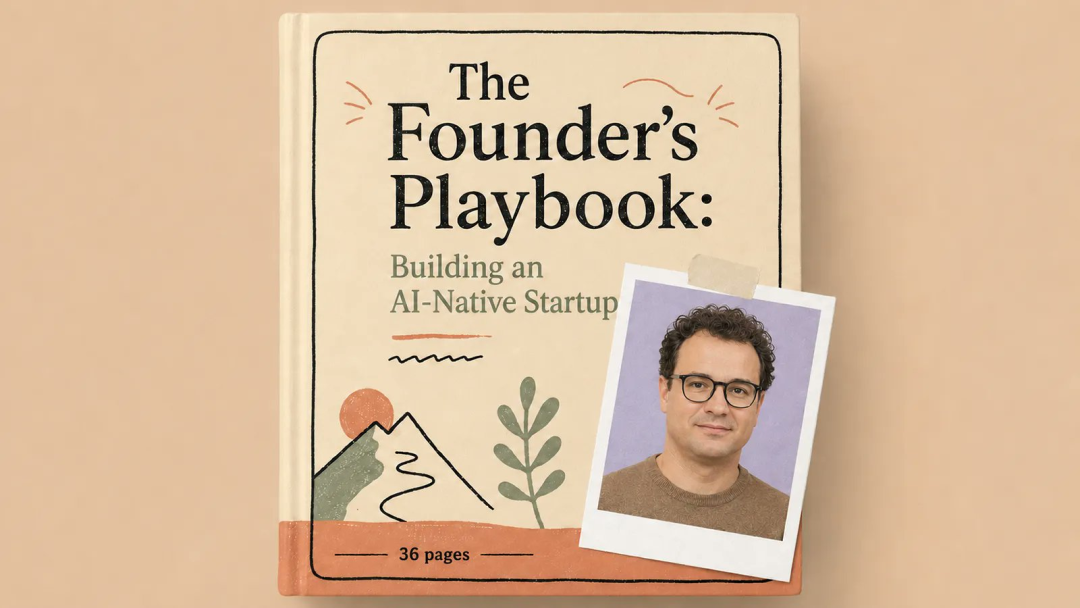
Anthropic Founder's Handbook: How to Build an AI-Native Company!

marsbitОпубликовано 2026-05-19Обновлено 2026-05-19

Введение

Anthropic has released "The Founder's Playbook: How to Build an AI Native Company," a guide that reimagines the startup lifecycle (Ideation, MVP, Launch, Scale) for 2026-era AI capabilities. The core thesis is that AI is fundamentally changing how ideas become reality, shifting the founder's role from an individual contributor to an orchestrator of AI agents. This lowers execution barriers, allowing domain experts (e.g., in medicine, law, education) to build products without deep technical skills, as AI can handle prototyping, coding, research, and operations. However, the playbook warns that easier prototyping increases the risk of building products no one needs, emphasizing that validation, not just building, is critical. It highlights that AI enables small teams to possess capabilities once reserved for large organizations, compressing functions like development, marketing, and support. This challenges traditional competitive advantages based on organizational size. For AI-native companies, sustainable moats will not come from the AI model alone but from deep domain knowledge, user data flywheels (behavioral fingerprints from real usage), and workflow lock-in that makes switching costly. Ultimately, the guide signals a shift in focus from raw model capability to how AI fundamentally reshapes company structure, processes, and competitive strategy. An AI-native company is defined not by using AI tools but by embedding AI into its core operational DNA from inception.

Yesterday, Anthropic released "The Founder's Handbook: How to Build an AI-Native Company."

Based on AI capabilities projected to be achievable by 2026, itreorganizes the four stages of a startup's lifecycle: Ideation, MVP, Launch, and Scale. Each stage corresponds to goals, exit criteria, common failure modes, and specific exercises that can be completed with AI.

By its title, it's a startup guide for founders. But what it really aims to convey:AI is changing how a person transforms an idea into reality.

In the past, there were many hurdles between an idea and its implementation. Understanding technology, finding people to write code, conducting research, writing a business plan, setting up processes, managing operations. Many things weren't unthinkable, but there was a lack of people, money, or time. So opportunities largely belonged to companies, to those with engineers and funding.

Now, AI can write and deploy code, conduct research, analyze competitors, draft business plans, and run operations. Work that once required a team can now be done by two or three people, sometimes just one knowledgeable person.

So the question changes: When AI fills in the execution capabilities, who is still qualified to build products? Who can organize complex work? Who can quickly turn a real-world problem in an industry into a verifiable, operational, and iterable system?

Startups are just the first scenario being transformed. The bigger change is that the boundaries between individual capability, team capability, and company capability are being redrawn.

Today, we'll clarify the core substance of the handbook for you.

I. Founders are No Longer Just Founders, But Orchestrators of Agents

One judgment in this handbook is crucial:

The founder's role is shifting from individual contributor to orchestrator of agents.

This statement is more important than "AI improves startup efficiency."

In the past, technical founders wrote code, non-technical founders ran the business. There was a wall between them. People who couldn't code, if they wanted to build a product, had to either find a technical co-founder, outsource, or raise funds to build a team.

Now, this wall is weakening. A person with industry experience, customer understanding, and business judgment can use AI to complete prototyping, product documentation, code development, user research, and operational processes.Technical ability is no longer the absolute barrier to entry in the startup game.

This leads to a very direct change:The profile of founders for AI-native companies will become more diverse.

In the future, some competitive AI companies may not come from the traditional technical elite. They could come from doctors, lawyers, teachers, salespeople, finance professionals, operations, manufacturing practitioners. Because when AI can supplement execution capabilities, what becomes truly scarce is domain judgment.

Whoever better understands the real problems within an industry has a better chance of turning AI into a product.

II. AI Lowers Execution Barriers, Not Judgment Barriers

Conversely, Anthropic reminds founders that AI makes prototyping too easy.A functioning product can easily be mistaken for evidence of "validated demand."

But it isn't!

In the past, a startup idea went through much friction to materialize: finding people, writing code, designing, building systems, running tests. Although slow, this process constantly exposed problems. Today, AI can compress that friction, allowing you to quickly get a seemingly complete product.

The problem is,the easier it is to build a product, the easier it is for people to skip validation.

This is a counter-intuitive aspect of the AI era:

The stronger the building capability, the higher the potential cost of going in the wrong direction.

Because AI doesn't inherently help you judge whether a problem is worth solving. It executes your premises very efficiently. If the premise is wrong, it will execute that wrong premise beautifully.

This is why the handbook repeatedly emphasizes that the focus in the ideation stage is not building, but validating.

In the AI era, the greatest danger is not failing to build a product.

It's building a product nobody needs, too quickly.

III. Small Teams Are Gaining Capabilities Previously Held by Large Companies

This handbook also has a clear tendency:It posits that AI will enable small teams to possess organizational capabilities previously reserved for large teams.

An AI-native team can use AI for code development, document generation, market research, sales materials, customer support, internal process automation. Tasks that once required coordination across multiple departments may now be handled by a few people with a set of tools.

This changes our understanding of "company scale": In the past, judging a company's maturity often looked at headcount, departments, management layers. More people meant more complex business; complete departments meant organizational maturity.

But AI-native companies may not grow this way.

They may stay small for a long time, yet possess fairly comprehensive product, operations, sales, and support capabilities.They are not in a hurry to expand the organization, but first use AI to run the processes.

This is an opportunity for startups, and pressure for large companies.

Because one of the advantages of large companies is precisely their organizational resources. They have engineering teams, marketing teams, legal teams, sales teams, customer success teams.Now, if AI allows small teams to mobilize similar capabilities, the organizational barriers of large companies are weakened.

In the future, the competitive difference may no longer be "who has more people," but "whose people are better at directing AI."

IV. Moats Are No Longer Just About Model Capability

If AI tools are accessible to everyone, where is the moat for an AI-native company?

The handbook offers several answers: domain knowledge, user data flywheel, workflow lock-in.

First, domain knowledge becomes more important.

General models can answer many questions, but they don't necessarily understand the tacit rules within specific industries. Healthcare, law, finance, education, manufacturing, government—each industry has a wealth of unwritten experience. Whoever can productize this experience can build something difficult for general models to replace.

Second, user data becomes a time-based asset.

How users operate within a product, where they pause, how they modify AI outputs, which suggestions are accepted, which are rejected—this behavioral data is not something competitors can directly buy. It comes from real usage, from accumulated time.

There's a precise sentence in the handbook:You cannot buy the behavioral fingerprints left by thousands of users repeatedly refining workflows within a product.

Third, workflow lock-in will be stronger than feature lock-in.

If an AI product only provides a certain function, users can switch anytime. But if it's embedded in a team's daily workflow, connected to data sources, carries automation rules, and trains employees' usage habits,then the switching cost is no longer "changing a tool," but "rebuilding a way of working."

This is the real moat for AI-native companies.

Not the model itself, but the system formed from the long-term combination of the model and specific business.

Conclusion: What This Handbook Really Indicates

Therefore, Anthropic's handbook is not just an operational guide for founders.

It's more like a signal: AI companies are entering the next phase.

Phase One: People cared about model capabilities. Whose model is stronger, whose context window is longer, whose reasoning is better.

Phase Two: People cared about application explosion. AI writing, AI programming, AI search, AI office tools, AI video—various products rapidly emerged.

Now, the question becomes:What kind of organization can truly use AI to redo a company?

This is also the most discussable aspect of the concept "AI-native startup."

It doesn't mean a company uses AI tools, or that its product integrates a large model API. A true AI-native company is one that, from the outset, assumes AI participates in R&D, operations, sales, management, and decision-making processes.

Its team structure is different, its product iteration method is different, its growth method is different, and its moat is different.

In other words, AI-native is not a feature label, but a company morphology.

AI is not only changing products.

It is also changing the company itself.

Original handbook address: https://claude.com/blog/the-founders-playbook

Связанные с этим вопросы

QWhat is the core change in the role of a founder in an AI-native company according to the article?

AThe founder's role is shifting from being an individual contributor to becoming an orchestrator of AI agents. Technical ability is no longer an absolute barrier, as individuals with deep domain expertise can leverage AI to handle execution tasks like prototyping, coding, and documentation.

QWhat major risk does the article highlight about the ease of building with AI?

AThe major risk is that building a functional prototype becomes too easy, which can lead founders to mistakenly believe they have validated a real market need. AI can efficiently execute a flawed premise, meaning the danger in the AI era is not failing to build a product, but building a product nobody needs too quickly.

QHow does AI change the capabilities and structure of small teams versus large companies?

AAI enables small teams to possess organizational capabilities that were previously only available to large companies with multiple departments. A small AI-native team can handle development, research, sales, and support using AI tools, potentially weakening the traditional organizational and resource advantages of large corporations.

QWhat are the three key areas identified as potential moats for an AI-native company?

AThe three key areas are: 1. Domain Knowledge: Productizing tacit, industry-specific expertise that generic models lack. 2. User Data Flywheel: Behavioral data from real users interacting with the product over time, which cannot be easily purchased. 3. Workflow Lock-in: Embedding the AI product deeply into a team's daily processes, making switching costs high as it requires rebuilding an entire work system.

QWhat does the article suggest is the true meaning of an 'AI-native' company?

AAn AI-native company is not simply one that uses AI tools or integrates APIs. It is a company whose very form is different—one built from the ground up with the assumption that AI participates in all core processes: R&D, operations, sales, management, and decision-making. It represents a new organizational form, not just a functional feature.

Похожее

Alibaba 'Stocks Up', ByteDance 'Trains'

"In late May, two closely timed events in China's AI industry clearly revealed the divergent strategic approaches of two tech giants: Alibaba and ByteDance. Alibaba is aggressively integrating AI into its existing commercial ecosystem, prioritizing immediate monetization. Its Qwen App now fully integrates with Taobao, leveraging the platform's 4-billion-item database for AI-powered shopping features like virtual try-on and price comparison. Internally, Alibaba has reorganized to incentivize AI-driven business growth, notably through the 'Agentic Commerce Trust Protocol' to enable AI-agent transactions. Financially, it emphasizes ROI, with CEO Daniel Wu stating every AI chip purchased is generating revenue. Alibaba's strategy bets that foundational AI model capabilities won't be leapfrogged in the next five years, allowing its 'AI-as-a-utility' approach to succeed. In stark contrast, ByteDance's Seed division focuses on pushing the frontiers of AGI with a long-term, research-oriented mindset. Its video generation model, Seedance 2.0, topped international benchmarks. The division, led by researchers Wu Yonghui and product head Zhu Wenjia, is tasked with 'exploring the upper limits of intelligence,' even considering open-sourcing its models—a rare move among Chinese firms. ByteDance is investing heavily, with reports of its 2026 capital expenditure plan being nearly triple that of 2024, funded by its substantial private profits. This allows it to pursue projects like an 8-month research paper questioning if video models are true 'world models,' devoid of immediate commercial pressure. The core divergence is less about corporate philosophy and more about structural constraints. As a publicly traded company, Alibaba is bound to quarterly financial expectations, forcing a pragmatic, revenue-focused AI integration. As a private entity, ByteDance has the luxury to fund long-term, high-risk foundational research without answering to public markets. The article concludes that the true determinant of a Chinese company's AI path is its IPO status, suggesting that if ByteDance were public, or if Alibaba were private, their strategies might well be reversed."

marsbit59 мин. назад

Alibaba 'Stocks Up', ByteDance 'Trains'

marsbit59 мин. назад

Why More AI Agents Does Not Equal Higher Productivity?

Editor's Note: As AI Agents become cheaper and easier to use, a new constraint emerges: the cost isn't in launching more Agents, but in the human attention required to manage, judge, and integrate their outputs. This hidden cost is called the "orchestration tax." The article argues that a developer's cognitive bandwidth is the key bottleneck—a serial, non-parallelizable resource akin to a Global Interpreter Lock (GIL). While many Agents can run concurrently, their results ultimately require human judgment for review, conflict resolution, and final integration. Therefore, more Agents don't automatically mean higher productivity; they can simply create longer queues, lead to cognitive fatigue, and create the illusion of busyness without real output. The core solution is to design workflows around this scarce human attention. Key strategies include: scaling the number of Agents to match review capacity (not UI capacity), categorizing tasks (delegating independent ones, keeping complex judgment-heavy ones serial), batch reviewing results to minimize context-switching costs, automating verifiable checks to reserve human judgment for critical decisions, and protecting focused, uninterrupted thinking time. Ultimately, the critical skill is not launching many Agents, but architecting systems that respect the fundamental limit of human attention. Unpaid "orchestration tax" accumulates as both technical and cognitive debt, undermining system understanding and quality. True productivity comes from thoughtfully managing the single-threaded resource—your focus.

marsbit2 ч. назад

Why More AI Agents Does Not Equal Higher Productivity?

marsbit2 ч. назад

Three Years Later: Looking Back at My Predictions About ChatGPT in 2023

Three Years Later: Revisiting My 2023 Predictions on ChatGPT In March 2023, shortly after ChatGPT's launch, I made 20 predictions about its future. Now, in mid-2026, I've used AI agents to fact-check each one against the latest data. Overall, most major directional forecasts were correct, with only one outright error (incorrectly stating GPT-4 had 100 trillion parameters). Key successes included predicting that RAG and retrieval architectures would become the standard for handling knowledge and hallucinations, that natural language interfaces (LUI) would create a massive new industry layer beyond the models themselves, and that China would develop viable large language models, significantly closing the performance gap with Western counterparts within about three years. Predictions about the absence of mass unemployment, the rise of a new "robot network" for agent communication, and ChatGPT not possessing consciousness also held true in their core arguments. However, the "devil was in the details." Errors frequently involved specific numbers, timelines, or overlooking distributional effects. I tended to overestimate the speed of adoption (e.g., for agent networks) while underestimating the ultimate scale of capabilities or costs (e.g., AI winning IMO gold without tools, or the extreme capital required for frontier models). Other misjudgments included: underestimating how AI would reinforce, not dissolve, information filter bubbles; incorrectly assuming AI-generated content would easily circumvent copyright (it has instead triggered record-breaking settlements); and misidentifying where value would be captured (it accrued overwhelmingly to the compute layer, like Nvidia, not just the application or model layers). Key lessons from reviewing these predictions are: 1) Directional and mechanistic insights are far more reliable than precise numbers or absolute statements. 2) There's a consistent bias to overestimate short-term speed but underestimate long-term magnitude. 3) Errors often lie in missing distributional impacts within a generally correct aggregate trend. 4) Predictions phrased with nuance and caveats aged the best. 5) Some fundamental debates (e.g., on machine consciousness or the ultimate value chain) remain unresolved even after three years. This exercise is less about scoring the past and more about establishing rules for clearer thinking about the next three years of AI.

marsbit9 ч. назад

Three Years Later: Looking Back at My Predictions About ChatGPT in 2023

marsbit9 ч. назад

Торговля

Спот
Фьючерсы

Популярные статьи

Как купить S

Добро пожаловать на HTX.com! Мы сделали приобретение Sonic (S) простым и удобным. Следуйте нашему пошаговому руководству и отправляйтесь в свое крипто-путешествие.Шаг 1: Создайте аккаунт на HTXИспользуйте свой адрес электронной почты или номер телефона, чтобы зарегистрироваться и бесплатно создать аккаунт на HTX. Пройдите удобную регистрацию и откройте для себя весь функционал.Создать аккаунтШаг 2: Перейдите в Купить криптовалюту и выберите свой способ оплатыКредитная/Дебетовая Карта: Используйте свою карту Visa или Mastercard для мгновенной покупки Sonic (S).Баланс: Используйте средства с баланса вашего аккаунта HTX для простой торговли.Третьи Лица: Мы добавили популярные способы оплаты, такие как Google Pay и Apple Pay, для повышения удобства.P2P: Торгуйте напрямую с другими пользователями на HTX.Внебиржевая Торговля (OTC): Мы предлагаем индивидуальные услуги и конкурентоспособные обменные курсы для трейдеров.Шаг 3: Хранение Sonic (S)После приобретения вами Sonic (S) храните их в своем аккаунте на HTX. В качестве альтернативы вы можете отправить их куда-либо с помощью перевода в блокчейне или использовать для торговли с другими криптовалютами.Шаг 4: Торговля Sonic (S)С легкостью торгуйте Sonic (S) на спотовом рынке HTX. Просто зайдите в свой аккаунт, выберите торговую пару, совершайте сделки и следите за ними в режиме реального времени. Мы предлагаем удобный интерфейс как для начинающих, так и для опытных трейдеров.

1.4k просмотров всегоОпубликовано 2025.01.15Обновлено 2025.03.21

Как купить S

Sonic: Обновления под руководством Андре Кронье – новая звезда Layer-1 на фоне спада рынка

Он решает проблемы масштабируемости, совместимости между блокчейнами и стимулов для разработчиков с помощью технологических инноваций.

2.3k просмотров всегоОпубликовано 2025.04.09Обновлено 2025.04.09

Sonic: Обновления под руководством Андре Кронье – новая звезда Layer-1 на фоне спада рынка

HTX Learn: Пройдите обучение по "Sonic" и разделите 1000 USDT

HTX Learn — ваш проводник в мир перспективных проектов, и мы запускаем специальное мероприятие "Учитесь и Зарабатывайте", посвящённое этим проектам. Наше новое направление .

1.8k просмотров всегоОпубликовано 2025.04.10Обновлено 2025.04.10

HTX Learn: Пройдите обучение по "Sonic" и разделите 1000 USDT

Обсуждения

Добро пожаловать в Сообщество HTX. Здесь вы сможете быть в курсе последних новостей о развитии платформы и получить доступ к профессиональной аналитической информации о рынке. Мнения пользователей о цене на S (S) представлены ниже.

活动图片