An AI-Generated 'Whistleblower Post': How Did It Make Two CEOs Write Self-Defense Essays at Midnight?

比推Опубликовано 2026-01-07Обновлено 2026-01-07

Введение

An anonymous post on Reddit, allegedly written by a drunken backend engineer from a major food delivery platform, went viral with 87,000 upvotes and 36 million views on X. The post accused the company of using algorithms to exploit drivers—assigning “desperation scores” to prioritize orders for more financially vulnerable drivers, delaying regular orders despite promised priority delivery, and misusing driver welfare funds for lobbying against unions. The viral allegations prompted immediate public denials from the CEOs of DoorDash and Uber, who issued statements and social media posts in the middle of the night to refute the claims. DoorDash published a detailed rebuttal on its website. The post was later exposed as an AI-generated hoax by a Platformer reporter. The “whistleblower” provided a fake 18-page technical document and an AI-generated employee ID, which was detected using Google’s SynthID watermarking tool. The account was deleted when further verification was requested. The incident highlights how AI can cheaply and convincingly fabricate content that aligns with public skepticism toward tech platforms. Past real controversies, such as DoorDash’s tip policy and Uber’s Greyball tool, made the false narrative feel plausible. The case underscores growing public anxiety over the difficulty of distinguishing real from AI-generated content and the power of emotionally resonant misinformation—even when debunked—to shape perception.

Written by: Curry, Deep Tide TechFlow

Original Title: The People Need a Bad Capitalist, AI Created a Food Delivery Rumor


Last week, something quite surreal happened.

The CEOs of two major American food delivery giants, one worth $2.7 billion and the other running the world's largest ride-hailing platform, were both awake at midnight on Saturday, writing self-defense essays online.

The cause was an anonymous post on Reddit.

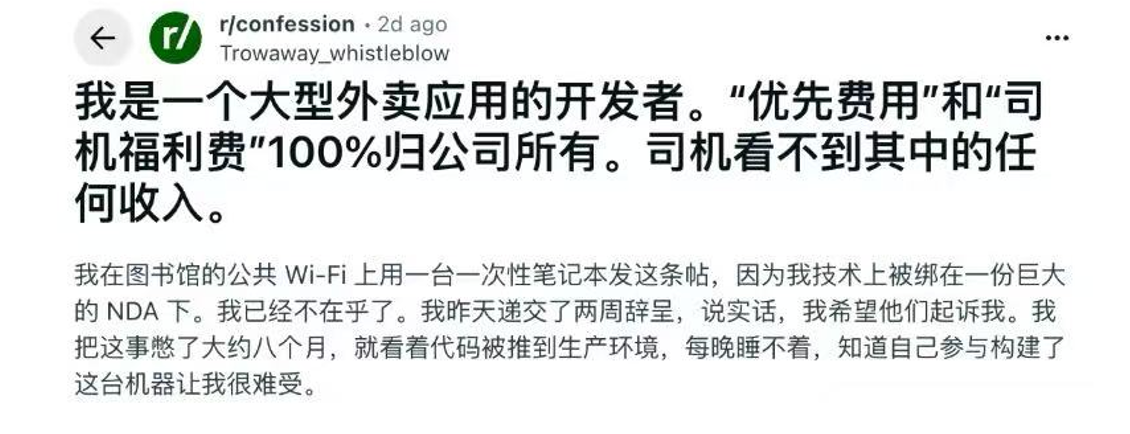
The poster claimed to be a backend engineer at a major food delivery platform, who got drunk and went to a library to use public WiFi to leak information.

The content roughly was:

The company analyzes ride-hailing drivers' situations and assigns them a "desperation score." The more financially strained the driver, the fewer good orders they receive; the so-called priority delivery for food orders is fake, as regular orders are deliberately delayed; various "driver welfare fees" are not given to drivers at all but are used to lobby Congress against unions...

The post ended in a very convincing manner: I'm drunk, I'm angry, so I'm leaking this.

It perfectly portrayed itself as a whistleblower role of "big companies using algorithms to exploit drivers."

The post received 87,000 upvotes in three days, reaching the front page of Reddit. Some also screenshotted and posted it on X, where it gained 36 million exposures.

Keep in mind, the American food delivery market has only a few major players. The post didn’t name names, but everyone was guessing who it was.

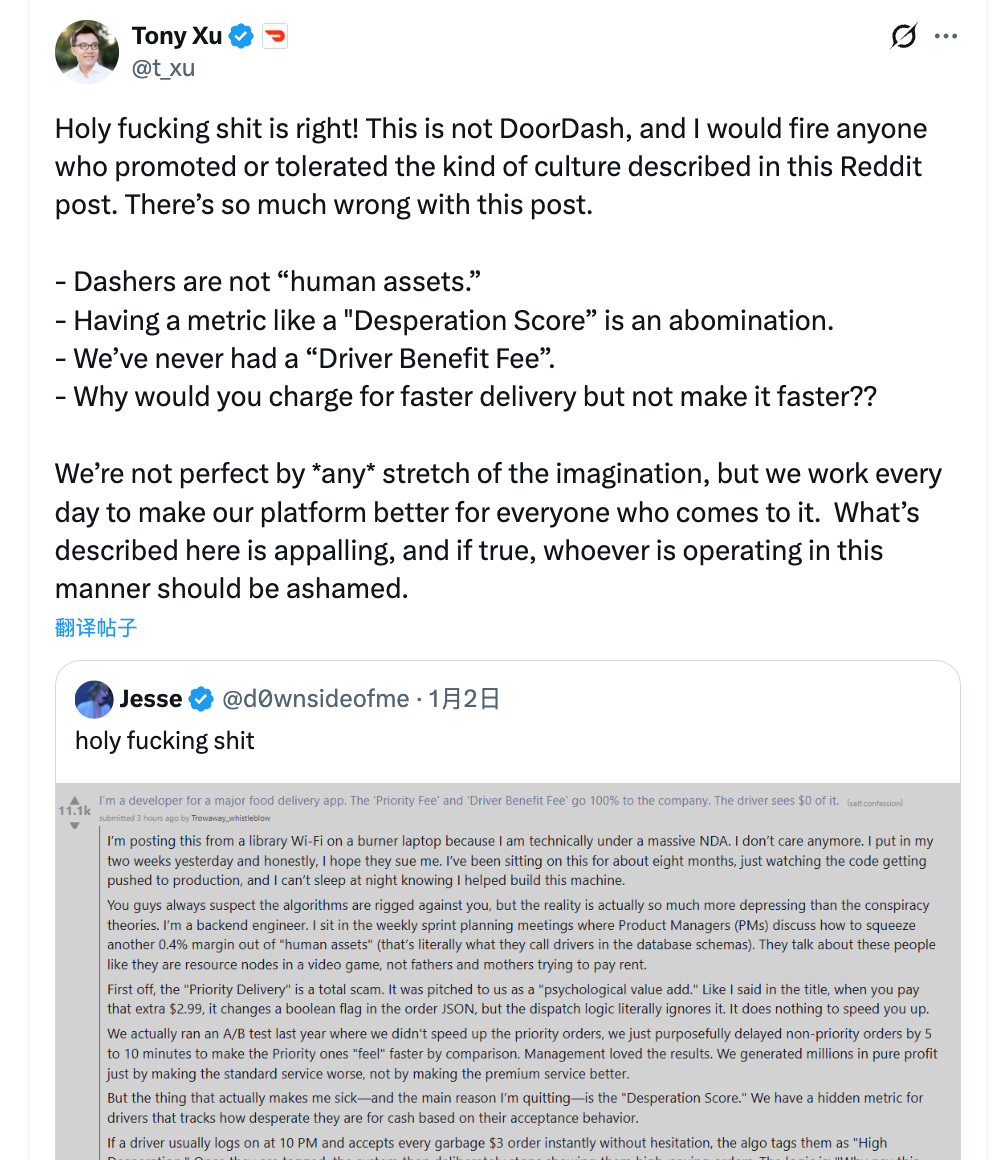
DoorDash's CEO Tony Xu was the first to react, tweeting that this wasn’t them and that he would fire anyone who did such a thing. Uber’s COO also jumped in to respond, "Don’t believe everything you see online."

DoorDash even published a five-point statement on its official website, refuting each point in the leak. These two companies, with a combined market cap of over $80 billion, were forced into overnight PR clarifications by an anonymous post.

Then, the post was proven to be fabricated.

It was debunked by Platformer reporter Casey Newton.

He contacted the poster, who immediately sent over an 18-page "internal technical document" titled "AllocNet-T: High-Dimensional Temporal Supply State Modeling."

Every page was watermarked "Confidential," attributed to Uber’s "Market Dynamics Group · Behavioral Economics Department."

The content explained the model mentioned in the Reddit post that calculates the "desperation score" for drivers. It included architecture diagrams, mathematical formulas, data flow charts...

(Fake paper screenshot, at first glance, it looked very real)

Newton said the document initially fooled him. Who would go to the trouble of forging an 18-page technical document to bait a journalist?

But now it’s different.

An 18-page document like this can be generated by AI in minutes.

Additionally, the leaker sent the reporter a blurred photo of their Uber employee ID to prove they worked there.

Out of curiosity, Newton ran the ID photo through Google Gemini for verification. Gemini said the image was AI-generated.

It could be identified because Google embeds an invisible watermark called SynthID in its AI-generated content, undetectable to the human eye but recognizable by machines.

Even more absurdly, the employee ID featured the "Uber Eats" logo.

An Uber spokesperson confirmed: They do not have Uber Eats-branded employee IDs; all badges only say Uber.

Clearly, this fake "whistleblower" didn’t even know who they were trying to target. When the reporter requested LinkedIn or other social media accounts for further verification,

The leaker deleted their account and vanished.

Actually, we don’t want to talk about AI’s ability to fake things; that’s not new.

We’d rather discuss: Why were tens of millions of people willing to believe an anonymous leak post?

In 2020, DoorDash was sued for using tips to offset drivers' base pay and settled for $16.75 million. Uber had a tool called Greyball to evade regulators. These are real events.

It’s easy to find a subconscious agreement: Platforms are not good guys, and this judgment is definitely correct.

So when someone says "food delivery platforms use algorithms to exploit drivers," the first reaction isn’t "Is this true?" but "I knew it."

Fake news spreads because it resembles what people already believe in their hearts.

What AI does is reduce the cost of creating this "resemblance" to almost zero.

There’s another detail in this story.

The deception was uncovered using Google’s watermark detection. Google develops AI, and Google also creates AI detection tools.

But SynthID can only detect Google’s own AI. This time, they caught it because the forger happened to use Gemini. With another model, they might not have been so lucky.

So solving this case was less a technical victory and more about:

The other party made a rookie mistake.

Previously, a Reuters survey found that 59% of people worry they can’t distinguish truth from falsehood online.

The food delivery CEOs’ clarification tweets were seen by hundreds of thousands, but how many firmly believe it’s just PR, just lies? Even though the fake leak post has been deleted, people are still criticizing the platforms in the comments.

The lie has run halfway around the world while the truth is still tying its shoes.

Now think, what if this post wasn’t about Uber but Meituan or Ele.me?

Things like "desperation score," "using algorithms to exploit riders," "welfare fees not given to riders at all." When you see these accusations, is your first reaction emotional agreement?

"Delivery Riders, Trapped in the System"—do you remember that article?

So the issue isn’t whether AI can fake things. The issue is, when a lie looks like what everyone already believes, does truth even matter?

What that account-deleting fugitive wanted, we don’t know.

We only know they found an emotional outlet and poured a bucket of AI-generated fuel into it.

The fire started. As for whether it’s real or fake firewood, who cares?

In fairy tales, Pinocchio’s nose grows when he lies.

AI has no nose.

Original link:https://www.bitpush.news/articles/7600729

Связанные с этим вопросы

QWhat was the main reason the anonymous Reddit post about food delivery platforms gained so much traction and led to CEOs responding?

AThe post gained traction because it tapped into pre-existing public skepticism and negative sentiment towards large food delivery platforms, with many people already believing that such companies exploit drivers through algorithms. The allegations, though fabricated, aligned with common perceptions, making them easily believable.

QHow was the anonymous Reddit post eventually exposed as being AI-generated?

AThe post was exposed as AI-generated when a journalist, Casey Newton, investigated and found that the 'internal technical document' provided by the whistleblower was likely created by AI in minutes. Additionally, a fake employee ID photo included in the evidence was identified as AI-generated by Google's SynthID watermark detection tool, and Uber confirmed they do not issue Uber Eats-branded employee cards.

QWhat specific allegations did the AI-generated Reddit post make against the food delivery companies?

AThe post alleged that the company analyzed ride-hailing drivers' situations and assigned them a 'desperation score,' where drivers in greater financial need received worse orders; that priority delivery for food orders was fake and regular orders were delayed; and that various 'driver welfare fees' were not given to drivers but used to lobby Congress against unions.

QWhy did the CEOs of DoorDash and Uber feel compelled to respond to the anonymous post?

AThe CEOs felt compelled to respond because the post went viral with 87,000 likes on Reddit and 36 million views on X, creating significant public pressure and potential damage to their reputations. They issued denials and clarifications to protect their companies' images and reassure the public and stakeholders.

QWhat broader concern does this incident raise about AI and misinformation?

AThe incident highlights how AI can easily generate convincing misinformation that aligns with existing public biases, making it difficult to distinguish truth from falsehood. It underscores the challenge of combating AI-generated content, especially when it reinforces preconceived notions, and raises concerns about the potential for widespread deception in the digital age.

Похожее

The Value Distribution of Stablecoins

**Summary: The Value Distribution of Stablecoins** The article argues that stablecoins are evolving from mere trading tools into broader channels for dollar access. It divides the stablecoin ecosystem into four layers to analyze how value is distributed: 1. **Issuance Layer:** Mints stablecoins, holds reserve assets, and captures the spread between reserve yield and user costs (e.g., Tether, Circle). This layer currently earns the largest profit margin. 2. **Infrastructure Layer:** Connects stablecoins to the traditional financial system, handling fiat on/off-ramps, banking integration, compliance (KYC/AML), and asset management (e.g., Bridge, BVNK). This is the "unglamorous" but critical work, building the essential bridges between crypto and real-world finance. 3. **Acquiring/Distribution Layer:** Integrates stablecoins into merchant systems, manages payment flows, and provides enterprise financial software (e.g., Stripe, Coinbase). They act as the access point for businesses. 4. **Application Layer:** The end-users and businesses that ultimately use stablecoins for payments, settlements, or as a store of value. They benefit from convenience but have little pricing power. The core thesis is that while the issuance layer currently dominates profits, the often-overlooked **infrastructure layer holds significant long-term potential**. The real challenge and barrier to mass adoption is not the on-chain transfer of stablecoins (which is simple), but the complex "last mile" integration into existing business workflows, banking systems, and regulatory frameworks across different countries. Companies in this layer are currently in a "land grab" phase, investing heavily to build networks, secure bank partnerships, and establish compliance pathways. While their position is currently pressured by the profitable issuers above and distribution platforms below, the article suggests that if stablecoins become a default financial rail for businesses, the infrastructure providers who have done the hard work of integration will ultimately gain strong pricing power and become entrenched, essential players.

marsbit5 ч. назад

The Value Distribution of Stablecoins

marsbit5 ч. назад

The Value Distribution of Stablecoins

The Value Distribution of Stablecoins The article argues that stablecoins are evolving from a mere trading tool into a broad "dollar channel." It analyzes the industry's value chain through four layers: 1. **Issuance Layer (e.g., Tether, Circle):** The top layer that mints stablecoins, holds reserve assets, and captures the thickest interest rate spread. 2. **Infrastructure Layer (e.g., Bridge, BVNK):** Connects stablecoins to the traditional financial system, handling critical but complex "dirty work" like fiat on/off-ramps, banking integration, compliance (KYC/AML), and cross-border settlement. 3. **Acquiring/Distribution Layer (e.g., Stripe, Coinbase):** Embeds stablecoins into merchant systems, manages payment flows, and integrates with enterprise software. 4. **Application Layer:** End-users and businesses that ultimately use stablecoins for payments, settlement, or storing value. The author posits that while the issuance layer currently captures the most profit, the most overlooked and potentially critical layer is infrastructure. The core challenge for stablecoin adoption isn't the on-chain transfer (which is simple), but bridging the gap between blockchain and the real-world financial system. This involves solving practical problems for businesses: fiat conversion, reconciliation, tax handling, and user onboarding. Infrastructure companies are currently in a difficult "land-grab" phase—building networks, securing banking relationships, and achieving compliance country-by-country. They face pressure from both the profitable issuance layer above and distribution platforms below. However, the author suggests this layer is building a crucial moat. Once stablecoins become a default business rail, the infrastructure players who have done the hard work of integration may gain significant, durable value and pricing power.

链捕手5 ч. назад

The Value Distribution of Stablecoins

链捕手5 ч. назад

Торговля

Спот
Фьючерсы

Популярные статьи

Неделя обучения по популярным токенам (2): 2026 может стать годом приложений реального времени, сектор AI продолжает оставаться в тренде

2025 год — год институциональных инвесторов, в будущем он будет доминировать в приложениях реального времени.

1.8k просмотров всегоОпубликовано 2025.12.16Обновлено 2025.12.16

Неделя обучения по популярным токенам (2): 2026 может стать годом приложений реального времени, сектор AI продолжает оставаться в тренде

Обсуждения

Добро пожаловать в Сообщество HTX. Здесь вы сможете быть в курсе последних новостей о развитии платформы и получить доступ к профессиональной аналитической информации о рынке. Мнения пользователей о цене на AI (AI) представлены ниже.

活动图片