AI Ignites Crypto’s Next Supercycle With BTC And ETH In Front, BlackRock Says

bitcoinistОпубликовано 2026-03-25Обновлено 2026-03-25

Введение

BlackRock's Robbie Mitchnick states that AI will be a more significant long-term driver for crypto than the creation of new tokens. He emphasizes that institutional investors are narrowing their focus to Bitcoin and Ethereum, dismissing most other tokens as lacking lasting value. According to Mitchnick, Bitcoin serves as a savings-style hedge, while Ethereum acts as productive infrastructure for on-chain activities. He highlights a natural alignment between “computer-native money” (crypto) and “computer-native intelligence” (AI), suggesting that autonomous agents are unlikely to use traditional financial systems like Fedwire or SWIFT. Instead, AI will require crypto-based infrastructure for real-world applications. This shift is already underway, with Bitcoin miners diversifying into AI compute services. The long-term outlook favors core crypto assets integrated with AI, rather than speculative altcoins.

BlackRock’s Robbie Mitchnick believes AI to be a bigger long-term force for crypto than the launching of new tokens.

The Future Of Crypto Is Not In Tokens But In AI

Robbie Mitchnick, the head of the world’s largest asset manager, BlackRock, said at the Digital Asset Summit in New York this Tuesday that big investors are rethinking their approach to crypto, signaling artificial intelligence (AI) as a more significant long‐term engine than simply launching more tokens, CoinDesk reports.

According to Mitchnick, since most tokens have short life cycles and limited long‐term value, client allocations are narrowing into a few core assets rather than broad altcoin baskets. As a result of this, institutional players are tightening their focus on bitcoin and ether, treating the bulk of remaining tokens as fleeting and mostly “nonsense”. “The majority of that is nonesense”, said Mitchnick himself.

Token turnover in the top ranks has been “pretty ferocious”, with only Bitcoin and Ethereum sustaining long‐term relevance, while the majority of circulating tokens lack staying power. Right now, BTC and ETH sit in different but complementary “monetary universes”: Bitcoin as a savings‐style hedge and Ethereum as productive infrastructure for on‐chain activity and tokenization.

What This Means For The Industry

Furthermore, Mitchnick sees this consolidation as a natural evolution and not a failure, with AI acting as the structural catalyst that will actually need crypto rails in the real economy. He believes there is an organic alignment between what he calls “computer-native money” and “computer-native data and intelligence”:

“AI agents are very unlikely to use, you know, Fedwire and SWIFT (...) What is crypto? Crypto is computer-native money... AI is computer-native data and intelligence. And so there’s a natural symbiosis there”

Under Mitchnick’s perspective, crypto is seen less as a speculative trade and more as core infrastructure. A growing cohort of Bitcoin miners is already reallocating capacity to AI workloads, attracted by more predictable income streams and surging demand for compute. Publicly listed firms like Hut 8 (HUT), Core Scientific (CORZ) and Iren (IREN) are converting data centers or signing hosting agreements focused on AI and high‐performance computing. Other miners are floating comparable strategies, even as traditional mining remains at the heart of their operations.

If BlackRock’s thesis holds, the real long‐term bet is on AI plus the core crypto stack (Bitcoin, Ethereum and tokenization rails), while long‐tail token churn turns even more fleeting and purely speculative. In an AI‐led market, the lasting upside is likely to accrue to the assets that autonomous agents and institutional plumbing actually rely on, not to whatever “AI coin” narrative happens to be trending next.

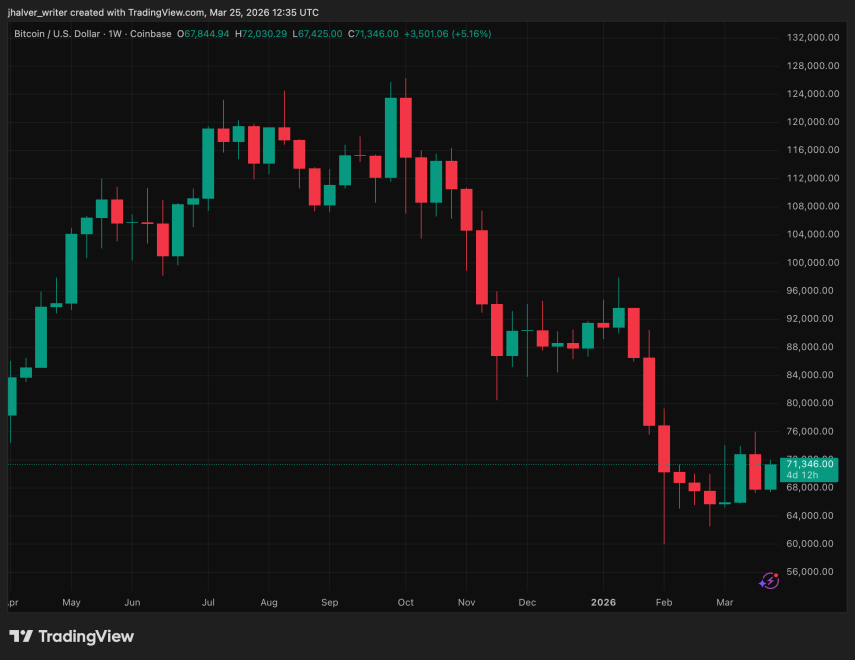
BTC trades for around $71k on the daily chart. Source: BTCUSD on Tradingview

Cover image from Perplexity, BTCUSD chart from Tradingview

Связанные с этим вопросы

QAccording to BlackRock's Robbie Mitchnick, what is a bigger long-term force for crypto than the launching of new tokens?

AArtificial intelligence (AI) is a bigger long-term force for crypto than the launching of new tokens.

QWhich two cryptocurrencies are institutional players tightening their focus on, according to the article?

AInstitutional players are tightening their focus on Bitcoin (BTC) and Ethereum (ETH).

QWhat natural relationship does Mitchnick see between crypto and AI?

AHe sees a natural symbiosis between 'computer-native money' (crypto) and 'computer-native data and intelligence' (AI), where AI agents are unlikely to use traditional systems like Fedwire and SWIFT and will instead need crypto infrastructure.

QWhat are some Bitcoin mining companies doing in response to the rise of AI?

ACompanies like Hut 8, Core Scientific, and Iren are converting data centers or signing hosting agreements focused on AI and high-performance computing, reallocating capacity to AI workloads.

QIn an AI-led market, where is the lasting upside likely to accrue, according to BlackRock's thesis?

AThe lasting upside is likely to accrue to the core crypto assets that autonomous agents and institutional plumbing actually rely on, such as Bitcoin and Ethereum, rather than to fleeting 'AI coin' narratives.

Похожее

Trend in US Stocks: Jensen Huang's One Sentence Triggers $47 Billion Surge; Google Raises Funds for First Time in 20 Years

U.S. markets reached record highs on June 2nd, but the real story was the intensifying AI arms race, now pivoting from chip supremacy to a scramble for capital to fund compute infrastructure. The day highlighted two stark realities: Nvidia CEO Jensen Huang's endorsement of Marvell Technology as the "next trillion-dollar company" at Computex fueled a historic 32.5% surge, adding $47 billion to its value. Conversely, Alphabet announced its first equity raise in two decades—an $80 billion plan—signaling that even its massive cash flow can't keep pace with soaring AI capital expenditures, forecast to exceed $180 billion in 2026. While the S&P 500 closed above 7,600 for the first time, led by tech and semiconductor stocks (SOXX +5.79%), sector performance was mixed. Alphabet's 4% drop dragged down communications services, illustrating market anxiety over the unsustainable cost of the AI buildout. Hewlett Packard Enterprise soared 25% on stellar earnings, proving AI's benefits extend beyond chip designers to infrastructure providers. Beneath the index highs, concerns linger over extreme concentration in a few AI stocks and geopolitical tensions. The focus now shifts to upcoming economic data, particularly Friday's nonfarm payrolls, which could challenge the market's current "ignore rates, chase AI" mentality.

marsbit18 мин. назад

Trend in US Stocks: Jensen Huang's One Sentence Triggers $47 Billion Surge; Google Raises Funds for First Time in 20 Years

marsbit18 мин. назад

Can DeepSeek Save China One Trillion Dollars?

"DeepSeek and the $1 Trillion Infrastructure Question" The article examines whether DeepSeek's AI optimization breakthroughs could potentially save China $1 trillion in future AI infrastructure costs. The analysis begins with Nvidia's upcoming Vera Rubin AI platform, costing ~$7.8 million, where memory (HBM4/LPDDR5X) constitutes $2 million—a 435% cost increase in one year, highlighting how AI hardware spending is shifting toward expensive memory components. DeepSeek's approach works in the opposite direction. Through three key technical innovations showcased in DeepSeek V4, the company dramatically improves hardware efficiency: 1. **Memory Compression (MLA)**: Re-engineers the attention mechanism to compress long-context memory (KV Cache) by over 90%, drastically reducing expensive HBM usage. 2. **Selective Activation (MoE)**: Employs Mixture-of-Experts architecture where only a small fraction of parameters (e.g., 49B out of 1.6T in V4-Pro) are activated per token, allowing most parameters to reside in cheaper memory/SSD. 3. **Computation Caching**: Reuses previously computed results via cache hits, replacing expensive GPU computations with cheap memory reads. Combined, these optimizations allow the same hardware to produce approximately 4x more tokens, effectively reducing required hardware investment by 75%. DeepSeek's pricing reflects this: a 10-billion token workload costs ~$522 monthly versus ~$9,000-$10,000 for competitors. The $1 trillion savings projection stems from McKinsey's estimate that global AI infrastructure will require ~$5.2 trillion investment by 2030. As China's daily token consumption grows toward quadrillions, even marginal efficiency gains scale massively. With a conservative 4x throughput improvement, China could avoid building tens of thousands of AI data centers equivalent to ~7 trillion RMB ($1 trillion) in saved investment. Critically, this strategy shifts dependency from scarce, expensive GPU/HBM—where China lags—toward more accessible storage, caching, and systems engineering where domestic suppliers like CXMT are gaining strength. Rather than "replacing Nvidia," DeepSeek rebalances AI's value chain away from monolithic hardware dependency. Ultimately, DeepSeek's technical breakthroughs could lower the barrier to AI adoption across Chinese industries by making advanced capabilities affordable at scale—transforming who can access next-generation AI.

marsbit1 ч. назад

Can DeepSeek Save China One Trillion Dollars?

marsbit1 ч. назад

Overturning the Mainstream Approach to Hallucinations: Metacognition is the New Solution for Large Models to Break the Hallucination Barrier

This paper, "Hallucinations Undermine Trust; Metacognition is a Way Forward," proposes a paradigm shift in combating AI hallucination. It argues that the current mainstream approaches—striving for omniscience by scaling data/models or having AI abstain from uncertain answers—are fundamentally flawed. The former has inevitable knowledge gaps, while the latter imposes a crippling "utility tax," requiring the rejection of many correct answers to achieve high accuracy, due to models' poor "discrimination" (the ability to distinguish correct from incorrect answers internally). The core contribution is redefining hallucination not as "being wrong," but as "expressing false information with unwarranted certainty." The proposed solution is **Faithful Uncertainty** or **Metacognition**: enabling AI to accurately perceive its internal uncertainty and honestly express it in its language (e.g., using hedging phrases when unsure). This creates a more reliable assistant that provides useful information while signaling its confidence, minimizing harm from errors. The paper emphasizes that metacognition is critical for the era of AI Agents. Without it, Agents cannot intelligently decide when to use tools like search engines, leading to inefficiency and misuse. Key implementation challenges are highlighted: the "bootstrapping paradox" of training with static uncertainty data, the "alignment distortion signal" where human preference training suppresses internal uncertainty cues, and the difficulty of causally evaluating true metacognition vs. its superficial imitation. The paper concludes that the goal should not be an infallible AI, but one that is honest about the limits of its knowledge, thereby building user trust through transparent communication of its certainty.

marsbit1 ч. назад

Overturning the Mainstream Approach to Hallucinations: Metacognition is the New Solution for Large Models to Break the Hallucination Barrier

marsbit1 ч. назад

Hedge by Buying Gold and Oil, Chase Soaring Returns with AI. ‘Dated’ Bitcoin Enters a Bear Market

Bitcoin has recently declined, hitting a two-month low near $66,123, while Ethereum fell to a three-month low around $1,837. Analysts suggest the drop is not merely due to factors like ETF outflows or MicroStrategy's selling but reflects a deeper issue: Bitcoin is losing a broader asset competition. In a near-zero interest rate environment, Bitcoin previously thrived as an outlet for investor dissatisfaction with inflation and limited options. However, the market landscape has shifted. Bitcoin now occupies an "awkward middle ground," facing competition on three fronts. For inflation hedging, investors prefer gold, energy stocks, and commodity producers—assets with tangible backing and clearer pricing power. For growth exposure, AI-related companies with actual revenues and profits are more attractive. Even within crypto, investors can choose stablecoins, exchanges, or infrastructure firms tied directly to adoption, offering clearer business models and leverage. Thus, Bitcoin is no longer the top choice for hedging, growth, or crypto exposure. This shift is evident in market reactions: despite recent warnings about persistent inflation from a Fed official, Bitcoin did not rally as it might have in the past. Instead, capital flowed to assets with direct commodity or energy exposure. The recent ETF outflows and MicroStrategy sales are symptoms, not causes, of this new reality. Investors are becoming more selective, demanding clearer value propositions beyond mere scarcity. The emerging bear case for Bitcoin is not about it being a bubble or failed technology, but that scarcity alone is no longer sufficient.

华尔街日报1 ч. назад

Hedge by Buying Gold and Oil, Chase Soaring Returns with AI. ‘Dated’ Bitcoin Enters a Bear Market

华尔街日报1 ч. назад

Торговля

Спот
Фьючерсы

Популярные статьи

Как купить S

Добро пожаловать на HTX.com! Мы сделали приобретение Sonic (S) простым и удобным. Следуйте нашему пошаговому руководству и отправляйтесь в свое крипто-путешествие.Шаг 1: Создайте аккаунт на HTXИспользуйте свой адрес электронной почты или номер телефона, чтобы зарегистрироваться и бесплатно создать аккаунт на HTX. Пройдите удобную регистрацию и откройте для себя весь функционал.Создать аккаунтШаг 2: Перейдите в Купить криптовалюту и выберите свой способ оплатыКредитная/Дебетовая Карта: Используйте свою карту Visa или Mastercard для мгновенной покупки Sonic (S).Баланс: Используйте средства с баланса вашего аккаунта HTX для простой торговли.Третьи Лица: Мы добавили популярные способы оплаты, такие как Google Pay и Apple Pay, для повышения удобства.P2P: Торгуйте напрямую с другими пользователями на HTX.Внебиржевая Торговля (OTC): Мы предлагаем индивидуальные услуги и конкурентоспособные обменные курсы для трейдеров.Шаг 3: Хранение Sonic (S)После приобретения вами Sonic (S) храните их в своем аккаунте на HTX. В качестве альтернативы вы можете отправить их куда-либо с помощью перевода в блокчейне или использовать для торговли с другими криптовалютами.Шаг 4: Торговля Sonic (S)С легкостью торгуйте Sonic (S) на спотовом рынке HTX. Просто зайдите в свой аккаунт, выберите торговую пару, совершайте сделки и следите за ними в режиме реального времени. Мы предлагаем удобный интерфейс как для начинающих, так и для опытных трейдеров.

1.4k просмотров всегоОпубликовано 2025.01.15Обновлено 2026.06.02

Как купить S

Sonic: Обновления под руководством Андре Кронье – новая звезда Layer-1 на фоне спада рынка

Он решает проблемы масштабируемости, совместимости между блокчейнами и стимулов для разработчиков с помощью технологических инноваций.

2.3k просмотров всегоОпубликовано 2025.04.09Обновлено 2025.04.09

Sonic: Обновления под руководством Андре Кронье – новая звезда Layer-1 на фоне спада рынка

HTX Learn: Пройдите обучение по "Sonic" и разделите 1000 USDT

HTX Learn — ваш проводник в мир перспективных проектов, и мы запускаем специальное мероприятие "Учитесь и Зарабатывайте", посвящённое этим проектам. Наше новое направление .

1.8k просмотров всегоОпубликовано 2025.04.10Обновлено 2025.04.10

HTX Learn: Пройдите обучение по "Sonic" и разделите 1000 USDT

Обсуждения

Добро пожаловать в Сообщество HTX. Здесь вы сможете быть в курсе последних новостей о развитии платформы и получить доступ к профессиональной аналитической информации о рынке. Мнения пользователей о цене на S (S) представлены ниже.

活动图片