After a Valuation of $1 Billion and Five Years of Exploration, Why Did It 'Admit Defeat'?

深潮Опубликовано 2025-12-09Обновлено 2025-12-09

Введение

After five years of development and raising $180 million at a near $1 billion valuation, Farcaster has officially conceded that its Web3 social strategy did not succeed. The platform, initially designed as a decentralized alternative to Twitter, aimed to address issues like platform monopoly, user data ownership, and creator monetization through an on-chain, protocol-based approach. Despite a brief surge in early 2024—when monthly active users (MAU) peaked at around 80,000—growth quickly stalled. MAU has since declined to under 20,000 by late 2025. Farcaster’s user base remained heavily concentrated within the crypto-native community, failing to attract mainstream users due to high barriers to entry, niche content, and inferior user experience compared to established platforms like X or Instagram. Co-founder Dan Romero announced a strategic pivot from social-first to a wallet-focused product, acknowledging that social alone wasn’t driving sustainable growth. Internal data showed that wallet features—used for transactions, trading, and interacting with dApps—consistently outperformed social modules in user retention and frequency. The shift reflects a broader realization: It’s easier to add social features to a wallet than to build a social product around crypto. While the move has sparked some community discontent, Farcaster is betting that deeper integration with on-chain utilities represents a more viable path to product-market fit.

Written by: Bootly

After five years of operation, raising approximately $180 million in total funding, and reaching a valuation once nearing $1 billion, Farcaster has officially admitted: the path of Web3 social has not succeeded.

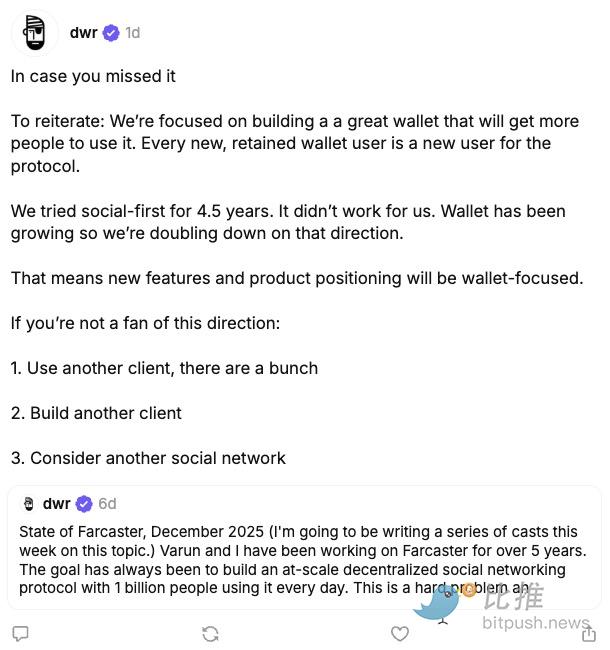
Recently, Farcaster co-founder Dan Romero posted a series of messages on the platform, announcing that the team will abandon the "social-first" product strategy and instead fully focus on the wallet direction. In his words, this is not an active upgrade but a choice forced by reality after a long period of attempts.

"We tried social-first for 4.5 years, and it didn't work."

This judgment not only signifies Farcaster's transformation but also once again highlights the structural challenges of Web3 social.

The Gap Between Ideal and Reality: Why Farcaster Failed to Become the 'Decentralized Twitter'

Farcaster was born in 2020, during the rise of the Web3 narrative. It attempted to solve three core problems of Web2 social platforms:

  • Platform monopoly and censorship

  • User data not belonging to users themselves

  • Creators unable to monetize directly

Its design approach was highly idealistic:

  • Decentralized protocol layer

  • Freedom to build clients

  • Social relationships on-chain and migratable

Among the various "decentralized social" projects, Farcaster was once considered the product closest to PMF. Especially after Warpcast gained traction in 2023, many KOLs from Crypto Twitter joined, making it seem like the prototype of the next-generation social network.

But problems soon emerged.

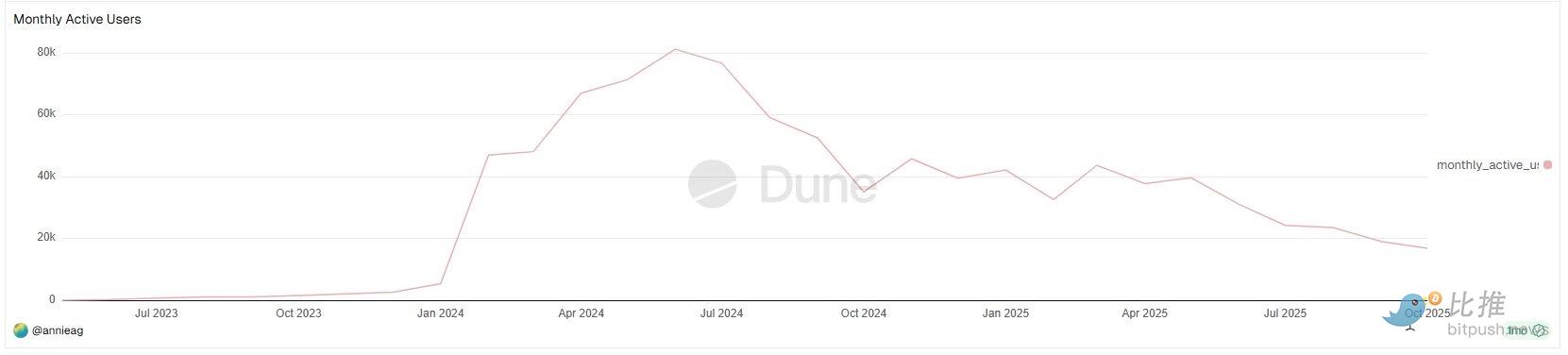
According to Farcaster's monthly active user (MAU) statistics on Dune Analytics, Farcaster's user growth trajectory shows a very clear but not optimistic pattern:

For most of 2023, Farcaster's monthly active users were almost negligible;

The real growth inflection point occurred in early 2024, with MAU rapidly increasing from a few thousand to about 40,000–50,000 in a short time, and even approaching 80,000 by mid-2024.

This was Farcaster's only truly scalable growth window since its inception. It is particularly noteworthy that this growth did not occur during a bear market but during a period of high activity in the Base ecosystem and the emergence of dense SocialFi narratives.

However, this window did not last long.

Starting in the second half of 2024, monthly active data showed a clear decline, and over the following year, it exhibited a volatile downward trend:

  • MAU rebounded multiple times, but the peaks continued to lower

  • By the second half of 2025, monthly active users had fallen to less than 20,000

In fact, Farcaster's growth has always been unable to "break through," with its user structure highly homogeneous:

  • Crypto practitioners

  • VCs

  • Builders

  • Crypto-native users

For ordinary users:

  • High registration barrier

  • Social content is heavily "insider-focused"

  • User experience not better than X / Instagram

This prevented Farcaster from ever forming true network effects.

DeFi KOL Ignas (@DeFiIgnas) on X bluntly stated that Farcaster "just admitted what everyone has felt for a long time":

The strength of X's (formerly Twitter) network effects is almost impossible to break head-on.

This is not a problem with the crypto narrative but a structural barrier of social products. From a product perspective, the issues with Farcaster's social side are very typical:

  • User growth has always been locked into the crypto-native crowd

  • Content is highly insular and difficult to spill over

  • Creator monetization and user retention did not form a positive feedback loop

This is why Ignas succinctly summarized Farcaster's new strategy in one sentence:

"It's easier to add social to a wallet than to add a wallet to a social product."

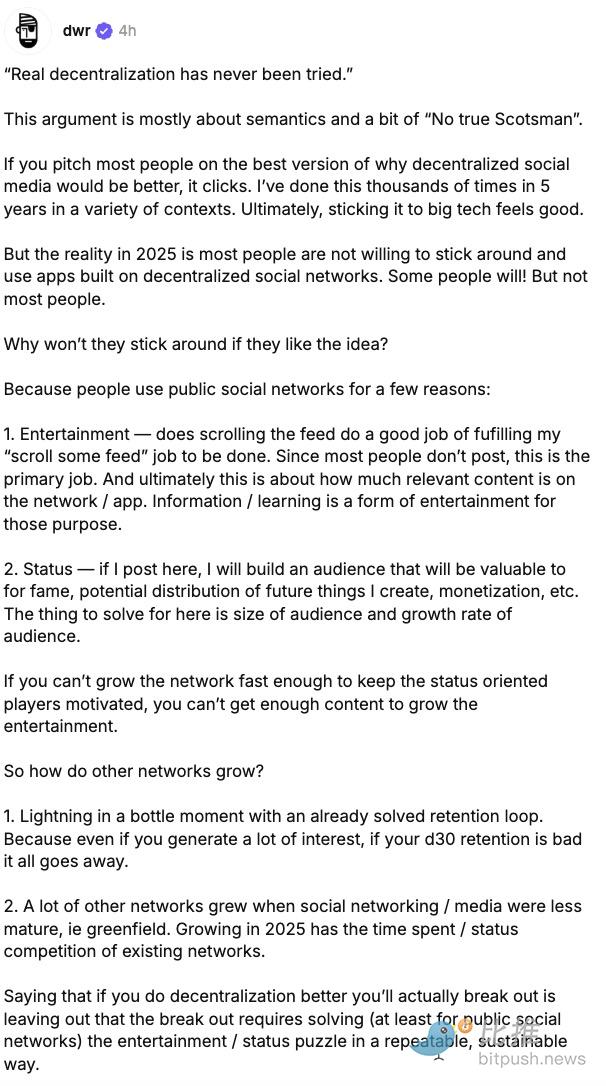
This judgment essentially admits that "social is not the first-order need of Web3."

"The Bubble Is Comfortable, but the Numbers Are Cold"

If MAU data answers "how Farcaster performed," then another question is: How big is this market itself?

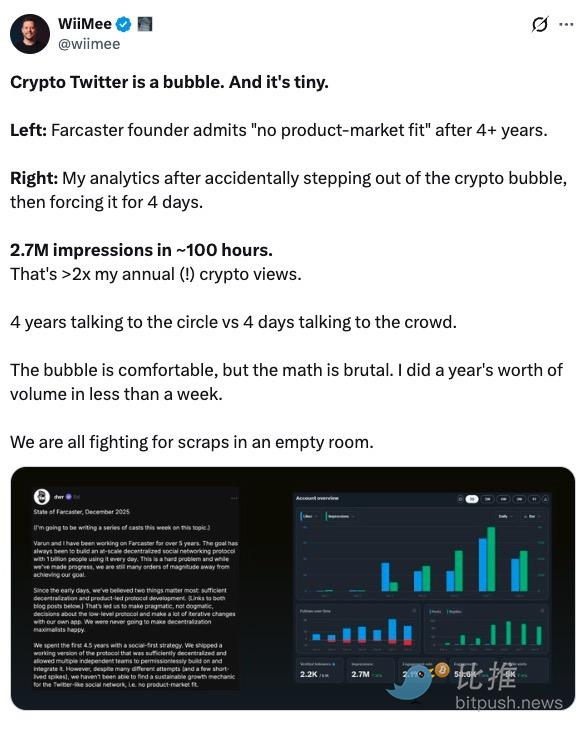
Crypto creator Wiimee provided a set of striking comparative data on X.

After "accidentally stepping out of the crypto content circle," Wiimee created content for a general audience for four consecutive days. His analysis data showed that in about 100 hours, he received 2.7 million impressions, more than double the total views of all his crypto content over a year.

He stated:

"Crypto Twitter is a bubble, and it's small. Four years of speaking to insiders is less effective than four days of speaking to the masses."

This is not a direct criticism of Farcaster but reveals a more fundamental problem:

Crypto social itself is a highly self-referential ecosystem with weak spillover capabilities. When content, relationships, and attention are all confined to the same batch of users, even the most refined protocol design cannot break through the upper limit of market scale.

This means Farcaster faced not "the product isn't good enough" but "there aren't enough people in the field."

Wallet, on the Other Hand, Achieved PMF

What truly changed Farcaster's internal judgment was not a reflection on social but the unexpected validation of the wallet.

Earlier in 2024, Farcaster introduced a built-in wallet in its application, initially intended only as a supplement to the social experience. But from usage data, the wallet's growth slope, frequency of use, and retention performance were significantly different from the social module.

Dan Romero emphasized in a public response:

"Every new and retained wallet user is a new user for the protocol."

This statement itself reveals the logical core of the strategic shift. The wallet addresses not "the desire to express" but real, rigid on-chain behavioral needs: transfers, transactions, signatures, and interactions with new applications.

In October, Farcaster acquired Clanker, an AI Agent-driven token issuance tool, and gradually integrated it into the wallet system. This move was also seen as the team's clear bet on the "wallet-first" path.

From a business perspective, this direction has clear advantages:

  • Higher frequency of use

  • Clearer monetization path

  • Tighter integration with the on-chain ecosystem

In contrast, social seems more like a nice-to-have rather than an engine for growth.

Although the wallet strategy is justified by the data, community controversy has also followed.

Several long-term users explicitly stated that they are not opposed to the wallet itself but are uncomfortable with the cultural shift that comes with it: from "users" being redefined as "traders," from "co-builders" being labeled as "old guard."

This exposes a practical problem: when a product direction changes, community sentiment is often harder to migrate than the roadmap. Farcaster's protocol layer remains decentralized, but the choice of product direction is still concentrated in the hands of the team. This tension is amplified during transformation.

Romero later admitted that there were communication issues but made it clear that the team had made its choice.

This is not arrogance but a common decisive reality for startup projects in the later stages of their lifecycle. In this sense, Farcaster did not abandon the social ideal but gave up the illusion of its scalability.

As one observer perhaps put it best:

"First, let users stay for the tools; then there is space for social to exist."

Farcaster's choice may not be the most romantic, but it might be the one closest to reality. Deeply integrating native financial tools (wallets, transactions, issuance) is the practical path to converting into sustainable commercial value.

Связанные с этим вопросы

QWhy did Farcaster decide to pivot from a social-first strategy to a wallet-focused approach?

AFarcaster shifted its strategy because after 4.5 years of focusing on social, it did not achieve product-market fit. The social approach failed to scale beyond the crypto-native user base, while the wallet feature demonstrated stronger growth, retention, and clearer monetization paths.

QWhat were the main challenges Farcaster faced in trying to build a decentralized social platform?

AFarcaster struggled with high user onboarding barriers, highly insular crypto-focused content, inability to break out of the crypto echo chamber, and failure to form genuine network effects competitive with platforms like X (Twitter) or Instagram.

QHow did Farcaster's user growth trend reflect its struggles in social?

AFarcaster's monthly active users (MAU) saw a brief surge to around 80,000 in mid-2024 but quickly declined, falling to under 20,000 by late 2025. Growth was confined to crypto insiders and never achieved broad adoption.

QWhat key insight did the comparison between crypto content and mainstream content exposure reveal?

AA creator's experiment showed that four days of creating content for a general audience generated 2.7 million impressions—more than double the exposure of a year's worth of crypto content—highlighting the small size and limited reach of the crypto social bubble.

QWhy is the wallet considered a more promising direction for Farcaster than social?

AThe wallet addresses core, frequent on-chain needs like transactions, transfers, and signing, leading to higher usage and retention. It integrates more effectively with the crypto economy and offers clearer monetization compared to social features, which are harder to scale and monetize.

Похожее

600 People, $66 Billion: The First Major Cash-Out in the Era of Large Models

The first systematic "big cash-out" of the AI era occurred in October 2025, when over 600 current and former OpenAI employees sold a total of $6.6 billion in shares via a secondary market. Approximately 75 individuals maxed out a $30 million per-person sale limit, while around 525 others cashed out an average of $8.3 million each. This event, exceeding the scale of any 2024 US IPO, functioned as a "shadow IPO." It marked a radical departure from the traditional Silicon Valley path of waiting for a public listing, instead allowing employees to convert equity to cash after just two years of tenure—a direct retention tool in a fiercely competitive talent market where rivals like Meta have offered packages worth hundreds of millions. This massive liquidity event presents a dual-edged sword for OpenAI. While it helps retain talent, it also risks triggering a brain drain as newly wealthy employees may depart. Furthermore, it creates a dilemma for those who sold: they forfeited potential future gains as the company's valuation soared from $400 billion to $852 billion within months. In stark contrast, employees at rival Anthropic demonstrated greater reluctance to sell during their own secondary offering. The financial narratives of the two labs also diverge sharply. OpenAI, while achieving over $20 billion in annualized revenue by 2025, faces massive projected losses (up to $14 billion in 2026), a long path to cash flow positivity, and significant revenue-sharing payments to Microsoft. Anthropic reports rapid revenue growth, improving gross margins, and a faster path to profitability. OpenAI's trajectory is thus balanced precariously between skyrocketing valuation based on funding narratives and the pressures of sustained financial losses post-cash-out. The event underscores that the AI race has evolved into a capital and human experiment, where immense wealth crystallizes the complex calculations of greed, fear, and ambition within the industry.

marsbit4 мин. назад

600 People, $66 Billion: The First Major Cash-Out in the Era of Large Models

marsbit4 мин. назад

NVIDIA Begins Adding Soap to the Bubble

NVIDIA is taking on a dual role: not just as a leading chip supplier, but as a massive capital allocator across the entire AI supply chain. In 2026, the company has committed over $40 billion in investments within five months, targeting everything from optical fiber manufacturing and data center operations to foundational AI model development. This investment spree, described as a systematic "sprinkler" approach, primarily funds companies that are major buyers of NVIDIA's own GPUs. Critics, including analysts from Goldman Sachs, label this a "circular revenue" loop—comparable to a supplier financing a customer to buy more of its products. A prominent example is NVIDIA's investment in OpenAI, which is expected to generate around $13 billion in revenue for NVIDIA, much of which may be reinvested back into OpenAI. While CEO Jensen Huang dismisses the "circular financing" critique as "absurd," arguing the investments are confidence votes in long-term generational shifts, some analysts express discomfort. They note that while investments in critical supply chain components like optics are strategically sound, funding new cloud providers like CoreWeave feels like "pre-paying for your own GPUs." The strategy carries significant risks. If the AI investment cycle turns, the market may question how much demand is genuine versus artificially sustained by NVIDIA's own balance sheet. Despite posting record-breaking earnings—$215.9 billion in annual revenue and $120 billion in net profit for FY2026—NVIDIA's stock fell after its report, signaling that "beating expectations" may no longer be enough to assure investors about the duration of the AI spending boom. The article concludes that while a bubble isn't necessarily a fraud, NVIDIA's actions resemble adding soap to a bubble—making it appear more robust and durable. This creates a complex scenario requiring extreme冷静 from investors to distinguish between real structural growth and financial engineering.

marsbit21 мин. назад

NVIDIA Begins Adding Soap to the Bubble

marsbit21 мин. назад

Short Positions Have Been Squeezed Out: Will the Next Leg of the U.S. Stock AI Rally Continue in Seoul?

"Short Squeeze Exhausted: Will the Next Leg of the AI Rally Continue in Seoul?" A Nomura report suggests the US AI stock rally, which saw the S&P 500 rise ~16.6% in 28 days largely driven by 10 key stocks, may be pausing. The fuel from short covering, CTA fund positioning, and volatility-control strategies is nearing its limit. For the rally to continue, new momentum from retail and sentiment-driven FOMO (Fear Of Missing Out) is needed. South Korea's market provided a potential answer on the very day the report was published. The KOSPI index surged 4.32%, triggering a buy-side circuit breaker, led by massive gains in chip giants SK Hynix (+11.98%) and Samsung. This surge is characterized by retail "hynix FOMO" and overseas funds precisely buying into AI themes via chip-focused ETFs, shifting from broad Korean market ETFs. The Korean rally is a high-beta extension of the US AI capital expenditure story, as major cloud providers plan massive infrastructure spending, directly benefiting memory chip leaders. However, this linkage also implies vulnerability. The sustainability of this next leg depends on whether US tech stocks correct, the trajectory of US inflation (with upcoming CPI data key), and geopolitical tensions around the Strait of Hormuz. Seoul has emerged as the new epicenter of the AI trade, but its fate remains tied to these broader macro and market dynamics.

marsbit26 мин. назад

Short Positions Have Been Squeezed Out: Will the Next Leg of the U.S. Stock AI Rally Continue in Seoul?

marsbit26 мин. назад

Торговля

Спот
Фьючерсы

Популярные статьи

Как купить HPP

Добро пожаловать на HTX.com! Мы сделали приобретение House Party Protocol (HPP) простым и удобным. Следуйте нашему пошаговому руководству и отправляйтесь в свое крипто-путешествие.Шаг 1: Создайте аккаунт на HTXИспользуйте свой адрес электронной почты или номер телефона, чтобы зарегистрироваться и бесплатно создать аккаунт на HTX. Пройдите удобную регистрацию и откройте для себя весь функционал.Создать аккаунтШаг 2: Перейдите в Купить криптовалюту и выберите свой способ оплатыКредитная/Дебетовая Карта: Используйте свою карту Visa или Mastercard для мгновенной покупки House Party Protocol (HPP).Баланс: Используйте средства с баланса вашего аккаунта HTX для простой торговли.Третьи Лица: Мы добавили популярные способы оплаты, такие как Google Pay и Apple Pay, для повышения удобства.P2P: Торгуйте напрямую с другими пользователями на HTX.Внебиржевая Торговля (OTC): Мы предлагаем индивидуальные услуги и конкурентоспособные обменные курсы для трейдеров.Шаг 3: Хранение House Party Protocol (HPP)После приобретения вами House Party Protocol (HPP) храните их в своем аккаунте на HTX. В качестве альтернативы вы можете отправить их куда-либо с помощью перевода в блокчейне или использовать для торговли с другими криптовалютами.Шаг 4: Торговля House Party Protocol (HPP)С легкостью торгуйте House Party Protocol (HPP) на спотовом рынке HTX. Просто зайдите в свой аккаунт, выберите торговую пару, совершайте сделки и следите за ними в режиме реального времени. Мы предлагаем удобный интерфейс как для начинающих, так и для опытных трейдеров.

88 просмотров всегоОпубликовано 2026.04.29Обновлено 2026.04.29

Как купить HPP

Что такое GENIUS

I. Введение в проект1. Что такое Genius?Genius (GENIUS) позиционируется как «конечный терминал на блокчейне», децентрализованная торговая платформа, ориентированная на конфиденциальность и скорость. Интегрируя технологии конфиденциальности высшего уровня, она стремится создать инфраструктуру торговли с конфиденциальностью нового поколения на таких сетях, как BNB Chain, позволяя пользователям взаимодействовать на блокчейне с бесшовным опытом, сопоставимым с централизованными биржами.2. Как работает Genius?Основная техническая архитектура Genius структурирована следующим образом:(1) Невидимость для цепочки: Пользователям не нужно вручную обрабатывать многоступенчатые одобрения для кросс-цепочных операций, упаковки активов или сложного управления газом.(2) Торговля без подписи: Благодаря интеграциям, таким как Turnkey, Genius позволяет мгновенно торговать без всплывающих подтверждений или авторизации на каждую транзакцию.(3) Аггрегатор аггрегаторов: Genius работает на основе лучшего в своем классе стека агрегации, интегрированного с более чем 150 DEX, утверждая о превосходной эффективности котировок по сравнению с конкурентными продуктами.(4) Управление аккаунтом: Платформа использует некастодиальную архитектуру и использует Turnkey и Lit Protocol для управления ключами, позволяя пользователям безопасно получать доступ к своим аккаунтам через пасскоды.3. Кто создал Genius?Согласно официальным Условиям обслуживания, Genius был разработан компанией Shuttle Labs, Inc. На основе официального аккаунта проекта в X, Райан Майер является одним из ключевых участников, способствующих итерации продукта, включая разработки, такие как внедрение протокола Ghost, а также более широкое вовлечение сообщества.Основатель Binance CZ официально присоединился к проекту в качестве советника с целью помочь команде создать более быструю и конфиденциальную торговлю на блокчейне.Кроме того, проект получил сильную поддержку от YZi Labs, которая инвестировала в Genius и работает вместе с Фондом Genius, ответственным за поддержание основного Протокола Моста Genius (GBP).4. Токеномика GeniusGENIUS — это родной токен экосистемы Genius. На данный момент проект не выпустил полный документ по токеномике.Согласно последним официальным раскрытиям, Genius включает дефляционный механизм, и 4,6% от общего объема токенов уже было сожжено в ходе ранней фазы запуска.Система Genius Points (GP):(1) Торговля за вознаграждение: Платформа создала пул вознаграждений в 200 миллионов Genius Points, и пользователи зарабатывают GP за каждую сделку, выполненную через терминал.(2) Уровни и значки: Genius предлагает систему значков на основе прогрессии от Умного до Бога, с более высокими уровнями, открывающими дополнительные привилегии и преимущества.(3) Родной доход: Пользователи, держащие определенные активы, такие как usdGG на панели управления, могут зарабатывать родной доход напрямую, не проходя через сложное стекинг.(4) Реферальные стимулы: Рефереры могут зарабатывать возвраты комиссии более 45%, выплачиваемые в USDC, а также дополнительные GP.5. Хронология и ключевые вехиМарт 2020: Официальный аккаунт проекта в X был создан, что ознаменовало начало его ранней подготовительной фазы.13 января 2026: Genius объявил о многомиллионной инвестиции от YZi Labs и одновременно подтвердил CZ в качестве советника для ускорения создания своей инфраструктуры торговли с конфиденциальностью.18 апреля 2026: Проект объявил, что протокол конфиденциальности Ghost будет запущен в ближайшее время.29 апреля 2026: Протокол Ghost официально открылся для первых 50 тестеров, что ознаменовало начало новой эры для торговли с конфиденциальностью на BNB Chain. В то же время команда подтвердила, что 4,6% токенов были сожжены.​II. Информация о токенах1) Основная информацияНазвание токена: GENIUS (Genius)III. Связанные ссылкиВебсайт: https://www.tradegenius.com/homeЭксплореры: https://bscscan.com/address/0x1f12b85aac097e43aa1555b2881e98a51090e9a6Социальные сети: https://x.com/GeniusTerminalПримечание: Введение в проект основано на материалах, опубликованных или предоставленных официальной командой проекта, и предназначено только для справки и не является инвестиционной рекомендацией. HTX не несет ответственности за любые прямые или косвенные убытки, возникшие в результате этого.

183 просмотров всегоОпубликовано 2026.04.29Обновлено 2026.05.12

Что такое GENIUS

Как купить GENIUS

Добро пожаловать на HTX.com! Мы сделали приобретение Genius (GENIUS) простым и удобным. Следуйте нашему пошаговому руководству и отправляйтесь в свое крипто-путешествие.Шаг 1: Создайте аккаунт на HTXИспользуйте свой адрес электронной почты или номер телефона, чтобы зарегистрироваться и бесплатно создать аккаунт на HTX. Пройдите удобную регистрацию и откройте для себя весь функционал.Создать аккаунтШаг 2: Перейдите в Купить криптовалюту и выберите свой способ оплатыКредитная/Дебетовая Карта: Используйте свою карту Visa или Mastercard для мгновенной покупки Genius (GENIUS).Баланс: Используйте средства с баланса вашего аккаунта HTX для простой торговли.Третьи Лица: Мы добавили популярные способы оплаты, такие как Google Pay и Apple Pay, для повышения удобства.P2P: Торгуйте напрямую с другими пользователями на HTX.Внебиржевая Торговля (OTC): Мы предлагаем индивидуальные услуги и конкурентоспособные обменные курсы для трейдеров.Шаг 3: Хранение Genius (GENIUS)После приобретения вами Genius (GENIUS) храните их в своем аккаунте на HTX. В качестве альтернативы вы можете отправить их куда-либо с помощью перевода в блокчейне или использовать для торговли с другими криптовалютами.Шаг 4: Торговля Genius (GENIUS)С легкостью торгуйте Genius (GENIUS) на спотовом рынке HTX. Просто зайдите в свой аккаунт, выберите торговую пару, совершайте сделки и следите за ними в режиме реального времени. Мы предлагаем удобный интерфейс как для начинающих, так и для опытных трейдеров.

158 просмотров всегоОпубликовано 2026.04.29Обновлено 2026.05.12

Как купить GENIUS

Обсуждения

Добро пожаловать в Сообщество HTX. Здесь вы сможете быть в курсе последних новостей о развитии платформы и получить доступ к профессиональной аналитической информации о рынке. Мнения пользователей о цене на A (A) представлены ниже.

活动图片