Abandoning Token Issuance, Abolishing veBAL: Can Balancer's 'All-or-Nothing Gamble' Bring Renewal?

marsbitОпубликовано 2026-03-24Обновлено 2026-03-24

Введение

Balancer, a veteran DeFi protocol, is undergoing a radical transformation following a major $120M security breach in November 2025 that accelerated its existing financial decline. With annual revenue of just $290K against a $2.87M operational budget, its DAO treasury was on track to be depleted within four years. TVL plummeted from a peak of $3B to under $160M. On March 23, 2026, the core team proposed two major overhauls: a tokenomics reform and an operational restructuring. The key strategy shifts from token emission-driven growth to a sustainable, fee-based model. Operational changes include dissolving Balancer Labs, reducing the team from 25 to 12.5 full-time equivalents, and cutting the annual budget by 34% to $1.9M. The protocol will focus solely on its core products: Boosted Pools, a revamped reCLAMM, and LBPs, while maintaining deployments only on Ethereum, Gnosis, Arbitrum, and Base. Tokenomics reforms are more drastic: BAL token emissions will stop immediately, and the veBAL governance system will be abolished. All protocol fees will now go entirely to the DAO treasury, and V3 protocol fees are reduced from 50% to 25% to attract LPs. A $500K compensation fund is allocated for veBAL holders. A crucial exit mechanism is proposed: a 12-week window, opening one year after the vote, allowing BAL holders to burn their tokens for stablecoins at a Net Asset Value (NAV) of $0.16 per BAL. If fully utilized, this could burn 35% of the circulating supply. The team projects...

Original Author: KarenZ, Foresight News

On November 3, 2025, a security incident resulting in losses exceeding $120 million largely shattered the growth illusion of the veteran DeFi protocol, Balancer.

This was the largest security incident in Balancer's history. But the deeper wound lies not in that astronomical figure.

Looking at the financial data attached to Balancer's latest proposal, its fundamentals are already grim: the protocol's annualized fees are approximately $1.65 million, while the DAO's estimated annualized revenue is only $290,000, accounting for 17.5%.

The remaining funds flow to veBAL holders, core pools, the Balancer Alliance plan, and other parties. The entire system appears to be a continuously running "money printer," but it's actually "leaking" on both sides: on one hand, fees are split and lost through multiple layers; on the other hand, the BAL token has an annual inflationary release of approximately 3.78 million tokens, creating continuous selling pressure of about $580,000 at current prices — note that BAL's current fully diluted valuation (FDV) is only $11 million.

The annual operating budget is as high as $2.87 million, while the annualized revenue is only $290,000, resulting in a deficit of $2.58 million.

The DAO treasury (excluding BAL) holds only $10.3 million. At this rate, the treasury has less than 4 years left.

After the security incident, Balancer's TVL took a further hit. It dropped from $800 million to approximately $300 million, and then continued to decrease. The current TVL is less than $160 million. Recall that at its peak in 2021, Balancer's TVL had reached over $3 billion.
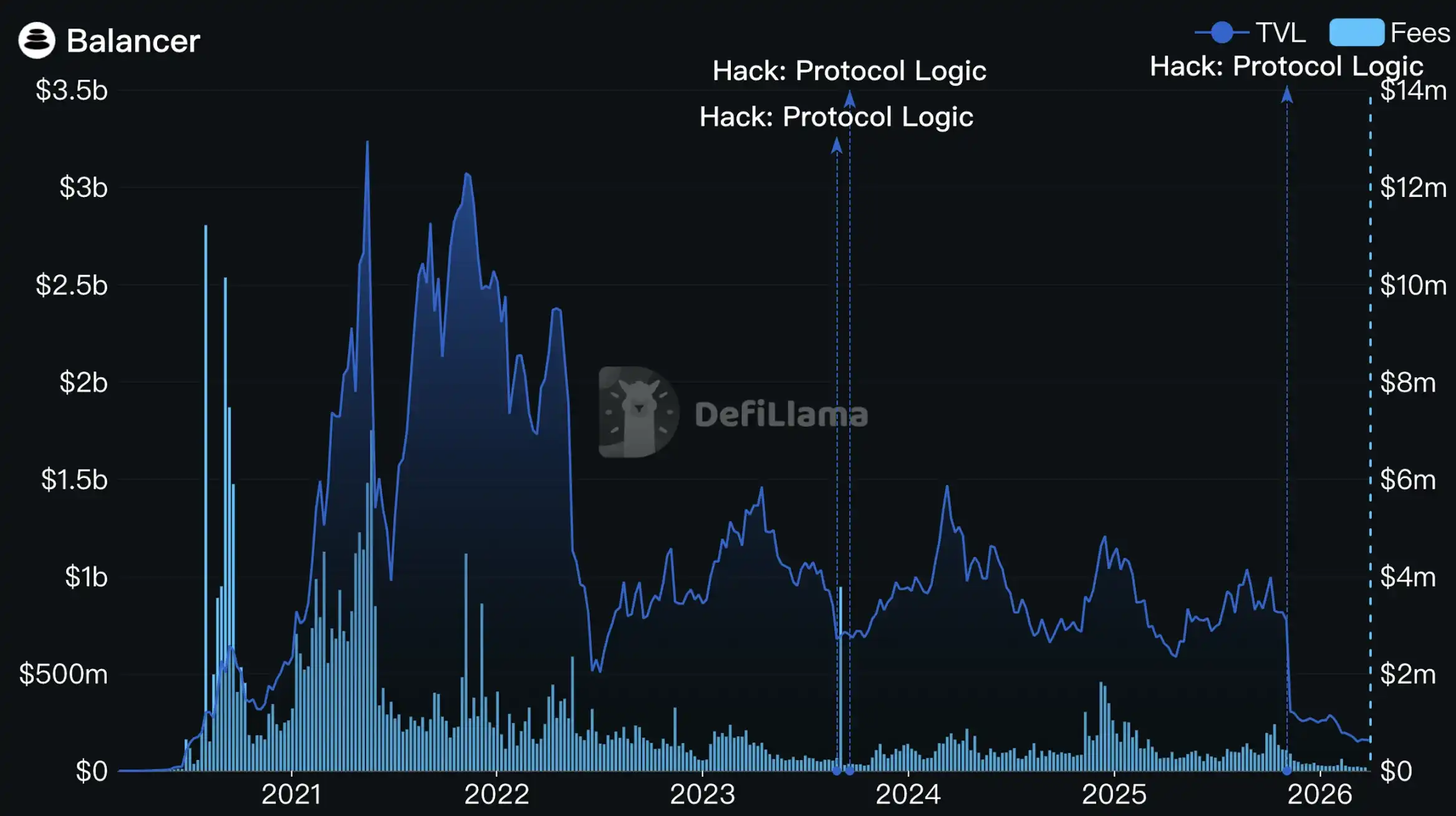
Source: DefiLlama

Balancer has officially reached a crossroads. On March 23, 2026, the Balancer core team simultaneously released two important governance proposals: a comprehensive overhaul of BAL tokenomics and an operational restructuring.

The core logic of these two documents combined can be summarized in one sentence: Abandon the growth model driven by token releases and shift towards sustainable operation driven by revenue.

Operational Restructuring: Team "Slimming Down," Annual Budget Reduced by 34%

The proposal suggests formally dissolving Balancer Labs, with its core technical personnel transitioning to contractor roles and merging into Balancer OpCo Limited, which will continue to operate as the DAO's legal proxy entity.

The team size will be compressed from about 25 people to 12.5 full-time equivalents (including dedicated service providers like Beets, MAXYZ, etc.), and the annual operating budget will be reduced from $2.87 million to $1.9 million, a 34% cut.
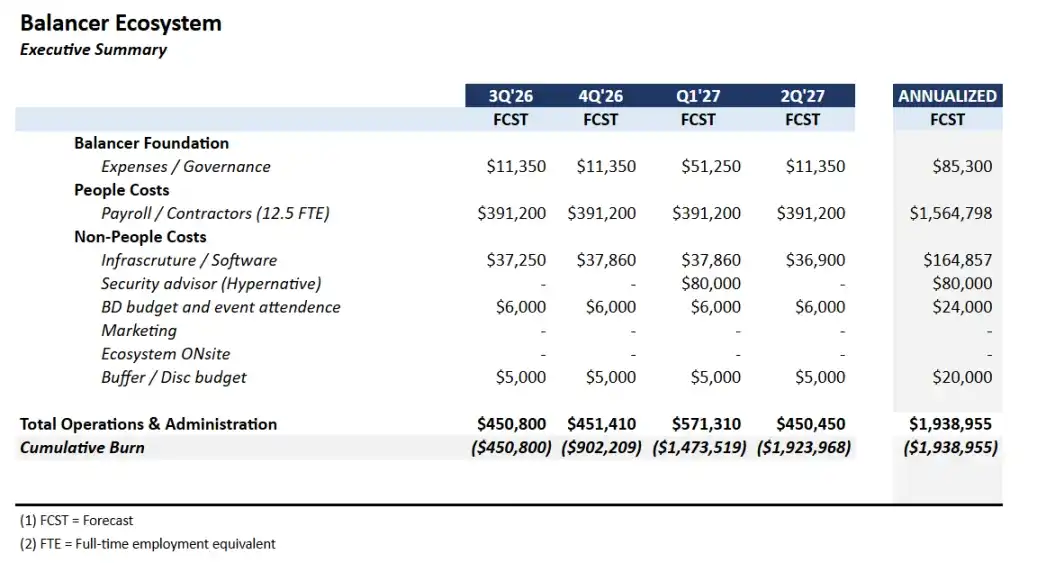
The product lines are also being drastically narrowed. The team will focus resources on three products with validated commercial viability: Boosted Pools (flagship product), reCLAMM (to be relaunched after fixing vulnerabilities, possibly renamed), and LBP (token launch pools, operated opportunistically).

Other exploratory directions, such as ETF structured products, yield optimizers, and AI-driven liquidity tools, will only proceed subject to meeting "core KPIs".

On-chain deployments are also being scaled back. The current model of maintaining V2 and V3 on over 9 chains is unsustainable. The team explicitly retains four core chains: Ethereum, Gnosis, Arbitrum, and Base. Other deployments will be reviewed individually based on fee revenue and operational costs, and terminated if they do not meet standards.

Tokenomics Reform: A Complete Overhaul, Not Minor Tweaks

Stop BAL Emissions, Abolish veBAL

If the proposal passes, Balancer will terminate BAL token incentive emissions, with no transition period.

Simultaneously, the veBAL governance mechanism will be formally abolished. Holders will stop receiving any economic rewards after the final bi-weekly fee distribution. Their locked veBAL will become purely governance credentials, waiting to expire at the end of the lock-up period.

This is a painful decision, but the logic behind it is clear: the veBAL mechanism had a structural flaw from the start, being prone to oligopolistic control. Currently, Aura Finance (a veBAL meta-governance protocol) and whales hold significant voting power, making genuine community voices increasingly faint in governance. This mechanism not only failed to promote the protocol's healthy development but became a vehicle for circular economic games — protocol money flows to middlemen via incentives, and the middlemen's votes direct more incentives towards themselves.

If veBAL was once an experiment by Balancer borrowing from Curve's design, the team now frankly admits: the experiment is over, and the results did not meet expectations.

Regarding the termination of veBAL economic rights, Balancer stated it will provide a $500,000 compensation activity, distributed directly to veBAL holders as pure cash compensation.

All Fees Go to DAO Treasury, Reduce V3 Protocol Take Rate

All protocol fees — V2 swap fees, V3 swap fees, Yield fees, LBP fees — will thereafter flow 100% to the DAO treasury, abandoning the previous multi-party split mechanism.

Simultaneously, the V3 protocol fee take rate will be reduced from 50% to 25%. This means for the same transaction, liquidity providers (LPs) previously received 50%, but will now receive 75%.

These two moves seem opposite in direction but share the same underlying logic: the former eliminates the circular economy, allowing the treasury to obtain real usable funds; the latter increases LP attractiveness, trading lower platform fees for more organic liquidity and real trading volume.

The proposal estimates that post-reform, the DAO's annualized revenue could reach approximately $1.22 million, more than 4 times the current $290,000.

Exit Option: Burn BAL for Stablecoins at $0.16 per Token

The treasury will also allocate 35% of its assets (currently about $3.6 million) to a dedicated pool. This is not for actively buying BAL on the secondary market, but to open a "burn for stablecoins" channel: BAL holders can voluntarily send their tokens to a contract to be burned, receiving stablecoins of equivalent value at the NAV price (Net Asset Value, approximately $0.16 per token).

The window will open 12 months after the proposal passes and last for 12 weeks. Any unused stablecoins after the window closes will return to the treasury. The 12-month waiting period is designed specifically to allow holders whose veBAL unlocks gradually to participate.

At the time of writing, the BAL price is $0.1548, below the NAV price. Offering an exit at the NAV price provides a more dignified option for those wanting to leave than a secondary market stampede.

If this channel is fully utilized, it would burn approximately 22.7 million BAL tokens, about 35% of the circulating supply, which is 6 times the current annual inflation emission.

9-Year "Runway": Is It Enough?

If both proposals pass, the team's projected financial model is as follows:

DAO annualized revenue ~$1.22 million (assuming TVL recovers somewhat after V3 fee reduction), annual operating expenses $1.9 million, buyback expenditure ~$3.6 million, plus the $500,000 veBAL compensation.

After completing the buyback and compensation, the treasury would still have approximately $6.2 million remaining. The annual funding gap would narrow from about $2.6 million to $700,000, giving a theoretical survival period of nearly 9 years.

For a DeFi protocol, 9 years is enough to span a full industry cycle.

But this model is built on optimistic assumptions: that reducing the V3 protocol take rate will indeed attract more organic TVL; that the slimmed-down team can truly support daily protocol operations, security maintenance, etc.; and that core products (especially reCLAMM) can successfully attract the market again after repairs.

If any link underperforms expectations, the 9-year survival period will shorten rapidly. The team itself explicitly states that if DAO monthly revenue falls below $60,000 for 3 consecutive months, a revised plan must be submitted to the community.

For Balancer, this is a nearly all-or-nothing reform. Abandoning the once-proud veBAL mechanism, abandoning the complex multi-party split structure, and returning to an extremely simplified origin: let real transaction fees drive protocol survival, not newly minted tokens maintaining false prosperity.

Whether this desperate reform will work ultimately depends on the market and time, awaiting long-term observation.


Связанные с этим вопросы

QWhat were the main reasons behind Balancer's decision to abandon the veBAL mechanism and stop BAL token emissions?

ABalancer decided to abandon veBAL and stop BAL emissions because the veBAL mechanism was structurally flawed, leading to oligopolistic control by entities like Aura Finance and large holders, which stifled genuine community governance. The token-based growth model created a circular economy where incentives flowed to middlemen instead of supporting protocol health. Additionally, the annual inflation of 3.78 million BAL tokens created significant sell pressure, exacerbating financial unsustainability.

QHow does Balancer plan to address its financial sustainability issues after the proposed changes?

ABalancer aims to achieve financial sustainability by shifting to a revenue-driven model. Key measures include redirecting 100% of protocol fees to the DAO treasury, reducing operational budget by 34% to $1.9 million annually, and lowering the V3 protocol fee take rate to 25% to attract more organic liquidity. These changes are projected to increase DAO annualized revenue to approximately $1.22 million, extending the treasury's runway to nearly 9 years.

QWhat compensation is Balancer offering to veBAL holders, and how will it be funded?

ABalancer is offering a $500,000 compensation package to veBAL holders, funded directly from the DAO treasury. This is a cash compensation for the termination of their economic rights, as veBAL will become a governance-only credential with no further financial benefits after the final fee allocation.

QWhat is the purpose of the 'burn-for-stablecoin' mechanism, and how does it work?

AThe 'burn-for-stablecoin' mechanism allows BAL holders to voluntarily burn their tokens in exchange for stablecoins at a fixed Net Asset Value (NAV) price of $0.16 per BAL. It is designed to provide an orderly exit for holders wishing to leave, reducing sell pressure on the secondary market. The DAO will allocate 35% of its treasury (about $3.6 million) for this purpose, with the window opening 12 months after proposal approval and lasting for 12 weeks.

QWhich product lines and chains will Balancer focus on after the operational restructuring?

APost-restructuring, Balancer will concentrate resources on three commercially validated product lines: Boosted Pools (flagship product), reCLAMM (to be relaunched after bug fixes and possible rebranding), and LBPs (opportunistic operation). Deployment will be limited to core chains: Ethereum, Gnosis, Arbitrum, and Base, with other chains subject to review based on fee revenue and operational costs.

Похожее

Индекс Sci-Tech Innovation 50 вырос на 10.73%: почему китайские акции показали «V-образный разворот»?

После нескольких дней снижения китайский фондовый рынок продемонстрировал сильный отскок. 21 июля основные индексы пережили V-образный разворот и резко выросли. Индекс STAR 50 подскочил на 10.73%, достигнув максимального однодневного роста за год. Шанхайский композитный индекс вырос на 1.79%, индекс Shenzhen Component — на 4.81%, а индекс ChiNext — на 7.05%. Объем сделок на трех биржах составил 2.97 трлн юаней. Более 3100 акций выросли в цене, свыше 100 достигли лимита роста. Ведущей силой восстановления стал сектор полупроводников, где активно росли акции компаний, занимающихся оборудованием, памятью, кремниевыми пластинами и HBM. Соответствующие тематические ETF также показали резкий рост. Сильный отскок рынка объясняется сочетанием трех факторов. Во-первых, на рынок вышли различные источники финансирования, включая "государственные фонды", страховые компании, а также выкуп акций компаниями и управляющими фондами. Это укрепило ликвидность и доверие инвесторов. Во-вторых, регуляторы, в частности председатель Комиссии по ценным бумагам Китая, заявили о приверженности поддержанию стабильности рынка. В-третьих, стабилизация и восстановление зарубежных рынков, особенно в Южной Корее, создали благоприятную внешнюю среду. Аналитики полагают, что наиболее паническая фаза для технологического сектора, вероятно, уже позади. Хотя краткосрочные колебания могут сохраниться, фундаментальные тренды, такие как спрос на вычисления для ИИ и импортозамещение в полупроводниковой отрасли, остаются неизменными. Среднесрочная динамика будет зависеть от новых отраслевых стимулов и подтверждения результатов компаний во время сезона отчетности.

marsbit27 мин. назад

Индекс Sci-Tech Innovation 50 вырос на 10.73%: почему китайские акции показали «V-образный разворот»?

marsbit27 мин. назад

Акции технологических компаний с импульсом показали крупнейший в истории рост за один день, но завершился ли обвал?

Технологические акции с высоким моментом (momentum stocks) в США продемонстрировали рекордно сильный однодневный рост во вторник, 21 июля. Индекс модности TMT Morgan Stanley вырос более чем на 12%, что стало самым большим суточным скачком в истории, превысив даже показатели периода пузыря доткомов в 2000 году. Ключевым драйвером выступили полупроводники: индекс Philadelphia Semiconductor Index подскочил на 4,6%. Этот резкий отскок произошел после трехдневного падения и кумулятивного снижения акций с моментом на 33%, которое стало одним из самых сильных со времен краха доткомов. Основной причиной роста стала "паническая скупка" (short squeeze), когда инвесторы, игравшие на понижение, были вынуждены закрывать свои позиции, создавая восходящую спираль. Однако внутренняя структура рынка остается слабой: объемы торгов были низкими, а в индексе S&P 500 количество падающих акций превышало количество растущих, что указывает на узкий, а не широкий характер восстановления. Мнения аналитиков разделились. Стратег BTIG Джонатан Крински предупреждает, что рост достиг ключевого уровня сопротивления, и рекомендует фиксировать прибыль, ожидая скорой остановки ралли. С другой стороны, аналитики Goldman Sachs и UBS считают, что распродажа активов с моментом подходит к концу, и видят возможность для постепенного увеличения позиций, особенно в акциях, связанных с ИИ. Дальнейшая динамика будет сильно зависеть от сезона корпоративных отчетов, ключевым событием которого станут результаты Alphabet (GOOGL) и ее ориентиры по капитальным затратам. Потенциальной угрозой для рынка акций остается рынок облигаций: доходности гособлигаций США растут, отчасти из-за роста цен на нефть, и их дальнейший рост может оказать давление на фондовый рынок. Таким образом, несмотря на впечатляющий однодневный рост, сохраняется значительная неопределенность относительно того, закончилась ли коррекция.

marsbit34 мин. назад

Акции технологических компаний с импульсом показали крупнейший в истории рост за один день, но завершился ли обвал?

marsbit34 мин. назад

Акции технологического импульса в США установили рекордный однодневный рост, но закончился ли обвал?

Акции технологических компаний с высоким импульсом («моментум») на рынке США показали рекордный рост во вторник, 21 июля. Индекс TMT-моментум Morgan Stanley вырос более чем на 12%, что стало самым большим однодневным скачком в истории. Причиной столь резкого роста стал эффект «сжатия коротких позиций» (short squeeze), когда продавцы, открывшие короткие позиции на фоне предыдущего падения импульсных акций на 33%, были вынуждены их закрывать, подпитывая восходящую динамику. Однако аналитики отмечают, что внутренняя структура рынка остается слабой: объемы торгов были низкими, а при общем росте индекса S&P 500 количество падающих акций превышало количество растущих. Это указывает на то, что восстановление затронуло лишь узкий круг наиболее популярных бумаг, таких как акции полупроводниковых компаний (индекс Philadelphia Semiconductor Index вырос на 4.6%). Стратеги разделились в оценках перспектив. BTIG советует сокращать позиции на росте, считая, что индекс импульсных акций уперся в ключевой уровень сопротивления. Напротив, Goldman Sachs и UBS полагают, что волна распродаж близка к завершению, и рекомендуют постепенно наращивать позиции. Ключевым фактором для определения устойчивости восстановления станут корпоративные отчеты. Особое внимание рынка приковано к отчету Alphabet (GOOGL) и новым прогнозам по капитальным затратам, которые дадут сигнал о перспективах инвестиций в ИИ. Одновременно фондовый оптимизм омрачается ростом доходности гособлигаций США и цен на нефть, что создает макроэкономические риски. Таким образом, несмотря на впечатляющий однодневный отскок, волатильность на рынке, вероятно, сохранится.

链捕手37 мин. назад

Акции технологического импульса в США установили рекордный однодневный рост, но закончился ли обвал?

链捕手37 мин. назад

Bitcoin подает 3 сигнала макро-дна — Но сможет ли BTC достичь $70 тыс.?

Рынок переходит от обсуждения локального дна к поиску макро-дна для биткоина. Аналитик Али Мартинес указывает на появление трех технических сигналов, исторически совпадавших с макро-низами циклов: месячный RSI около 43.65, осциллятор Чанде (CMO) на уровне -71 и цена рядом со скользящей средней за 50 месяцев. Эта комбинация наблюдалась в 2015, 2019 и 2022 годах, каждый раз предшествуя масштабным ралли. Несмотря на прорыв выше $66 000 и оптимистичные технические сигналы, ключевым испытанием остается ликвидность. Доминирование стейблкоинов растет, но их общая капитализация снизилась более чем на $10 млрд за месяц. Данные показывают отток стейблкоинов с бирж в течение 35 дней подряд при отсутствии значительного накопления биткоина на спотовом рынке. Таким образом, хотя техническая картина указывает на формирование макро-дна, для уверенного движения к $70 000 требуется приток свежей ликвидности, который пока отсутствует.

ambcrypto40 мин. назад

Bitcoin подает 3 сигнала макро-дна — Но сможет ли BTC достичь $70 тыс.?

ambcrypto40 мин. назад

Вечно вместе и снова порознь: Когда L1 становится собственным Rollup, что ждет Ethereum в финале?

Стремясь решить проблему масштабируемости, Ethereum изначально принял стратегию, где L1 выступает в качестве безопасного, но дорогого уровня расчетов, а Rollup на L2 предоставляют дешевое пространство для выполнения транзакций. Однако по мере того, как L1 сам развивает свои возможности (увеличение лимита газа, безсостоятельность, zkEVM), его пропускная способность значительно возрастает. Это ставит под вопрос уникальную ценность L2, основанную лишь на низкой стоимости транзакций. В ответ Ethereum пересматривает отношения между L1 и L2. L1 должен стать мощным, устойчивым глобальным хабом для расчетов, общего состояния и ликвидности. Роль L2 смещается от простого расширения к предоставлению дифференцированных функций, таких как оптимизация под конкретные приложения, конфиденциальность или гибкие модели управления, формируя спектр сред выполнения с разной степенью наследования безопасности Ethereum. Ключевой вызов фрагментированной многокомпонентной экосистемы — взаимодействие. Улучшение пользовательского опыта сосредоточено на нативной абстракции аккаунтов (например, EIP-7702) и межоперабельности. Цель — позволить Ethereum «снова ощущаться как единый блокчейн». Это включает в себя фреймворки интентов (intents), такие как Open Intents Framework, и протоколы межоперабельности (Ethereum Interop Layer), которые упрощают кросс-чейн взаимодействия. Сокращение времени финализации транзакций на L1 с минут до секунд также критически важно для эффективной работы мостов и приложений. Интригующая перспектива, выдвинутая исследователями, — это возможная конвергенция архитектур L1 и L2. С внедрением систем доказательств (например, zkEVM) на основном уровне, валидаторы L1 могут начать проверять состояние с помощью доказательств, а не повторного выполнения, что делает сам Ethereum в некотором роде «своим собственным Rollup». Одновременно концепция Native Rollup предполагает более тесную интеграцию проверки L2 в протокол L1. Это может привести к размытию четких границ между уровнями, превратив Ethereum в единую систему консенсуса с множеством специализированных сред выполнения (доменов), которые разделяют общую основу безопасности, ликвидность и надежную синхронизацию состояния. Таким образом, эволюция Ethereum движется от разделения выполнения для масштабирования к повторной интеграции разрозненных компонентов в единую, но разнородную экосистему. Итогом может стать не иерархия L1/L2, а сеть взаимосвязанных сред, которые вместе образуют целостный и мощный Ethereum.

链捕手51 мин. назад

Вечно вместе и снова порознь: Когда L1 становится собственным Rollup, что ждет Ethereum в финале?

链捕手51 мин. назад

Торговля

Спот
活动图片




