Abandon Illusions, Prepare for the Most Grueling Time in the Crypto Market

marsbitОпубликовано 2025-12-20Обновлено 2025-12-20

Введение

The article argues that while cryptocurrency adoption will continue to accelerate, market valuations may remain depressed or decline further for a prolonged period. This decoupling between real-world usage and price action is presented not as a flaw, but as a necessary and healthy feature of the market's maturation. The author draws a parallel to the dot-com bubble, where internet user growth exploded even as the Nasdaq crashed. The core thesis is that the market is undergoing a painful but essential recalibration. Many assets were fundamentally overvalued, and the current phase will pressure-test business models, eliminating flawed projects and forcing rational valuations. Cryptocurrency is transitioning from a speculative asset to a core, "boring" infrastructure technology, much like the internet did. This shift creates discomfort. Builders, early investors, and retail token holders may see value captured by traditional companies and VCs that leverage the open infrastructure. The article posits that the biggest beneficiaries might be traditional and hybrid businesses that use crypto to improve efficiency, rather than the underlying protocols themselves. The author's outlook for near-term prices is not optimistic, warning that the process could be a prolonged test of patience. They advocate for a long-term perspective, capital preservation, and a focus on businesses with sound unit economics, while cautioning against over-financialized models and excessive infrastructure ...

Author: Santiago Roel Santos

Compiled by: Tim, PANews

The Price and Adoption Paradox

Crypto adoption will continue, but market prices may not recover for a long time.

This contradiction between accelerating real-world adoption and lagging market prices is not a flaw, but a necessary feature of the current stage of crypto market evolution.

If you look at the crypto market from a ten-year perspective, its prospects are very attractive. However, maintaining this long-term perspective is psychologically challenging. You should be prepared to watch adoption rates expand while prices stagnate or slowly decline; you must also be prepared to watch others profit in other areas (AI, stocks, or the next hot trend the market hypes) while the crypto space seems forgotten.

It will feel unfair, and the process will be grueling. But the price lag is inevitable. Fundamentally, many of these crypto assets never deserved the valuations they once had.

The market doesn't care about actual adoption until the price crashes and it starts to care again.

Application Proliferation Fuels Bubbles

Initial application proliferation can actually fuel bubble problems. This is the painful process of value discovery. When real usage demand cannot support inflated valuations, the market will recalibrate, and this is precisely the necessary path to long-term healthy development.

When crypto infrastructure achieves scaled application, it becomes clear that the capital invested far exceeds its actual needs. Application proliferation will bring pressure tests for business models rather than value verification. Some projects will die off quietly, and while others may survive, their valuations will be far lower than the visions painted at their peak.

Cryptocurrency is moving from the spotlight, the main character, to gradually fading from view, becoming ordinary. From exciting to mundane, and this is the necessary path from noise to maturity.

This is a good thing.

This script isn't new. During the dot-com bubble burst, the NASDAQ index plummeted by about 78%, while the number of internet users tripled and broadband infrastructure was fully deployed. The market took years to recover, and now the internet has quietly reshaped the world. While investors were still licking their wounds, software was "eating" the whole world.
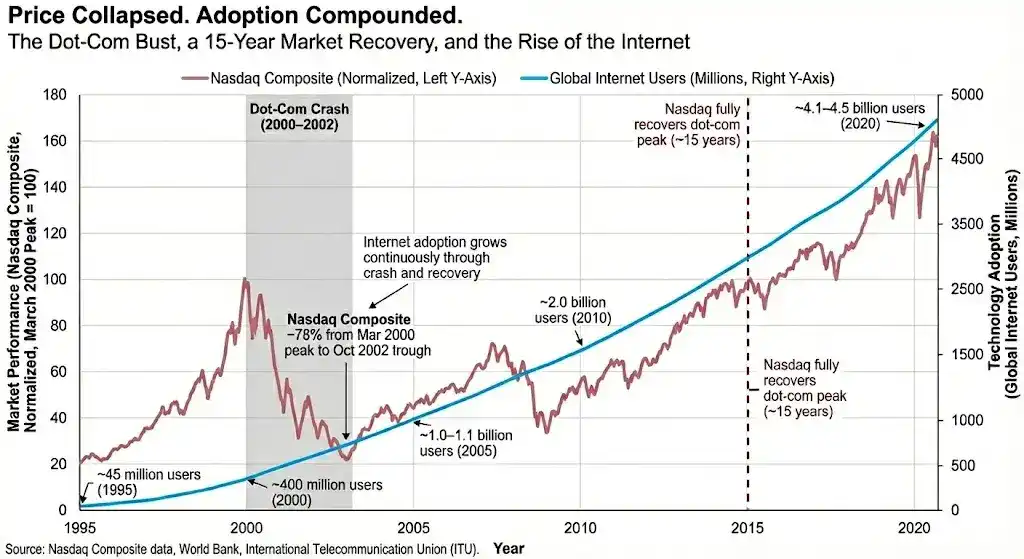
Infrastructure technology does not reward impatient investors.

When Infrastructure Wins, Who Will Be the Real Winners?

The shift in market phases will make many participants uncomfortable. Builders who have spent years maintaining open-source codebases will watch other companies copy their work and reap most of the economic benefits; early native crypto VCs who invested in infrastructure will see traditional VCs capture more value; retail investors who bought tokens instead of equity may feel marginalized, as enterprises benefit from the ecosystem network without returning corresponding value to token holders.

Some are structural problems, some are self-inflicted dilemmas.

The market is adjusting itself. Open networks will develop rapidly, system incentives will change, value capture mechanisms will improve, but not all models will survive long enough to benefit.

Crypto adoption is quietly advancing, it's just that the market hasn't truly valued it yet. It may take years for the market to re-establish the value connection and recognize that crypto technology is a core operating system, not just a speculative asset.

Price Cycles and Application Cycles Are Two Different Things

Price cycles are driven by market psychology and liquidity.

Application cycles are driven by utility value and infrastructure.

The two are related, but not synchronized. Historically, prices often led adoption, which is common in early technological revolutions. Now, adoption is starting to lead, and prices are instead lagging.

Right now, the marginal buyers of crypto assets are elsewhere, they are chasing the AI wave. This phenomenon may continue, or it may reverse, regardless of our will.

But what we can see is that a world without stablecoins, without transparent capital channels, without global 24/7 real-time settlement is becoming increasingly difficult to imagine.

The most profound lesson cycles teach us is: we must accept that the disconnect between application and price may last much longer than expected, and if you want sustained compound interest, you need to remain rational when you lose patience.

This is not a HODL manifesto.

Many crypto projects will never recover. Some were flawed by design, some lack moats, and others have been completely abandoned. New winners will inevitably be born, there will be fallen stars, and a few true dark horses.

Pullbacks Are Healthy

We are entering a different regulatory and economic environment. This creates an opportunity to solve long-standing problems: weak product revenue, insufficient asset disclosure, mismatched equity and token structures, and opaque team incentives.

If the crypto industry really wants to become what it aspires to be, it must first act the part.

I believe anything is possible. My most confident view is that most businesses will adopt crypto technology to remain competitive within the next 15 years. By then, the total market capitalization of cryptocurrency will exceed ten trillion dollars. Stablecoins, tokenization, user scale, and on-chain activity will grow exponentially. Meanwhile, valuation standards will be redefined, existing giants may decline, and unreasonable business models will eventually be eliminated.

This is healthy, and necessary.

Cryptocurrency will eventually become invisible. The more a company makes crypto the core of its product, the more fragile its business model often is. The truly lasting winners will embed it deeply in business processes, payment systems, and balance sheets. Users should not be aware of the crypto technology's existence, but should feel its benefits: faster settlement, lower costs, and reduced intermediaries.

Cryptocurrency should be pure and "boring".

As capital tightens, the era of airdrop proliferation, subsidy-driven demand, unreasonable incentives, and over-financialization is coming to an end. This is just another inevitable historical cycle.

My basic judgment is simple: crypto adoption will accelerate, prices will readjust, and valuations will return to rationality. Crypto is a long-term trend, but this absolutely does not mean the tokens you hold will necessarily rise.

Who Actually Captures the Value of Crypto Technology?

Basic technology primarily benefits consumers by lowering prices and improving experience. The secondary beneficiaries are those enterprises that upgrade their own systems to leverage cheaper, faster, more programmable infrastructure.

This theoretical framework raises some uncomfortable but necessary questions:

  • Visa or Circle?
  • Stripe or Ethereum?
  • Robinhood or Coinbase?
  • A basket of Layer 1 protocols or user aggregators?
  • A basket of Layer 1 protocols or DeFi?
  • A basket of Layer 1 protocols or DePIN?
  • DeFi or traditional finance stocks?
  • DePIN or infrastructure stocks?

This isn't an absolute either/or; diversified investment strategies are also feasible. The question is about relative value and relative performance. Who will capture the surplus value created by blockchain?

I lean towards traditional and hybrid enterprises that connect to open settlement channels to reduce costs and increase profit margins. History suggests they often benefit more than the infrastructure itself.

But it must be emphasized that there are exceptions to every theoretical framework.

What I Believe, and What I Don't

I do believe that networks with real demand will eventually monetize, the internet has proven this. Facebook also went through many years before commercialization.

I am confident that the value of some Layer 1s will be validated as they develop, eventually matching their valuation. But I also believe most will struggle to attract users and find sufficient value support.

I believe the gap between winners and losers will widen further. Distribution, market entry strategy, user relationships, and unit economics will be far more important than first-mover advantage.

A common misconception in crypto is overestimating the early advantage of technological leadership while underestimating other elements required for subsequent development.

Back to Reality

My view on price movements in the coming years is not particularly optimistic. Adoption will continue to rise, but prices may fall further, potentially exacerbated by broader stock market mean reversion and a cooling AI hype cycle.

But, patience is a great advantage.

  • I am bullish on Crypto-as-a-Service models
  • I am bullish on crypto-enabled enterprises
  • I am bearish on over-financialization
  • I am bearish on failed unit economics
  • I am bearish on overbuilding infrastructure

Protecting capital becomes crucial. Cash is undervalued: not for its yield, but for the psychological immunity it grants. It allows you to act decisively when others cannot.

The market has entered a fast-paced and increasingly impatient era. Nowadays, having a longer time horizon than most participants is itself a substantial advantage. Professional managers must frequently adjust positions to prove their value. Faced with increasing life pressures, retail investors are increasingly chasing short-term trends. And institutional investors will inevitably once again declare cryptocurrency dead.

Slowly, more traditional companies will adopt crypto technology, more balance sheets will connect to the blockchain.

One day, when we look back on this period in hindsight, everything will seem so clear. The signals were everywhere, it's just that firm conviction often seems easy only after prices rise.

Until then: wait for the pain to arrive.

Wait for sellers to capitulate, wait for faith to collapse, but we are not there yet.

No need to rush into action, the market will continue to fluctuate, life goes on, spend more time with the people you care about. Don't let your investment portfolio become your whole life.

The crypto world will operate silently, whether the market is in the shadows or under bright lights.

Good luck to all.

Связанные с этим вопросы

QAccording to the article, what is the paradox between price and adoption in the current crypto market?

AThe paradox is that crypto adoption continues to accelerate, but market prices may stagnate or decline for a long time. This is a necessary feature of the current stage of market evolution, not a flaw.

QWhat historical event does the author compare the current crypto market phase to, and what was the outcome of that event?

AThe author compares it to the dot-com bubble burst, where the NASDAQ index fell about 78% while internet user numbers tripled and broadband infrastructure was widely deployed. The market took years to recover, but the internet ultimately reshaped the world.

QWho does the author suggest will be the ultimate beneficiaries as crypto infrastructure matures and becomes widely adopted?

AThe author suggests that the primary beneficiaries will be consumers through lower prices and better experiences, and the secondary beneficiaries will be traditional and hybrid enterprises that upgrade their systems to use the cheaper, faster, and more programmable infrastructure.

QWhat is the author's view on the future price trend of crypto assets in the coming years?

AThe author is not particularly optimistic about price movements in the coming years. They believe adoption will continue to rise, but prices may fall further, potentially exacerbated by a broader stock market mean reversion and a cooling AI hype cycle.

QWhat key piece of caution does the author give to investors regarding their investment strategy and mindset?

AThe author cautions that protecting capital is crucial and emphasizes the underestimated value of cash, not for its yield, but for the psychological immunity it provides, allowing one to act decisively when others cannot. They advise having a longer time horizon and not letting one's portfolio become their entire life.

Похожее

Неправомерно пострадавшие A-акции: Устойчивость, ожидания и основание

В июле глобальные технологические акции столкнулись с коррекцией, начавшейся с распродаж в Южной Корее и затронувшей рынки США, Японии и Китая (A-shares). Однако китайский рынок продемонстрировал устойчивость благодаря нескольким факторам. Во-первых, базовые показатели технологического сектора Китая остаются прочными. Такие подотрасли, как оптические модули и оптическое волокно, показывают высокий рост прибыли (например, New Eastsoft, Changfei Optical Fiber). В отличие от южнокорейского рынка, сильно зависящего от полупроводников памяти, китайский технологический сектор диверсифицирован (компьютеры, связь, электроника) и опирается как на глобальные цепочки поставок (например, для NVIDIA), так и на политику импортозамещения. Во-вторых, государственные институты («команда страны») активно поддерживают рынок, выделив сотни миллиардов юаней на выкуп акций и ETF через такие компании, как China Reform Holdings и China Chengtong. Этот шаг направлен на стабилизацию ликвидности и формирование позитивных ожиданий, сигнализируя о возможном достижении локального дна. В-третьих, другие ключевые секторы A-shares демонстрируют внутренний потенциал для восстановления: * **Потребительский сектор:** CPI стабильно превышает 1%, указывая на улучшение маржи. Ключевые игроки, такие как Kweichow Moutai, повышают цены, а розничные продажи алкоголя растут. * **Сырьевой сектор (например, алюминий):** Высокая рентабельность, сохраняющийся дефицит предложения и низкие оценки создают потенциал для роста. * **Финансовый сектор:** Банки предлагают высокие дивиденды, а брокеры и страховщики выигрывают от оживления на рынке капитала. Таким образом, текущая коррекция в основном вызвана внешними факторами, а не ухудшением фундаментальных показателей. При поддержке государства и наличии внутренних драйверов роста в нескольких секторах рынок A-shares обладает значительной устойчивостью для возвращения к стабильности.

marsbit23 мин. назад

Неправомерно пострадавшие A-акции: Устойчивость, ожидания и основание

marsbit23 мин. назад

Квантовые компьютеры ещё не пришли, а 1,1 миллион биткоинов Сатоши Накамото уже стали проблемой

**Квантовые компьютеры еще не прибыли, а 1,1 миллион биткоинов Сатоши уже стали проблемой** Инструмент на основе доказательств с нулевым разглашением (ZK) от Project Eleven обещает помочь владельцам современных кошельков (после 2012 года) безопасно мигрировать активы перед квантовой атакой. Однако для ранних биткоинов, включая примерно 1,1 миллион монет, добытых Сатоши Накамото и хранящихся в устаревших адресах P2PK, этот инструмент бесполезен. У этих «старых» монет нет иерархической структуры ключей (HD), что делает их криптографически незащищенными. Сообщество Bitcoin столкнулось с политической, а не технической дилеммой: как защитить сеть, не нарушая ее основные принципы? Предлагается четыре спорных пути, каждый со своими последствиями: бездействие (риск массовой кражи), принудительная заморозка старых монет (нарушение прав собственности), ограничение их расходования («песочные часы») или принудительное перераспределение (разрушение неизменности реестра). Рынок уже реагирует на этот кризис управления. Например, Jefferies сократил свои биткоин-холдинги, ссылаясь именно на неопределенность в вопросе уязвимых монет. Угроза не только в будущих атаках, но и в «отложенном» взломе: злоумышленники уже сейчас сохраняют данные блокчейна для последующей расшифровки. Ключевой вопрос остается без ответа: как Bitcoin может пережить смену технологических эпох, не отказавшись от своих фундаментальных основ? Квантовый вызов уже породил кризис доверия.

marsbit32 мин. назад

Квантовые компьютеры ещё не пришли, а 1,1 миллион биткоинов Сатоши Накамото уже стали проблемой

marsbit32 мин. назад

Где будет главное поле битвы следующего бычьего рынка? Ответ скрыт в этих двух классах активов

Крипторынок показывает признаки достижения дна. С 1 июля биткойн вырос на 9%, тогда как индекс Nasdaq 100 упал на 6%. Вопрос о том, какие активы возглавят следующий бычий цикл, становится актуальным. По мнению Мэтта Хоугена, главным нарративом следующего бума криптовалют станет слияние традиционных финансов (TradFi) и ончейн-финансов (DeFi). Это будет включать стейблкоины, токенизацию активов, круглосуточную торговлю, мгновенные расчеты и рост институционального DeFi до масштаба в триллионы долларов. Два ключевых направления для инвестиций выделяются в этой тенденции: 1. **Нативные криптопроекты с реальными доходами и качественной токеномикой**, такие как Hyperliquid (HYPE). Эта L1-сеть для деривативов привлекает пользователей удобством и быстро расширяется на торговлю традиционными активами (нефть, индексы). Платформа генерирует значительные доходы, 99% из которых направляются на выкуп и сжигание токена HYPE. 2. **Устоявшиеся традиционные компании, активно внедряющие криптоинфраструктуру**, такие как Robinhood (HOOD). Брокер не только предлагает торговлю криптовалютами, но и запустил собственную L2-сеть Robinhood Chain для круглосуточной торговли токенизированными акциями и использования DeFi-протоколов в 120 странах, демонстрируя серьезные намерения. Автор считает, что будущий бычий рынок, движимый реальной полезностью и нацеленный на глобальные финансы, может стать крупнейшим в истории. Инвесторам стоит обратить внимание на проекты и компании, которые уже сегодня активно строят мосты между двумя мирами финансов.

Foresight News36 мин. назад

Где будет главное поле битвы следующего бычьего рынка? Ответ скрыт в этих двух классах активов

Foresight News36 мин. назад

Путь к принятию закона Clarity: Дорога двухпартийных компромиссов в США усыпана терниями

Закон о регулировании крипторынка Clarity сталкивается со значительными трудностями на пути к принятию в Конгрессе США. Несмотря на двухпартийное согласие о необходимости законодательства, ключевые разногласия по этическим нормам для избранных лиц, вопросам «доходности» и защите разработчиков блокируют прогресс. В мае законопроект прошел комитет Сената по сельскому хозяйству без поддержки демократов, которые настаивают на строгих этических гарантиях. К июлю давление возросло: республиканцы стремятся к голосованию, а демократы и некоторые республиканцы, а также правоохранительные органы выражают озабоченность по поводу потребительских рисков и отмывания денег. Хотя работа над поиском компромисса продолжается, включая переговоры с Белым домом, сенаторы-демократы четко дают понять, что без приемлемых этических положений их поддержки не будет. Несмотря на оптимизм в отрасли, путь к принятию закона остается крайне сложным и зависит от способности сторон найти взаимоприемлемое решение по спорным вопросам.

marsbit44 мин. назад

Путь к принятию закона Clarity: Дорога двухпартийных компромиссов в США усыпана терниями

marsbit44 мин. назад

Основатели Kalshi и Polymarket враждуют? Эта бизнес-война оказалась гораздо ожесточеннее, чем можно представить

В 2024 году основатель Polymarket Шейн Коплан столкнулся с обыском ФБР, который, по мнению его команды, мог быть инициирован его главным конкурентом — CEO Kalshi Тареком Мансуром. Два основателя предсказательных рынков, оба ставшие миллиардерами, ведут ожесточенную борьбу, выходящую далеко за рамки обычной бизнес-конкуренции и переходящую в личную вражду. Их противостояние основано на разных подходах: Kalshi делает ставку на полное соблюдение правил США, в то время как Polymarket долгое время работал через офшорную платформу, доступную американским пользователям через VPN. Мансур публично осуждает методы Polymarket как «незаконные и неэтичные». Конфликт проявляется во всем: в попытках сорвать сделки друг друга (как в случае с переговорами о финансировании от Intercontinental Exchange), в переманивании сотрудников, в публичных нападках и даже в предположениях о слежке. Kalshi неоднократно жаловалась регуляторам на Polymarket. Несмотря на давление, Polymarket, получившая крупные инвестиции и купившая лицензированную платформу, вернулась на рынок США. Сейчас Kalshi лидирует по объему торгов и оценке, но война за доминирование на быстрорастущем рынке предсказаний продолжается, привлекая все больше внимания регуляторов.

marsbit51 мин. назад

Основатели Kalshi и Polymarket враждуют? Эта бизнес-война оказалась гораздо ожесточеннее, чем можно представить

marsbit51 мин. назад

Торговля

Спот
活动图片





