I Built Myself an Investment Workbench Using AI

marsbitОпубликовано 2026-06-16Обновлено 2026-06-16

Введение

For the past two weeks, I've been immersed in Vibe Coding—using AI to write code from natural language descriptions. This process has enabled me to quickly build functional tools that address long-standing personal ideas. Previously, I had many concepts but found execution too cumbersome. Key ideas included a unified dashboard for assets across US stocks, Crypto, HK stocks, and A-shares; a real-time alert system for price movements; an investment map visualizing sector relationships; and a tool to correlate prediction market bets with news and market data. Traditional development hurdles meant these often remained unrealized. Using AI (Codex, Claude Code, and DeepSeek API), I built four initial tools: 1. A **Cross-Market Asset Dashboard** showing total assets, daily P&L, and holdings by market, with added features for alerts and sector mapping. It's deployed locally for privacy. 2. A **Prediction Market (PM) Monitor** tracking bets on events (e.g., company valuations) and correlating probability shifts with news and market movements. I categorize bets by conviction to filter noise. 3. A **Simple Operations Backend** for managing my writing workflow (topics, progress, publishing). It's cloud-deployed for mobile access. 4. A **One-Click Formatting Tool** that automates converting drafts into various platform-specific formats, saving manual effort. While these tools are basic, they represent a significant shift: AI lowers the barrier to creating personalized systems. I be...

Over the past couple of weeks, I’ve been a bit obsessed with Vibe Coding.

Not the "I'm going to build an amazing product" kind of obsession, but a sudden realization that many of the little ideas that have been stuck in my head for so long can actually be brought to life, bit by bit.

As you all know, Vibe Coding is about using natural language to command AI to write code for you, to "craft" a product.

I mainly use a combination of Codex and the Claude Code client, describing requirements and functional modules, and they write the code for me. When I run out of quota, I switch to the CLI and continue running with the DeepSeek API.

One: Those "I wanted to do it but never did" ideas

I used to have a lot of ideas pop into my head.

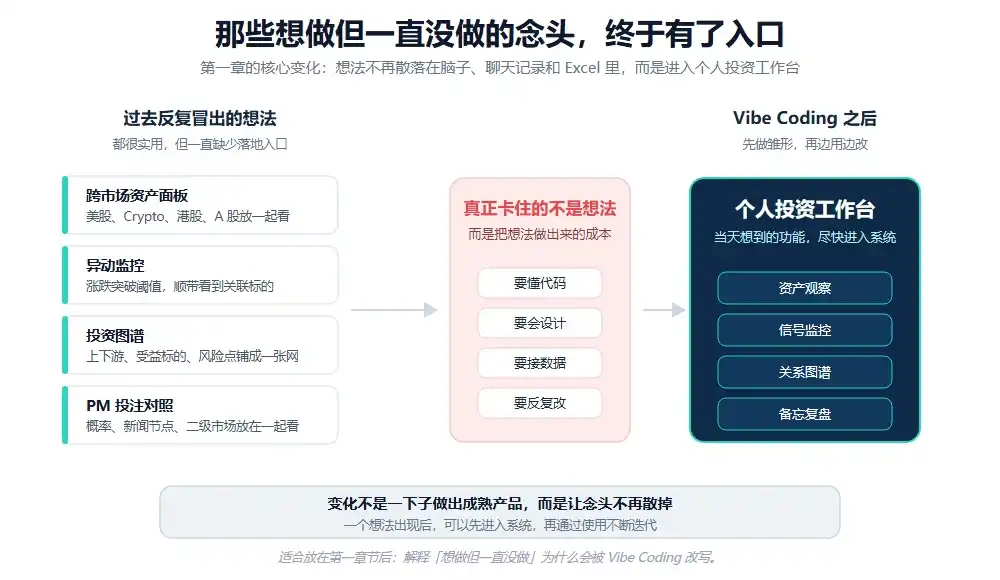
For example, could I have a dashboard to view assets like US stocks, Crypto, Hong Kong stocks, and A-shares all together, instead of switching between several apps every day?

For example, could I create an anomaly monitor, so if an asset suddenly spikes or crashes, I can see it immediately, and also know what other assets or sectors it's related to.

For example, could I build an investment map, so when researching a sector, I don't just focus on one project, but lay out the entire network: upstream, downstream, beneficiaries, potential risks, related assets.

And for example, on prediction markets (PM), there are many bets about unlisted company valuations, market cap overtakes, macro events. Could I put this data together with news events and secondary market changes for comparison?

Plenty of ideas, but actually doing them was too much hassle.

You need to know code, design interfaces, integrate data, and iterate repeatedly; hiring someone is expensive, and requirements aren't always clear. After a few rounds, most ideas ended up with that phrase—"Forget it, let’s just make do with Excel for now."
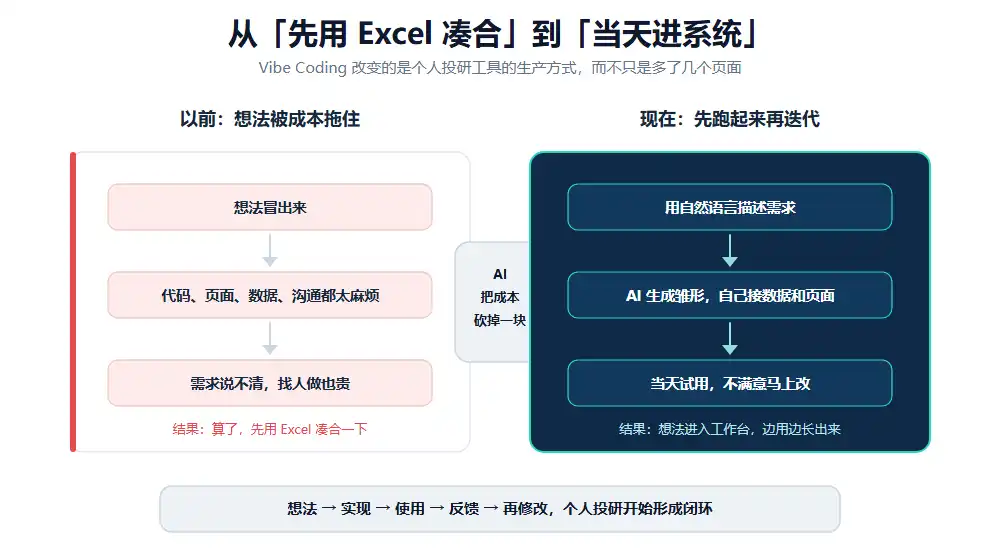
But after tinkering with Vibe Coding for these two weeks, I found this is truly different.

I started building some rough but practical tools for myself. An idea pops up, and it can be integrated into the system the same day, instead of being scattered across chat records, bookmarks, and my own mind.

Two: Four small tools I crafted in two weeks

I mainly built four things in these two weeks (other miscellaneous small tools don't count).

First, Cross-Market Asset Dashboard

The reason was very simple. My assets are scattered across several places: Hong Kong and US stocks in brokerage apps, Crypto on trading platforms, A-shares in another software.

Every day, wanting to see my overall situation meant opening each one, switching back and forth. After checking everything, I still couldn't piece together the full picture. So the first thing I did was stuff all my holdings into one page:

Top section shows total assets, daily P&L. Below, divided by market—one section for US stocks, one for Crypto, one each for HK and A-shares. At a glance, the state of my entire portfolio, who's up and who's down today, is crystal clear.
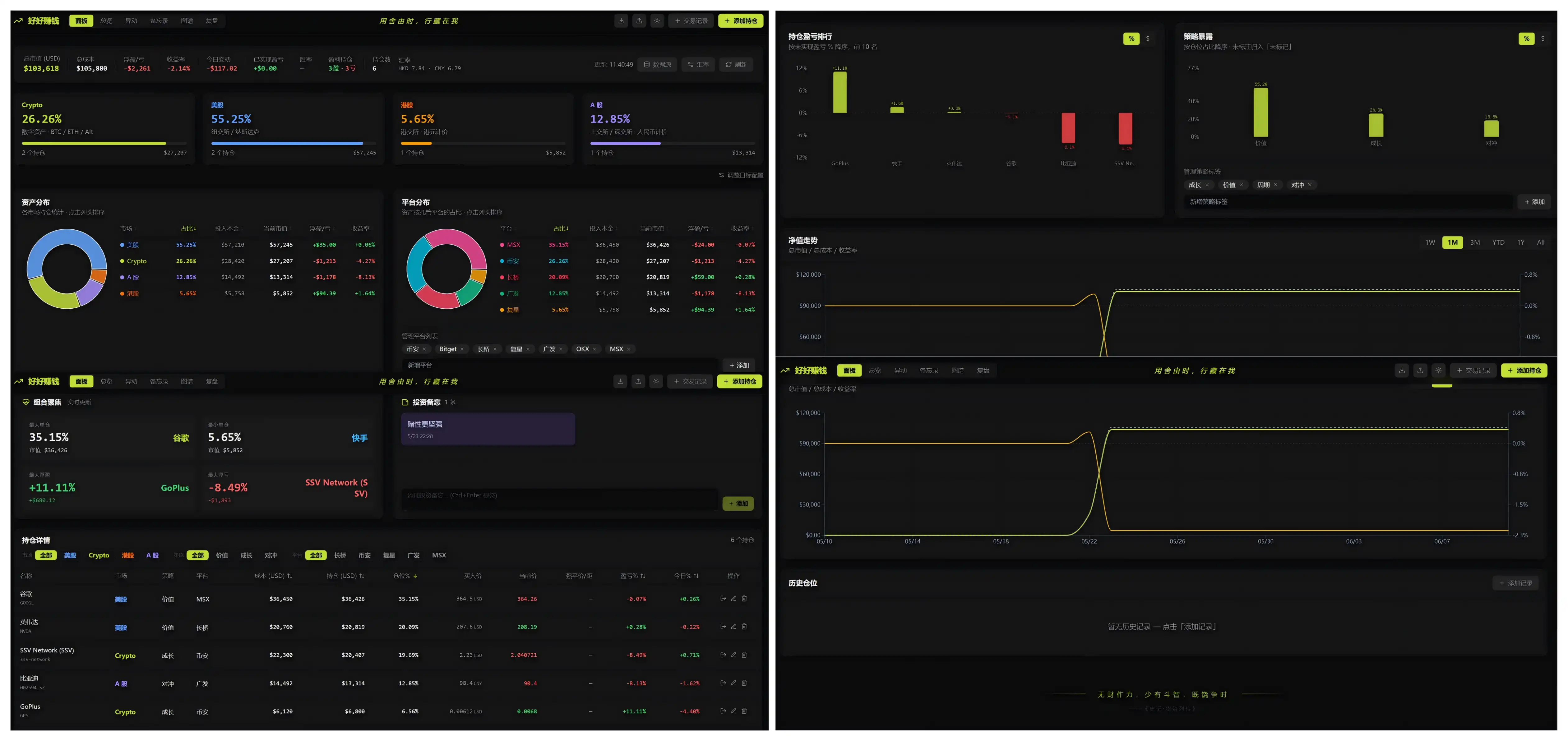
After finishing it, I found it quite useful, and couldn't help but keep adding Tab after Tab, because new needs kept emerging as I used it:

  • Anomaly Monitor: I pre-set the assets I care about and thresholds. If anyone suddenly surges or crashes, it highlights it for me, saving me from constantly watching the market.
  • Investment Map: When researching a sector, draw the upstream, downstream, beneficiaries, risk points, and related assets into a network, making it easier to trace capital flow chains and relationships.
  • Memo + Review: Jot down why I was bullish initially, what happened later, where my judgment was right or wrong, so I can look back later.
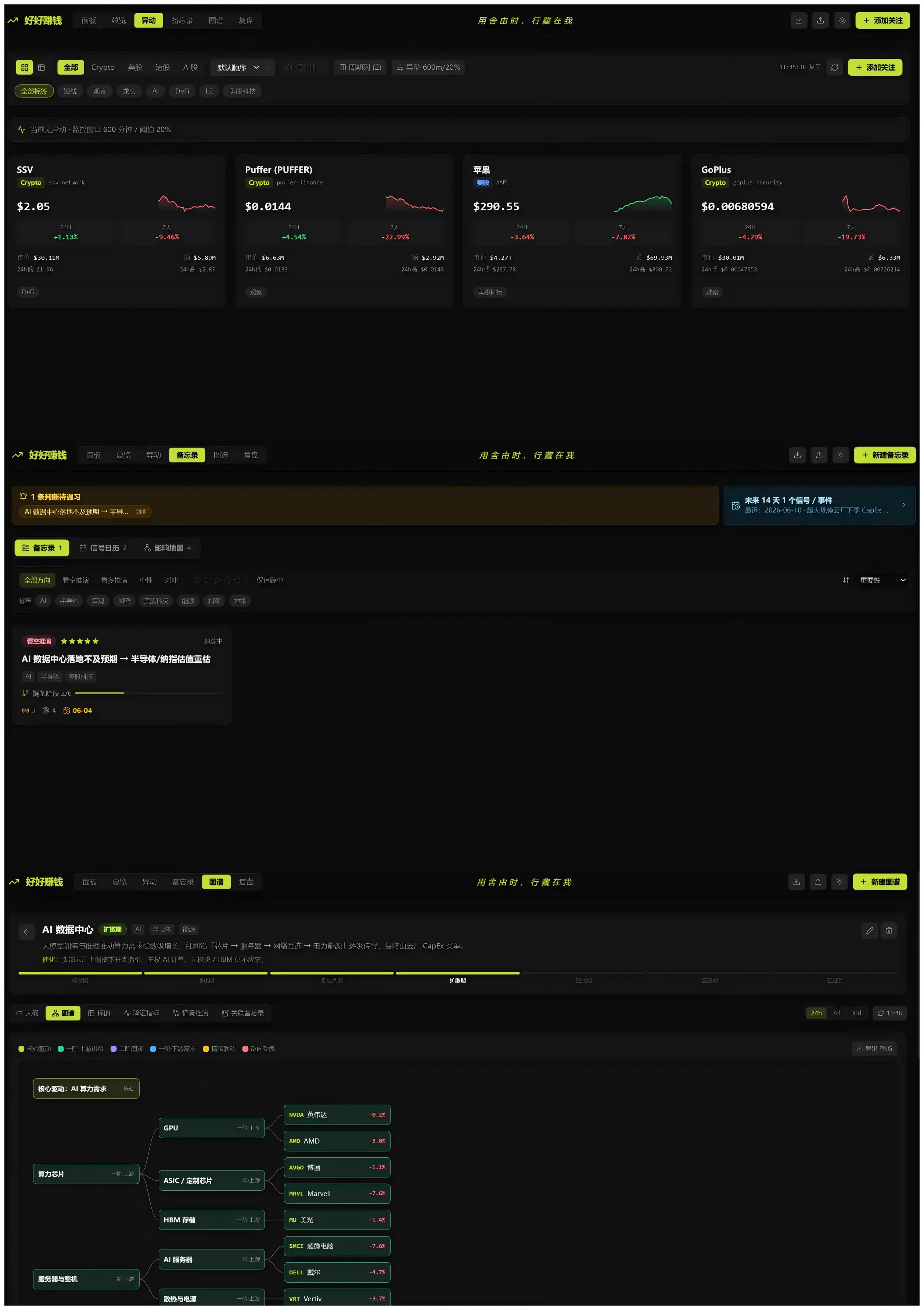
Since this dashboard contains all my real holdings, it's quite private, so I deployed it locally.

Second: PM Bet Monitor

This one is specifically for watching prediction markets.

To explain briefly, prediction markets (like PM) are where people use real money to bet on whether a future event will happen. The price itself represents the market's perceived probability—for example, a "yes" for "SpaceX market cap reaches $2 trillion by end of June" priced at 0.8 means the market thinks there's an 80% chance of it happening.

For the bets I care about, like "Will OpenAI/Anthropic's valuation go up by year-end?" "Will a certain market cap overtake event among the Magnificent Seven happen?", "Will xx and xx meet?", I used to have to check each one individually. Now I've centralized them into a single dashboard. I also compare probability changes alongside news events and secondary market fluctuations. Who moves first, who influences whom, becomes clear at a glance.
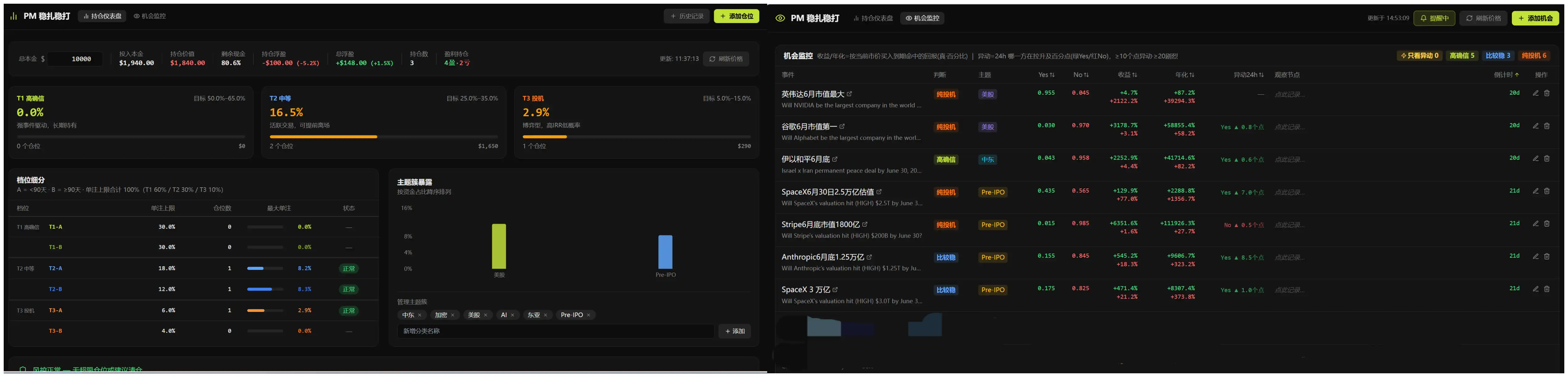
I also tiered these bets according to my own criteria (internally called T1 (high conviction) / T2 (relatively stable) / T3 (pure speculation)), sorted by expected return, so I can instantly distinguish which are just noise.

Honestly, a small edge I have in this market is Chinese information and East Asian political-economic dynamics—many are dominated by Western players, and pricing for this area is often half a step behind. Opportunities hide in this time gap.

Third: Small Operations Backend

This one isn't related to investment; it's for my own writing.

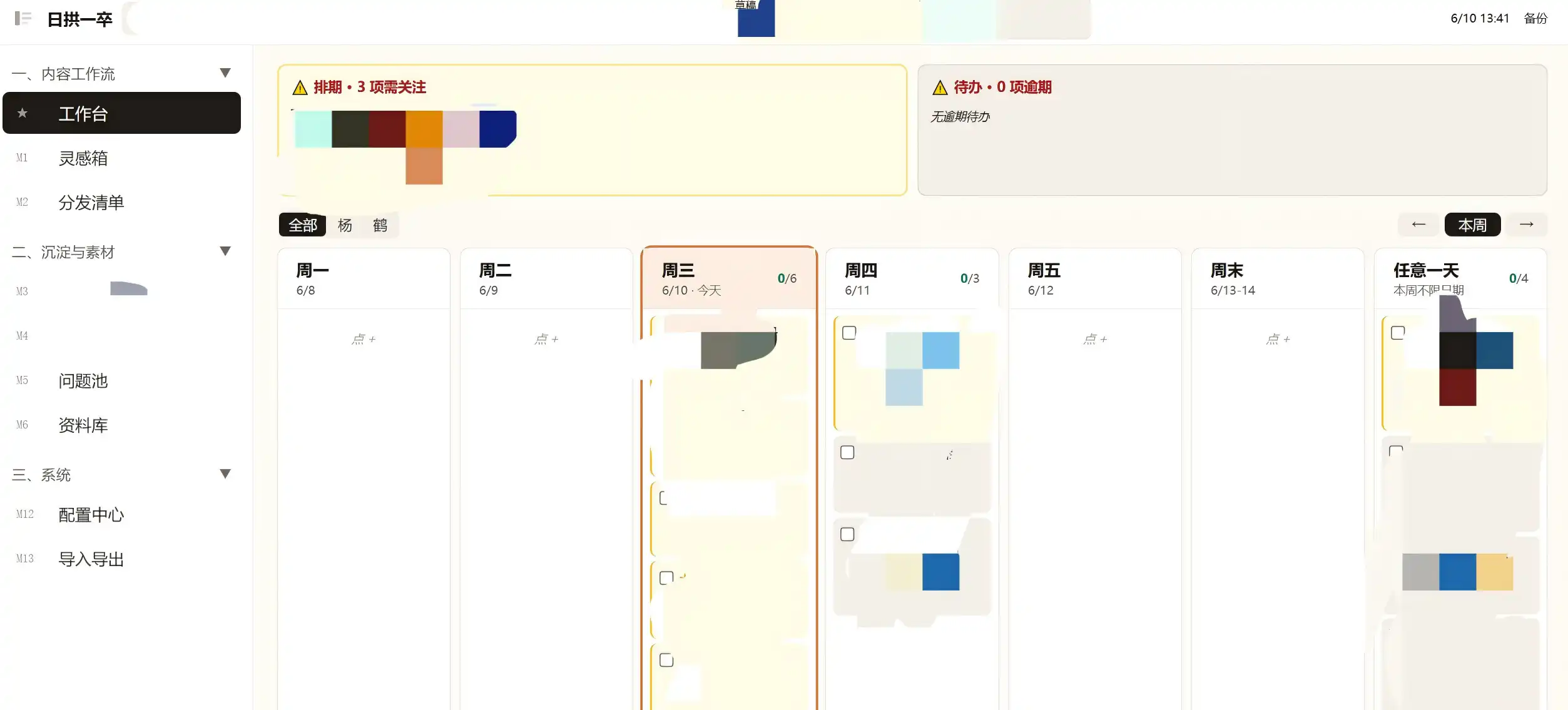
I usually manage topics, write articles, and publish on several platforms. Progress was all in my head or by digging through chat records, often messy. So I made a small backend to manage it, including a topic list, article progress, publishing platforms, and an inspiration box.

Since I might need to use this when I'm out, I didn't make it local, but deployed it to the cloud—using GitHub + Vercel. I can open it on my phone to view and edit, quite convenient.
Fourth: One-Click Formatting Tool

This was mainly to solve a personal minor need. After writing an article, I need to publish it on many platforms, especially for Web3 media. Each platform has different formatting rules, and manually adjusting each time is very time-consuming.

So I created a small tool. Paired with a browser Tampermonkey script I fine-tuned through coding, I throw in an original Markdown or Word document, and it automatically converts it into the corresponding format for each platform and directly inserts images. It's not particularly advanced, but it saves me some mechanical work every day.

To be honest, these four things are still very basic, even a bit ugly, and can't be considered mature products. But for me, they are already very useful because once an idea appears, I can immediately integrate it into the system, rather than letting it scatter and be forgotten.

This is the most important change I feel.

Three: Ordinary People's Investment Research Approach Has Really Changed

Because of this, I increasingly feel that ordinary people doing investment don't necessarily need to start with complex models, but should at least have a few of their own basic systems.

Because the change AI brings to ordinary people isn't suddenly turning you into a guru, but enabling you to first create a prototype for many things you "wanted to do but couldn't" before.

Especially for someone like me who watches the market daily, the feeling is particularly obvious. As long as you have an idea, every ordinary investor can gradually accumulate a few of their own basic systems:

  • Asset Observation System: What assets are you actually watching? Which market do they belong to? What recent changes have occurred?
  • Signal Monitoring System: Which events, once they happen, might indicate a change in market expectations?
  • Map Organization System: A sector isn't a point, but a network. Who's upstream, who's downstream, who benefits from sentiment, who from performance, who from capital flows. Especially over the past year-plus, AI sector stocks have almost rewarded those who could thoroughly understand a sector (from HPC to optical modules to the memory chain).
  • Review System: Why were you bullish initially? What happened later? What was right, what was wrong?
These things weren't impossible to do before, but they were too troublesome, hard to sustain. The biggest meaning of AI is that it cuts away a huge chunk of this "trouble."

You may not know how to code, but you can describe requirements, and slowly accumulate your own product design. And you don't have to finish it all at once; release the first version, and modify it while using it.

This is also the most attractive part of Vibe Coding for me: the feedback is so fast. In the past, the gap between an idea popping up and landing could be very long, so long you forgot why you wanted to do it in the first place.

Now, if I think of a feature today, I can try it the same day. If I'm not satisfied after trying, I modify it immediately. After using it for two days, new needs emerge, and I iterate further.

This closed loop of "idea—implementation—use—feedback—modify again," once it starts spinning, really makes you unable to stop.

In Conclusion

Consider this as the first record for the new phase of "太乐 Tyler."

Moving forward, I'll try to update regularly, recording my investment thoughts, tool tests, on-chain operations and arbitrage research, as well as some educational/introductory Web3 operations and investment knowledge points.

Welcome to follow, and feel free to communicate anytime.

Связанные с этим вопросы

QWhat is Vibe Coding and how does the author use it?

AVibe Coding is using natural language to command AI to write code and build products. The author primarily uses Codex and the Claude Code client, switching to the CLI with DeepSeek API when limits are reached, to create personal tools based on their ideas.

QWhat are the four main tools the author built using Vibe Coding?

AThe author built: 1) A cross-market asset dashboard for viewing holdings across stocks and crypto. 2) A prediction market (PM) betting monitor. 3) A personal operations backend for managing writing tasks. 4) A one-click typesetting tool for formatting articles for different platforms.

QWhat advantage does the author claim to have in prediction markets?

AThe author claims a small advantage lies in having better access to Chinese information and East Asian political-economic dynamics. They state that pricing on these events in Western-dominated markets is often slow, creating opportunities in that time lag.

QAccording to the author, how has AI changed research and tool-building for ordinary investors?

AAI hasn't made ordinary investors experts overnight, but it allows them to create initial versions of tools they previously 'wanted to build but couldn't'. It significantly reduces the hassle, enabling a fast 'idea-implementation-use-feedback-modification' loop to build personal systems for observation, monitoring, and analysis.

QWhat systems does the author suggest ordinary investors should gradually build for themselves?

AThe author suggests building several personal foundational systems: an Asset Observation System, a Signal Monitoring System, a Map/Network Organization System for understanding industry sectors, and a Review/Post-mortem System to track reasoning and outcomes.

Похожее

2029 Finale Prediction: When Cryptocurrency Completely "Vanishes", Who Can Remain in This Financial Upheaval?

By 2029, the crypto industry will have transformed into a largely invisible but foundational layer for traditional finance. This timeline outlines the key shifts from now until then. By mid-2026, the most sought-after assets on-chain will not be traditional tokens, but synthetic perpetual contracts for private, high-growth companies (like SpaceX, OpenAI). These become primary price discovery tools, highlighting the market's craving for real-world asset value. Most altcoins enter a sustained bear market as their fundamental lack of asset-backed value is exposed. In late 2026, the "AI + Crypto" narrative largely fades as AI giants prove they don't need crypto infrastructure, except for prediction markets betting on model performance. Simultaneously, a quiet but significant wave of tokenization for institutional assets (money market funds, private credit) begins. The industry splits into a noisy speculative economy and a silent institutional one. Throughout 2027, major public blockchain foundations pivot decisively to serve institutional clients, building compliance toolkits and sales teams. However, key sectors hit growth ceilings: private perpetual contracts are legally restricted from public promotion, stable币 growth is capped by looming political uncertainty, and tokenization projects remain cautious. In 2028, following a U.S. election assumed to maintain a regulatory (not prohibitive) stance, a pivotal change occurs. After a major liquidation crisis exposes the flaws of synthetic contracts lacking a real-asset anchor, new regulations allow the *public solicitation* of private security sales (secondary market shares) to accredited investors. This creates a legitimate, direct on-ramp for retail capital into previously illiquid private equity. By 2029, the resulting bull market is driven by trading in real, innovative company shares (biotech, robotics, AI labs), not speculative tokens. "Crypto" as a distinct asset class recedes; it becomes the mundane, unseen plumbing for this new global private markets infrastructure. Tokens that survive are those capturing real cash flows from this infrastructure. Speculation persists but is marginalized. The core questions posed at the start are answered: token value is tied to legally enforceable claims on real assets, frontier tech adoption happens via private market channels, and crypto's absorption into traditional finance is marked by its becoming boring and invisible. The key validation for this entire thesis is whether, by late 2028, a legal pathway exists for ordinary accredited investors to access private assets directly.

marsbit25 мин. назад

2029 Finale Prediction: When Cryptocurrency Completely "Vanishes", Who Can Remain in This Financial Upheaval?

marsbit25 мин. назад

After the U.S. Banned Fable 5, Zhipu's Stock Soared 47%

On June 15, Chinese AI company Zhipu's stock surged up to 47.6% in Hong Kong, closing with a 32.82% gain. This sharp rise followed two key industry events. On June 12, Anthropic was compelled by a U.S. government export control order to suspend global access to its latest flagship models, Claude Fable 5 and Claude Mythos 5, impacting developers and businesses reliant on them. The next day, Zhipu announced it was opening access to its new open-source flagship model, GLM-5.2, for all Coding Plan users, with API and model weights (under the MIT license) to follow. The Anthropic incident highlighted a critical shift in the AI industry: beyond raw capability, the stability, continuous accessibility, and control over AI models are becoming equally vital, especially as AI integrates deeper into business workflows. Zhipu's move, emphasizing that "frontier intelligence should not belong to a few nor be subject to arbitrary revocation," positioned its open, accessible model as an alternative. GLM-5.2 focuses on "Long Horizon Tasks" with a 1M context window, aiming for consistency in complex, extended projects. Market analysts suggest this event exposes the risk of dependency on closed-source models subject to single jurisdiction policies, potentially accelerating a shift toward domestic base models and localized deployments. The investment response indicates a new valuation metric is emerging—prioritizing which companies can provide AI capabilities that are not only advanced but also reliably and sustainably accessible.

marsbit26 мин. назад

After the U.S. Banned Fable 5, Zhipu's Stock Soared 47%

marsbit26 мин. назад

PANews Column Registration and Article Submission Guide

"PANews Column Registration and Submission Guide" provides instructions for users to register as columnists and publish articles on the PANews platform. Key application requirements are emphasized: content should focus on in-depth analysis within Crypto, Web3, blockchain, data, and viewpoints. Content primarily for brand/product introductions will not be approved, and heavily AI-generated content will be rejected. Promotional (PR/soft) content is directed to the business channel. **Registration Process:** * **Web:** Go to the official website footer, click "Apply for Column," and register with a phone number or email (login via verification code, no password). Fill in the column name, description, upload an avatar, and submit links to previously published work. * **Mobile:** Navigate to "My" -> "Contribute & Create" and complete the form. **Article Submission Tutorial:** 1. Log in to the PANews website. 2. Access the "Creator Center" from your personal homepage. 3. Use the editor to create and publish articles. **Video Upload:** The platform supports embedding videos from third-party sites (e.g., Bilibili). Copy the embed code from the source video, use the editor's "Insert/Edit media" button, paste the code under the "Embed" tab, and adjust the display size (recommended: width 100%, height 560px). **PANews Skills (AI Agent Tool):** PANews offers an official AI Agent skill set called PANews Skills, enabling AI tools to query platform content, track trends, and publish column articles directly. It includes three main skills: 1. `panews`: For tracking daily must-read lists, popular articles, and funding news. 2. `panews-creator`: For managing columns, publishing articles, and uploading images. 3. `panews-web-viewer`: For parsing PANews webpages into Markdown. These skills are compatible with various AI Agent tools (OpenClaw, Cursor, Claude Code, ChatGPT, Gemini, etc.). To use the `panews-creator` skill, users must obtain a specific authentication value from the PANews website after logging into their columnist account.

marsbit37 мин. назад

PANews Column Registration and Article Submission Guide

marsbit37 мин. назад

After Tokenization of Assets, How to Exit?

Title: How to Exit After Asset Tokenization? Author: Symbiotic Compiled by: Hu Tao, ChainCatcher Summary: Tokenization addresses how assets go on-chain but largely leaves the redemption question unresolved. While tokenized assets can settle instantly, the underlying redemption for assets like treasuries, private credit, or real estate can take from T+1 to 180 days. This gap hinders DeFi adoption of Real World Assets (RWAs). Three emerging models aim to provide instant exit liquidity, differing primarily in their capital structure and efficiency: 1. **Balance Sheet Model (e.g., Grove Basin):** A single entity (like Sky) provides immediate liquidity from its balance sheet, acting as a bridge during the settlement period. It offers simplicity and deep initial liquidity but is constrained by a single entity's capacity and risk appetite. 2. **Asset-Specific Vault Model (e.g., Upshift Clear):** Independent liquidity providers fund dedicated vaults for each supported asset, earning fees. It decentralizes capital sources but isolates liquidity and capital per asset, leading to potential fragmentation. 3. **Shared Liquidity Layer Model (e.g., Symbiotic Liquid Lane):** A shared capital pool supports multiple RWA types simultaneously. Funds remain productive between redemptions (e.g., earning yield in lending markets). Exits are settled via a competitive RFQ market. This model aims for higher capital efficiency, scalability across assets, and serves longer-duration assets like private credit. Key differentiators are: 1) Source of capital and risk bearer, 2) Redemption pricing mechanism, 3) Capital efficiency, 4) Scalability to new asset types, and 5) Composability. The shared liquidity layer model represents a move from piecemeal solutions toward scalable infrastructure, enabling T+0 exits by pooling capital, maintaining yield, and using competitive pricing, thus enhancing RWA utility in DeFi.

marsbit1 ч. назад

After Tokenization of Assets, How to Exit?

marsbit1 ч. назад

Торговля

Спот
Фьючерсы

Популярные статьи

Неделя обучения по популярным токенам (2): 2026 может стать годом приложений реального времени, сектор AI продолжает оставаться в тренде

2025 год — год институциональных инвесторов, в будущем он будет доминировать в приложениях реального времени.

1.8k просмотров всегоОпубликовано 2025.12.16Обновлено 2025.12.16

Неделя обучения по популярным токенам (2): 2026 может стать годом приложений реального времени, сектор AI продолжает оставаться в тренде

Обсуждения

Добро пожаловать в Сообщество HTX. Здесь вы сможете быть в курсе последних новостей о развитии платформы и получить доступ к профессиональной аналитической информации о рынке. Мнения пользователей о цене на AI (AI) представлены ниже.

活动图片