Author: Think AI, Aaron
Recently, NVIDIA founder Jensen Huang has been stealing the spotlight. Just after dominating the trending charts for treating a whole night market in Taipei to supper, he is again reported by the Financial Times today:
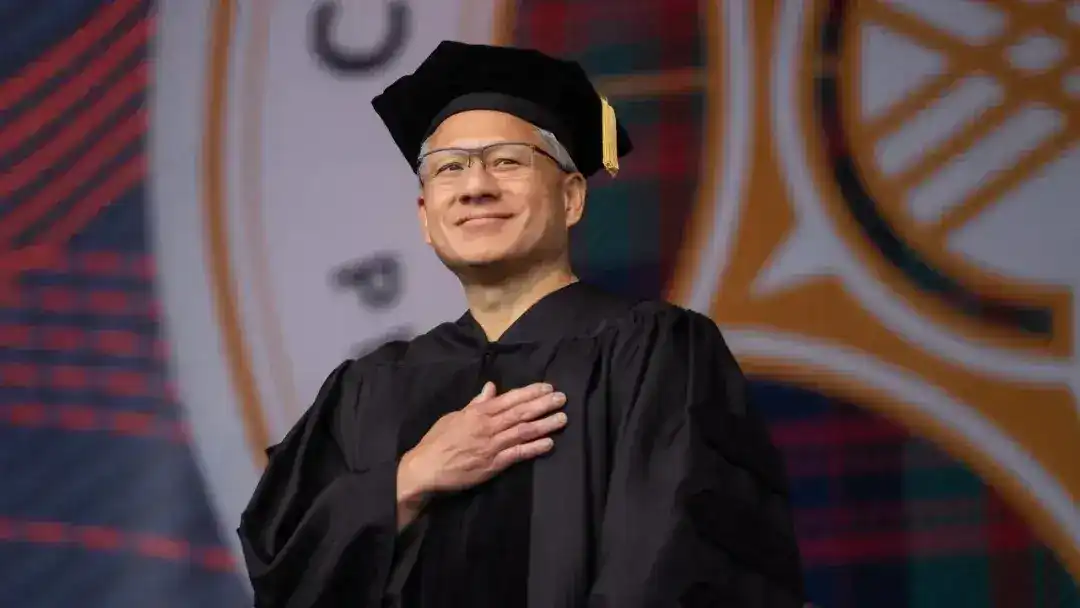
Jensen Huang will join the Advisory Committee of the School of Economics and Management at Tsinghua University, welcoming a new "teacher" to Tsinghua.
This also marks Huang's first appointment to an advisory body at a mainland Chinese university. Previously, he has served in similar institutions at National Taiwan University, Stanford University, and Harvard University in the US, but entry into mainland China had been delayed until now.
What are the "unspoken difficulties" in between?
It's important to know that this committee currently has 65 members, including major figures from the US financial and tech sectors. Our familiar friend Elon Musk joined as early as ten years ago. Why has Jensen Huang been unable to join until now?
Firstly, of course, is the exceptionally high caliber of Tsinghua's SEM Advisory Committee.
The "Weight" of "Joining"
The Tsinghua SEM Advisory Committee was established in 2000, with then Dean Premier Zhu Rongji actively promoting the formation of this top-tier think tank.
The committee's core mission is to provide high-level guidance on the school's development strategy, international cooperation, faculty building, etc., while also building a dialogue bridge between China and global business elites.
Not only are the members top-tier talents from various industries, but during the annual meetings, state leaders also cordially meet with the attending members. President Xi Jinping has met with them in person twice and delivered a video address once.
The current committee chairman is former Apple CEO Tim Cook, who currently serves as chairman.
With Huang's addition, the five major US tech giants are now formally assembled. The other three are Tesla's Elon Musk, Microsoft's Satya Nadella, and Meta's Mark Zuckerberg.
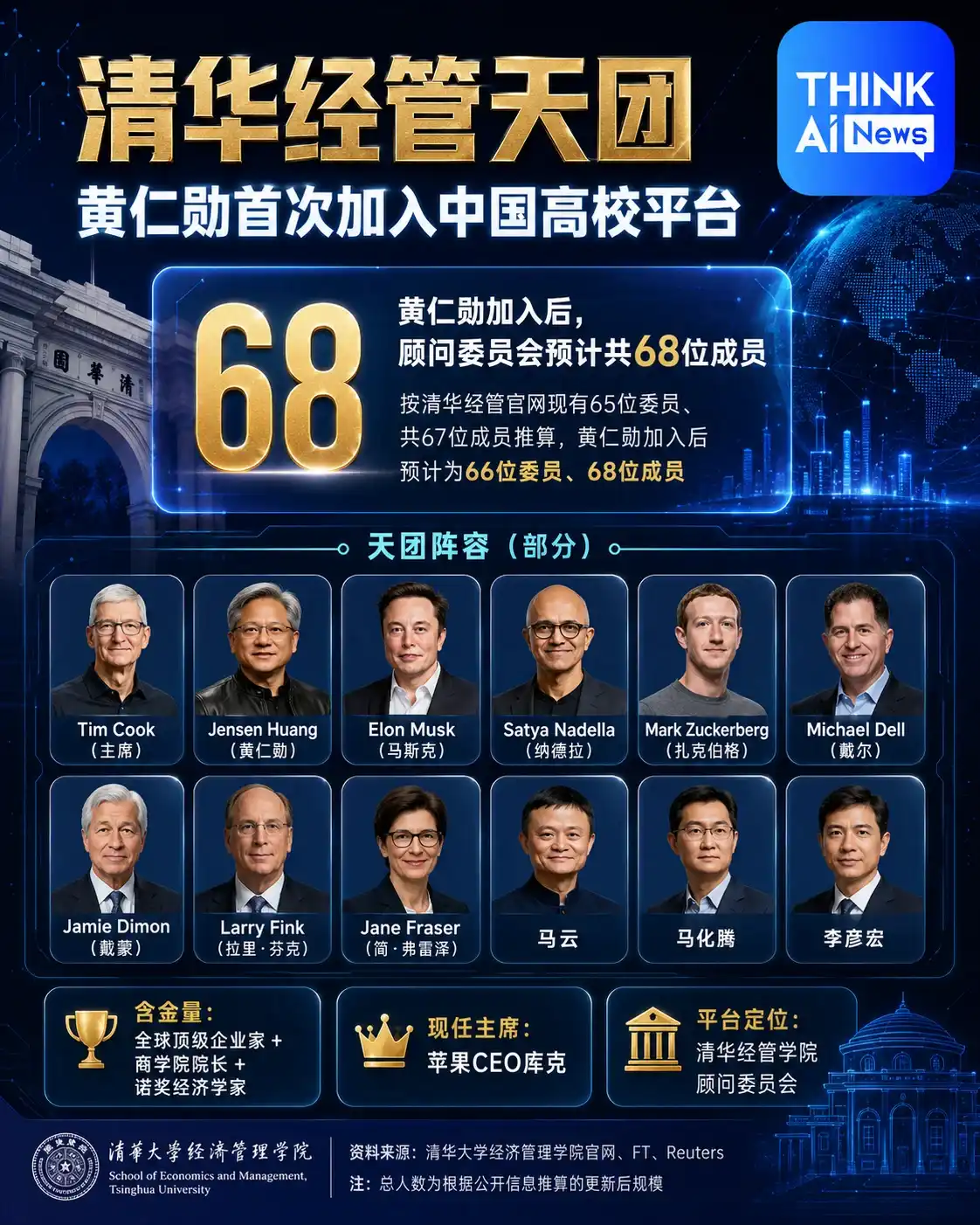
The finance sector is represented by Wall Street's top giants: Jamie Dimon of JPMorgan Chase, Stephen Schwarzman of Blackstone, Larry Fink of BlackRock, and Ray Dalio, founder of Bridgewater Associates.
There are also leaders from other globally renowned leading companies, such as BMW, Siemens, Coca-Cola, and so on.
Domestic heavyweights include Jack Ma, Pony Ma (Ma Huateng), Robin Li (Li Yanhong), Terry Gou (Guo Taiming), and others.
As can be seen from the list above, this is not an ordinary academic advisory panel but one of the highest-caliber and most influential circles of global business elites.
Why Now?
Both are tech giant CEOs. Why could Musk join in 2015, while Huang had to wait until now?
There were indeed many twists and turns in between, but now Huang's entry feels like a natural progression.
Looking back to 2015, US-China relations were relatively relaxed, and technological cooperation was in a honeymoon phase. Musk's entry had the right timing, location, and conditions.
At that time, the committee's tech sector already had Cook and Ballmer (former Microsoft CEO), but it lacked leaders in new energy and aerospace. Musk's Tesla and SpaceX正好 filled that gap;
Furthermore, in 2015, Tesla had not yet built a factory in China, but Musk was actively optimistic about the Chinese market, frequently expressing goodwill publicly, with no policy friction;
Coinciding with the committee's 2015-2016 academic year membership renewal, two new seats were added, and Musk became the sole new addition from the tech field;
Musk's "innovative disruptor" persona highly aligned with Tsinghua's goal of cultivating top talent, posing no political risk.
However, NVIDIA's strategic importance was not as pivotal as it is today, and the AI field had not yet demonstrated disruptive potential. In other words, Huang simply did not have the qualifications at that time.
Following 2018, US-China relations gradually became tense. Even as NVIDIA developed rapidly and Huang's wealth surged, it became more difficult to find a good opportunity amidst the climate.
US sanctions against China targeted NVIDIA as a core entity, forcing both Tsinghua and NVIDIA to be swayed by the broader environment.
Additionally, spots on the Tsinghua SEM Committee are highly limited. The tech circle has long been full, with only minor adjustments made annually. A vacancy恰好opened up earlier this year.
Market-wise, even without exporting high-end chips previously, NVIDIA maintained a monopoly position in China's AI chip sector until domestic chips强势崛起 in recent years, prompting Huang to seek new connections and circles to reopen the Chinese market.
Shortly after Trump's recent visit to China, US-China relations saw an easing. Huang accompanied the visit, partially mitigating political risks, allowing him to send more friendly signals towards China.
Huang's "Academic" Moves
It must be said that within the current tech circle, Jensen Huang is one of the tech founders most keen on joining university academic circles, which also makes his committee appointment feel一点也不违和.
It should be noted that while Huang本人已经确认 this news about joining Tsinghua, NVIDIA and Tsinghua have not officially announced it yet. Further official updates can be followed.
Huang himself holds a Master's degree in Electrical Engineering from Stanford University.
He has also received a total of 7 honorary doctorates to date, from universities across the globe including Taiwan, the US, Hong Kong, and Sweden, awarded in recognition of his industry achievements.
Regarding university advisory roles similar to Tsinghua's SEM Committee, Huang has also joined the Harvard Business School Dean's Advisory Board, the Stanford University Advisory Council, and the National Taiwan University College of Management Advisory Board, among others.
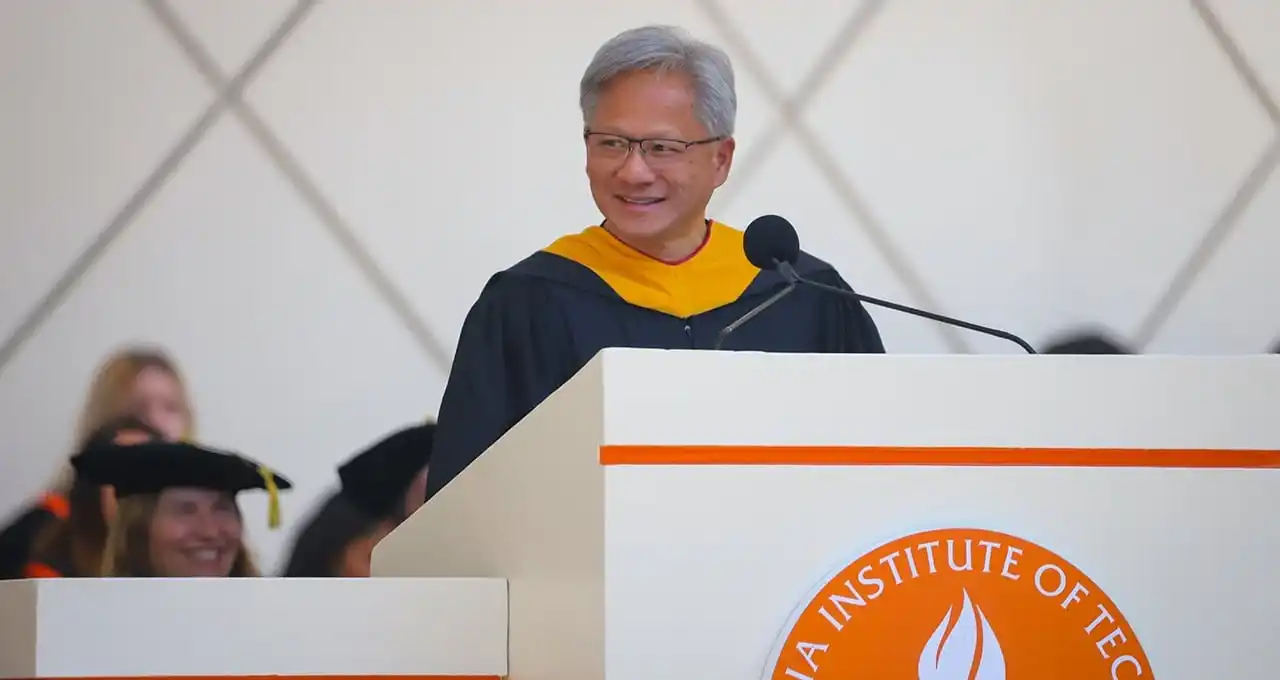
Huang's university speeches in recent years have also been full of quotable lines.
He pointed out, "You are not replaced by AI, but by those who use AI." He also strongly驳斥 the notion that AI leads to job cuts.
He stated, "AI only started to have an impact six months ago, yet they were laying people off because of AI two years ago? How is that possible? It makes no sense."
Overall, Huang's加入委员会 is a microcosm of a decade of geopolitical博弈, market变迁, and利益重构.
The Chinese market remains the重中之重 that Jensen Huang is迫切想要打开.