A Panoramic View of the Solana Privacy Ecosystem: The Complete Privacy Stack from Computation to AI

marsbitОпубликовано 2026-06-17Обновлено 2026-06-17

Введение

**Solana Privacy Ecosystem: A Comprehensive Overview from Computation to AI** Solana's privacy ecosystem, while nascent, is rapidly evolving to address key challenges across multiple layers. Key figures like Helius CEO Mert acknowledge that Solana has lagged in privacy but highlight its unique potential for scalable, composable privacy protocols, potentially leveraging technologies like ZK compression without persistent rollups. The foundational layer is **Private Compute**, addressed by providers like Arcium and Magic Block. Arcium utilizes Multi-Party Computation (MPC) networks to process encrypted data off-chain with final settlement on Solana, supporting use cases like confidential payments (via its C-SPL token standard) and encrypted data analysis. Magic Block employs Trusted Execution Environments (TEEs) to create private, ephemeral rollups, offering confidentiality, scalability, and composability. Both enable private order books, dark pools, and DeFi rails. Building on this infrastructure are applications for **Private Transfers and Balances**. Umbra, built on Arcium, offers encrypted token accounts with amount, balance, and sender-receiver linkage privacy, plus compliance features. Privacy Cash uses Tornado-style shielded pools for SOL, while Hush provides private staking and trading with integrated swaps via Jupiter. To eliminate **On-Chain Trails** from everyday activities like trading, protocols like encifherio and VanishTrade are emerging. encifherio privately...

Authored by: Castle Labs

Compiled by: AididiaoJP, Foresight News

Solana's Privacy Ecosystem is Still in Its Early Stages

We previously spoke with Helius CEO @mert, asking his perspective on Solana's privacy. In his own words, Solana is "a bit behind" on privacy.

So, what should a mature privacy ecosystem look like?
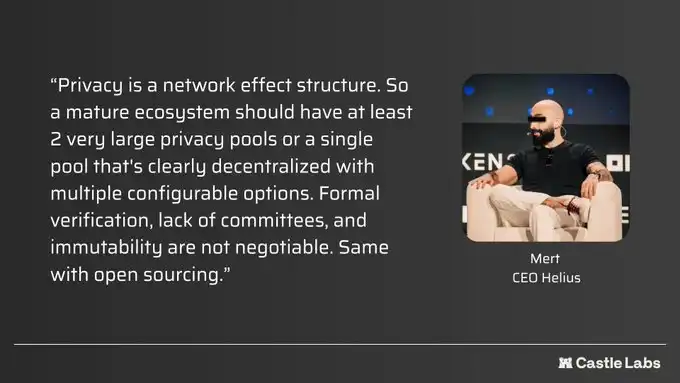
Essential elements include:

  • Formal verification
  • No committee
  • Immutability
  • Open source code

Solana's unique architecture also leads to different privacy priorities compared to EVM chains. Mert specifically mentioned ZK compression: "We can achieve mass-scale and composable privacy protocols on Solana without persistent Rollups, at least not when based rollups can be used."

In Solana's specific context, the two most relevant verticals for privacy development are Neobanks and Private DeFi. However, in terms of tooling and user experience, Solana still has a significant gap to reach a fully functional, composable privacy ecosystem.

We also asked Mert about his view on the privacy tech stack. As the report emphasizes, privacy should not be seen as a single technology, but as a "final privacy stack" where all primitives will eventually work together. For Mert, the endgame is a combination of FHE (Fully Homomorphic Encryption) and ZK (Zero-Knowledge proofs). TEE and MPC are practical for certain use cases but cannot provide sufficient guarantees in adversarial systems.

Finally, we asked him about Helius Privacy.

Helius Privacy will be developed as a ZK-based UTXO privacy layer on Solana. It will utilize "Zones," allowing individual companies to choose their own trade-offs.

It will also provide a public Zone for all ordinary users to use, offering full anonymity in an immutable, formally verified manner. More details will be announced soon.

Against this backdrop, this article focuses on how the Solana privacy ecosystem is addressing various privacy challenges.

Private Compute

Currently, there are mainly two providers in this space: @Arcium and @magicblock.

Both are tackling a similar problem: private computation.

Arcium processes arbitrary data via MPC (Multi-Party Computation). It splits data and distributes it across independent node clusters, which collectively compute a result without seeing individual inputs. Meanwhile, Arcium operates as an independent compute network, with final settlement on Solana, which handles task ordering, network security, and fee payments.

All this private computation happens within Multi-Party eXecution Environments (MXEs)—customizable, parallelizable execution environments.

Beyond solving the computation problem, Arcium's product also serves Solana's broader privacy ecosystem. They are building the Confidential SPL (C-SPL) token standard, enabling confidential tokens, transfers, and transactions on Solana.

We asked the Arcium team about the source of demand. Unsurprisingly, it primarily comes from payments and crypto data analytics, while institutional demand is growing, especially in healthcare—enabling models to be trained on encrypted datasets. C-SPL also enables seamless private transfers, further attracting institutional interest.

In terms of data, since the Alpha mainnet launch in early February 2026, Arcium has processed over 900,000 computations and 3.5 million+ transactions, with most growth occurring in early May.
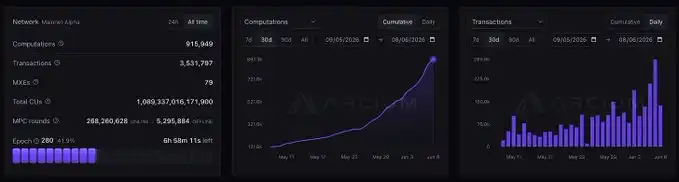
Currently, most demand comes from early applications like Umbra. In the coming weeks, applications like ZINC and Crafts will also go live, and we expect demand to increase further.

ZINC is working on encrypted proof-of-work mining, while Crafts uses Arcium for sealed-bid auction fundraising, allowing startups to tokenize part of their equity with fair price discovery.

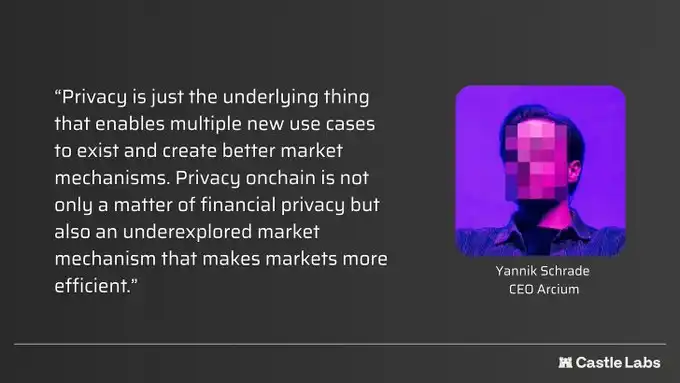
"Some exciting new things being built on Arcium include: capital formation using sealed bids, opportunity markets, encrypted settlement in prediction markets, and other financial privacy applications."

Many of these use cases are creating new or improved markets where users may not even be aware of the privacy involved.
Magic Block tackles private computation via TEE (Trusted Execution Environments), whereas Arcium relies on cryptographic guarantees from MPC. Its product works by: Intel TDX creating a hardware-verified black box—the Private Ephemeral Rollup (PER), where transactions are aggregated and processed before being submitted back to Solana.

MagicBlock helps developers preserve these properties across the entire stack, including: confidentiality (protected state), scalability (high throughput), composability (still interoperable with other Solana programs), and compliance (an access control layer).

Although their approaches differ, both can generate deployable private order books, dark pools, and private DeFi rails with minimal code changes. This is already evident in the ecosystem built on Arcium, spanning DeFi, prediction markets, Neobanks, and more.

Private Transfers and Balances

As private compute infrastructures like Arcium and MagicBlock gradually mature, use cases built on these foundations are also growing, including private transfers.

@UmbraPrivacy is the first, built on Arcium's MPC infrastructure. Umbra introduces Encrypted Token Accounts (ETAs), the direct counterpart to Solana's standard Associated Token Accounts, but with balances stored encrypted, providing:

  • Amount Privacy: Transaction amounts are encrypted using Rescue cipher
  • Balance Privacy: Balances are stored as ciphertext
  • Association Privacy: Complete on-chain dissociation between sender and receiver via shielding pools + ZK proofs

Additionally, Umbra offers compliance features, allowing users to grant selective viewing permissions to auditors and compliance systems without exposing full transaction history. This is crucial for institutional workflows and users who want to prove fund holdings without revealing detailed transaction histories.

In the privacy wallet space, @theprivacycash and Hush are two others.

Privacy Cash uses Tornado-style shielding pools for SOL: users deposit SOL to generate a commitment added to a Merkle tree, then use a ZK proof to withdraw to any recipient, completely severing the on-chain link between deposit and withdrawal addresses.

Hush is inspired by Zcash but adds DeFi utility. Users deposit SOL into Hush's shielding pool, which is automatically converted to jitoSOL, passively earning staking yield and MEV revenue while remaining private. Inside the pool, users can transfer to other Hush participants, receive funds, and transact multiple times without touching Solana's public ledger. Upon exiting the pool, withdrawals are mixed to unbind from the original deposit. In-pool transfers cost 0.01 jitoSOL, and withdrawals incur a 50 bps fee. Hush also integrates Jupiter for private swaps and performs geographic blocking for sanctioned regions, giving it a good compliance profile among institutional users.

No Onchain Trail

Private transfers solve the problem of companies and institutions paying employee salaries or conducting private transactions on-chain. But to go further, we need to embed privacy into everyday on-chain activities, especially trading.

Every order placed on a public AMM is a signal that front-runners, copy-traders, and MEV bots can read and exploit. Several protocols on Solana are already addressing this.

@encifherio is a privacy-first DeFi interface that routes trades through Jupiter while keeping transaction details private. The team states: "Execution quality remains the same because we don't add custom routing; we use the same routes and liquidity provided by Jupiter."

It wraps the tokens a user wants to swap and encrypts swap details using ElGamal. On-chain records only show state changes of wrapped asset types, enough for Jupiter to know the correct tokens are being routed. Trade counts, counterparties, participants, and even whether a trade was executed, are all handled within a TEE environment (AWS Nitro Enclaves) and never broadcast publicly. This enables large-scale private swaps.

@VanishTrade approaches this from a different layer. They are building private trading infrastructure using shielded transaction routing to protect trading strategies from leaving on-chain traces. Unlike encifherio wrapping tokens, Vanish routes trades through shielded liquidity. Additionally, Vanish has launched the Vanish Integrity Framework (VIF), powered by Elliptic and Range, embedding safeguards to prevent routing of any illicit transactions.

Darklake is another contender in this category, building ZK-native liquidity infrastructure and dark pools. Its zk-AMM is called the "Blind Slippage Pool," a commitment layer added atop an AMM to hide slippage data before execution. Searchers cannot read order intent before a trade lands but can verify the outcome afterward. This delay asymmetry prevents sandwich attacks while preserving verifiability. They've extended this model to private perpetual contracts (zk-Perps) using Arcium's compute layer, and an inference framework called Zyga, which abstracts proof complexity, providing a foundation of secure logic and coordination for builders. Recently, they've also expanded into an infrastructure protocol, allowing apps and users to privately verify, connect, and compute using a "Proof as Intelligence" model.

Private Prediction Markets

Private prediction markets are a more advanced privacy application, as user strategies can easily be copied, leading to a loss of edge. To address this, protocols are using Arcium infrastructure to build specialized dark pools for prediction markets.

@meleemarkets is building prediction markets supporting private order flow. They encrypt the order book via Arcium's MPC infrastructure. Participants can place orders without exposing their direction on the public market until settlement.

The Private AI

As AI agents increasingly operate on-chain, will every query and every piece of PII they consume be permanently public?

Loyal answers this with its decentralized, censorship-resistant smart protocol. Built using Magic Block's ephemeral rollup execution and Arcium's encrypted compute, they are building on-chain AI that protects user data: conversations, queries, preferences, and activity—all encrypted on Solana with strict access rules. Users own and can export their encrypted conversation history and can self-host the frontend without losing any data. Additionally, Loyal supports private trading and treasury management, allowing depositors to earn yield in a private state.


Связанные с этим вопросы

QWhat are the two main providers of Private Compute on Solana mentioned in the article, and what is the core difference in their technical approach?

AThe two main providers are Arcium and Magic Block. Arcium uses MPC (Multi-Party Computation) to split and process data across independent node clusters, while Magic Block utilizes TEEs (Trusted Execution Environments) like Intel TDX to create hardware-verified enclaves for private computation.

QAccording to the article, what is the ultimate vision for the privacy technology stack on Solana as described by Helius CEO Mert?

AMert envisions that the ultimate privacy stack for Solana will be a combination of FHE (Fully Homomorphic Encryption) and ZK (Zero-Knowledge proofs). He also mentioned that TEEs and MPC are practical for certain use cases but do not provide sufficient guarantees in adversarial systems.

QWhat specific privacy features does the Umbra protocol provide for private transfers on Solana?

AUmbra provides Encrypted Token Accounts (ETAs), which offer amount privacy (encrypted transaction amounts), balance privacy (encrypted stored balances), and association privacy (fully breaking the on-chain link between sender and receiver using a shielded pool and ZK proofs). It also includes compliance features for selective disclosure to auditors.

QHow do protocols like encifherio and VanishTrade protect users' trading strategies from leaving an on-chain trail?

Aencifherio wraps the tokens users want to swap and encrypts swap details using ElGamal encryption, processing the transaction within a TEE (AWS Nitro Enclaves) so sensitive data is never broadcast. VanishTrade routes transactions through shielded liquidity pools and uses a framework with built-in protections to prevent routing illegal trades, thereby hiding trading strategies.

QWhat problem does the Loyal protocol aim to solve in the context of AI on the blockchain, and what key technologies does it leverage?

ALoyal aims to prevent AI agents' queries and personal data from being permanently and publicly exposed on-chain. It uses Magic Block's ephemeral rollups for execution and Arcium's encrypted computation to build a decentralized protocol that stores user data like conversations and preferences in an encrypted form on Solana with strict access rules.

Похожее

Behind HYPE's Repeated Record Highs, the 'Minions' in the Ecosystem Can't Keep Up

While HYPE, the native token of the Hyperliquid ecosystem, surges to new all-time highs above $76 and attracts significant institutional ETF inflows, a starkly different reality unfolds within its HyperEVM application layer. Multiple core DeFi protocols across lending, NFTs, stablecoins, and DEXs have announced shutdowns between May and June. The article argues HYPE functions more like an "application stock" than a traditional ecosystem token. Its value is anchored to the trading fees from Hyperliquid's core perpetual contracts platform (HyperCore), which boasts a diversified revenue stream from crypto, commodities, and indices. Approximately 97% of protocol fees fund buybacks and burns of HYPE. This means HYPE's price is largely decoupled from the health of projects built on HyperEVM. The closures of significant projects like lending protocol HypurrFi (peak TVL >$300M) and NFT marketplace Drip.Trade highlight a structural tension. Hyperliquid's minimalist philosophy offers infrastructure without official grants, liquidity support, or marketing coordination for HyperEVM projects. This forces protocols into a fiercely competitive environment from day one. Furthermore, the success of HyperCore creates a liquidity vacuum, and mechanisms like HIP-3 (allowing direct perpetual market deployment) divert user attention and capital away from application-layer projects. The stronger the core perpetual trading business becomes, the more difficult it is for peripheral "DeFi lego" projects to survive and capture value, despite the flagship token's rising price.

Foresight News29 мин. назад

Behind HYPE's Repeated Record Highs, the 'Minions' in the Ecosystem Can't Keep Up

Foresight News29 мин. назад

Conversation with Arthur Hayes: AI Has Drained Market Liquidity, BTC Will Be Below 100k by Year-End

In this June 2026 podcast interview, BitMEX co-founder Arthur Hayes explains his decision to sell his major crypto holdings (HYPE, NEAR, Worldcoin, Zcash). His rationale is based on a macro view linking oil prices, the Iran conflict, US politics, and an impending AI bubble burst. Hayes argues that high oil prices, driven by the ongoing war, will pressure domestic US inflation. To salvage the Republican Party's chances in the midterm elections, he believes Donald Trump may pivot to a populist, anti-AI stance—advocating for taxes and regulation—which would deflate the AI investment narrative. He sees the AI sector, particularly massive capital expenditure on data centers, as having absorbed nearly all excess market liquidity (around $1.5 trillion in debt issuance since 2025), starving other assets like Bitcoin. He highlights the upcoming SpaceX IPO at a ~$1.8 trillion valuation and 100x price-to-sales ratio as a potential tipping point. If these hyped IPOs underperform, it could shatter market confidence in AI. In such a scenario, all risk assets, including crypto, would fall together as correlations converge to 1 during a broad correction. Hayes has moved his portfolio into Treasuries and energy stocks (like ExxonMobil), predicting Bitcoin will be below $100k by year-end. He sees a potential crypto bull market only after the AI frenzy cools, liquidity stops flowing exclusively into AI, and possibly after a significant market downturn prompts new monetary stimulus.

marsbit40 мин. назад

Conversation with Arthur Hayes: AI Has Drained Market Liquidity, BTC Will Be Below 100k by Year-End

marsbit40 мин. назад

Fed's Internal Doves Flock to Hawkish Stance, Warsh's Debut "Between a Rock and a Hard Place"

U.S. Federal Reserve officials who previously advocated for rate cuts, including Governor Christopher Waller, have recently shifted their stance, with many now not ruling out the possibility of future rate hikes. This sets a challenging stage for new Fed Chair Kevin Warsh's first policy meeting. Appointed by President Trump based on his dovish views, Warsh now faces a committee where the debate has pivoted from "when to cut" to "whether to hike," driven by persistent inflation above 3%, a strong labor market, and supply-side pressures from AI infrastructure demands and geopolitical tensions. Key figures illustrate the shift. Governor Waller, once concerned about employment, now says data has pushed him toward considering rate increases. Even moderate voices like Governor Lisa Cook, while expecting inflation to ease, have indicated readiness to hike if it fails to do so. Long-time hawks such as regional Fed presidents Beth Hammack, Lorie Logan, and Neel Kashkari have grown more vocal, arguing that the real policy rate is effectively falling and that action may soon be needed. The upcoming Fed meeting is expected to keep rates steady but will likely remove the "easing bias" from its statement, signaling a neutral stance between cuts and hikes. The quarterly "dot plot" is anticipated to show most officials projecting no cuts this year, with some potentially indicating hikes. Chair Warsh, a critic of the Fed's reliance on forward guidance like the dot plot, must navigate communicating this pivot using tools he has questioned, all while steering policy in a direction counter to the preferences of the president who appointed him. The consensus suggests the Fed's next move could well be a rate increase.

marsbit1 ч. назад

Fed's Internal Doves Flock to Hawkish Stance, Warsh's Debut "Between a Rock and a Hard Place"

marsbit1 ч. назад

The Trillion-Yuan Market Cap 'Yi Zhong Tian': Who is the True Value King?

The article analyzes the three leading Chinese optical module companies, collectively nicknamed "Yi Zhong Tian": Xinyisheng, Zhongji Innolight, and TFC Optical Communication. It evaluates their "cost-performance" not by current stock price, but through three lenses: PEG ratio (growth vs. valuation), earnings quality, and premium/discount for certainty. Xinyisheng shows the most attractive PEG ratio and high profitability, but its valuation reflects discounts for risks like high customer concentration and reliance on overseas markets. Zhongji Innolight, the most expensive, commands a premium for its market leadership, dominant share in key products like 800G/1.6T modules, and higher earnings certainty, though it faces geopolitical risks. TFC Optical, as an upstream component supplier ("water seller"), has the highest gross margin and bets on the long-term CPO/NPO architecture trend, but trades at a high valuation with more stable, less explosive growth. The core argument is that while these companies dominate module assembly, the true profit pool and technological moat lie upstream in laser and switch chips, currently controlled by U.S. firms like Lumentum and Coherent. The long-term "cost-performance" for these Chinese leaders hinges on whether the domestic industry, exemplified by companies like Yuanjie Technology, can successfully move up the value chain into high-power laser chips. Otherwise, their high growth may remain confined to the lower-margin assembly segment.

marsbit1 ч. назад

The Trillion-Yuan Market Cap 'Yi Zhong Tian': Who is the True Value King?

marsbit1 ч. назад

Торговля

Спот
Фьючерсы

Популярные статьи

Обсуждения

Добро пожаловать в Сообщество HTX. Здесь вы сможете быть в курсе последних новостей о развитии платформы и получить доступ к профессиональной аналитической информации о рынке. Мнения пользователей о цене на SOL (SOL) представлены ниже.

活动图片