ChatGPT Can Manage Your Money for You. Would You Trust It with Your Bank Account?

marsbitОпубликовано 2026-05-16Обновлено 2026-05-16

Введение

OpenAI has launched a personal finance tool for ChatGPT, currently in preview for US-based ChatGPT Pro users. This feature allows users to connect their bank and investment accounts (via Plaid, supporting over 12,000 institutions) directly to ChatGPT. It analyzes transactions, generates visual dashboards, and offers conversational financial advice—such as budgeting or planning for major purchases—based on the user's actual data. This move follows OpenAI's acquisitions of fintech startups Roi and Hiro Finance, signaling a strategic push into vertical "super assistant" applications, similar to its earlier health-focused feature. However, the launch has sparked significant privacy concerns. Critics question the safety of granting such sensitive financial access to an AI, especially amid ongoing lawsuits alleging OpenAI shared user chat data with third parties like Meta and Google. OpenAI emphasizes that ChatGPT only reads data (no transaction capabilities), deletes it within 30 days if disconnected, and offers opt-out options for model training. Yet, trust remains a major hurdle. The trend reflects a broader industry shift: AI companies like Anthropic and Perplexity are also targeting high-value, data-rich domains like finance and health. While technically promising, the tool operates in a regulatory gray area—it provides personalized guidance but disclaims formal financial advice or liability. Ultimately, OpenAI's challenge is convincing users to trust an AI with their most p...

On May 15, OpenAI launched a new feature that left many feeling "both excited and uneasy" — a ChatGPT personal finance tool. Simply put, you can now directly connect your bank accounts and investment accounts to ChatGPT.

This feature is currently available for preview only to ChatGPT Pro users (monthly fee $200) in the United States. OpenAI uses the financial data service Plaid to facilitate account connections, supporting over 12,000 financial institutions, including JPMorgan Chase, Fidelity, Charles Schwab, Robinhood, American Express, and Capital One.

It sounds great. But the comments section almost exploded — would you really dare to give your bank account to an AI?!

01

What Does Your "AI Personal CFO" Look Like?

First, let's see what this tool can actually do.

Users go to the "Finances" option in the ChatGPT sidebar, click start, or directly type "@Finances, connect my accounts" in the dialog box. ChatGPT will then guide you through connecting your bank accounts via Plaid. The entire authorization process is essentially the same as linking your bank card in apps like Venmo or Robinhood — Plaid's tokenized authentication mechanism means ChatGPT itself does not have access to your bank passwords.
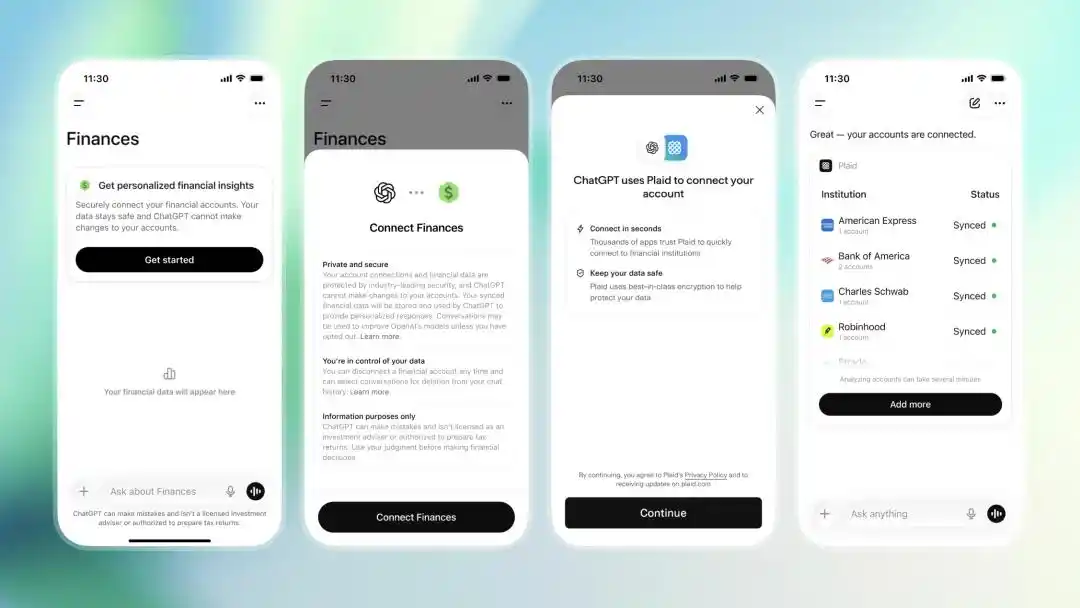
You need to connect your bank account via Plaid first | Image source: OpenAI

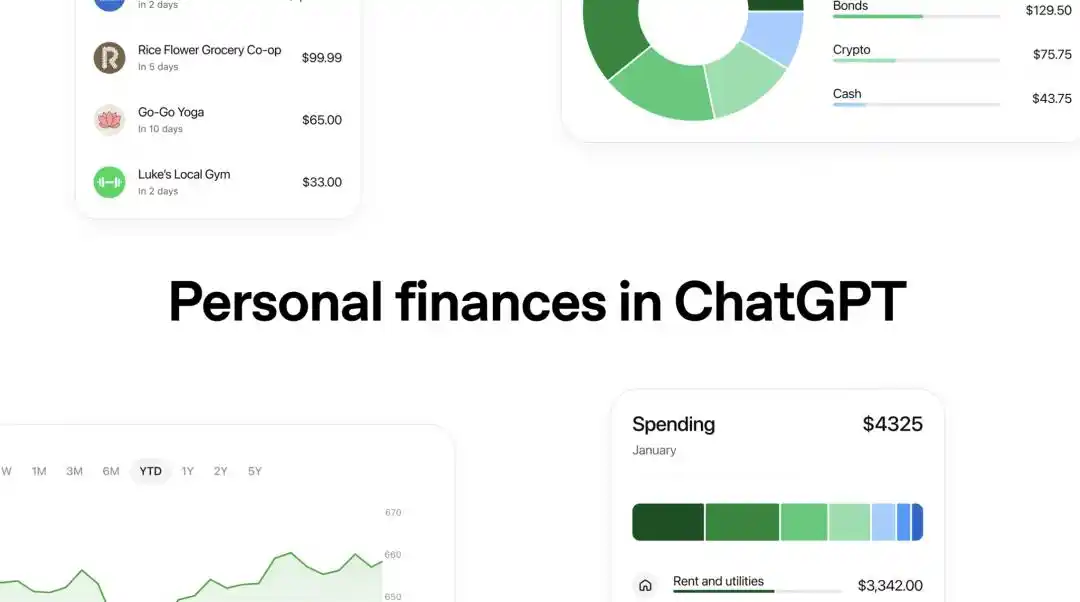
Once connected, ChatGPT will take a few minutes to sync and categorize your financial data, then generate a visual financial dashboard. This dashboard covers comprehensive information: checking and savings account balances, transaction history, spending breakdown by category, monthly recurring subscription services, upcoming bills, payroll deposit records, investment portfolio performance, as well as liabilities like credit card debt and mortgages.

But the dashboard is just the starting point. The really interesting part is "conversational finance management." Unlike traditional budgeting tools like Mint or YNAB, ChatGPT doesn't require you to look at charts, browse categories, or manually set budgets. You simply ask questions in natural language, and it provides answers based on your actual data.
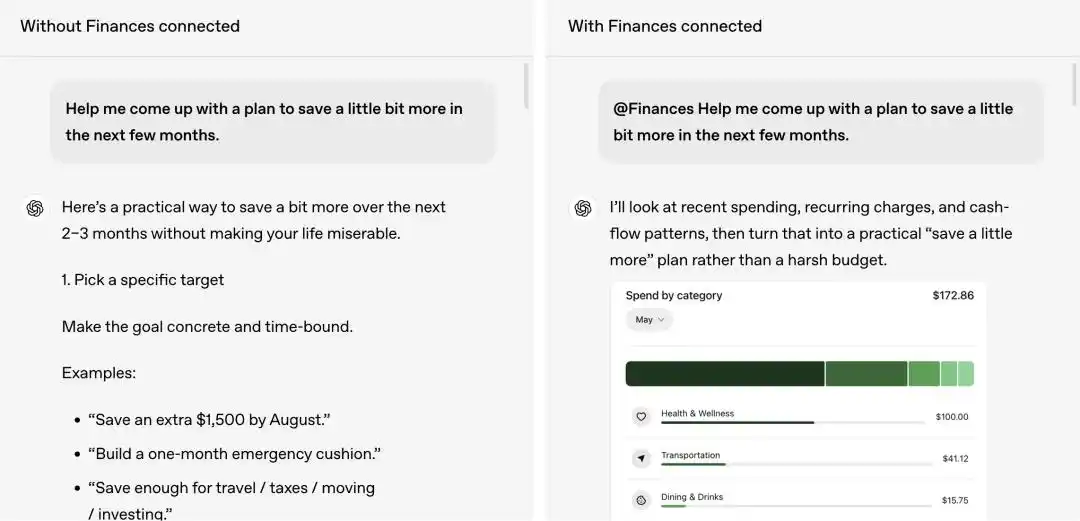
Comparison of financial questions before (left) and after (right) using personal financial data. Clearly, the latter is more planned and targeted | Image source: OpenAI

OpenAI provided several example scenarios: you can ask, "Am I spending more lately than before? What's changed?" ChatGPT will analyze your transaction history for spending trends.

You can say, "Help me make a plan to buy a house locally within five years," and it will calculate based on your income, savings rate, and current liabilities; you can even tell it, "I still owe my parents some money" or "I plan to buy a car early next year." ChatGPT will store this information in its "financial memory," and subsequent conversations will consider this context.

This is completely different from ChatGPT's previous experience in answering financial questions. Before, if you asked it "How should I save money to buy a house?" you'd get a bunch of generic textbook financial advice. Now that it can see your bank account balance, monthly spending structure, investment returns, and debt ratio, the suggestions are no longer generic nonsense like "we recommend saving 20% of your salary each month."

OpenAI also hinted at the next step: soon supporting Intuit data integration, allowing users to have ChatGPT analyze the specific tax impact of selling a particular stock or assess their approval probability for a certain credit card application.

OpenAI wants to evolve ChatGPT from "helping you look up a concept" to "helping you make decisions."

02

Two Acquisitions, Three Strategic Moves

OpenAI didn't undertake this on a whim.

Its groundwork has actually been underway for over half a year. In October 2025, OpenAI acquired the personal finance app Roi, and its founder Sujith Vishwajith subsequently joined OpenAI.

In April 2026, OpenAI acquired another personal finance startup, Hiro Finance, with founder Ethan Bloch and the entire team joining. Hiro's positioning was "AI personal CFO" and had helped users manage over $1 billion in assets. Bloch previously founded the automated savings app Digit, which was acquired for over $200 million in 2021.

Two acquisitions, two fintech veterans, half a year — OpenAI is clearly building a "financial task force" in a planned manner.

The driving data behind this is also staggering. OpenAI revealed that over 200 million people ask financial-related questions on ChatGPT every month — from budget management to how to cut expenses. These users were already using a "general-purpose chatbot" for financial tasks, except previously ChatGPT's responses lacked personalized data support.
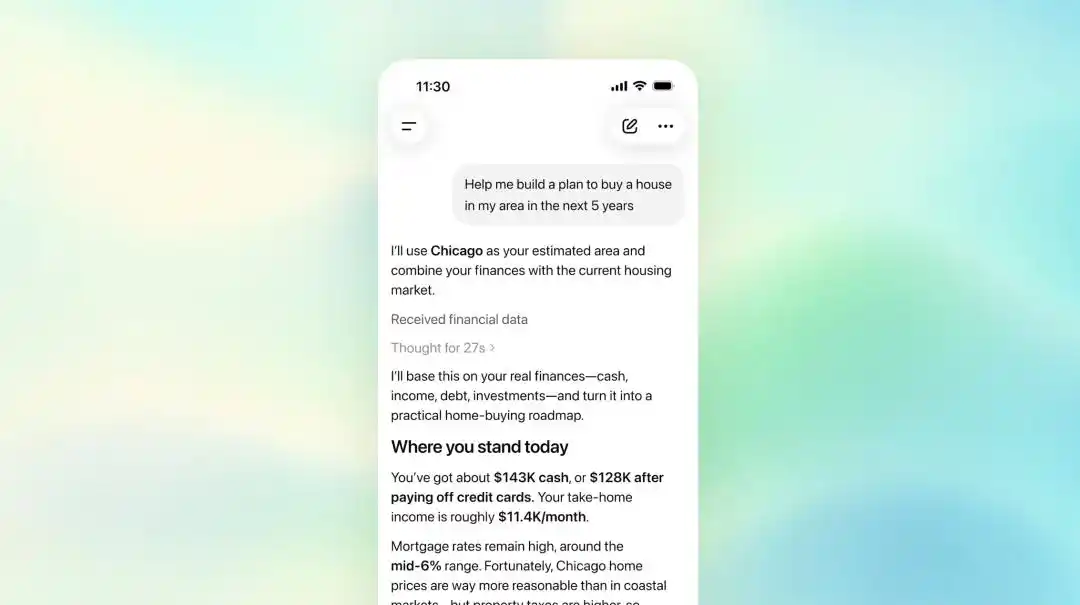
Users can directly conduct financial analysis within ChatGPT | Image source: OpenAI

Now, with Plaid's account connections and the stronger reasoning capabilities of the GPT-5.5 model, ChatGPT's goal is clear: to evolve from a "chat-about-anything" general assistant into a "super assistant" that truly understands your financial situation.

OpenAI has actually already tested this path before.

In January of this year, it launched ChatGPT Health, allowing users to connect medical records and health apps like Apple Health and MyFitnessPal. Official data shows over 230 million people ask health questions on ChatGPT weekly. From health to finance, OpenAI is shaping ChatGPT into an entry point covering all "high-value decision-making" scenarios in life.

03

Privacy Storm Arrives Faster Than the Product

But the problem is, managing money isn't like writing copy. What you're handing over isn't a prompt, but your entire financial profile.

Following the release of this feature, reactions on social media were overwhelmingly skeptical. Someone commented on Twitter: "What sane person would willingly give that level of access to OpenAI?" Others immediately brought up past issues: "You guys were just hit with a class-action lawsuit for secretly sharing ChatGPT conversation data with Google and Facebook."

This isn't baseless. Just one day before the finance feature launch, a new class-action lawsuit was filed in a California federal court, alleging that OpenAI embedded Meta Pixel and Google Analytics tracking codes in the ChatGPT webpage, transmitting chat topics, user IDs, email addresses, and other information to Meta and Google for ad targeting without user knowledge. The complaint points out that many users discuss extremely private topics like finance, health, and law on ChatGPT.
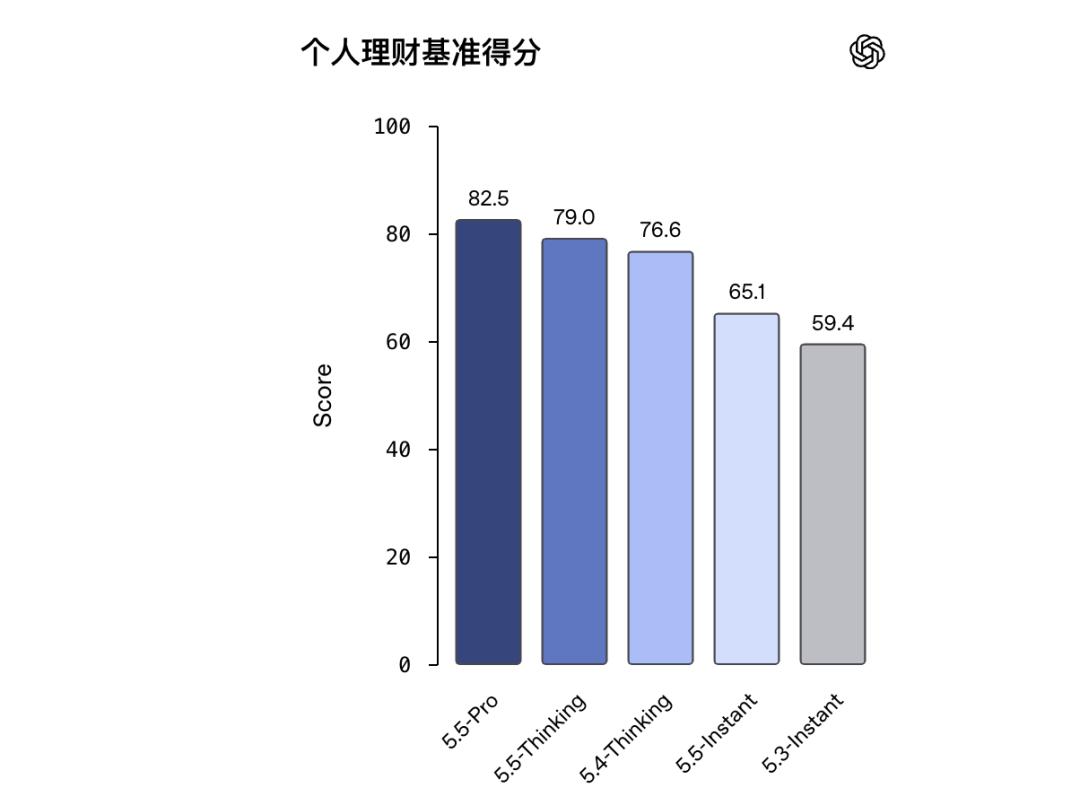
OpenAI officially stated that GPT-5.5 Pro performs better for private financial analysis | Image source: OpenAI

Getting sued for allegedly secretly sharing user chat data, then launching a new product that asks users to connect their bank accounts — this timing coincidence is almost a PR disaster-level coincidence.

OpenAI clearly recognizes the trust issue. It repeatedly emphasized in its announcement that ChatGPT cannot perform any actions on user accounts, nor can it see full account numbers; it can only read balances, transaction history, investment portfolios, and liability information. Upon disconnection, data will be deleted within 30 days. Users can also view and delete the financial "memories" ChatGPT retains.

But one detail is noteworthy — there is an optional switch in the system called "Improve the model for everyone." If users turn it on, their financial conversation data will be used to train the AI model. Although this switch is off by default, its very existence sends a signal:

Your financial data, within OpenAI's system, can theoretically become training material.

04

AI Companies Collectively Rush Towards "High-Value Data"

Viewing ChatGPT's financial tool within a broader context reveals a collective shift in the AI industry.

The era of general-purpose chatbots is ending; the war for "vertical super assistants" has begun.

OpenAI launched health in January and finance in May; Anthropic released ten professional AI Agents for the financial industry in early May, directly targeting banking, insurance, and asset management, with data sources including Moody's, S&P Capital IQ, and Morningstar — news that caused FactSet's stock to drop 8% that day. Perplexity also launched "Computer for Professional Finance" around the same time, targeting professional investment research teams, supporting connections to data sources like PitchBook and Daloopa, and offering 35 preset financial workflows.

Interestingly, Perplexity's financial product recently also started supporting user connections to brokerage accounts via Plaid — using the same infrastructure as ChatGPT. This means Plaid is becoming the underlying pipeline for the "AI finance management" era, much like Stripe for online payments.

But the strategic differences between companies are also evident. OpenAI is taking a consumer (C) route, aiming to bring every ordinary person's bank account into ChatGPT. Anthropic and Perplexity are taking a business (B) route, aiming to let financial professionals use AI to replace some functions of Bloomberg Terminal.

However, whether B or C, the core logic is the same: whoever gains access to users' most private, highest-value data occupies the entry point in the next phase of AI.

Health data, financial data, legal data — these fields are being collectively targeted by AI companies not because AI suddenly became good at finance, but because these scenarios naturally require personalization, inherently involve high-frequency interaction, and naturally have a willingness to pay.

05

The Ultimate Test for the "Super Assistant"

Returning to ChatGPT's launch. From a product logic perspective, it's actually quite well done: using Plaid connections ensures a baseline of security, read-only permissions rather than operational permissions reduce risk, and the 30-day data deletion provides an exit mechanism. OpenAI also stated it will soon support Intuit connections, allowing users to analyze the tax impact of stock sales or assess credit card approval probabilities.

But there is a chasm between a well-made product and user trust.

Sam Altman wants to turn ChatGPT into a "personal super assistant," covering every aspect of life from writing to search, from health to finance, from programming to shopping. This vision is undeniably grand. But the grander the vision, the higher the demand for trust. And OpenAI's track record on privacy issues doesn't inspire complete confidence.

A comment on Slashdot was quite direct: "Hand over your bank account to a hallucinating chatbot? Since when can AI's financial advice be written into the disclaimer?"

This is harsh but touches the core issue. There's a fundamental difference between AI financial tools and traditional financial advisors — human financial advisors are subject to financial regulation, have licenses, and bear legal responsibility; ChatGPT's terms of service clearly state it does not provide investment advice and bears no financial consequences.

When a tool looks like a financial advisor, talks like a financial advisor, and even understands your spending data better than most advisors — yet legally, it is nothing of the sort — this itself is a gray area that needs serious discussion.

OpenAI says it will first gather feedback from Pro users before deciding whether to open it up to Plus users. This is a smart strategy — using the most adventurous hardcore users to "beta test." But if the trust issue isn't resolved, the larger user base might never see it.

Technically, ChatGPT is ready to manage your money.

But are you ready? This might be an unavoidable choice for everyone in the AI era.

Geek's Question

Would you be willing to connect your bank account to an AI chatbot? Why or why not?

This article is from the WeChat public account "GeekPark" (ID: geekpark), author: Huà Lín Wǔ Wáng


Связанные с этим вопросы

QWhat is the new ChatGPT feature announced by OpenAI, and what does it allow users to do?

AOpenAI announced a personal finance tool for ChatGPT, currently in preview for U.S. ChatGPT Pro users. It allows users to connect their bank and investment accounts (through the financial data service Plaid) directly to ChatGPT, enabling it to analyze personal financial data and provide tailored advice.

QWhat are some of the key privacy concerns raised about this new ChatGPT feature?

AMajor privacy concerns include users handing over sensitive financial data to OpenAI, especially following recent lawsuits alleging OpenAI shared user chat data with companies like Meta and Google. There is also concern about the 'Improve the model for everyone' optional setting, which could allow financial conversation data to be used for AI training.

QHow does OpenAI's approach with its finance tool differ from that of companies like Anthropic and Perplexity in the financial AI space?

AOpenAI is targeting the consumer (C端) market, aiming to connect individual bank accounts to ChatGPT for personal finance management. In contrast, Anthropic and Perplexity are focused on the business/professional (B端) market, providing AI tools for financial professionals with data from sources like Moody's and PitchBook, aiming to replace parts of platforms like Bloomberg Terminal.

QWhat previous acquisitions did OpenAI make to build its finance capabilities?

ATo build its finance capabilities, OpenAI acquired the personal finance app Roi in October 2025 and the personal finance startup Hiro Finance in April 2026. These acquisitions brought in founders and teams with fintech expertise to form a 'financial commando unit' within OpenAI.

QAccording to the article, what is a fundamental legal distinction between an AI like ChatGPT and a human financial advisor?

AA fundamental legal distinction is that human financial advisors are regulated, licensed, and bear legal liability for their advice. In contrast, ChatGPT's terms of service clearly state that it does not provide investment advice and bears no responsibility for financial outcomes, creating a significant regulatory grey area.

Похожее

Winter for Crypto IPOs: Consensys and Ledger Withdraw Applications

The crypto IPO window is tightening significantly in 2026, marked by prominent companies delaying or pausing their public listing plans. Following a successful 2025 "harvest year" that saw Circle, Bullish, and Gemini go public amidst a bull market, the tide has turned. Consensys, developer of MetaMask, recently postponed its IPO until at least fall 2026. Hardware wallet leader Ledger also suspended its planned US listing due to unfavorable market conditions, with Kraken having previously delayed its own plans. This shift is driven by a cooling market in 2026, characterized by a significant Bitcoin price correction, declining trading volumes, and reduced investor risk appetite for crypto stocks. The poor post-IPO performance of 2025 listings like Circle and Bullish, which saw major share price declines, has heightened investor caution. This contrasts sharply with the current AI sector, where companies like SpaceX, OpenAI, and Anthropic are commanding massive valuations and investor enthusiasm based on narratives of stable, exponential growth. Crypto companies now face pressure to transition from hype-driven models to demonstrating reliable cash flows and robust compliance. While the paused IPO plans may lead to valuation resets and affect ecosystem liquidity, they also accelerate industry consolidation toward stronger, more compliant infrastructure players. A potential recovery in Bitcoin's price and clearer regulations could reopen the IPO window in the latter half of 2026.

marsbit3 ч. назад

Winter for Crypto IPOs: Consensys and Ledger Withdraw Applications

marsbit3 ч. назад

Breaking: OpenAI Undergoes Major Reorganization, President Brockman Assumes Command

OpenAI has announced a major internal reorganization just months before its anticipated IPO. The company is merging its three flagship product lines—ChatGPT, Codex, and the API platform—into a single, unified product organization. The most significant leadership change involves co-founder and President Greg Brockman moving from a background technical role to take full, permanent control over all product strategy. This follows the indefinite medical leave of AGI Deployment CEO Fidji Simo. Additionally, ChatGPT's longtime lead, Nick Turley, has been reassigned to enterprise products, with former Instagram executive Ashley Alexander taking over consumer offerings. The consolidation, internally framed as a strategic move towards an "Agentic Future," aims to break down internal silos and create a cohesive "Super App." This planned desktop application would integrate ChatGPT's conversational abilities, Codex's coding power, and a rumored internal web browser named "Atlas" to autonomously perform complex user tasks. The reorganization occurs amid significant internal and external pressures. OpenAI has recently seen a wave of high-profile departures, including Sora co-lead Bill Peebles and other senior technical leaders, leading to concerns about a thinning executive bench. Externally, rival Anthropic recently secured funding at a staggering $900 billion valuation, surpassing OpenAI's own. Google's upcoming I/O developer conference also poses a competitive threat. Analysts suggest the dramatic restructure is a pre-IPO move to present a clearer, more focused narrative to Wall Street—streamlining operations and demonstrating decisive leadership under Brockman to counter internal turbulence and intense market competition.

marsbit7 ч. назад

Breaking: OpenAI Undergoes Major Reorganization, President Brockman Assumes Command

marsbit7 ч. назад

Торговля

Спот
Фьючерсы

Популярные статьи

Что такое $BANK

Банк ИИ: Революционный шаг в будущее банковского дела Введение В эпоху, отмеченную быстрыми темпами технологического прогресса, Банк ИИ находится на пересечении искусственного интеллекта (ИИ) и банковских услуг. Этот инновационный проект стремится переопределить финансовый ландшафт, повышая операционную эффективность, меры безопасности и качество обслуживания клиентов с помощью ИИ. Приступая к этому изучению Банка ИИ, мы углубимся в то, что включает в себя проект, его операционную динамику, его исторический контекст и значительные вехи. Что такое Банк ИИ? В своей основе Банк ИИ представляет собой преобразовательную инициативу, направленную на интеграцию искусственного интеллекта в различные банковские операции. Этот проект использует возможности ИИ для автоматизации процессов, улучшения протоколов управления рисками иEnhancing взаимодействия с клиентами через персонализированные услуги. Основные цели Банка ИИ включают: Автоматизация банковских функций: Используя технологии ИИ, Банк ИИ стремится автоматизировать рутинные задачи, снижая нагрузку на человеческие ресурсы и повышая эффективность. Улучшение управления рисками: Проект использует алгоритмы ИИ для прогнозирования и выявления рисков, тем самым укрепляя меры безопасности против мошенничества и других угроз. Персонализация банковских услуг: Банк ИИ сосредоточен на предложении индивидуально подобранных финансовых продуктов и услуг, анализируя данные и поведение клиентов. Улучшение клиентского опыта: Внедрение решений на базе ИИ, таких как чат-боты и виртуальные помощники, направлено на предоставление пользователям более человеческого взаимодействия, революционизируя способ, которым клиенты взаимодействуют с банками. С этими целями Банк ИИ позиционирует себя как ключевого игрока в сделании банковских услуг более эффективными, безопасными и ориентированными на пользователей. Кто создатель Банка ИИ? Детали, касающиеся создателя Банка ИИ, остаются неизвестными. Таким образом, ни одно конкретное лицо или организация не были идентифицированы в доступной информации. Анонимность, окружающая начало проекта, поднимает вопросы, но не умаляет его амбициозного видения и целей. Кто инвесторы Банка ИИ? Подобно создателю проекта, конкретная информация о инвесторах или поддерживающих организациях Банка ИИ не была раскрыта. Без этой информации трудно описать финансовую поддержку и институциональную поддержку, которая может продвигать проект вперед. Тем не менее, важность наличия прочной инвестиционной базы является ключевой для поддержания развития в такой инновационной сфере. Как работает Банк ИИ? Банк ИИ работает на нескольких инновационных фронтах, сосредотачиваясь на уникальных факторах, которые отличают его от традиционных банковских рамок. Ниже приведены ключевые операционные особенности: Автоматизация: Применяя алгоритмы машинного обучения, Банк ИИ автоматизирует различные ручные процессы внутри банков. Это приводит к снижению операционных затрат и позволяет работникам перераспределять свои усилия на более стратегические деятельности. Совершенное управление рисками: Интеграция ИИ в практики управления рисками обеспечивает банки инструментами для точного прогнозирования потенциальных угроз, таких как мошенничество, обеспечивая безопасность информации и активов клиентов. Индивидуализированные финансовые рекомендации: Путем непрерывного обучения на основе взаимодействия с клиентами, системы ИИ развивают тонкое понимание потребностей пользователей, позволяя им предлагать персонализированные советы по финансовым решениям. Улучшенные взаимодействия с клиентами: Используя чат-боты и виртуальных помощников на базе ИИ, Банк ИИ обеспечивает более увлекательный клиентский опыт, позволяя пользователям быстро получать ответы на свои запросы, тем самым сокращая время ожидания и повышая уровень удовлетворенности. Все вместе эти операционные особенности позиционируют Банк ИИ как пионера в банковском секторе, устанавливающего новые эталоны для предоставления услуг и операционного совершенства. Хронология Банка ИИ Понимание траектории Банка ИИ требует взгляда на его исторический контекст. Ниже представлена хронология, подчеркивающая важные вехи и события: Начало 2010-х: Концепция интеграции ИИ в банковские услуги начала привлекать внимание, когда банковские учреждения осознали потенциальные преимущества. 2018: Произошел заметный рост внедрения технологий ИИ, когда банки начали использовать инструменты ИИ, такие как чат-боты, для базового обслуживания клиентов и системы управления рисками для улучшения безопасности. 2023: Сложность ИИ продолжала развиваться, при этом генеративный ИИ был представлен для выполнения более сложных задач, таких как обработка документов и анализ инвестиций в реальном времени. Этот год стал значительным шагом вперед в возможностях, которые ИИ-технологии предоставили банкам. 2024-Настоящее состояние: На данный момент Банк ИИ находится на восходящей траектории, с продолжающимися исследованиями и разработками, которые расширяют возможности в банковских операциях. Продолжение изучения приложений ИИ намекает на захватывающие события, которые еще предстоят. Ключевые моменты о Банке ИИ Интеграция ИИ в банковское дело: Банк ИИ сосредоточен на принятии искусственного интеллекта для оптимизации банковских процессов и улучшения пользовательского опыта. Автоматизация и фокус на управлении рисками: Проект сильно акцентирует внимание на этих областях, стремясь сместить бремя рутинных задач, одновременно усиливая системы безопасности с помощью предсказательной аналитики. Персонализированные банковские решения: Используя данные клиентов, Банк ИИ предоставляет индивидуально подобранные банковские услуги, которые учитывают потребности отдельных пользователей. Обязанность по развитию: Банк ИИ остается приверженным постоянным исследовательским и развивающим усилиям, обеспечивая свою адаптируемость и постоянную актуальность по мере того, как технологии продолжают развиваться. Заключение В заключение, Банк ИИ является важным шагом вперед в банковской индустрии, использующим искусственный интеллект для изменения операционных парадигм, повышения безопасности и повышения удовлетворенности клиентов. Несмотря на пробелы в информации о создателе и инвесторах, четкие цели и функциональные механизмы Банка ИИ обеспечивают прочную основу для его постоянной эволюции. Поскольку технологии ИИ продолжают развиваться и сливаться с банковским сектором, Банк ИИ хорошо позиционирован, чтобы существенно повлиять на будущее финансовых услуг, улучшая наш подход к пониманию и взаимодействию с банковским делом.

148 просмотров всегоОпубликовано 2024.04.06Обновлено 2024.12.03

Что такое $BANK

Как купить BANK

Добро пожаловать на HTX.com! Мы сделали приобретение Lorenzo Protocol (BANK) простым и удобным. Следуйте нашему пошаговому руководству и отправляйтесь в свое крипто-путешествие.Шаг 1: Создайте аккаунт на HTXИспользуйте свой адрес электронной почты или номер телефона, чтобы зарегистрироваться и бесплатно создать аккаунт на HTX. Пройдите удобную регистрацию и откройте для себя весь функционал.Создать аккаунтШаг 2: Перейдите в Купить криптовалюту и выберите свой способ оплатыКредитная/Дебетовая Карта: Используйте свою карту Visa или Mastercard для мгновенной покупки Lorenzo Protocol (BANK).Баланс: Используйте средства с баланса вашего аккаунта HTX для простой торговли.Третьи Лица: Мы добавили популярные способы оплаты, такие как Google Pay и Apple Pay, для повышения удобства.P2P: Торгуйте напрямую с другими пользователями на HTX.Внебиржевая Торговля (OTC): Мы предлагаем индивидуальные услуги и конкурентоспособные обменные курсы для трейдеров.Шаг 3: Хранение Lorenzo Protocol (BANK)После приобретения вами Lorenzo Protocol (BANK) храните их в своем аккаунте на HTX. В качестве альтернативы вы можете отправить их куда-либо с помощью перевода в блокчейне или использовать для торговли с другими криптовалютами.Шаг 4: Торговля Lorenzo Protocol (BANK)С легкостью торгуйте Lorenzo Protocol (BANK) на спотовом рынке HTX. Просто зайдите в свой аккаунт, выберите торговую пару, совершайте сделки и следите за ними в режиме реального времени. Мы предлагаем удобный интерфейс как для начинающих, так и для опытных трейдеров.

971 просмотров всегоОпубликовано 2025.05.09Обновлено 2025.05.09

Как купить BANK

Обсуждения

Добро пожаловать в Сообщество HTX. Здесь вы сможете быть в курсе последних новостей о развитии платформы и получить доступ к профессиональной аналитической информации о рынке. Мнения пользователей о цене на BANK (BANK) представлены ниже.

活动图片