Stablecoin supply nears $318B: Fresh inflows or just capital rotation?

ambcryptoОпубликовано 2026-03-20Обновлено 2026-03-20

Введение

Stablecoin supply is approaching $318 billion, signaling a period of controlled expansion. While fresh capital is entering through fiat on-ramps, a significant portion of this growth reflects internal capital rotation into yield-bearing and regulated assets rather than entirely new inflows. Tether (USDT) continues to dominate the market, though its growth has slowed, while others like USDC and USDS are expanding more rapidly. This liquidity is increasingly being actively deployed, evidenced by rising DEX volumes and exchange inflows. However, the market remains split between genuine capital inflows and internal redistribution, with a large share of stablecoins still held on exchanges.

HyperEVM is emerging as a strong liquidity hub, with stablecoin supply and TVL both surpassing $1 billion soon after launch. At the same time, Hyperliquid [HYPE] L1 holds over $5 billion in stablecoins, which reinforces broader ecosystem momentum.

However, bridges such as HyperCore receive the majority of inflows, which transfer USDHL, USDe, and feUSD across chains, indicating a reallocation of liquidity rather than its creation.
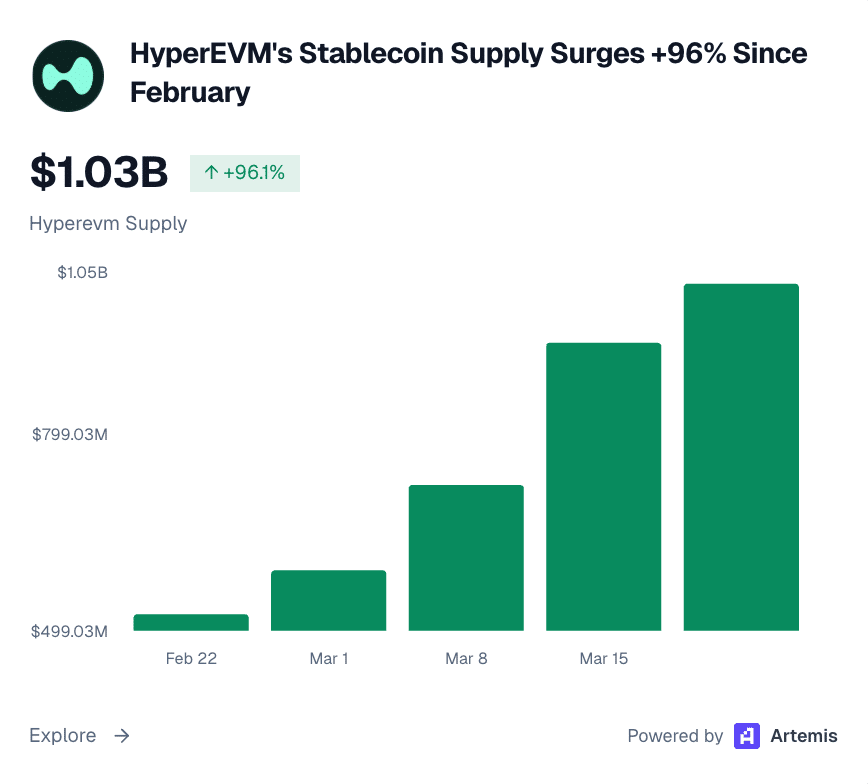
Source: Artemis/ X

USDhl minting adds treasury-backed supply while supporting demand through HYPE-linked incentives, which sustains short-term activity. As these flows continue, unique active wallets steadily increase, reflecting growing participation.

Simultaneously, platforms like Hyperlend, DEXs, and perpetual venues absorb this capital and drive usage. Still, this growth leans on incentives and yield opportunities, which may fade. For now, HyperEVM shows traction, although lasting expansion depends on steady organic demand.

Stablecoin supply near $318B reflects growth

Stablecoin supply is approaching $318 billion, rising 0.47% weekly and 2.86% monthly, which reflects controlled expansion rather than aggressive inflows. Building on this trend, Tether [USDT] still dominates at $184 billion, although its 0.10% weekly growth shows slowing momentum.

Meanwhile, USDC at $79.24 billion expands faster with 7.75% monthly gains, while USDS and USYC surge by 20.87% and 40.59%, highlighting shifting demand. As these changes unfold, minting continues to exceed burns, suggesting fresh capital entering through fiat on-ramps.
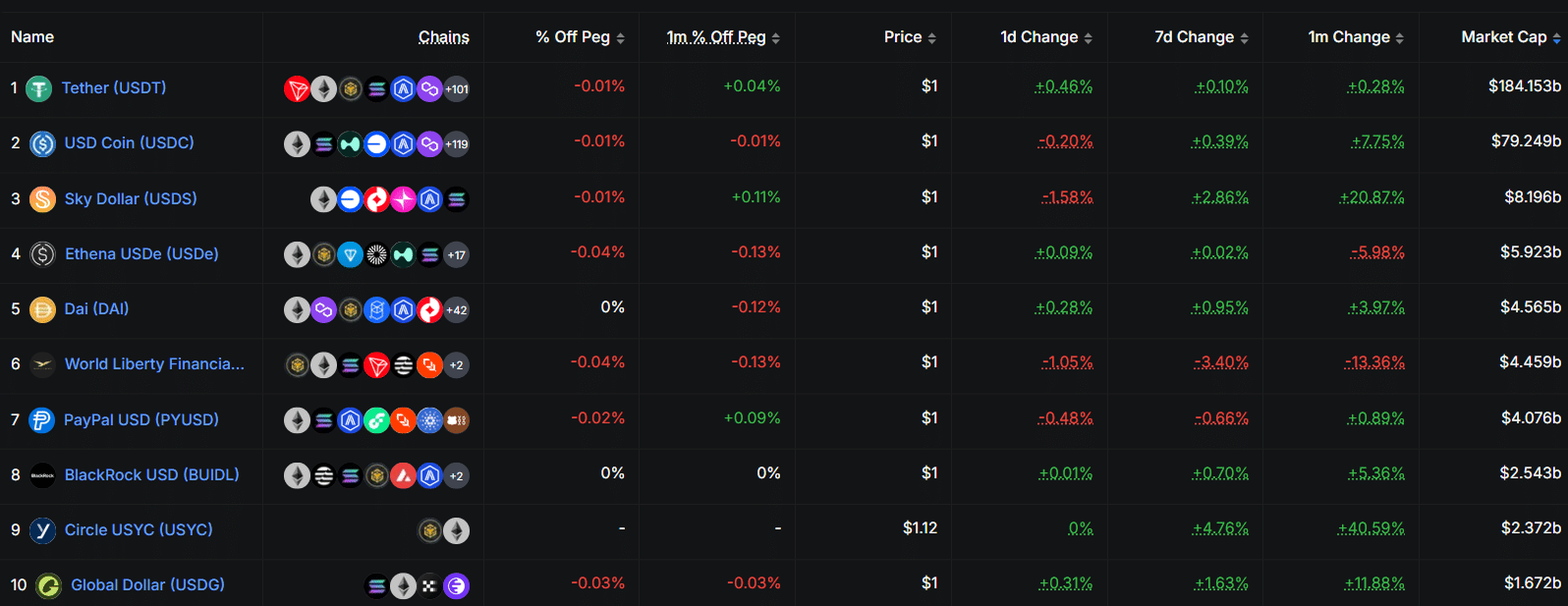
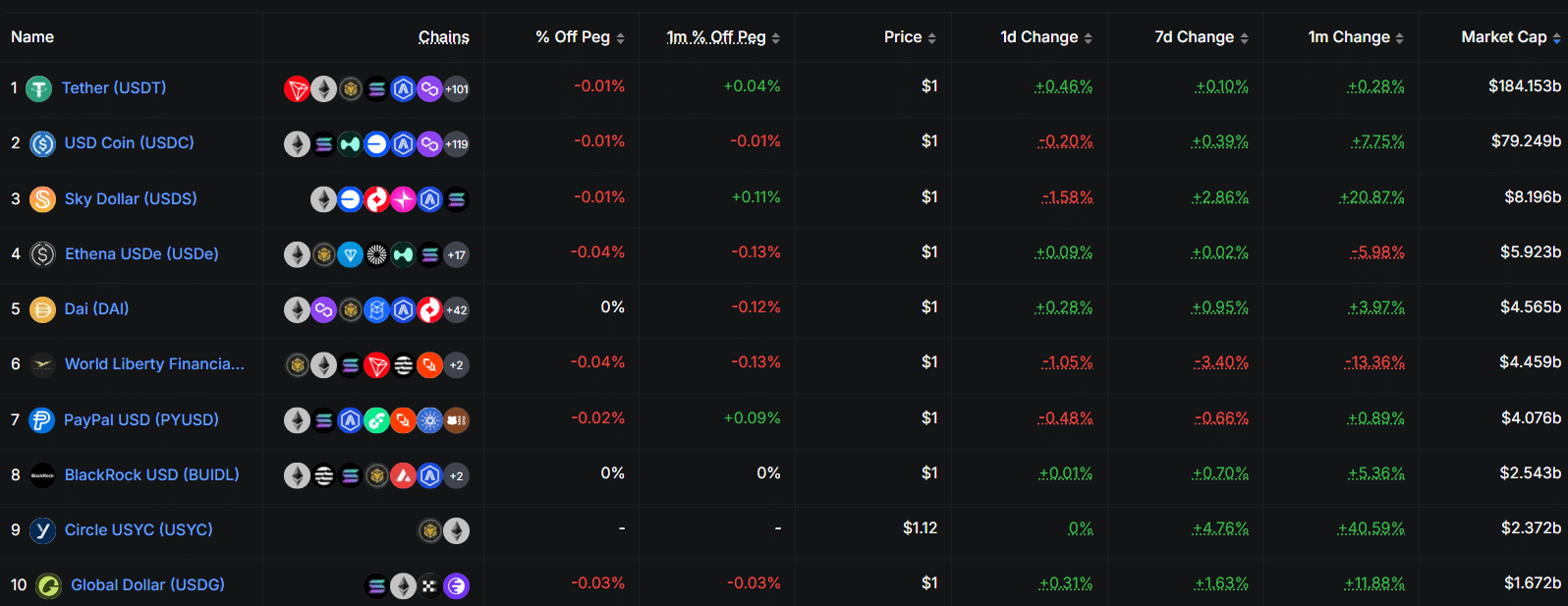
Source: DeFiLlama

However, part of this rise also reflects capital rotating into yield-bearing and regulated assets. In parallel, the stablecoin ratio holds near 9–10% of the $2.5 trillion crypto market cap, showing relative balance.

This steady structure suggests liquidity is gradually expanding, yet not accelerating sharply, leaving the market split between real inflows and internal redistribution.

Stablecoins move from storage to utilization across crypto markets

Stablecoin growth is increasingly translating into active deployment, as DEX volume reaches $7.65 billion and rises 8.91% weekly. Building on this, Uniswap [UNI] processes $1.289 billion, while PancakeSwap [CAKE] sustains steady stablecoin-pair activity, reinforcing spot demand.

Perpetual Open Interest holds near $48–51 billion, showing sustained positioning without sharp liquidations. As flows deepen, stablecoin netflows turn positive, with ERC-20 inflows around $484 million moving toward exchanges.

This shift aligns with holdings data, where exchanges control $70.4 billion, or 45%, anchoring liquidity concentration. From here, consumer balances reach $65.3 billion, or 41%, reflecting growing retail usage.
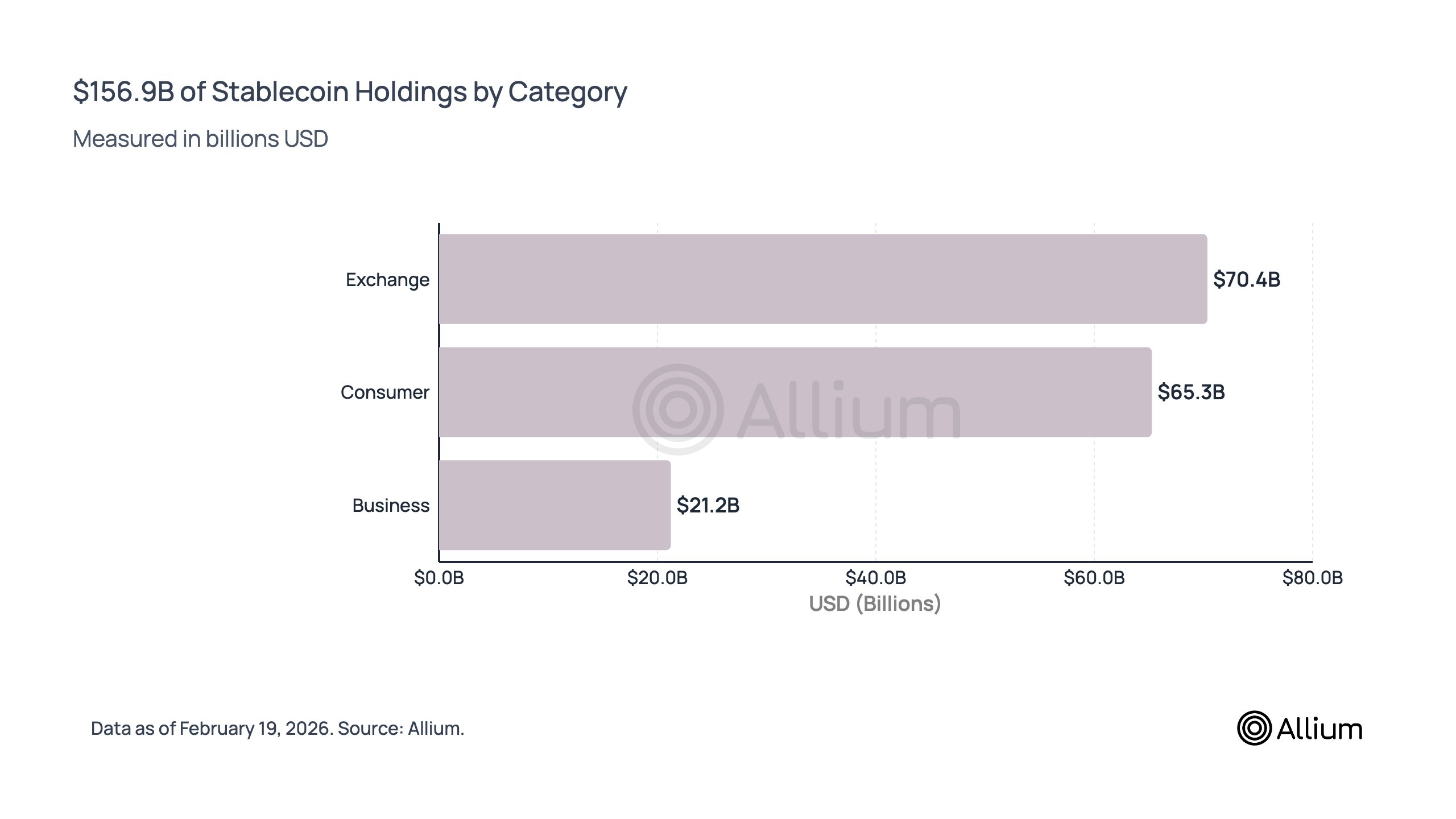
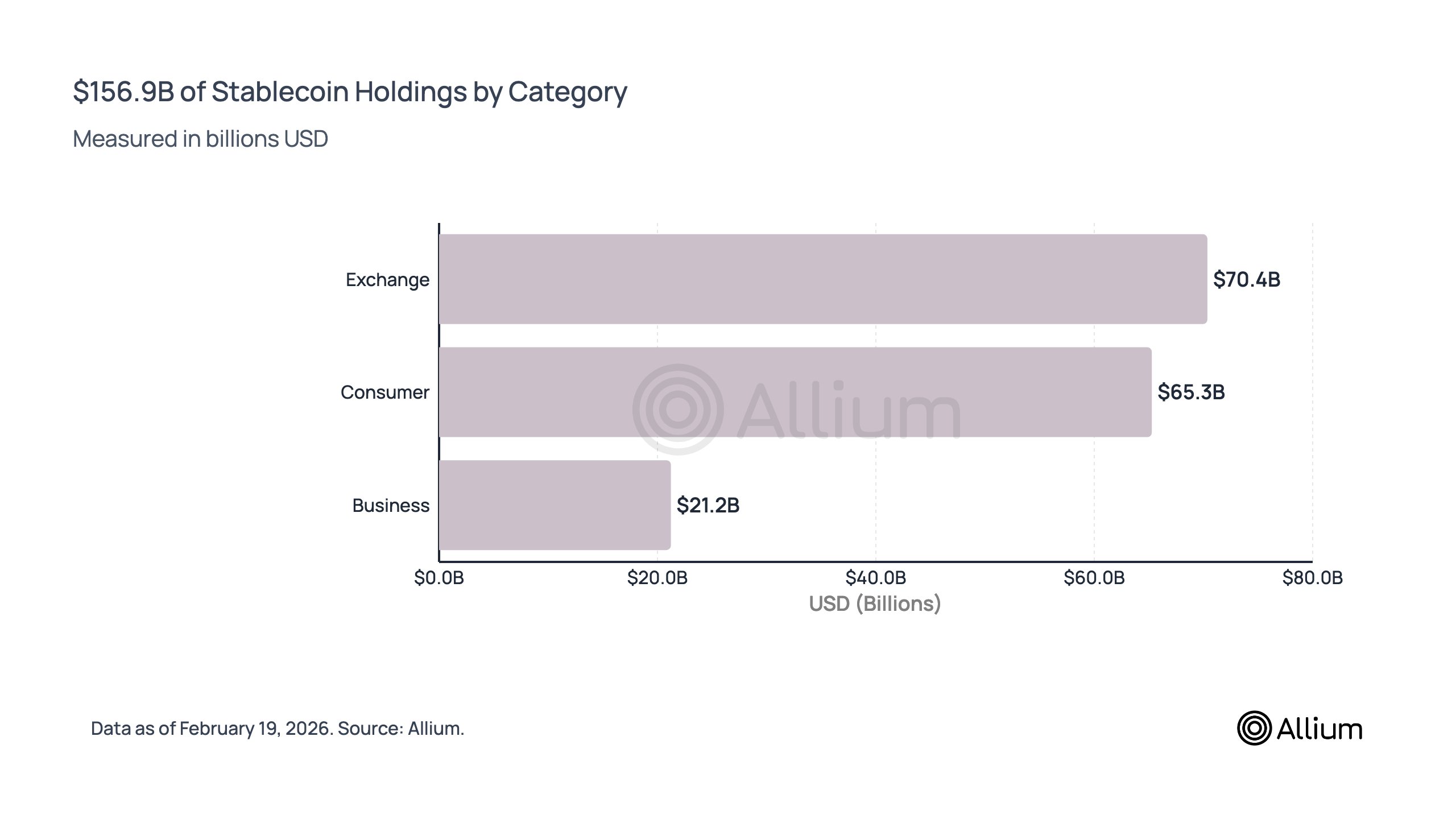
Source: Allium/ X

Business holdings at $21.2 billion support payment flows tied to $374.5 billion in volume. As distribution broadens, capital appears actively deployed, although exchange dominance suggests part of liquidity remains positioned rather than fully utilized.


Final Summary

  • Hyperliquid ecosystem growth reflects rising liquidity and user activity, yet heavy reliance on bridged inflows and incentives questions sustainability.
  • Stablecoins, led by Tether [USDT], show gradual expansion and active deployment, although a portion of liquidity still rotates internally across exchanges and DeFi.


Связанные с этим вопросы

QWhat is the total stablecoin supply approaching according to the article, and what does this growth reflect?

AThe total stablecoin supply is approaching $318 billion, reflecting controlled expansion rather than aggressive inflows, with a 0.47% weekly and 2.86% monthly increase.

QWhich stablecoin dominates the market in terms of supply, and what is its current growth trend?

ATether [USDT] dominates the market with a supply of $184 billion, but its weekly increase of only 0.10% shows a deceleration in its growth momentum.

QWhat does the majority of inflows into bridges like HyperCore indicate about the nature of the liquidity?

AThe majority of inflows into bridges like HyperCore, which transfer assets such as USDHL, USDe, and feUSD across chains, indicate a reallocation or rotation of existing liquidity rather than the creation of new capital.

QHow is the growing stablecoin supply being actively utilized in the crypto markets?

AThe growing stablecoin supply is being actively utilized, as evidenced by a DEX volume of $7.65 billion (an 8.91% weekly rise) and Perpetual Open Interest holding near $48-51 billion, showing capital is moving from storage to active deployment in trading and yield opportunities.

QWhat is a key factor questioning the sustainability of the HyperEVM ecosystem's current growth?

AA key factor questioning the sustainability of HyperEVM's growth is its heavy reliance on bridged inflows and incentive programs, as lasting expansion depends on steady organic demand rather than these potentially temporary drivers.

Похожее

The Allbirds, the Internet-Famous Shoes That Took Silicon Valley by Storm, Are Now All in on AI

Allbirds, the once-popular sustainable shoe brand favored by Silicon Valley elites and celebrities, has announced a drastic pivot from footwear manufacturing to AI infrastructure. On April 15, 2026, the company revealed plans to abandon its shoe business entirely, rebrand as "NewBird AI," and focus on GPU-as-a-service and AI cloud solutions. The move caused its stock to surge over 800% in a single day. The brand, known for its wool-based eco-friendly shoes, had struggled financially in recent years. Revenue fell from a peak of $298 million in 2022 to $152 million in 2025, with cumulative losses of $419 million over five years. In March 2026, Allbirds sold its intellectual property and footwear assets for just $39 million—a fraction of its former $4.1 billion valuation. The company secured up to $50 million in convertible notes to fund the acquisition of GPU hardware for AI compute leasing. However, the announcement lacked details about technical capacity, clients, or infrastructure plans. Critics highlight the high execution risks in the competitive AI infrastructure market, dominated by major cloud providers. The shift reflects a broader trend of companies rebranding around AI to attract investor interest, despite uncertain fundamentals. Allbirds also removed its "public benefit" corporate mission, signaling a departure from its original sustainability ethos. The move underscores the power of AI narrative in today’s capital markets, where storytelling often precedes substance.

marsbit37 мин. назад

The Allbirds, the Internet-Famous Shoes That Took Silicon Valley by Storm, Are Now All in on AI

marsbit37 мин. назад

The Complete Landscape of Encrypted AI Protocols: Starting from Ethereum's Main Battlefield, How to Build a New Operating System for AI Agents?

The year 2026 is emerging as a pivotal moment for the convergence of Crypto and AI, marked by AI's evolution from a tool to an autonomous economic agent. These AI agents require identity, payment channels, and verifiable execution environments—needs that blockchain is uniquely positioned to address. Ethereum is positioning itself as the trust layer for AI. Vitalik Buterin's updated framework outlines a vision where Ethereum provides verifiable, auditable infrastructure for AI, rather than accelerating its development unchecked. This is being realized through key protocol developments: - **Identity & Reputation (ERC-8004):** A standard for creating NFT-based identities for AI agents, complete with a reputation system built on verifiable on-chain interactions. - **Payments (x402):** Now under the Linux Foundation, this protocol embeds machine-to-machine payments directly into HTTP requests, enabling agents to pay for API access seamlessly with stablecoins or traditional methods. - **Execution (ERC-8211):** Allows AI agents to execute complex, multi-step DeFi transactions atomically in a single signature, overcoming a major operational bottleneck. Beyond Ethereum, other ecosystems are finding their roles. Solana is becoming a hub for high-frequency, low-cost agent payments and interactions due to its speed and low fees. Decentralized physical infrastructure networks (DePIN) provide the necessary compute power. In summary, a complementary crypto-AI stack is forming: Ethereum sets the standards for trust and identity, Solana excels at high-frequency execution, and DePIN supplies decentralized computation. The goal is not to accelerate AI uncontrollably, but to build a verifiable, decentralized foundation for the incoming AI agent economy.

marsbit43 мин. назад

The Complete Landscape of Encrypted AI Protocols: Starting from Ethereum's Main Battlefield, How to Build a New Operating System for AI Agents?

marsbit43 мин. назад

Торговля

Спот
Фьючерсы
活动图片