From Tokens to Machine Labor: AI is Shifting from Tool to "Worker"

marsbitОпубликовано 2026-05-31Обновлено 2026-05-31

Введение

The article "From Token to Machine Labor: AI is Evolving from Tool to 'Worker'" argues that the business model for AI is shifting beyond simply selling computational resources (tokens, GPU hours) or model access. Instead, a new "machine labor market" is emerging, where the core economic transaction is the purchase of economically useful work directly performed by software. The central thesis is that AI pricing will evolve through four stages: 1) raw tokens, 2) standardized LLM capabilities (e.g., text generation), 3) industry-specific labor markets (e.g., legal review, radiology), and finally 4) a programmable results market where tasks like resolving a support ticket are bid on and priced based on outcome. In this future, buyers will care less about *which* model or GPU completes a task and more about whether the work meets specified standards for accuracy, latency, and cost. This transition reframes the impact of AI on human labor. Rather than simple replacement, it suggests a re-coordination where machines handle standardized, verifiable work, freeing humans for roles involving oversight, context management, responsibility, and final judgment. In some cases, this "last 1%" of human input becomes more valuable as it enables the other 99% to be automated. Furthermore, as AI reduces the cost of work, demand may expand, creating larger markets (e.g., 24/7 customer service) rather than just cheaper versions of existing ones. The article concludes that while infrastructure (G...

Editor's Note: As AI begins to write code, handle customer service tickets, and review legal documents, a more fundamental question is emerging: what are businesses truly purchasing—tokens, GPU hours, or completed work?

This article proposes a noteworthy framework: the commercialization of AI should not merely be understood as a "computing power market" or a "model invocation market," but is moving toward a new "machine labor market." In this market, tokens are merely a unit of measurement, GPUs are input goods, models are production tools, and the real objects being priced and traded are economic tasks directly completed by software.

The article's core thesis is that AI pricing mechanisms will evolve from raw tokens and standardized model capabilities to industry-specific labor, and finally to a programmable outcomes market. This means that in the future, enterprises might no longer care which specific model or GPU type completes a task, but rather whether it delivers a result meeting defined standards within specified latency, accuracy, reliability, and cost constraints.

This also implies that AI's impact on the human labor market may not be simple replacement. As machines take on more standardized, verifiable work, the human role may shift towards review, accountability, context management, and final judgment. In some scenarios, the final 1% of human judgment could become even more valuable, as it unlocks large-scale automation of the other 99%.

From this perspective, the next stage of competition in the AI market may no longer be just about model capability, nor a simple price war over computing power, but about who can first standardize, verify, and price "work," and ultimately turn machine labor into a new type of factor of production that can be procured, settled, and traded.

Original article follows:

Waves of productivity have historically come from providing humans with tools and software to optimize how work gets done. Spreadsheets aided accountants and analysts, conveyor belts increased throughput, hammers amplified human leverage. But the actual labor always came from humans.

Now, AI is producing work outcomes end-to-end, directly executing the labor itself. It can write code, handle customer service tickets, review legal documents. A compression is happening at the far end of the tech stack: the old stack supported labor, the new stack is starting to produce it.

If you've listened to discussions on AI financialization recently, you've likely heard Jensen and others say that LLM tokens and/or GPU hours are becoming the new commodities. This intuition is understandable because tokens are measurable, billable, and easy to chart; billions of dollars are also flowing into GPU hours. But tokens remain merely a meter, GPU hours are just an input—no one buys them for their own sake. What people actually want is to get work done. AI is turning the tech stack itself into a source of labor.

Machine Labor: Work performed by software, for an economic purpose, and sold into the production process.

The market is already moving in this direction. Benchmark's Sarah Tavel prefers to understand this opportunity through the lens of outsourcing labor markets, not software categories. If a repeatable task is already performed by a dedicated offshore team or professional services firm, it's often also a good candidate for AI delivery. a16z's Alex Rampell calls this "software eating labor": software's next act is to do the work itself. Sequoia's Julien Bek describes the same shift from another angle: services are turning into software, copilots sell tools, while autopilots sell the work.
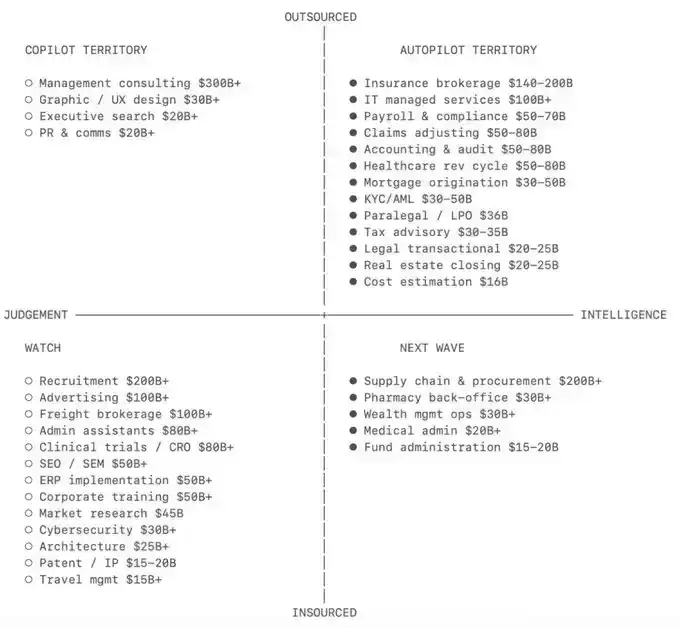
The Missing Market Behind Outcomes-Based Pricing

Seat pricing charges for access, token pricing charges for usage. Outcomes-based pricing charges when work is completed. Outcomes pricing moves us a step forward, but it still doesn't answer one question: who decides the price?

If machine labor can be bought directly, price should come from competition among suppliers. These suppliers must be able to meet the same class of tasks or work completion standards, which requires standardization within different industries and tasks.

The current approach uses LLM tokens, but raw tokens are just the lowest layer. A barrel of oil is just a unit of measurement; what's actually traded is a barrel of a specific grade of oil, with defined quality, delivery terms, and market price. A barrel of Brent crude and a barrel of high-sulfur heavy crude are not the same commodity. It's the same with LLM tokens. Tokens are just the unit; what matters is the intelligence behind them: model quality, benchmark floors, latency, context window, reliability, and delivery guarantees. One million tokens from a frontier coding model are not the same commodity as one million tokens from a cheap general-purpose model. The market needs standardized inference grades, just as the energy market needs standardized oil grades.

Anjali Shriva points this out directly: a token is not a fixed cost unit. Its economics vary with context length, task structure, input/output ratio, retry counts, tool calls, and agent workflows. A token in a short prompt and a token buried in a long agent loop are not the same economic object.

We already do this in human labor markets. No one hires a radiologist as a generic "human hour." They look at training background, certifications, specialty, years of experience, availability, reputation, liability, etc. Different human contract specs correspond to different minimum standards and grade expectations.

Human labor markets already run on these specs; it's just that these specs are often muddled, qualitative, and full of proxy signals. Machine labor will make these specs more explicit and quantifiable.

For an LLM or an agent, metrics like skill, experience, speed, and reliability can be written directly into a contract: benchmark scores, latency, throughput, context window, max output length, tool-use accuracy, uptime, error rates. We can procure labor based on quantifiable expectations and outcomes.

TheGrid.ai's contract spec is essentially a qualification filter, plus price competition for LLM outputs. Any supplier meeting the spec can enter the competition:

Intelligence Benchmark ≥ Floor

Latency ≤ Ceiling

Throughput ≥ Floor

Uptime ≥ Floor

Error Rate ≤ Ceiling

Once suppliers all meet the same minimum bar, they compete on price. The buyer asks: which supplier can deliver the required labor at the best price?

Hiring a radiologist, in the LLM context, becomes a measurable question: which LLMs can read X-rays with high proficiency, meeting defined latency, context window, and other outcome-based contract specs.

Outcome is how the buyer measures success; Labor is the economic activity being supplied; Token is the fuel the machine consumes while doing the work.

The Grid is the machine labor market.

From Tokens to Machine Labor Market

The market can price inputs of the tech stack, but to price outputs requires a machine labor market. Buyers don't care about GPU hours. Model endpoints themselves are unstable: they get renamed, deprecated, wrapped, or simply retired.

Users and liquidity hate frequent changes. GPUs and models will keep evolving, but the stable unit is the work itself.

I believe the market will evolve along the following path. Each step up the ladder, what is being purchased becomes more abstract, more valuable, but also harder to verify. The Grid should climb this ladder progressively:

Raw Tokens → Commoditized LLM Capability Market → Commoditized Labor Market → Programmable Outcomes Market

Stage 1: Raw Tokens

Claude 4.7, GPT 5.5, Kimi 2.6, DeepSeek V4, GLM 5, etc.

Today, buyers purchase raw model output from inference providers. They send their prompts, receive inference results, and pay per use. This is easy to verify, but it's still just raw material. Buyers don't actually want tokens; they want useful intelligence at the best price.

Stage 2: Commoditized LLM Capability Market

E.g., text/usd, code/usd, agent/usd, etc.

The buyer no longer chooses a specific model, but the category of intelligence they need. The buyer still owns the workflow, prompts, data, and application logic. The Grid just routes each request to the qualified model that meets the contract spec and offers the lowest price.

Note: This is the first real abstraction above raw tokens, and where TheGrid.ai currently sits.

Stage 3: Commoditized Labor Market

E.g., accounting/usd, support_agent/usd, legal/usd, healthcare/usd, radiology/usd, etc.

As models become more specialized, the capability market can evolve further into industry-specific markets. This is analogous to specialization in human labor markets.

At this layer, we're selling inference suited for workflows in specific labor verticals. This category will expand rapidly as niche industry models become common. Examples include Cursor's Composer, Harvey for legal work, and EvidenceOpen for healthcare.

Stage 4: Programmable RFQ and Outcomes Market for Agents

E.g., support_ticket_resolved/usd, pr_merged/usd, claim_processed/usd, etc.

The final layer is where The Grid moves from an inference market to a machine labor market.

This layer requires RFQs (Request for Quote), escrow, delayed settlement, buyer confirmation, supplier reputation, clawback, dispute resolution, etc. It will likely start with RFQs rather than order books. Buyers define the job, constraints, acceptance criteria, and settlement terms; agents bid to complete it. The Grid helps route, price, verify, and settle these jobs.

This is the most valuable layer, but also the hardest to verify, as outcomes can be delayed, subjective, and easily gamed. A customer service ticket might be reopened; a pull request might pass tests but still introduce poor architecture.

Total Price = Cost of doing the work + Cost of bearing the risk

A workflow does not automatically become a market just because intelligence has a market or intelligence gets cheaper. Some work is deeply dependent on private context, like customer history or internal policies. The more context-dependent the work, the less likely it is to be cleanly liquidated in an open market. [@hypersoren https://hypersoren.xyz/posts/cybernetic-arbitrage/]

The market needs to reveal which labor categories will expand and which will contract.

"Machine Labor vs. Human Labor" or "Machine Labor & Human Labor"

Anjali Shriva notes in her mechanism design draft that the AI narrative is too often described as replacement. But in reality, it's more of a coordination problem: how work, attribution, incentives, and value get reorganized when both humans and machines participate in production.

Today, much AI usage inside companies remains stuck because employees use AI privately, workflows stay locked on individuals, and the firm cannot price these productivity gains or scale them.

Most automatable work will likely shift to machines. Some work will turn into human review, accountability, training, and context management. In some cases, the final 1% of human judgment will become more valuable, as it unlocks the other 99% of automation at scale.

Rachel Su Park's "Brave New World of AI Markets" points out that AI's TAM should not be simply modeled as a replacement for existing human labor spend, because it changes both price and quantity. As the cost of work falls, unit price may decline, but quantity consumed may expand because existing work gets consumed more often, and entirely new work that wasn't economical before becomes possible. The article summarizes it as:

P × Q: Market Size = Price per unit of work × Quantity of work consumed

If AI makes a customer service interaction cheaper, companies can afford to offer 24/7 coverage. The market won't just be a cheaper version of the old customer service labor market; it might become a much larger market for customer interactions.

AI is an expansionary market because demand does not stay constant when the cost of work falls.

The Labor Layer

The machine labor market should start with work that can be crisply defined in specs. GPU hours contain too much input information; they only tell you what powered the work. Pricing full outcomes is too complex, too context-dependent. As verification, reputation, and risk/insurance pricing get handled by machines, the market will move further into the pure outcomes layer.

Machine labor can become tradable because buyers will increasingly not care which model or which GPU produced the work, but rather whether the work itself meets the minimum standards and grade from the contract spec, at the right price. Agents will care even less about the underlying source.

Machines can now directly execute work for an economic purpose, and that work can be defined, measured, priced, procured, and eventually traded. Electricity, compute, models, and tokens are still important, of course, but they're all still upstream.

Downstream is where the work actually gets done, and the market is moving toward a simpler object: machine labor.


Связанные с этим вопросы

QAccording to the article, what is the core evolution path of AI pricing mechanism?

AThe article states that the AI pricing mechanism will evolve from raw tokens, to standardized model capabilities, to industry-specific labor, and finally to a programmable results market.

QWhat does the article define as 'machine labor'?

AThe article defines 'machine labor' as work performed by software for economic purposes, which is then sold into the production process.

QWhat are the four evolutionary stages of the AI market, from primitive to advanced, as outlined in the article?

AThe four stages are: 1) Raw Tokens, 2) Commoditized LLM Capability Market, 3) Commoditized Labor Market, and 4) Programmable Results Market for Agents.

QHow does the article suggest AI will change the human job market, rather than simply replacing it?

AThe article suggests that as machines take over standardized work, human roles will shift towards review, accountability, context management, and final judgment. In some cases, the final 1% of human judgment becomes more valuable as it unlocks large-scale automation of the other 99%.

QWhat key factor does the article identify as necessary for a true machine labor market to function?

AThe article identifies the need for standardization and verifiable specifications within different industries and tasks. Suppliers must meet defined standards (like benchmark scores, latency, error rates) for a specific type of work, enabling price competition based on the delivered labor, not the underlying tokens or compute.

Похожее

Are Rising U.S. Stocks Getting More Dangerous? Goldman Sachs: Downside Protection Mechanisms Have Almost Failed

The US stock market rally is showing signs of becoming increasingly precarious as key downside protection mechanisms fail, according to Goldman Sachs. Derivatives strategist Brian Garrett notes that the S&P 500 options volatility skew has plunged to an 18-month low, indicating the market now prices an 8% probability for both a 10% drop and a 10% rise—a sign of "skew failure." Concurrently, Goldman's Panic Index hit a two-year low, reflecting minimal demand for tail-risk hedging. This complacency emerges amid a relentless market surge, with the S&P 500 setting new records frequently in 2024. Garrett highlights three major concerns: extreme concentration in the top ten stocks (40% of index weight), heavy reliance on AI-themed performance, and a price pattern eerily similar to the 1998-1999 period. Despite pervasive media pessimism, this fear is absent in options pricing. Downside hedge costs are historically low. Goldman suggests tactical trades: buying RSP outperformance options versus the SPX for a broadening rally, purchasing VIX calls for protection, and going long on Bitcoin ETF volatility. Hedge funds have been net buyers for two weeks, with sector rotation into financials and out of industrials. Notably, the global single-stock leveraged/ inverse ETF AUM has doubled to over $60 billion in two months, underscoring growing speculative activity.

marsbit3 мин. назад

Are Rising U.S. Stocks Getting More Dangerous? Goldman Sachs: Downside Protection Mechanisms Have Almost Failed

marsbit3 мин. назад

DAT Failure? Listed Companies Betting on HYPE Floating Profit of $12.5 Billion

Several public companies that adopted a "HYPE Treasury" strategy—holding significant reserves of the HYPE token from the Hyperliquid ecosystem—have achieved substantial paper gains, collectively exceeding $1.25 billion. This contrasts with the reported struggles of MicroStrategy's flagship BTC treasury strategy. The article profiles three such HYPE-focused treasury companies: 1. **Hyperliquid Strategies Inc. (PURR):** The largest holder, with approximately 22.3 million HYPE tokens valued at ~$1.636 billion, resulting in an unrealized gain of ~$1.22 billion. It has fully transitioned from a biotech firm to a dedicated crypto treasury, adding staking and validator operations to enhance returns. 2. **Hyperion DeFi (HYPD):** Holds around 2 million HYPE tokens (~$147 million value) with a gain of ~$49.4 million. It is deeply integrated into the Hyperliquid ecosystem, running a major validator node and building DeFi products for additional yield. 3. **Lion Group Holding (LGHL):** A smaller holder with ~194,000 HYPE tokens (~$14.14 million value), maintaining a long-term commitment to the token. The success of these HYPE treasuries is attributed not only to the token's significant price appreciation but also to active on-chain participation through staking, validation, and ecosystem integrations, creating a compounding "flywheel" effect. The article posits that while MicroStrategy's BTC strategy faces challenges, HYPE treasuries may offer a more sustainable model through deeper protocol engagement, with potential for further growth if HYPE's price rises as predicted by some analysts.

marsbit23 мин. назад

DAT Failure? Listed Companies Betting on HYPE Floating Profit of $12.5 Billion

marsbit23 мин. назад

DAT Failing? Listed Companies Betting on HYPE Have Floating Profits of $12.5 Billion

Facing a potential need to sell Bitcoin to pay dividends amid a $12.5B quarterly net loss, the crypto treasury strategy pioneered by Strategy appears strained. In contrast, public companies that adopted a similar strategy by betting on the HYPE token are seeing massive gains, with collective unrealized profits exceeding $1.25 billion. Three key HYPE treasury companies are highlighted: 1. **Hyperliquid Strategies Inc. (PURR):** The largest holder, with approximately 22.3 million HYPE tokens valued at ~$1.636 billion, resulting in ~$1.22 billion in unrealized gains. It has fully transitioned from a biotech firm to a native crypto treasury, focusing on staking and ecosystem participation via validator operations. 2. **Hyperion DeFi (HYPD):** Holds about 2 million HYPE tokens (~$147M value) with ~$49.4M in gains. It is deeply integrated into the Hyperliquid ecosystem, running a top validator node and building DeFi products to generate additional yield. 3. **Lion Group Holding (LGHL):** A smaller player holding ~193,775 HYPE tokens (~$14.14M value), maintaining a long-term holding strategy alongside other crypto assets. The article argues that HYPE treasuries have an advantage over Bitcoin-based ones like Strategy's. Their success stems not just from price appreciation but from active on-chain participation—staking, earning validator rewards, and engaging with ecosystem protocols—creating a compounding "flywheel" effect. With Hyperliquid dominating the on-chain perpetuals market and HYPE's tokenomics encouraging buys and burns, these treasuries are positioned to benefit further if HYPE's price rises as some predict. While the original Bitcoin treasury strategy isn't declared a failure, the current narrative highlights the outsized success of early movers into the HYPE ecosystem.

Odaily星球日报28 мин. назад

DAT Failing? Listed Companies Betting on HYPE Have Floating Profits of $12.5 Billion

Odaily星球日报28 мин. назад

Comics Illustration: Helping You Understand China's New Regulations on Outbound Investment

Summary: Understanding China's New Regulations on Overseas Investment The State Council has announced new regulations on overseas investment, effective July 1, 2026. The core message is not a prohibition on international investment, but a call for both companies and individuals to operate with strong regulatory awareness. Here are the key points: 1. **Scope is Broad:** The rules apply not only to companies but also to other organizations and individual residents. 2. **Definition of Investment is Wide:** It encompasses not just capital transfers but also asset contributions, obtaining equity or rights, financing, providing guarantees, and direct or indirect acquisition of rights related to overseas entities or assets. 3. **Companies Must Plan Comprehensively:** Beyond simple ownership charts, firms need clear plans covering the investing entity, required approvals or filings, fund transfer paths, and compliance with technology, data, and security reviews. 4. **Individuals Should Prioritize Compliance:** Before focusing on returns, individuals must first assess their eligibility, understand legal channels for capital outflow, know what they are acquiring, and identify responsible parties in case of issues. 5. **Penalties are Significant:** Violations can result in fines and potentially restrictions on future overseas investment activities. In essence, overseas investment remains possible, but it must be approached with regulatory compliance as a fundamental priority, not solely based on commercial opportunity. *Note: This is a general informational summary and does not constitute legal advice or investment recommendations.*

marsbit42 мин. назад

Comics Illustration: Helping You Understand China's New Regulations on Outbound Investment

marsbit42 мин. назад

Nvidia Rack Disassembly Reveals New Growth Opportunity, MLCC Value Surges 182%

Supply bottlenecks in AI infrastructure have expanded to fundamental hardware components like multilayer ceramic capacitors (MLCCs), crucial for stabilizing power and filtering noise in AI servers. Both Goldman Sachs and Morgan Stanley highlight MLCCs as entering a historic "volume-price dual increase" supercycle driven by AI. Goldman forecasts the AI server MLCC market to surge over fourfold from ~$1.4B in FY2025 to ~$5.8B in FY2030, a 34% CAGR. The core driver is a structural supply-demand imbalance. While AI server demand is projected to grow ~4.3x by 2030, industry capacity expands at only ~10% annually, constrained by internal production of equipment and materials. This is compounded by strong demand from electric vehicles. The shortage is evident, with lead times for high-end MLCCs exceeding 20 weeks. The price cycle has officially begun. Japanese leaders Murata and Taiyo Yuden have raised prices by 15-35% for AI server and automotive MLCCs since April, citing material costs. Japan's April export data confirms the trend, with MLCC export value up 28% year-over-year. Profit leverage is significant: Goldman estimates a mere 5% price increase could boost Murata's FY2027 operating profit by ~13% and Taiyo Yuden's by up to 37%. Morgan Stanley's teardown of Nvidia's upcoming Vera Rubin AI rack reveals another catalyst: the MLCC value per rack has skyrocketed 182% from the previous generation to ~$4,320, highlighting the component's growing importance. With demand set to massively outstrip constrained supply, and price increases just starting, analysts position MLCCs at the beginning of a major, prolonged upcycle.

marsbit42 мин. назад

Nvidia Rack Disassembly Reveals New Growth Opportunity, MLCC Value Surges 182%

marsbit42 мин. назад

Торговля

Спот
Фьючерсы

Популярные статьи

Неделя обучения по популярным токенам (2): 2026 может стать годом приложений реального времени, сектор AI продолжает оставаться в тренде

2025 год — год институциональных инвесторов, в будущем он будет доминировать в приложениях реального времени.

1.8k просмотров всегоОпубликовано 2025.12.16Обновлено 2025.12.16

Неделя обучения по популярным токенам (2): 2026 может стать годом приложений реального времени, сектор AI продолжает оставаться в тренде

Обсуждения

Добро пожаловать в Сообщество HTX. Здесь вы сможете быть в курсе последних новостей о развитии платформы и получить доступ к профессиональной аналитической информации о рынке. Мнения пользователей о цене на AI (AI) представлены ниже.

活动图片