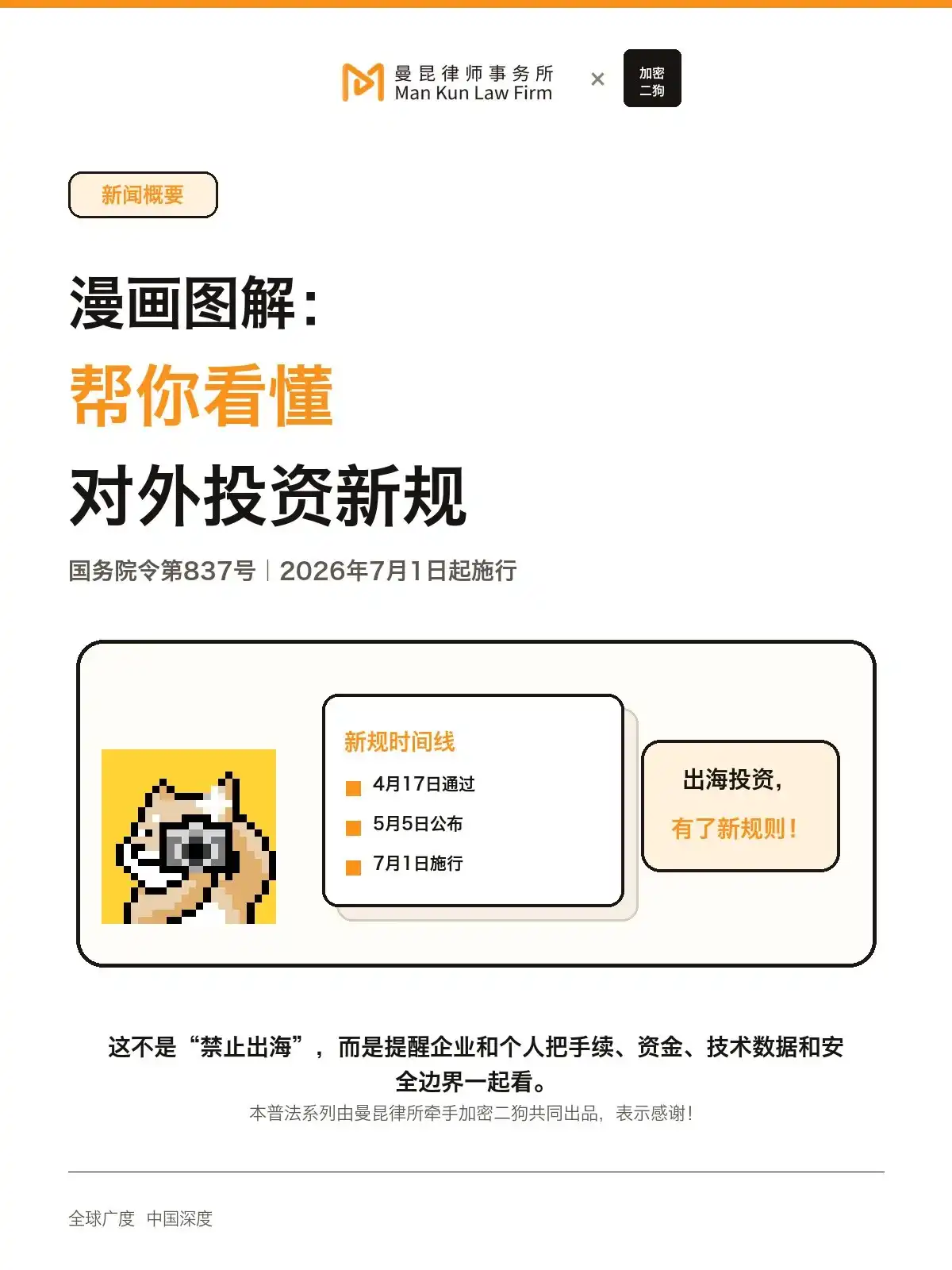
Comics Illustration: Helping You Understand China's New Regulations on Outbound Investment

marsbitОпубликовано 2026-06-01Обновлено 2026-06-01

Введение

Summary: Understanding China's New Regulations on Overseas Investment The State Council has announced new regulations on overseas investment, effective July 1, 2026. The core message is not a prohibition on international investment, but a call for both companies and individuals to operate with strong regulatory awareness. Here are the key points: 1. **Scope is Broad:** The rules apply not only to companies but also to other organizations and individual residents. 2. **Definition of Investment is Wide:** It encompasses not just capital transfers but also asset contributions, obtaining equity or rights, financing, providing guarantees, and direct or indirect acquisition of rights related to overseas entities or assets. 3. **Companies Must Plan Comprehensively:** Beyond simple ownership charts, firms need clear plans covering the investing entity, required approvals or filings, fund transfer paths, and compliance with technology, data, and security reviews. 4. **Individuals Should Prioritize Compliance:** Before focusing on returns, individuals must first assess their eligibility, understand legal channels for capital outflow, know what they are acquiring, and identify responsible parties in case of issues. 5. **Penalties are Significant:** Violations can result in fines and potentially restrictions on future overseas investment activities. In essence, overseas investment remains possible, but it must be approached with regulatory compliance as a fundamental priority, no...

Author: Liu Honglin, Mankun Blockchain

The State Council has promulgated the "State Council Regulations on Outbound Investment," which will take effect from July 1, 2026.

This is not simply a matter of "cannot go overseas."

More accurately, it serves as a reminder to enterprises and individuals: outbound investment must follow rules.

To understand this new regulation, keep the following points in mind first:

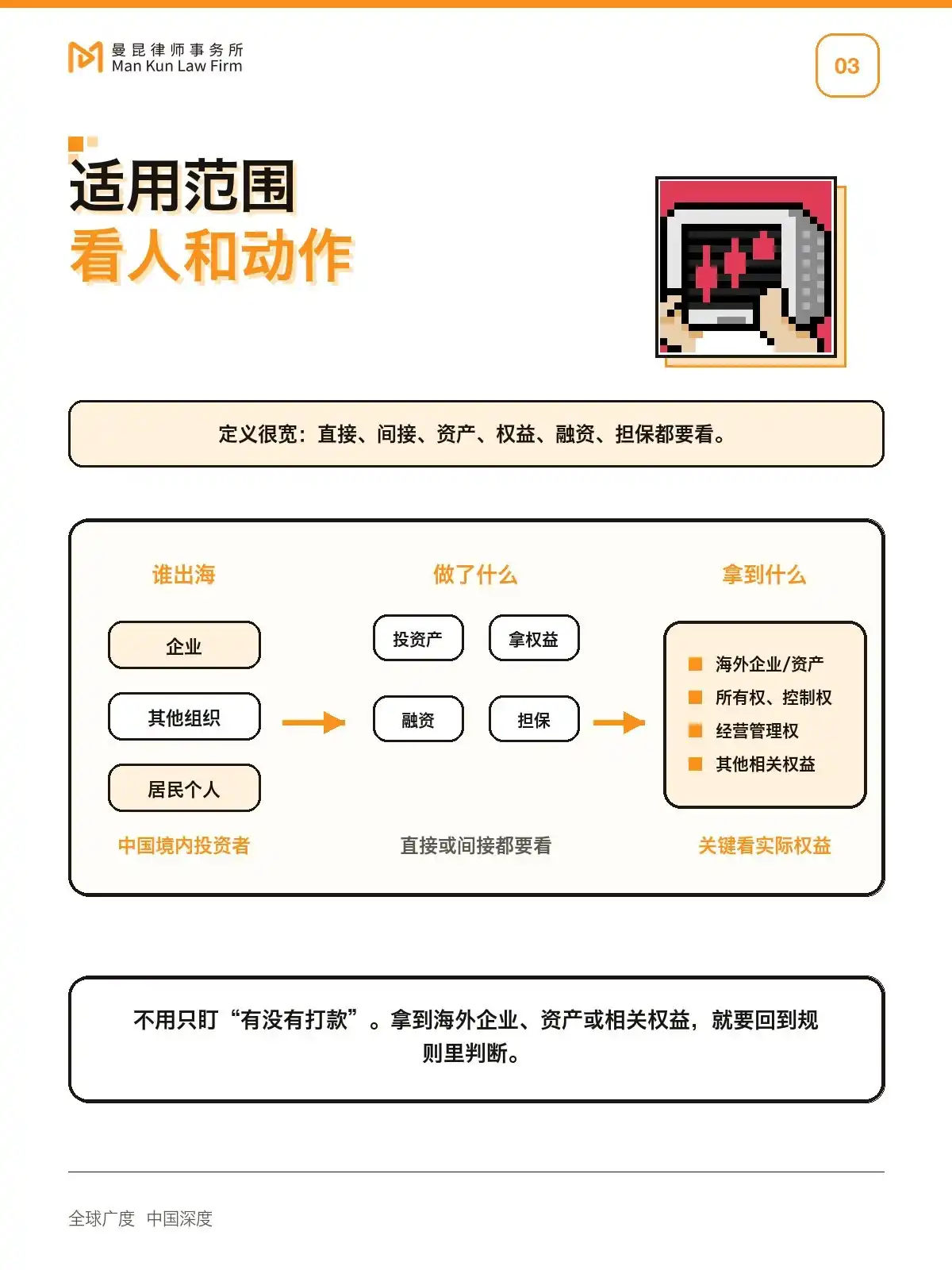
1️⃣ It's not just enterprises that are regulated. The scope of investors includes domestic enterprises, other organizations, and resident individuals.

2️⃣ It's not just about transferring money. Acquiring assets, obtaining equity rights, providing financing or guarantees, and directly or indirectly acquiring rights and interests related to overseas enterprises or assets all require assessment.

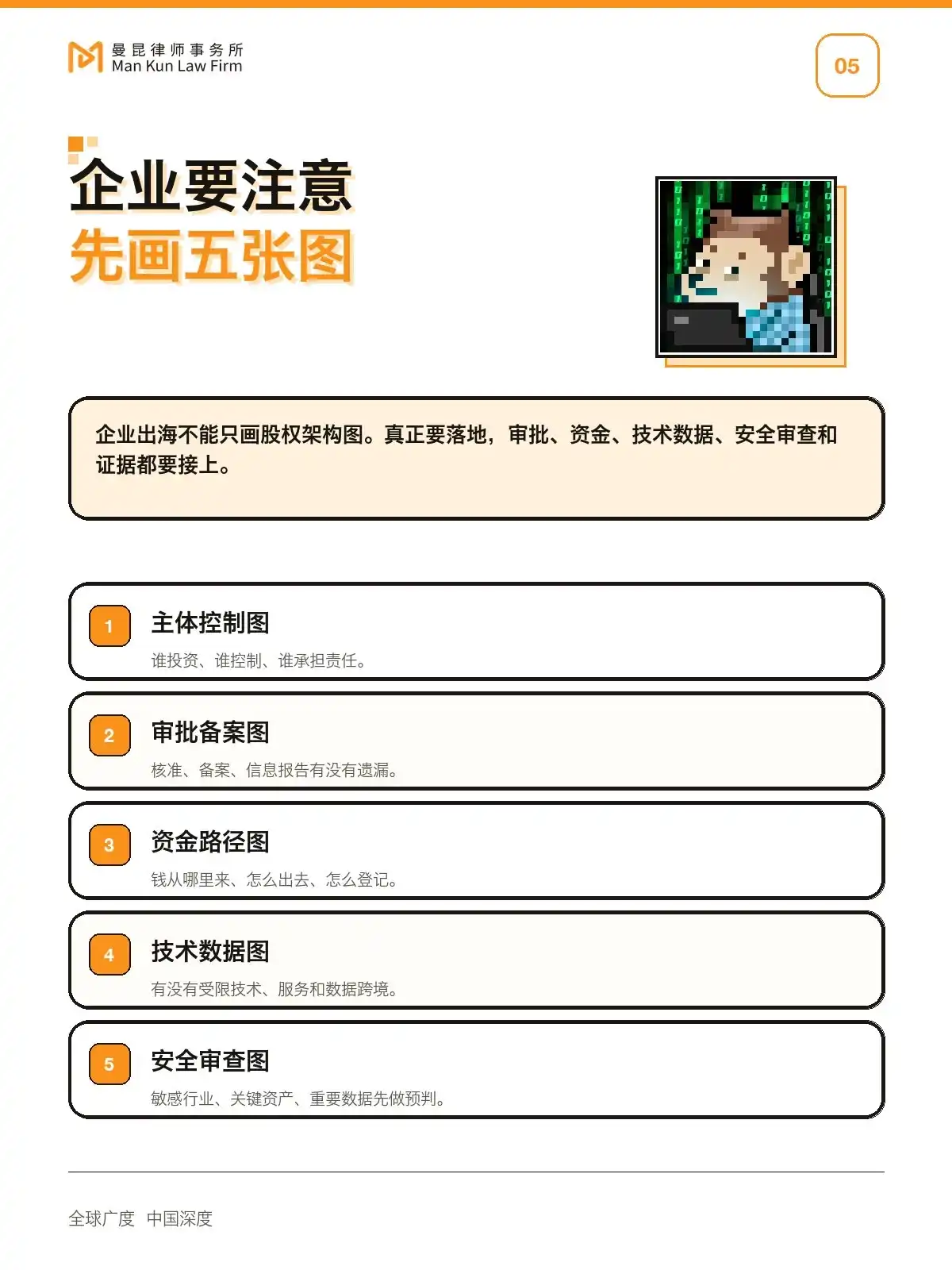
3️⃣ Enterprises shouldn't just draw equity structure charts. They also need to clearly chart the entities, approval/filing procedures, fund flow paths, technology, data, and security reviews.

4" Individuals shouldn't just look at returns. First, consider whether you are eligible to invest, how the funds will go out, what you are actually buying, and whom to turn to if something goes wrong.

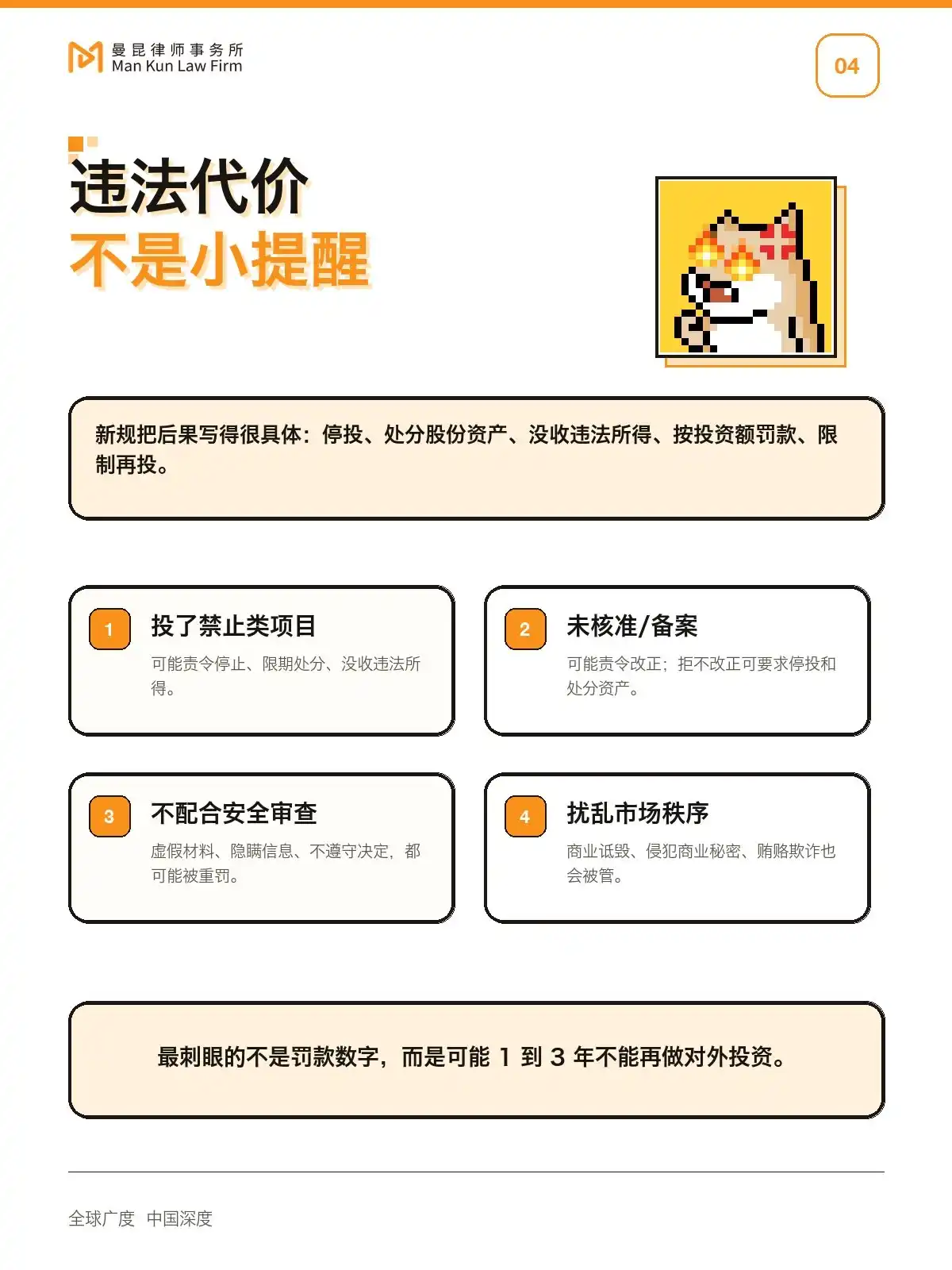
5️⃣ The price of non-compliance is not light. Beyond fines, there may be restrictions on continuing outbound investment activities.

In a nutshell: Outbound investment is not prohibited, but it cannot be pursued solely based on commercial opportunities.

The above is for general information sharing only and does not constitute legal advice or investment recommendations.

Связанные с этим вопросы

QWhat is the core message of China's new regulations on outward investment according to the article?

AThe core message is that outward investment is not prohibited, but it must be conducted with a strong awareness of and compliance with the rules. The regulations emphasize that decisions cannot be based solely on commercial opportunities.

QWho is covered as 'investors' under these new regulations?

AThe regulations cover not only domestic enterprises but also other domestic organizations and resident individuals. All are explicitly included within the scope of investors subject to the rules.

QWhat are some of the forms of outward investment mentioned that require consideration under the new rules?

AThe rules apply not just to monetary transfers. Activities like investing assets, acquiring equity interests, providing financing, offering guarantees, and obtaining rights related to overseas entities or assets, either directly or indirectly, all fall under consideration.

QWhat additional requirements do enterprises need to prepare for besides their corporate ownership structure charts?

AEnterprises must also clearly outline and prepare documentation related to the involved entities, the processes for obtaining necessary approvals or filings, the paths for fund transfers, and considerations for technology, data, and security reviews.

QWhat are the potential consequences for violating these regulations?

ABeyond financial penalties, violators may face restrictions or prohibitions on their ability to continue engaging in outward investment activities in the future.

Похожее

"Water Scarcity": The Hidden Fatal Flaw of AI Infrastructure

“Water Scarcity: The Hidden Vulnerability of AI Infrastructure” In June 2026, SpaceX revised its IPO prospectus to highlight a core resource constraint alongside power and processors: water. This move signals a pivotal shift where water scarcity has transformed from an operational cost to a major, uncontrollable investment risk, directly threatening AI data center expansion. The scale of the problem is immense. U.S. data centers consumed an estimated 17 billion gallons of water for direct cooling in 2023, with indirect water use for power generation exceeding 211 billion gallons. Giants like Google alone use billions of gallons annually, with single sites consuming volumes equivalent to a medium-sized city. This water is largely “consumptive,” evaporated into the atmosphere and lost. This massive demand is colliding with scarcity. Tech companies are building “water tigers” in arid regions, sparking community protests in places like Mexico and Arizona, where data centers can legally use millions of gallons daily—enough for tens of thousands of residents. These conflicts are not about illegality, but about a mismatch between historic water allocation frameworks and new, colossal demand. The consequences are real. Community opposition, largely centered on water, has reportedly stalled or canceled $64 billion in U.S. data center projects over two years. Simultaneously, investors are pressuring companies for greater water footprint transparency, viewing it as a financial risk, not just an ESG metric. Technological solutions like air or liquid cooling involve trade-offs between water and electricity use, with final choices dictated by local constraints. The irony is stark: while industry leaders envision AI as a utility “like water,” its physical infrastructure is straining real-world water supplies. The race for AI supremacy may ultimately be governed not by the fastest chip, but by the slowest water meter.

marsbit3 мин. назад

"Water Scarcity": The Hidden Fatal Flaw of AI Infrastructure

marsbit3 мин. назад

Global Card Issuance Enters a Compliance-Driven Era: WasabiCard is Building the Next-Generation Payment Infrastructure

Global card issuance is entering a compliance-driven era, with WasabiCard building next-generation payment infrastructure. The platform asserts that as stablecoins increasingly enter cross-border payments, corporate settlements, and global commerce, the industry is shifting focus from "availability" and "growth-driven" models to long-term, compliant operation under global frameworks. Competition will center on sustainable compliance and global infrastructure capabilities. Stablecoins are evolving from on-chain assets into key payment tools in global business, with card issuance acting as critical infrastructure connecting digital assets to traditional payment networks like Visa and Mastercard. This expansion has revealed structural issues, including cross-regional issuance, BIN resource management, and insufficient AML and risk controls. In response, the industry is moving away from reliance on "grey efficiency" towards prioritizing compliance, risk management, and long-term operational stability. WasabiCard outlines its strategy: collaborating with licensed principals and local partners for localized operations, building robust KYC/AML systems, strictly separating commercial and consumer BIN usage, and enhancing global issuance, payment, and cross-border fund flow infrastructure. The goal is to build stable, scalable payment infrastructure amid evolving global regulations, shifting industry competition from scale to infrastructure capability. As stablecoins integrate further with global commerce, payment infrastructure will become a fundamental, embedded component of internet business. WasabiCard will continue to develop capabilities in global card issuance, stablecoin payments, cross-border fund flows, and API-driven financial workflows.

marsbit13 мин. назад

Global Card Issuance Enters a Compliance-Driven Era: WasabiCard is Building the Next-Generation Payment Infrastructure

marsbit13 мин. назад

Zhou Hang: How Much Is SpaceX Really Worth?

**Zhou Hang: How Much is SpaceX Really Worth?** SpaceX, arguably one of the greatest industrial companies of the past 50 years, is reportedly targeting a staggering $1.75 trillion valuation in its potential IPO. However, the author argues this figure is inflated by approximately $1.25 trillion when assessed through standard financial metrics. The analysis begins by acknowledging SpaceX's undeniable success: drastically reducing launch costs, achieving near-monopoly in commercial launches, and building the strategic Starlink network. Its achievement surpasses even Tesla's, given it disrupted a state-monopolized industry. Despite this greatness, a $1.75 trillion valuation places SpaceX above the combined market cap of Boeing, Lockheed Martin, Northrop Grumman, RTX, and General Dynamics. Projecting optimistic 2030 revenues of $50-80 billion and applying generous tech-sector multiples yields a "reasonable" valuation range of $500 billion to $1.2 trillion. The $1.25 trillion gap is attributed to three non-financial premiums: 1. **Long-term vision premium** for future Starship-enabled markets (e.g., space-based computing). 2. **Sovereign asset/strategic premium**, as SpaceX is deeply integrated into U.S. national security. 3. **Retail narrative/Musk cult premium**, driven by a heroic story and personal following. Post-IPO, three scenarios are outlined: valuation solidifying (25% probability), sideways volatility as narrative outpaces reality (50%), or a re-rating down to $800B-$1.2T if execution falters or Musk-related risks emerge (25%). The probability-weighted expected value is $1.3-1.5 trillion, suggesting negative expected returns for those buying at the IPO price. The conclusion advises investors to separate the company's excellence from its stock price. Buying at the IPO likely prices in excessive optimism. A more prudent strategy would be to wait for key milestones (e.g., Starship V3 stability) or a significant price correction before investing, or to treat an early purchase as a long-term, high-conviction hold with limited position size, not a short-term bet.

链捕手17 мин. назад

Zhou Hang: How Much Is SpaceX Really Worth?

链捕手17 мин. назад

Торговля

Спот
Фьючерсы
活动图片