Bitcoin Crash Says Liquidity Is Dying As May Job Report Comes Back With Staggering Numbers

bitcoinistОпубликовано 2026-06-08Обновлено 2026-06-08

Введение

Bitcoin fell below $60,000 over the weekend, a drop linked to a stronger-than-expected May 2026 U.S. jobs report. The report showed 172,000 jobs added, far exceeding estimates, which reduced expectations for Federal Reserve rate cuts and tightened market liquidity. This hurt risk assets like Bitcoin, which is already in a bear market, down over 50% from its 2025 high. Spot Bitcoin ETFs have seen heavy outflows, removing a key source of demand. However, Bitcoin's breach of its 200-week moving average, a historical bear-market bottom indicator, offers some hope for bulls that the downturn may be nearing its end.

Bitcoin’s weekend crash below $60,000 can be linked to a deeper meaning relating to the May 2026 jobs report that came in far stronger than expected.

The report from the US Department of Labor shows a resilient labor market, but it also complicated the liquidity that risk assets had been trying to price in, leaving Bitcoin exposed at a time when confidence across crypto is already very low.

May Jobs Report Lands Very Strong

The Bureau of Labor Statistics reported on Friday that US employers added 172,000 jobs in May, more than double the consensus estimate of 85,000 from economists polled by LSEG.

The unemployment rate held steady at 4.3%, which would have been enough to rattle rate-cut expectations. Interestingly, there were revisions to the job numbers in prior months, which added a further 93,000 jobs to the March and April tallies combined, with March revised up to 214,000 and April revised up to 179,000.

The print was the second-strongest in over a year, and investment markets adjusted immediately. Following the release, Polymarket increased the probability of a Federal Reserve rate increase before year-end to 53%, while the CME FedWatch tool shows a 42.7% chance that rates will be higher by December. As it stands, prediction markets are pricing roughly a 68.8% probability of zero rate cuts in 2026.

Goldman Sachs Asset Management’s Lindsay Rosner, head of multi-sector fixed income investing, called the report a Payroll Blowout, and said the Fed has gained more and more confidence that it does not need to worry about the labor market.

Bitcoin’s Liquidity Is Braking Down

The Kobeissi Letter captured the scale of the reaction by noting that the S&P 500 erased nearly $2 trillion in market cap just hours after what it described as the third-strongest US jobs report in 18 months. The same post also noted that Bitcoin is now down more than 50% from its October 2025 record high, with the bear market gaining momentum this week and crushing risk appetite.
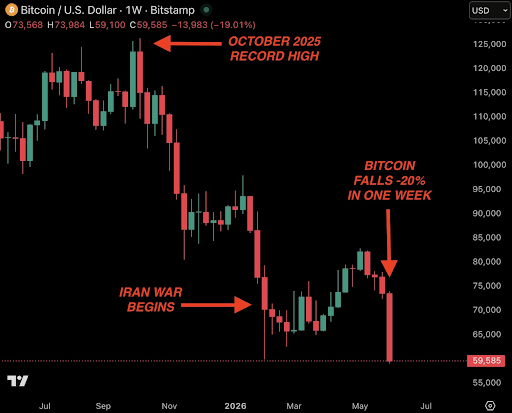
Source: Chart from The Kobeissi Letter on X

The brief crash below $60,000 over the weekend also showed that traders are reacting to a broader message that liquidity is drying up. Spot Bitcoin ETFs have been dealing with heavy outflows in recent weeks, reducing one of the most important sources of marginal demand that supported the cryptocurrency during its rally in early May.

However, Bitcoin bulls may still have one reason to stay hopeful. Bitcoin slipped through its 200-week moving average over the weekend, which currently sits at $61,000, leading to its first major interaction with the level since 2022.

Data from Coinglass shows that Bitcoin has historically found bear-market bottoms around the 200-week moving average across major cycles between 2015 and 2020. The last time Bitcoin tested this line was in June 2022, making the latest breach, almost four years later, a notable moment in the current downturn.

Standard Chartered’s global head of digital assets research, Geoff Kendrick, told clients on June 4 that the bear market may be in its final stages, noting that the recent painful week of price action might be the buying zone we all wanted when Bitcoin returns to $100,000 and Ethereum returns to $4,000.

BTC trading at $63,319 on the 1D chart | Source: BTCUSDT on Tradingview.com

Связанные с этим вопросы

QAccording to the article, what is the primary reason given for Bitcoin's crash below $60,000 over the weekend?

AThe primary reason given is a stronger-than-expected May 2026 jobs report, which complicated liquidity expectations and reduced the likelihood of Federal Reserve rate cuts, causing risk assets like Bitcoin to suffer.

QWhat were the key figures in the May 2026 US jobs report mentioned in the article?

AThe report showed that US employers added 172,000 jobs in May, significantly above the consensus estimate of 85,000. The unemployment rate held steady at 4.3%, and prior months' job numbers were revised upward by a combined 93,000.

QHow did the strong jobs report impact market expectations for Federal Reserve interest rate policy in 2026?

AFollowing the report, prediction markets dramatically reduced expectations for rate cuts. The probability of zero rate cuts in 2026 increased to roughly 68.8%, and the probability of a rate *increase* before year-end rose to 53% on Polymarket and 42.7% on the CME FedWatch tool.

QWhat technical indicator did Bitcoin breach over the weekend, and why is it historically significant according to the article?

ABitcoin breached its 200-week moving average, which was around $61,000. This is historically significant because data shows Bitcoin has historically found bear-market bottoms around this moving average in major cycles between 2015 and 2020.

QWhat two factors does the article cite as contributing to the drying up of liquidity for Bitcoin?

AThe article cites two main factors: 1) The strong jobs report reducing expectations for Fed rate cuts, which tightens financial conditions, and 2) Heavy outflows from spot Bitcoin ETFs in recent weeks, reducing a key source of marginal demand.

Похожее

Huang Renxun Dramatically 'Saves' South Korean Stock Market

In early June, South Korea's stock market experienced a sharp decline, with the KOSPI index dropping over 5% and triggering a trading halt. Amid this volatility, NVIDIA CEO Jensen Huang's visit to Seoul provided a dramatic boost to market sentiment. During his trip, Huang held a dinner meeting with SK Group Chairman Chey Tae-won and SK Hynix CEO Kwak Noh-Jung. He announced that NVIDIA's new Vera CPU would utilize SK Hynix DRAM and confirmed a multi-year technical collaboration between the two companies. This partnership aims to co-develop next-generation memory for NVIDIA's AI infrastructure roadmap, covering products from data center supercomputers to personal AI devices. Huang also publicly commented that AI company stocks were attractively priced. A key announcement was that NVIDIA's upcoming Vera Rubin AI supercomputer systems will use HBM4 memory, with supply qualifications granted to all three major suppliers: SK Hynix, Samsung Electronics, and Micron Technology. Despite this multi-sourcing strategy, Huang warned that the industry-wide chip shortage, affecting everything from wafers to packaging, is expected to persist for several years due to relentless demand from global AI factory construction. The collaboration extends beyond memory supply. SK Hynix will employ NVIDIA's AI platforms and Omniverse digital twin technology to enhance its own semiconductor design, simulation, and manufacturing processes, aiming for more autonomous factory operations. This visit builds upon a prior October 2025 agreement for SK Group to build a large-scale AI data center using over 50,000 NVIDIA GPUs. Huang's itinerary also included meetings with other Korean giants like Hyundai, LG, and Samsung, indicating NVIDIA's broader strategy to deepen ties with South Korea's tech industry.

链捕手1 ч. назад

Huang Renxun Dramatically 'Saves' South Korean Stock Market

链捕手1 ч. назад

When Inference Becomes a Scarce Resource, Who Captures the Value?

When Inference Becomes the Scarce Resource, Who Captures the Value? The core AI bottleneck has shifted from model training to inference (runtime execution). While concerns persisted about an "AI compute gap"—initially a $200B, now a $600B problem—the market is now recognizing that the solution and value lie in the inference layer. Nvidia's financial restructuring around "serving tokens" and Cerebras's successful IPO highlight this shift. Inference is a recurring, usage-based cost, estimated to be 10-50x larger than the one-time training market, especially with the rise of agentic AI. The inference stack spans six layers: silicon (e.g., Nvidia), bare metal (e.g., CoreWeave), GPU rental/aggregation, deployment/optimization, model APIs, and end applications. Most companies operate in one layer. However, Hyperbolic uniquely spans three layers (GPU rental, deployment, and model APIs) without owning any hardware. It aggregates fragmented GPU supply from multiple cloud providers into a standardized pool, offering developers the cheapest available compute through intelligent routing. Its multi-cloud aggregation creates a data moat and a flywheel: more supply leads to better pricing data and liquidity, attracting more developers and providers. In contrast, applications like Venice operate at the top of the stack, reselling privacy-wrapped inference but remaining dependent on and constrained by the underlying compute costs they purchase. As inference demand explodes, value accrues not just to consumer applications but increasingly to the aggregation and routing layer that captures their cost of revenue. The coming potential GPU oversupply reinforces this dynamic. While hardware owners may suffer from depreciation, asset-light aggregators like Hyperbolic benefit from price arbitrage, routing workloads to the cheapest available capacity. The ultimate winner in the inference economy may not be the entity with the most GPUs, but the one that can most efficiently discover, aggregate, and route the world's fragmented compute.

链捕手1 ч. назад

When Inference Becomes a Scarce Resource, Who Captures the Value?

链捕手1 ч. назад

Торговля

Спот
Фьючерсы

Популярные статьи

Тест по Bitcoin Биткоина

HTX Learn: Изучите Bitcoin halving и Заработаете Токены USDT

3.1k просмотров всегоОпубликовано 2024.04.16Обновлено 2024.04.16

Тест по Bitcoin  Биткоина

Что такое $BITCOIN

ЦИФРОВОЕ ЗОЛОТО ($BITCOIN): Комплексный анализ Введение в ЦИФРОВОЕ ЗОЛОТО ($BITCOIN) ЦИФРОВОЕ ЗОЛОТО ($BITCOIN) — это проект на основе блокчейна, работающий в сети Solana, который стремится объединить характеристики традиционных драгоценных металлов с инновациями децентрализованных технологий. Хотя он носит имя Биткойн, часто называемого “цифровым золотом” из-за его восприятия как средства хранения ценности, ЦИФРОВОЕ ЗОЛОТО является отдельным токеном, предназначенным для создания уникальной экосистемы в ландшафте Web3. Его цель — позиционировать себя как жизнеспособный альтернативный цифровой актив, хотя детали его применения и функциональности все еще развиваются. Что такое ЦИФРОВОЕ ЗОЛОТО ($BITCOIN)? ЦИФРОВОЕ ЗОЛОТО ($BITCOIN) — это токен криптовалюты, специально разработанный для использования в блокчейне Solana. В отличие от Биткойна, который выполняет широко признанную роль хранения ценности, этот токен, похоже, сосредоточен на более широких приложениях и характеристиках. Примечательные аспекты включают: Инфраструктура блокчейна: Токен построен на блокчейне Solana, известном своей способностью обрабатывать высокоскоростные и недорогие транзакции. Динамика предложения: ЦИФРОВОЕ ЗОЛОТО имеет максимальное предложение, ограниченное 100 квадриллионами токенов (100P $BITCOIN), хотя детали о его обращающемся предложении в настоящее время не раскрыты. Утилита: Хотя точные функциональные возможности не описаны, есть указания на то, что токен может быть использован для различных приложений, потенциально связанных с децентрализованными приложениями (dApps) или стратегиями токенизации активов. Кто создатель ЦИФРОВОГО ЗОЛОТА ($BITCOIN)? На данный момент личность создателей и команды разработчиков, стоящих за ЦИФРОВЫМ ЗОЛОТОМ ($BITCOIN), остается неизвестной. Эта ситуация типична для многих инновационных проектов в области блокчейна, особенно тех, которые связаны с децентрализованными финансами и феноменом мем-криптовалют. Хотя такая анонимность может способствовать культуре, ориентированной на сообщество, она усиливает опасения по поводу управления и ответственности. Кто инвесторы ЦИФРОВОГО ЗОЛОТА ($BITCOIN)? Доступная информация указывает на то, что у ЦИФРОВОГО ЗОЛОТА ($BITCOIN) нет известных институциональных спонсоров или значительных венчурных капиталовложений. Проект, похоже, функционирует по модели пирингового взаимодействия, сосредоточенной на поддержке и принятии сообществом, а не на традиционных путях финансирования. Его активность и ликвидность в основном сосредоточены на децентрализованных биржах (DEX), таких как PumpSwap, а не на устоявшихся централизованных торговых платформах, что еще больше подчеркивает его подход, ориентированный на grassroots. Как работает ЦИФРОВОЕ ЗОЛОТО ($BITCOIN) Операционные механизмы ЦИФРОВОГО ЗОЛОТА ($BITCOIN) можно подробно описать на основе его дизайна блокчейна и характеристик сети: Механизм консенсуса: Используя уникальный механизм доказательства истории (PoH) Solana в сочетании с моделью доказательства доли (PoS), проект обеспечивает эффективную валидацию транзакций, что способствует высокой производительности сети. Токеномика: Хотя конкретные дефляционные механизмы не были подробно описаны, большое максимальное предложение токенов подразумевает, что оно может быть предназначено для микротранзакций или нишевых случаев использования, которые еще предстоит определить. Интероперабельность: Существует потенциал для интеграции с более широкой экосистемой Solana, включая различные платформы децентрализованных финансов (DeFi). Однако детали относительно конкретных интеграций остаются неуточненными. Хронология ключевых событий Вот хронология, которая подчеркивает значимые вехи, касающиеся ЦИФРОВОГО ЗОЛОТА ($BITCOIN): 2023: Первоначальное развертывание токена происходит в блокчейне Solana, отмеченное его адресом контракта. 2024: ЦИФРОВОЕ ЗОЛОТО приобретает видимость, когда оно становится доступным для торговли на децентрализованных биржах, таких как PumpSwap, позволяя пользователям обменивать его на SOL. 2025: Проект наблюдает спорадическую торговую активность и потенциальный интерес к инициативам, возглавляемым сообществом, хотя на данный момент не зафиксировано никаких значительных партнерств или технических достижений. Критический анализ Сильные стороны Масштабируемость: Основная инфраструктура Solana поддерживает высокие объемы транзакций, что может повысить полезность $BITCOIN в различных сценариях транзакций. Доступность: Потенциально низкая цена торговли за токен может привлечь розничных инвесторов, способствуя более широкому участию благодаря возможностям дробного владения. Риски Отсутствие прозрачности: Отсутствие публично известных спонсоров, разработчиков или процесса аудита может вызвать скептицизм относительно устойчивости и надежности проекта. Волатильность рынка: Торговая активность сильно зависит от спекулятивного поведения, что может привести к значительной волатильности цен и неопределенности для инвесторов. Заключение ЦИФРОВОЕ ЗОЛОТО ($BITCOIN) является интригующим, но неоднозначным проектом в быстро развивающейся экосистеме Solana. Хотя он пытается использовать нарратив “цифрового золота”, его отход от установленной роли Биткойна как средства хранения ценности подчеркивает необходимость более четкого различения его предполагаемой утилиты и структуры управления. Будущее принятие и усвоение, вероятно, будут зависеть от решения текущей непрозрачности и более четкого определения его операционных и экономических стратегий. Примечание: Этот отчет охватывает синтезированную информацию, доступную на октябрь 2023 года, и с тех пор могут произойти события.

99 просмотров всегоОпубликовано 2025.05.13Обновлено 2025.05.13

Что такое $BITCOIN

Fractal Bitcoin: масштабирование Биткоина с помощью рекурсивной системы

Fractal Bitcoin — масштабное Layer-1-решнение, созданное на базе кода Биткоина, позволяющего достигать бесконечного масштабирования с помощью рекурсивного подхода.

2.3k просмотров всегоОпубликовано 2025.06.30Обновлено 2025.06.30

Fractal Bitcoin: масштабирование Биткоина с помощью рекурсивной системы

Обсуждения

Добро пожаловать в Сообщество HTX. Здесь вы сможете быть в курсе последних новостей о развитии платформы и получить доступ к профессиональной аналитической информации о рынке. Мнения пользователей о цене на BTC (BTC) представлены ниже.

活动图片