AGI is Not the End, DeepMind's New Paper: Moving Towards ASI, the Real AI Progress Has Just Begun

marsbitОпубликовано 2026-06-16Обновлено 2026-06-16

Введение

In a new report, Google DeepMind researchers argue that achieving Artificial General Intelligence (AGI) is not the end goal, but rather a step toward Artificial Superintelligence (ASI). They outline four potential pathways for this transition: 1) continued scaling of compute, models, and data; 2) algorithmic evolution and potential paradigm shifts; 3) recursive self-improvement; and 4) multi-agent coordination and collective intelligence. The report also identifies six key bottlenecks that could hinder progress: data limitations (the "data wall"), economic and resource pressures, limitations of current neural network paradigms, increasing research difficulty, "abstraction barriers" in forming new concepts, and regulatory and societal pushback. Looking ahead, the authors emphasize the need for new evaluation methods once AI surpasses human benchmarks. They call for a large-scale, interdisciplinary effort to prepare for a future where AI-driven advancements could trigger transformative changes across multiple fields. The path and speed of progress remain uncertain, constrained by physical laws, computational complexity, and real-world feedback loops.

If artificial general intelligence (AGI) were achieved tomorrow, what would the next phase of AI look like?

Google DeepMind's team and its collaborators propose in a latest research report that AGI is likely not the endpoint. In their view, AI will not plateau at a level close to humans but will continue to become more powerful, surpassing the most top-tier teams of human experts and ultimately moving towards artificial superintelligence (ASI).

As Alan Turing wrote in 1950: “We can only see a short distance ahead, but we can see plenty there that needs to be done.”

In this report, the research team outlines four potential pathways for AI's transition from AGI to ASI, possible key bottlenecks, and the most pressing research questions to advance.
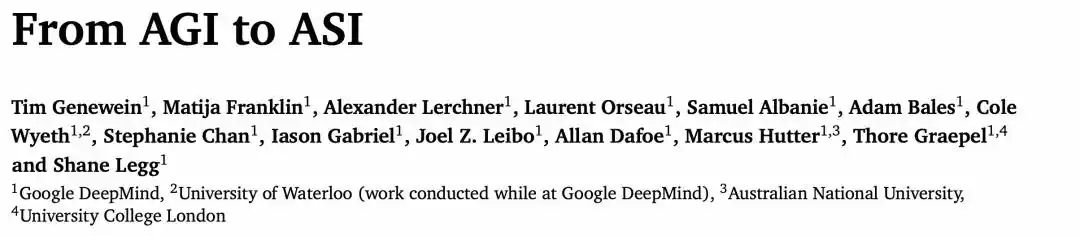
Paper Link: https://arxiv.org/abs/2606.12683

The research team stated that due to the considerable uncertainty in predicting ASI progress, the possibility of AI continuing to accelerate its development in the coming years cannot be ruled out. This may mean that the notion of a “single transformative leap” triggered by introducing human-level AGI into society might be inaccurate.

A more fitting prospect might be that AI-driven progress and breakthroughs will emerge successively across numerous fields of science and technology, thereby triggering a series of transformative societal changes.

To address this prospect, a large-scale, interdisciplinary project with a global vision and broad concern is needed.

After AGI, Comes ASI

Before discussing how AI might continue to become stronger, the research team first distinguishes three easily confused concepts: AGI, ASI, and UAI.

AGI (Artificial General Intelligence): A general intelligent system that reaches the median human level in most cognitive tasks. This corresponds to the general cognitive ability of an average person, not the level of top experts. The research team also notes that the first generation of AGI might already surpass humans in some tasks, just not yet possessing sufficiently broad generality.

ASI (Artificial Super Intelligence): It does not surpass humans in only a few tasks but overall exceeds humans in nearly all fields of human concern; the reference is not a single expert but large-scale, well-coordinated collectives of human experts.

UAI (Universal Artificial Intelligence): The theoretical upper bound of machine intelligence, formally described by the AIXI framework. AIXI corresponds to a theoretically optimal universal agent. Real-world AI can only gradually approach this upper bound, not directly achieve it.

Simultaneously, the research team points out that the transition from AGI to ASI might not have only one path. They propose four potentially parallel advancing pathways, detailed as follows:

Path One: Continue Scaling Computation, Models, and Data

This path continues the basic logic of AI progress over the past decade, including more powerful hardware, larger training runs, higher algorithmic efficiency, larger models, and more data. The research team notes that recent “effective compute” has roughly grown tenfold annually. Following this path, AI's improvement comes not only from individual models becoming stronger but also potentially from collective capability expansion due to more instances, faster inference, and larger-scale collaboration.

Path Two: Continued Algorithmic Evolution, Even New Paradigm Shifts

The research team states that longer context, continual learning, retrieval augmentation, tool use, robust decision-making in interactive environments, world models, etc., all belong to extensions of existing paradigms; whereas new architectures, training objectives, or learning mechanisms are closer to genuine paradigm shifts. The team does not specifically predict what the next paradigm shift might be but believes it could still be a crucial source of continued AI progress post-AGI.

Path Three: Recursive Self-Improvement

A stronger AI can help develop the next generation of even stronger AI, forming a positive feedback loop. The research team mentions this mechanism could manifest in algorithm and code improvement, hardware design, data generation and filtering, and efficiency gains in division of labor. For example, AlphaZero's approach of first using search to improve outputs, then distilling results back into the model, is a relevant case. More importantly is the question of how far this positive feedback can develop in reality.

Path Four: Multi-Agent Coordination and Collective Intelligence

This path focuses not on how strong a single model becomes, but on numerous AGI systems forming collective intelligence exceeding individual limits through division of labor and collaboration. The research team views automated companies, research organizations, and virtual economic systems as possible manifestations of this path. According to this path, ASI might not necessarily be an extremely powerful individual model but could be a highly coordinated AI collective.

The research team also cautions that the move from AGI to ASI may not simply be about more compute being better. Compute expansion is certainly important but will soon hit resource ceilings, requiring new algorithmic ideas, even new paradigms. More notably, even if a single AGI is only near human-level, once many AGIs can efficiently divide labor and collaborate, their collective capability might exceed humanity's.

Where Do the Real Challenges Lie?

After discussing the four potential paths, the research team also summarizes six categories of key bottlenecks that could affect AI's continued strengthening. Details as follows:

1. Data Wall

The research team points out that high-quality human-generated data is finite; human text data suitable for large-scale pre-training may approach its limit within this decade. Whether synthetic data, simulated environment data, and data generated from AI interacting with the real world can fill this gap fast enough is not concluded by the team but listed as a core uncertainty.

2. Economic and Natural Resource Pressures

If AI progress continues to rely primarily on scaling, then energy, chips, data centers, supply chains, and capital investments must grow in sync. The research team sees this as a real-world constraint but also notes that AI itself might increase economic output and improve algorithmic and hardware efficiency, thereby alleviating these pressures.

3. Current Neural Network Paradigms Might Be Inadequate

The research team does not rule out the possibility of the current path leading to ASI but also cautions that this path may still have fundamental limitations in areas like continual learning, stable reasoning, interactive decision-making, uncertainty representation, as well as issues like hallucinations and prompt injection.

4. Research Itself Will Become Increasingly Difficult

The research team notes that as a field matures, further progress often requires greater investment; whether AI can offset this trend through automated research remains to be studied.

5. Abstraction Barrier

The research team believes that if today's AI primarily learns from concepts and symbolic systems humans have already formed, it might excel at recombining existing concepts but not necessarily at autonomously extracting new conceptual primitives from the raw world. For example, if a modern large model were trained solely on pre-Newtonian knowledge, it would be almost impossible for it to derive general relativity or quantum mechanics from that material alone.

6. Regulation, Governance, and Societal Backlash

The research team argues that regulatory thresholds, licensing regimes, incident reporting requirements, and societal reactions to accidents will all influence the pace of AI capability expansion. This involves not just technical issues but also policy, institutions, markets, and public risk perception.

Shortcomings and Future Developments

Finally, the research team raises a very practical question: If AI already surpasses humans, how should we continue to assess its capabilities?

Today, many benchmarks use human-level as a reference. Once AI approaches or surpasses top humans in exams, programming, mathematics, Q&A, and professional knowledge tests, the original evaluation metrics may lose meaning. Therefore, future needs include establishing new evaluation and forecasting systems for the post-AGI era, encompassing tasks like multi-agent competition and cooperation, automated test generation, universal compression tasks, economic productivity and other indirect indicators, along with assessment mechanisms that can be continuously updated and do not saturate prematurely.

However, in terms of content, this is not an experimental paper but more like a technical report centered on the post-AGI era. The research team points out that future directions worthy of attention include: continuing to scale existing AGI systems, exploring new AI paradigms, achieving recursive self-improvement of systems, and forming stronger overall capabilities through large-scale multi-agent collaboration.

Finally, the research team notes that ASI is also not an omniscient, omnipotent “magic system”; it remains constrained by physical laws, computational complexity, data, resources, experimentation time, and the speed of real-world feedback. Which path AI will advance along and at what speed remains highly uncertain. In the future, there is still a need to establish continuously updated benchmarks, predictions, and research mechanisms to reduce uncertainty in judgment.

This article is from the WeChat public account "Academic Headlines" (ID: SciTouTiao), author: Academic Headlines

Связанные с этим вопросы

QWhat are the four potential pathways for AI to progress from AGI to ASI according to the DeepMind paper?

AThe four potential pathways are: 1. Continued scaling of compute, models, and data. 2. Algorithmic evolution, including possible paradigm shifts. 3. Recursive self-improvement. 4. Multi-agent coordination and collective intelligence.

QWhat is the key difference between AGI and ASI as defined in the research?

AAGI (Artificial General Intelligence) refers to a system performing at the median human level across most cognitive tasks. ASI (Artificial Super Intelligence) refers to a system that surpasses human capability not just in a few tasks, but across virtually all domains of human concern, exceeding the collective performance of large, well-coordinated teams of human experts.

QWhat are some of the major bottlenecks that could hinder AI's progress from AGI to ASI?

AThe major bottlenecks include: 1. The data wall (limited high-quality human-generated data). 2. Economic and natural resource pressures. 3. Potential fundamental limitations of current neural network paradigms. 4. Increasing difficulty of research itself. 5. The abstraction barrier (AI may struggle to autonomously derive new primitive concepts). 6. Regulation, governance, and societal backlash.

QWhy might traditional AI benchmarks become inadequate in the post-AGI era?

ATraditional benchmarks, which are often anchored to human-level performance, may lose their meaning once AI approaches or exceeds top human performance in tests like exams, coding, and expert knowledge. New evaluation systems are needed, focusing on multi-agent competition/cooperation, automatically generated tests, universal compression tasks, and indirect metrics like economic productivity.

QWhat is the purpose of the 'large-scale interdisciplinary project' mentioned in the report?

AThe purpose is to proactively address the prospective scenario where AI-driven advancements and breakthroughs emerge successively across many fields of science and technology, leading to a series of transformative social changes. This project requires a global perspective and broad concern to manage this transition.

Похожее

How Much of the Subscription Fee You Pay to Claude Can Optical Module Companies Get?

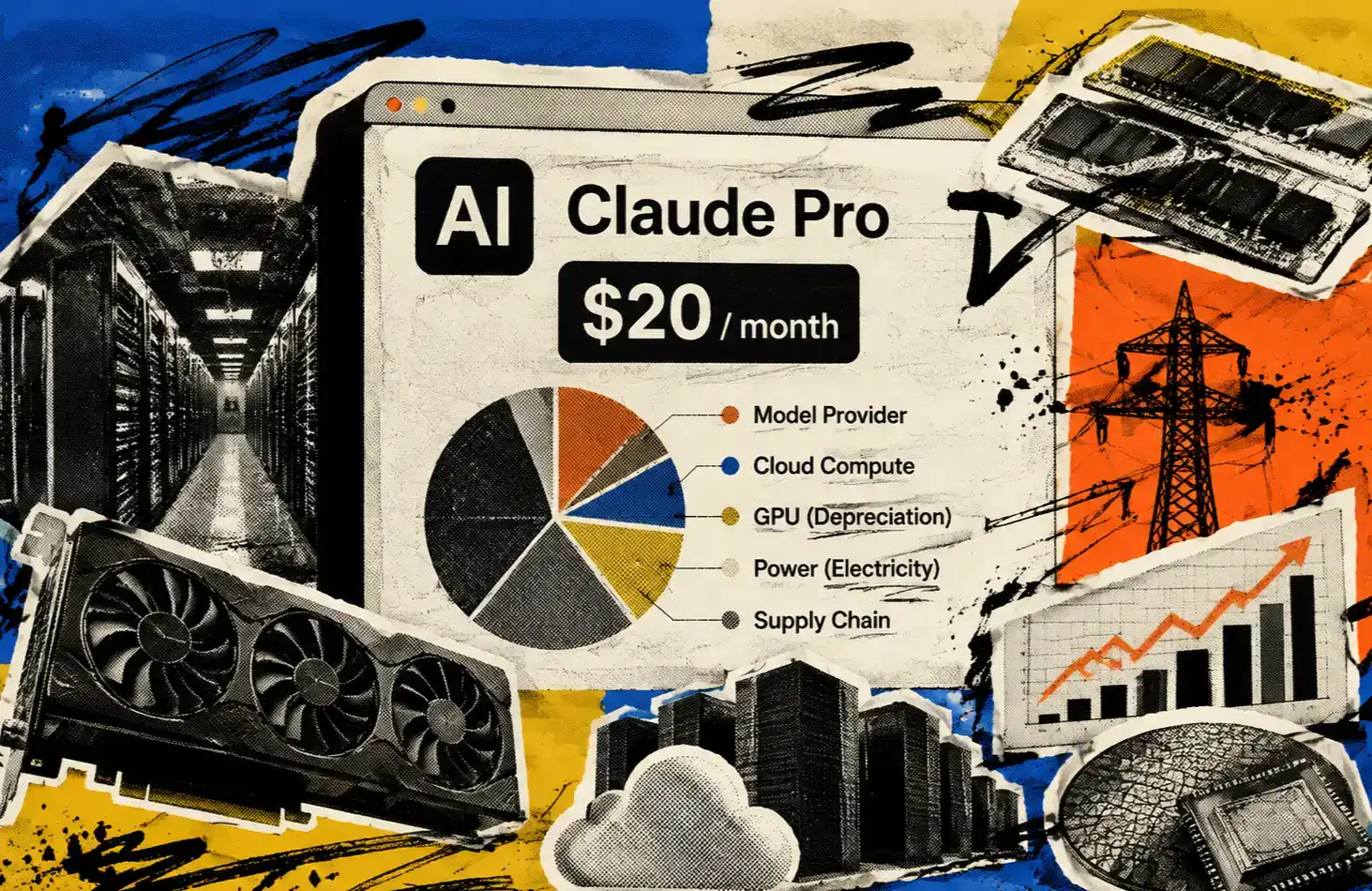
How much of your $20 Claude Pro subscription actually goes to AI model companies like Anthropic? A viral breakdown image highlights the fundamental valuation challenge for AI applications versus traditional SaaS. Unlike SaaS with high software margins, AI subscriptions face variable "inference costs": every user query consumes GPU time, power, and cloud resources. This creates a tension between fixed subscription fees and usage-driven expenses. While the specific dollar splits are illustrative, the core question is whether AI revenue can achieve SaaS-like margins as usage scales. Currently, infrastructure providers (cloud platforms, GPU makers like Nvidia, HBM suppliers, power/data centers) capture more certain revenue from growing AI usage. Their financials reflect pricing power and faster earnings validation. The bullish case hinges on efficiency improvements: model optimization, caching, smaller models, and custom chips could lower per-token costs over time. The key debate is whether cost declines can outpace increases in user workload complexity and volume. Ultimately, for AI companies to command high SaaS-like valuations, they must demonstrate not just user growth but also improving gross margins after accounting for inference costs. Investors will scrutinize not just subscriber numbers, but usage patterns, enterprise pricing tiers, and real efficiency gains.

marsbit11 мин. назад

How Much of the Subscription Fee You Pay to Claude Can Optical Module Companies Get?

marsbit11 мин. назад

OpenAI's Hyperliquid Pre-IPO Pricing Venture: Why Did It Last Only Half a Year?

The article discusses the rise and fall of Pre-IPO pricing markets on the Hyperliquid blockchain. Trade.xyz, an anonymous team, successfully built the largest pre-market for SpaceX (SPCX) by launching a contract with a clear anchor: the eventual Nasdaq listing price. This provided inherent price stability and validation. In contrast, Ventuals, a team backed by Paradigm, failed despite holding exclusive contracts for highly sought-after companies like OpenAI and Anthropic. Its key mistake was its pricing mechanism. For companies with no near-term IPO date, Ventuals' oracle relied partly on opaque private market transactions and, critically, partly on its own contract's moving average price. This created a self-referential feedback loop where prices were artificially propped up and detached from genuine supply and demand, leading to illiquid markets. Ventuals shut down after nine months, settling positions at final prices of $1,341.80 for OpenAI and $1,618.90 for Anthropic. Ironically, some employees and late-stage investors of these very companies reportedly used these flawed Ventuals prices for valuation reference, highlighting the acute demand for any price signal in illiquid private markets. The article concludes that while demand for pre-IPO trading is real and growing, with players like Coinbase now entering the space, the fundamental challenge remains: without a public listing to provide a definitive price anchor, these markets struggle to establish truly accurate and liquid pricing. The need for a transparent, self-correcting market is the critical lesson from Ventuals' failure.

marsbit27 мин. назад

OpenAI's Hyperliquid Pre-IPO Pricing Venture: Why Did It Last Only Half a Year?

marsbit27 мин. назад

With Daily Active Users Reaching 3-4 Times That of the Industry's Second Place, Which Crack in the Office Agent Market Has Tencent's WorkBuddy Torn Open?

Tencent's AI office assistant, WorkBuddy, has achieved daily active users (DAU) 3-4 times that of the industry's second-place product, primarily driven by non-technical users like HR, operations, and administrative staff. Its rapid growth, starting with a public beta in March 2026, highlights a key strategic divergence from competitors like OpenAI's Codex and Anthropic's Claude Code. Unlike those tools, which originated as developer-focused assistants (in command lines or IDEs) and are now expanding towards office scenarios, WorkBuddy was built from the ground up for non-technical office workers. Its development was user-driven, initiated after腾讯云's team observed non-technical employees using their CodeBuddy coding tool for general tasks. WorkBuddy's design is defined by three core decisions aimed at lowering barriers: 1) Using natural language instead of technical concepts, so users describe their goal without needing to understand prompts or agents. 2) Providing pre-packaged "Skill" templates for common office tasks like data processing, content creation, and research. 3) Natively integrating into existing腾讯 ecosystems like腾讯 Docs and WeChat, making the agent a seamless part of the user's workflow rather than a separate tool. This "scenario encapsulation" approach, prioritizing the shortest path for users to get work done, contrasts with the "underlying capability" focus of Codex and Claude, which offer more flexibility but require more technical setup. Analysts confirm WorkBuddy's leading market position in China by mid-2026, with massive user and request growth following its launch. Recognizing the same trend of surging non-technical adoption, OpenAI and Anthropic are now pivoting their products with features like role-based plugins (Codex) and a simplified desktop interface (Claude Cowork). However, adapting tools built for developers requires significant changes to interaction models and integrations. WorkBuddy currently holds an estimated six-month lead in delivering a complete solution for non-technical office users. Its recently launched enterprise version aims to solidify this advantage. The competition underscores two valid paths: embedding agent capabilities directly into familiar work environments versus building powerful, general-purpose agents that users must learn to access. WorkBuddy's early success demonstrates the effectiveness of the former strategy for mainstream office adoption.

marsbit36 мин. назад

With Daily Active Users Reaching 3-4 Times That of the Industry's Second Place, Which Crack in the Office Agent Market Has Tencent's WorkBuddy Torn Open?

marsbit36 мин. назад

Торговля

Спот
Фьючерсы

Популярные статьи

Неделя обучения по популярным токенам (2): 2026 может стать годом приложений реального времени, сектор AI продолжает оставаться в тренде

2025 год — год институциональных инвесторов, в будущем он будет доминировать в приложениях реального времени.

1.8k просмотров всегоОпубликовано 2025.12.16Обновлено 2025.12.16

Неделя обучения по популярным токенам (2): 2026 может стать годом приложений реального времени, сектор AI продолжает оставаться в тренде

Обсуждения

Добро пожаловать в Сообщество HTX. Здесь вы сможете быть в курсе последних новостей о развитии платформы и получить доступ к профессиональной аналитической информации о рынке. Мнения пользователей о цене на AI (AI) представлены ниже.

活动图片