KuCoin taps Tomorrowland festivals as MiCA-era on-ramp for European fans

cointelegraphОпубликовано 2025-12-17Обновлено 2025-12-17

Введение

KuCoin has signed an exclusive multi-year partnership with Tomorrowland music festivals from 2026 to 2028, becoming the event's official crypto and payments partner. This follows KuCoin’s recent acquisition of a MiCA-regulated license in the EU, allowing it to operate as a fully compliant crypto service provider. The collaboration aims to integrate cryptocurrency seamlessly into festival operations—including ticketing, merchandise, and concessions—without disrupting the user experience. Emphasizing security and regulatory compliance, KuCoin seeks to position crypto as a mainstream financial tool, learning from past failed Web3 partnerships like FTX’s with Tomorrowland. The goal is a smooth, invisible integration of digital assets into live events.

KuCoin announced an exclusive multiyear deal with Tomorrowland Winter and Tomorrowland Belgium from 2026 to 2028, making the exchange the music festival’s exclusive crypto and payments partner.

The move comes just weeks after KuCoin secured a Markets in Crypto-Assets Regulation (MiCA) service provider license in the European Union.

KuCoin’s MiCA play goes mass‐market

KuCoin EU Exchange recently obtained a crypto asset service provider license in Austria under the EU’s MiCA regime, giving it a fully regulated foothold in the bloc as Brussels’ new rulebook for exchanges, custody and stablecoins comes into force.

The Tomorrowland deal signals how KuCoin plans to use that status, not just to run a compliant trading venue, but to plug crypto rails directly into mainstream culture.
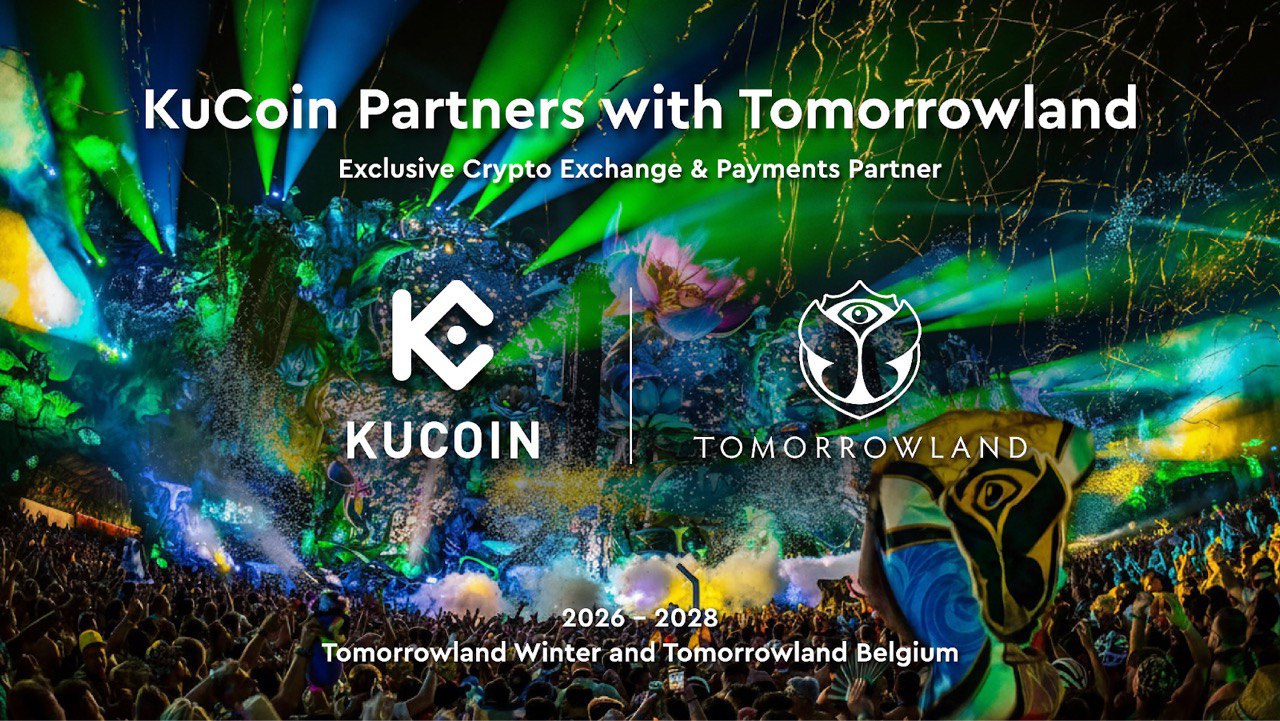
KuCoin joins forces with Tomorrowland. Source: KuCoin

KuCoin said the Tomorrowland deal will cover Tomorrowland Winter 2026 in Alpe d’Huez, France, and Tomorrowland Belgium 2026 in Boom, Belgium, with the same arrangement continuing through 2028.

Related: Burning Man-inspired festival in Bali goes full Web3: Here’s how

From sponsorship to payment rails

KuCoin insists this is not just a logo play. A spokesperson at KuCoin told Cointelegraph that as an exclusive payments partner, the exchange is working with Tomorrowland to weave crypto into the festival’s existing payments stack so that “financial tools” sit behind the scenes of ticketing, merch and food and drink.

The stated goal is to keep the rails “intuitive and invisible,” rather than forcing festivalgoers through clunky wallets or unfamiliar flows, with KuCoin positioning itself as facilitating the secure and efficient movement of value while fans focus on the music.

The company declined to spell out exactly which assets and rails will be supported on‐site, or whether every purchase will run natively onchain, but said that KuCoin’s “Trust First. Trade Next.” mantra runs through its messaging.

The spokesperson stressed advanced security, multi‐layer protection and adherence to EU standards as the foundation for taking crypto beyond the trading screen and into live events.

Related: What is Markets in Crypto-Assets (MiCA)?

Learning from FTX’s Tomorrowland flop

Tomorrowland’s organizers have been here before. In 2022, the festival announced a Web3 partnership with FTX Europe that promised NFTs and “the future of music festivals” before collapsing along with the exchange itself months later.

That experience makes the choice of a MiCA‐licensed partner, and the emphasis on user protection, more than cosmetic; it is a second attempt at bridging culture and crypto (this time with regulatory scaffolding and clearer guardrails).

Rather than setting public hard targets for user numbers or payment volumes by 2028, KuCoin is pitching success as “seamless integration” of crypto into the festival experience:

“We aim to demonstrate that digital assets can be a core component of global digital finance, moving from a niche technology to a mainstream utility. “

Related: Spain’s regulator sets out MiCA transition rules for crypto platforms
Похожее

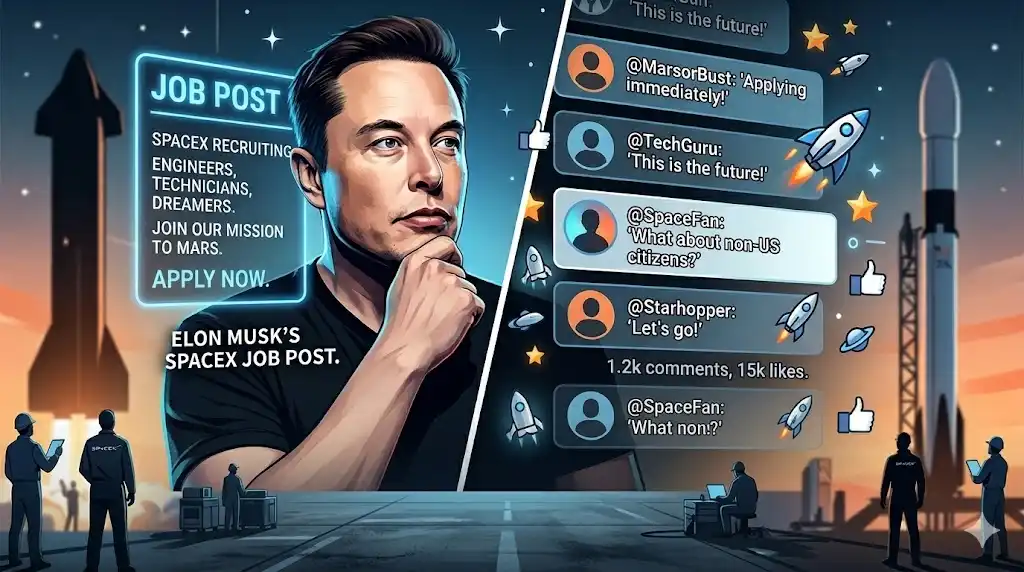
Musk Posted a Recruitment Ad for SpaceX, and After Reading the Comments Section, I Understood

On May 20th, SpaceX filed for a landmark IPO with a $1.75 trillion valuation. Shortly after, Elon Musk posted a recruitment call on X, seeking "world-class engineers and physicists" for SpaceX. The application process was starkly simple: email with three bullet points proving "exceptional ability," with real, complex projects as a plus. Musk promised to review qualifying emails himself. The post garnered millions of views and thousands of replies, revealing a spectrum of responses. Most comments, including a highly-upvoted humorous one listing absurd "skills," merely listed credentials or experiences in a conventional, non-differentiating way. This highlighted a key insight: a traditional resume listing degrees and skills often fails to demonstrate true exceptionalism. Effective self-presentation requires "performance efficiency." A standout reply came from an OpenAI engineering lead, who simply stated "codex." This demonstrated that for those who have built significant, recognized products, the product itself becomes the ultimate resume. The article argues that in the AI era, any tangible, shareable output—a tool, research, or online project—serves as a living, self-evident credential more powerful than a list of attributes. However, a twist emerged when applicants found the provided email address non-functional, leading to speculation that the post might also serve as an IPO publicity stunt, projecting an image of aggressive talent acquisition to investors. Ultimately, the episode served as a microcosm: some participate through performance, others through proof of work, while some question the reality of the stage itself. It underscores the enduring challenge of defining and demonstrating value in an age of abundant, yet often superficial, content.

marsbit29 мин. назад

Musk Posted a Recruitment Ad for SpaceX, and After Reading the Comments Section, I Understood

marsbit29 мин. назад

Cutting Off OpenAI, Anthropic Acquires the Tool Provider Used by a Quarter of Global Developers

Anthropic has acquired Stainless, a developer tool company that automatically generated official SDKs (Software Development Kits) for AI giants including OpenAI, Anthropic, Meta, and Cloudflare. The deal, reportedly valued at around $300 million, marks a strategic shift for Anthropic as it builds its "AI agent" infrastructure. Stainless acted as a "translator," converting complex API specifications into ready-to-use code libraries for developers. Its tools indirectly reached about a quarter of professional software developers globally. Following the acquisition, Stainless will shut down its public products and its team will join Anthropic to focus on internal platform development, notably for the Claude Platform. Existing SDKs remain with their respective client companies but will no longer receive updates from Stainless. This move is part of Anthropic's broader 18-month strategy to assemble a complete "agent stack." The stack consists of the Claude model at its core, the newly acquired Stainless for standardized API interfaces, and the Model Context Protocol (MCP), an open standard for connecting agents to external tools and data. This contrasts with OpenAI's focus on model generations and consumer-scale compute. Anthropic believes an agent's ultimate utility depends on its ability to connect to external systems. By internalizing the SDK layer and promoting MCP as a connection standard, Anthropic aims to lock in long-term ecosystem advantages and create path dependency, moving beyond the transient lead provided by any single model generation.

marsbit31 мин. назад

Cutting Off OpenAI, Anthropic Acquires the Tool Provider Used by a Quarter of Global Developers

marsbit31 мин. назад

Bankless Founder Sells Off ETH, Collective Collapse of Ethereum Faith

Ethereum faces a "crisis of faith" as David Hoffman, co-founder of the prominent pro-Ethereum media outlet Bankless, announces he has sold all his ETH. This move, coupled with reports of major layoffs at Bankless, signals a potential retreat of Ethereum's staunchest supporters. Hoffman and co-founder Ryan Sean Adams confirm Bankless is entering a "second era," with Adams stepping back and Hoffman exploring new frontiers. Hoffman sharply criticizes the Ethereum Foundation, stating that ETH's poor price performance cannot be separated from its leadership. He has a history of public dissatisfaction, citing the Foundation's failure to drive market growth and its "endless manifestos." His frustration coincides with ETH/BTC hitting multi-month lows and a significant exodus of senior researchers and executives from the Ethereum Foundation, partly attributed to controversial "loyalty oaths." The article contrasts Ethereum's current predicament—with its Layer-2 narrative discredited and ecosystem stagnant—against what should have been a highlight year in 2026 amid tokenization trends. While a previous surge to near $5,000 was driven by corporate buybacks (DAT热潮), ETH has since fallen over 50%. The core question remains: with fading faith and intense competition, what is Ethereum's next solution? Hoffman's divestment symbolizes a growing disconnect between the community and the ecosystem's direction.

Odaily星球日报54 мин. назад

Bankless Founder Sells Off ETH, Collective Collapse of Ethereum Faith

Odaily星球日报54 мин. назад

a16z Invests Heavily with $356 Million in HYPE, Surpassing Paradigm to Become the Largest External Holder

On May 21st, HYPE surged past $59, reaching a new high since September 2025, with a market cap nearing $150 billion. Analysts attribute the rally to a short squeeze and significant ETF inflows. The launch of two U.S. spot ETFs for Hyperliquid has driven substantial capital, with their inflows at times surpassing those of Bitcoin and Ethereum ETFs. Major institutions are actively accumulating HYPE. Venture firm a16z has become the largest external holder with a $356 million position, surpassing Paradigm. Other firms like Goldman Sachs, Grayscale, and Galaxy Digital have also made large purchases, with Goldman reportedly selling portions of its XRP, ETH, and BTC holdings to buy HYPE. Bitwise CIO Matt Hougan calls HYPE one of the most "mispriced" assets, arguing its valuation should reflect Hyperliquid's broader platform beyond just a perpetual DEX token. The protocol generates substantial real revenue, using 97% of fees to buy back and burn HYPE. Its expansion into RWA commodities and prediction markets has driven user growth and transaction volume, now commanding about 70% of the on-chain perpetual DEX market. However, this rapid growth faces challenges. Traditional exchanges CME and ICE are pressuring the CFTC to regulate Hyperliquid, citing concerns over its impact on global commodity benchmarks. Concurrently, some major market makers have withdrawn significant liquidity from the platform. With HYPE up over 125% year-to-date, operational risks are rising. Large holders are reportedly hedging with sizable short positions. The regulatory outlook from the CFTC remains a key uncertainty, adding another layer to the ongoing battle over the future of on-chain finance.

链捕手55 мин. назад

a16z Invests Heavily with $356 Million in HYPE, Surpassing Paradigm to Become the Largest External Holder

链捕手55 мин. назад

Торговля

Спот
Фьючерсы

Популярные статьи

Как купить ERA

Добро пожаловать на HTX.com! Мы сделали приобретение Caldera (ERA) простым и удобным. Следуйте нашему пошаговому руководству и отправляйтесь в свое крипто-путешествие.Шаг 1: Создайте аккаунт на HTXИспользуйте свой адрес электронной почты или номер телефона, чтобы зарегистрироваться и бесплатно создать аккаунт на HTX. Пройдите удобную регистрацию и откройте для себя весь функционал.Создать аккаунтШаг 2: Перейдите в Купить криптовалюту и выберите свой способ оплатыКредитная/Дебетовая Карта: Используйте свою карту Visa или Mastercard для мгновенной покупки Caldera (ERA).Баланс: Используйте средства с баланса вашего аккаунта HTX для простой торговли.Третьи Лица: Мы добавили популярные способы оплаты, такие как Google Pay и Apple Pay, для повышения удобства.P2P: Торгуйте напрямую с другими пользователями на HTX.Внебиржевая Торговля (OTC): Мы предлагаем индивидуальные услуги и конкурентоспособные обменные курсы для трейдеров.Шаг 3: Хранение Caldera (ERA)После приобретения вами Caldera (ERA) храните их в своем аккаунте на HTX. В качестве альтернативы вы можете отправить их куда-либо с помощью перевода в блокчейне или использовать для торговли с другими криптовалютами.Шаг 4: Торговля Caldera (ERA)С легкостью торгуйте Caldera (ERA) на спотовом рынке HTX. Просто зайдите в свой аккаунт, выберите торговую пару, совершайте сделки и следите за ними в режиме реального времени. Мы предлагаем удобный интерфейс как для начинающих, так и для опытных трейдеров.

688 просмотров всегоОпубликовано 2025.07.17Обновлено 2025.07.17

Как купить ERA

Обсуждения

Добро пожаловать в Сообщество HTX. Здесь вы сможете быть в курсе последних новостей о развитии платформы и получить доступ к профессиональной аналитической информации о рынке. Мнения пользователей о цене на ERA (ERA) представлены ниже.

活动图片