Standard Chartered, AirAsia parent to test ringgit stablecoin in Malaysia

cointelegraphОпубликовано 2025-12-12Обновлено 2025-12-12

Введение

Standard Chartered Bank Malaysia and Capital A, the parent company of AirAsia, have signed a letter of intent to jointly explore a ringgit-pegged stablecoin. The initiative falls under Malaysia’s Digital Asset Innovation Hub, a regulatory framework introduced by the central bank. Standard Chartered will serve as the issuer, while Capital A and its ecosystem partners will develop and pilot wholesale use cases. This move aligns with Malaysia’s broader effort to modernize its financial system with digital assets, supported by recent regulatory developments including a central bank roadmap for asset tokenization and the formation of an industry working group.

Standard Chartered Bank Malaysia and Capital A, the parent company of AirAsia, plan to jointly explore a stablecoin pegged to Malaysia’s local currency, the ringgit.

In a statement Friday, the bank’s Malaysian arm and Capital A said they signed a letter of intent to explore a ringgit-pegged stablecoin under the country’s Digital Asset Innovation Hub, an initiative announced by Bank Negara Malaysia (BNM) in June.

This is Capital A’s first interaction with the regulated digital asset space. The initiative will rely on Standard Chartered’s infrastructure and financial expertise, as well as Capital A’s ecosystem, to pilot the stablecoin in a wholesale fashion, rather than focusing on the retail market.

Standard Chartered Malaysia will serve as the issuer of the stablecoin, while Capital A and companies within its ecosystem will be tasked with developing, testing, and piloting wholesale use cases.

Source: Air Asia

Related: Malaysian regulator proposes easing crypto asset listing process

Malaysia is not getting left behind

Malaysia is moving to ensure it is not left behind as more countries weave crypto and stablecoins into mainstream finance. Capital A’s announcement said the effort “supports the aspirations of Malaysia,” positioning the stablecoin work as part of a broader national push to modernize payments and capital markets with digital asset technology.

That direction appears to have backing at the highest levels. The eldest son of Malaysia’s billionaire king recently launched a stablecoin pegged to the national currency. The Digital Asset Innovation Hub allows fintech and digital asset firms to test new technologies under BNM oversight.

Related: Illegal crypto mining surges in Malaysia amid unclear policies

Last month, BNM also unveiled a three-year roadmap to explore and test asset tokenization across the financial sector while building on the regulatory sandbox framework. The roadmap anticipates that the institution will launch proof-of-concept projects and conduct live pilots.

The central bank also decided to create an Asset Tokenization Industry Working Group to coordinate industry-wide exploration, share knowledge and identify regulatory and legal challenges in the country.

Malaysia has been considering a change in its approach to the digital asset industry since the beginning of 2025. In mid-January, the local government reportedly began exploring the possibility of establishing a cryptocurrency policy that could recognize the industry and modernize the nation’s financial system.

Похожее

Detained for 37 Days: The First Wave of People Who Got Rich from 'AI Gateways' Are Starting to Go to Jail

A prominent AI proxy service operator was reportedly detained for 37 days and is now on bail pending trial, highlighting the legal risks in China's booming but unregulated AI intermediary market. These services act as "AI scalpers," providing domestic users with access to restricted overseas models (like OpenAI, Claude) by bundling APIs, handling payments, and bypassing network blocks, all for a fee. Their controversial profitability stems from practices like bulk-registering accounts to resell free credits, exploiting refund policies, overcharging for tokens, substituting cheaper models, and illegally selling user conversation data. Major figures, including cryptocurrency entrepreneurs, are now entering this space. Legally, these operations face severe risks. Their core model often involves unauthorized API access and operating without required telecom licenses, potentially constituting illegal business operations. They fail to meet data security obligations for the vast amounts of user data they process, risking charges for failing to fulfill network security duties. Crucially, the unauthorized collection and sale of user data, which can include personal and commercial secrets, easily meets the threshold for the crime of infringing on personal information. The case underscores a critical juncture for the AI industry. While proxies lower access barriers, they expose user data to unsecured middlemen and undermine the business models of AI developers, forcing them to divert resources to security and distorting market value perceptions. The article argues that the industry's sustainable future depends on building trust, protecting data, and fostering compliant competition, moving away from its current "wild growth" phase.

marsbit26 мин. назад

Detained for 37 Days: The First Wave of People Who Got Rich from 'AI Gateways' Are Starting to Go to Jail

marsbit26 мин. назад

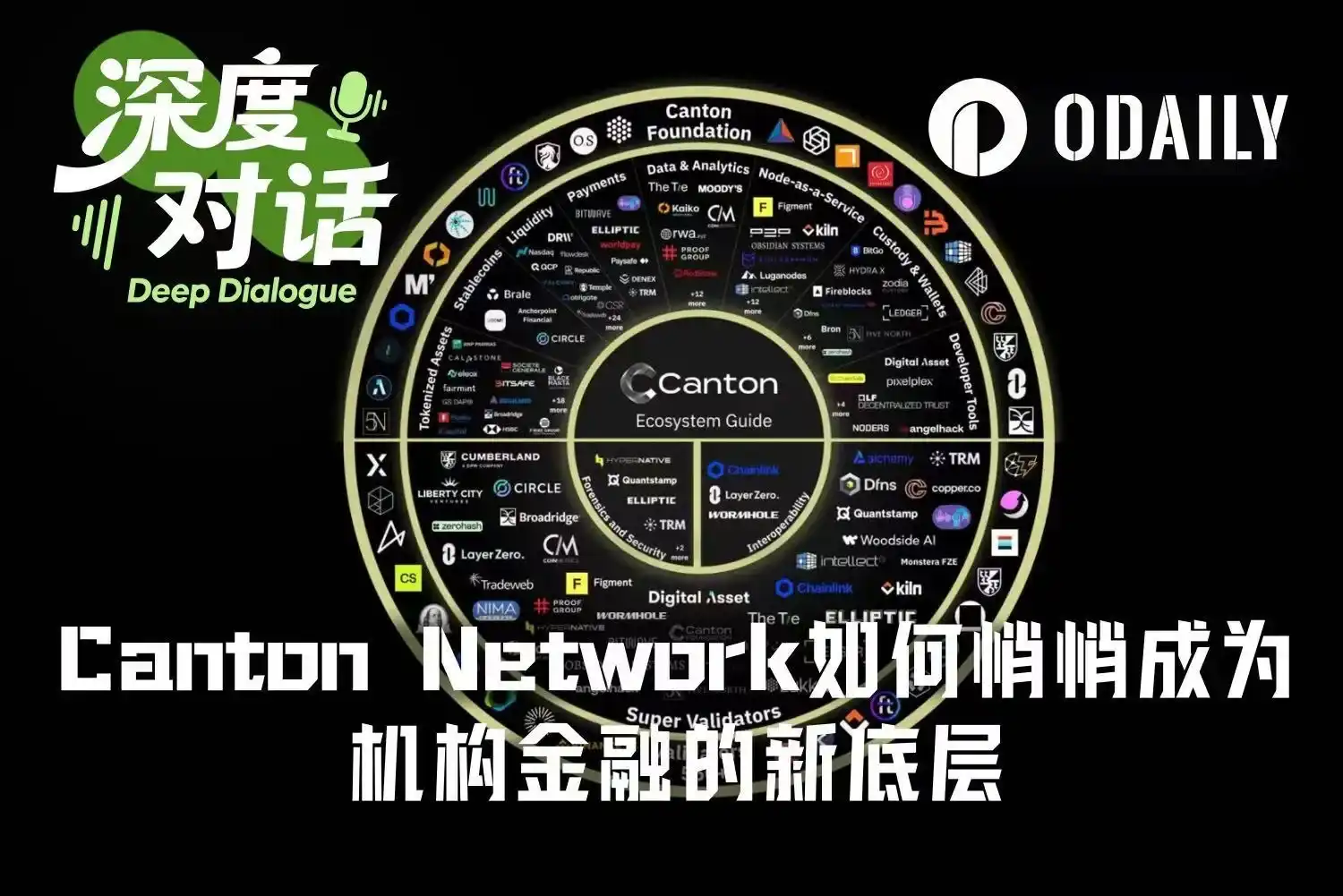
Putting Markets On-Chain: Canton Network Quietly Becomes the New Backbone of Institutional Finance

**Title: Letting the Market Itself Go On-Chain: Canton Network Quietly Becomes the New Backbone for Institutional Finance** **Summary:** The Canton Network, a blockchain platform designed for institutional finance, is gaining significant traction. A key sign of its maturity was Visa's recent entry as a super-validator, a proposal approved in just three days—highlighting prior, extensive collaboration between traditional finance and crypto. Unlike public chains like Ethereum that prioritize transparency and asset onboarding, Canton focuses on enabling confidential, compliant business operations for regulated institutions. Its core design features built-in **data visibility control**, meaning transaction details are only shared between direct counterparties. This privacy is fundamental, allowing competing institutions (like banks Goldman Sachs, JPMorgan, and BNP Paribas, all validators) to interact on the same network without exposing sensitive positions or strategies. Developed by Wall Street veterans at Digital Asset, Canton has taken a slow, deliberate approach to onboard real financial activity. It now handles over **$9 trillion monthly** in transaction volume, primarily from real-world institutional use cases like **tokenized repo agreements**, Treasury settlements, and collateral mobility. Major live applications include **JPM Coin** for institutional payments and **DTCC's tokenized U.S. Treasuries** project. Canton's native token, **CC**, is framed as a "network utility asset" with zero pre-mine or VC allocations. Its value is intended to be driven by the volume of real financial activity on the network. Looking ahead, Canton aims to become the invisible foundational layer for global finance—enabling atomic settlement (where payment and asset delivery occur simultaneously), 24/7 capital flows, and the native issuance and settlement of various asset classes, from corporate bonds to potentially equities. The main challenges are no longer technical but involve navigating fragmented global regulations and integrating with legacy financial systems.

marsbit46 мин. назад

Putting Markets On-Chain: Canton Network Quietly Becomes the New Backbone of Institutional Finance

marsbit46 мин. назад

It's Bankless That Needs Ethereum, Not Ethereum That Needs Bankless

Titled "Bankless Needs Ethereum, Not the Other Way Around," this article analyzes the significant recent news involving Bankless, a prominent crypto media outlet. Bankless co-founder David Hoffman announced the sale of all his ETH holdings, while the company also reportedly underwent major layoffs, with its founders parting ways. The news, likened to a high-profile defection, initially sent shockwaves through the Ethereum community, given Bankless's historical role as a key evangelist and "semi-official" narrative builder for Ethereum. For years, through its podcasts and writings, Bankless championed core Ethereum ideas like "ultrasound money" and the blockchain's role as a new financial settlement layer, acting as a crucial community hub and belief system during its growth phase. However, the article argues this development is not necessarily negative for Ethereum. It suggests Bankless's "first mission"—serving as Ethereum's passionate, inward-facing "propaganda department"—has largely been completed. As Ethereum matures and moves towards mainstream, institutional adoption, the narrative baton has shifted. Today, the value propositions of ETH are increasingly communicated to traditional finance by asset managers like BlackRock and VanEck, public companies adding ETH to their treasuries, and established financial figures. This represents a natural evolution towards a more decentralized, professional, and institutionally-focused narrative network. Therefore, while Bankless's retreat marks the end of an era, it signifies Ethereum's growing resilience and its reduced reliance on any single entity for belief, as its story is now carried forward by a broader and more mature ecosystem of advocates.

链捕手1 ч. назад

It's Bankless That Needs Ethereum, Not Ethereum That Needs Bankless

链捕手1 ч. назад

Google Officially Declares War

Google Declares War with AI-First I/O 2026 At its 2026 I/O developer conference, Google launched an aggressive, multi-pronged offensive, embedding AI across its ecosystem and challenging rivals on performance and price. The event showcased three major releases: Gemini 3.5 Flash, the video-centric Gemini Omni Flash, and the system-level AI assistant Spark. Gemini 3.5 Flash, despite being a smaller "Flash" model, outperforms its Pro counterpart in key benchmarks like mathematical reasoning (GSM8K) and coding (SWE-bench). Google attributes this to "extreme knowledge distillation" from a larger teacher model and a novel, highly granular MoE (Mixture of Experts) architecture with 256 experts, achieving sub-65ms response times. The native multi-modal model, Gemini Omni Flash, offers real-time video understanding with 120ms latency, enabling applications like preventing a cup from overfilling. The new Spark assistant gains deep Android system integration, allowing it to automate complex multi-app workflows based on voice commands. Complementing these, Google unveiled lightweight AI glasses featuring Micro-OLED displays and on-device Gemini chips for instant, offline translation and scene analysis. CEO Sundar Pichai announced Gemini has reached 900 million monthly active users, leveraged through integration into Chrome, Android, and Workspace. Google also slashed prices dramatically: the Gemini 3.5 Flash API is priced at a fraction of competitor rates. This price war is enabled by Google's vertically integrated TPU infrastructure. The strategy signals a shift: standalone AI models are becoming commoditized. Google's advantage lies in its "device + cloud + ecosystem + hardware" integration, aiming to reshape internet traffic from user-initiated searches to AI-driven service distribution. This move pressures pure-play AI firms like OpenAI and Anthropic on business models, and challenges Apple to respond in the next-generation, screen-less device race.

链捕手1 ч. назад

Google Officially Declares War

链捕手1 ч. назад

Торговля

Спот
Фьючерсы
活动图片