A Robotic Version of MicroStrategy Has Arrived! Can Ordinary People Invest in Giants in the Robotics Sector?

marsbitОпубликовано 2026-05-21Обновлено 2026-05-21

Введение

Andrew Kang, a prominent former crypto investor, has shifted his focus to AI and robotics, taking on the role of CEO at RoboStrategy. This publicly traded closed-end fund, inspired by MicroStrategy's capital model, aims to give retail investors access to early-stage robotics investments, a sector traditionally dominated by institutional capital. RoboStrategy recently listed on NASDAQ under the ticker "BOT" and secured a $2 billion equity financing commitment. Kang, co-founder of Mechanism Capital, began investing in robotics two years ago, with a notable early investment in Figure AI. RoboStrategy's portfolio now includes several robotics companies across hardware and software. The fund differentiates itself through permanent capital, a team of industry experts, and strong marketing capabilities. Its core strategy, termed R.I.S.E., involves raising capital when its share price trades at a premium to Net Asset Value (NAV), investing in high-conviction private robotics companies, scaling those investments, and using the resulting NAV growth to attract further capital—creating a potential flywheel effect. However, risks include its current high share price premium over NAV, the subjective valuation and illiquidity of its private holdings, and the inherent volatility of a closed-end fund structure.

Author: Nancy, PANews

Andrew Kang, a star investor once active in the crypto market, is shifting his focus to the AI and robotics sectors. On May 20, Andrew Kang announced his official appointment as CEO of RoboStrategy, responsible for the company's strategic direction and investment portfolio management.

As an innovative fund inspired by the capital model of the crypto DAT company Strategy, RoboStrategy recently officially launched on Nasdaq and secured up to $20 billion in equity financing commitments, quickly drawing market attention.

From Crypto to Robotics, Already Invested in Star Companies Like Figure

RoboStrategy is a public closed-end fund focused on robotics and embodied AI, co-founded by Andrew Kang and Marc Weinstein in 2025. Its goal is to open up early-stage robotics investment opportunities, previously accessible only to a few institutional investors, to a broader base of ordinary investors.

Andrew Kang and Marc Weinstein are also co-founders of the crypto investment firm Mechanism Capital. Since its establishment in 2020, Mechanism Capital has invested in over a hundred crypto projects, including well-known protocols and platforms such as Arbitrum, Pendle, Near, Deribit, and 1inch. However, based on public information, Mechanism Capital has rarely disclosed new crypto investment activities since October 2025. Andrew Kang recently admitted that he has not been closely following the crypto market for the past few months.

In contrast, he has been dedicating more effort to the robotics field. According to Andrew Kang, he began researching the robotics industry two years ago, but at that time, most VCs advised against entering this sector. In the market environment back then, robotics companies generally faced fundraising difficulties. The industry lacked mature, large-scale success stories, and there were many doubts from the outside world regarding their commercialization paths, technology implementation capabilities, and potential market size.

In his view, however, the acceleration of embodied AI development will completely transform the entire industry. Humanoid robots are one of the few directions with the potential to go "from zero to a multi-trillion dollar market," similar to the developmental stage of Bitcoin in 2013, but with a larger long-term market space. Particularly as manufacturing, logistics, and service industries continue to face labor shortages, embodied AI and robotics technologies are accelerating their entry into real industrial scenarios.

Therefore, in February 2024, Andrew Kang completed his first significant investment in robotics, investing $19 million in Figure AI. Today, Figure AI has become one of the world's highest-valued humanoid robotics companies, with a latest valuation of $39 billion, compared to its pre-money valuation of approximately $2 billion in February 2024. (Related reading:The Entrepreneur from the Farm: After Building Flying Cars, Gambles on a $39 Billion Giant in the Robotics Sector)

However, Andrew Kang also realized that the future development of the robotics industry will heavily rely on massive long-term capital, which is difficult to sustain through individuals or traditional funds alone. Meanwhile, robotics startups also need a long-term capital platform that truly understands industry demands to help them secure continuous financing, industrial resources, and market recognition support. More importantly, current robotics innovation is mainly concentrated in the private market, making it difficult for most ordinary investors to participate.

Based on this, Andrew Kang co-founded RoboStrategy. Currently, RoboStrategy has invested in robotics companies including Figure AI, Apptronik, Dyna Robotics, Dexmate, Standard Bots, and Path Robotics, covering multiple areas from hardware and infrastructure to software, with an average investment size per round of approximately $7 million.

In Andrew Kang's view, compared to traditional VCs, RoboStrategy possesses several differentiated advantages. First, as a closed-end fund, its capital is permanent, free from the fund term limitations of traditional VCs, allowing it to adopt an extremely long-term perspective in deploying in the robotics and embodied AI industry. Second, the team brings together multiple seasoned professionals from the robotics industry, including long-time founders or operators, making it regarded by many startups as one of the "most professional and knowledgeable investment institutions in the robotics industry." Additionally, leveraging the team's strengths in digital marketing and social media, RoboStrategy not only has stronger fund distribution capabilities but is also more adept at expanding market influence and industry awareness, thereby helping its portfolio companies gain more attention, talent, and resources.

Launched on Nasdaq, Attempting to Replicate the Strategy Capital Flywheel

As the first closed-end fund specifically designed for public market investors, RoboStrategy officially began trading on Nasdaq on May 11, under the ticker symbol "BOT." As of now, the BOT stock price is around $28.2, having declined approximately 21.58% since listing.
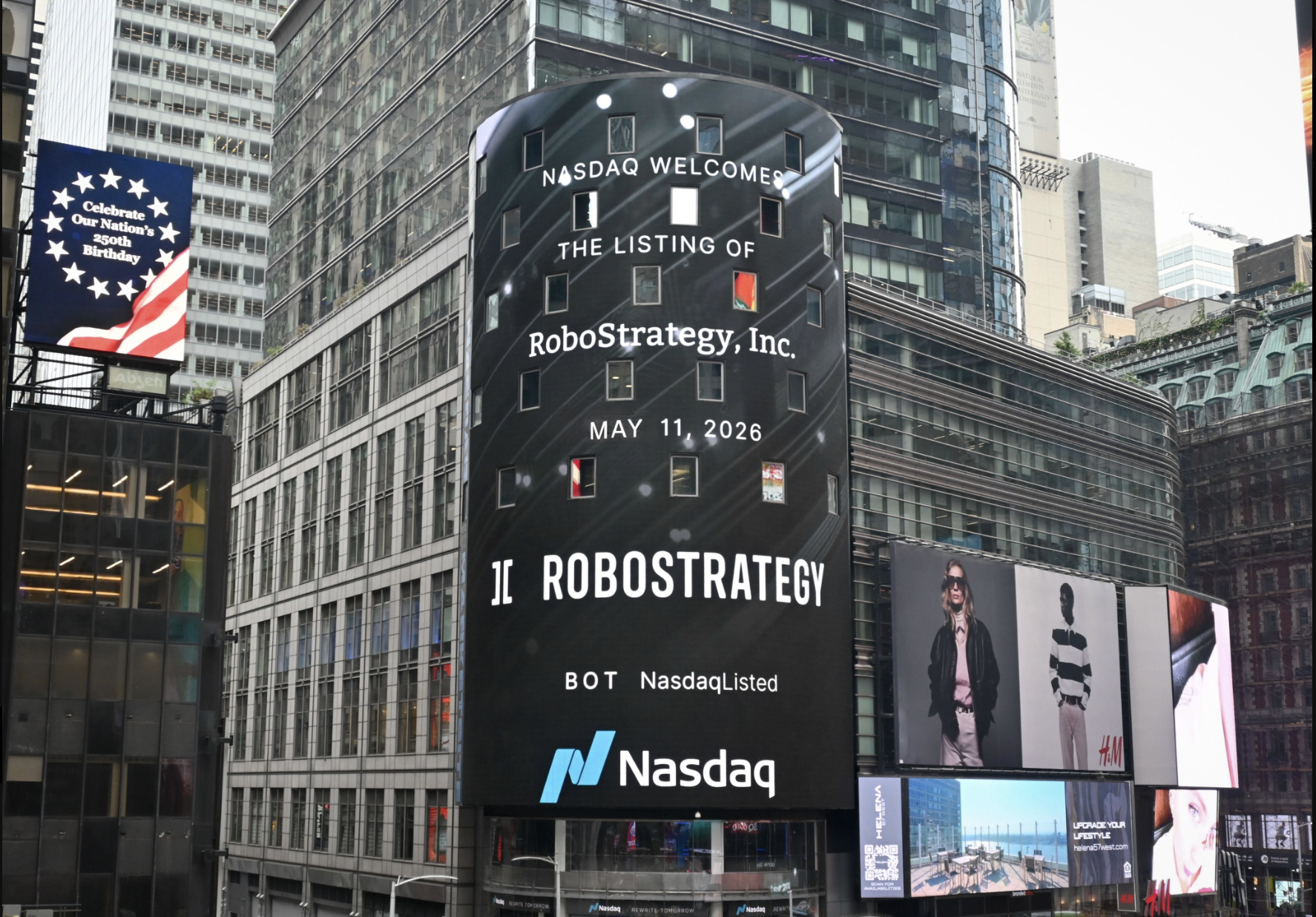
Public information shows that RoboStrategy board member Jason Zhao purchased 400,000 shares of the company at $10 per share in October last year; subsequently, Andrew Kang also purchased 246,000 shares at the same price. Meanwhile, the investment advisory firm FP Strategies LLC continued to increase its holdings by 290,000 shares at $10 per share in April this year, currently holding a cumulative total of approximately 390,000 shares.

In terms of capital operation logic, RoboStrategy draws inspiration from Strategy's Bitcoin treasury model. The latter continuously issues stocks and convertible bonds in the public capital market to obtain low-cost funds for consistently increasing its Bitcoin holdings, leveraging stock price premiums to form a capital flywheel. This model has been emulated by numerous companies.

RoboStrategy attempts to replicate this logic in the robotics sector. The fund's core idea is to use three main financing instruments—CEF, PIPE, and ATM—to continuously raise funds when the fund's stock price trades at a premium relative to its Net Asset Value (NAV), then deploy that capital into high-growth private robotics and embodied AI companies, thereby constructing the R.I.S.E capital compound interest flywheel.
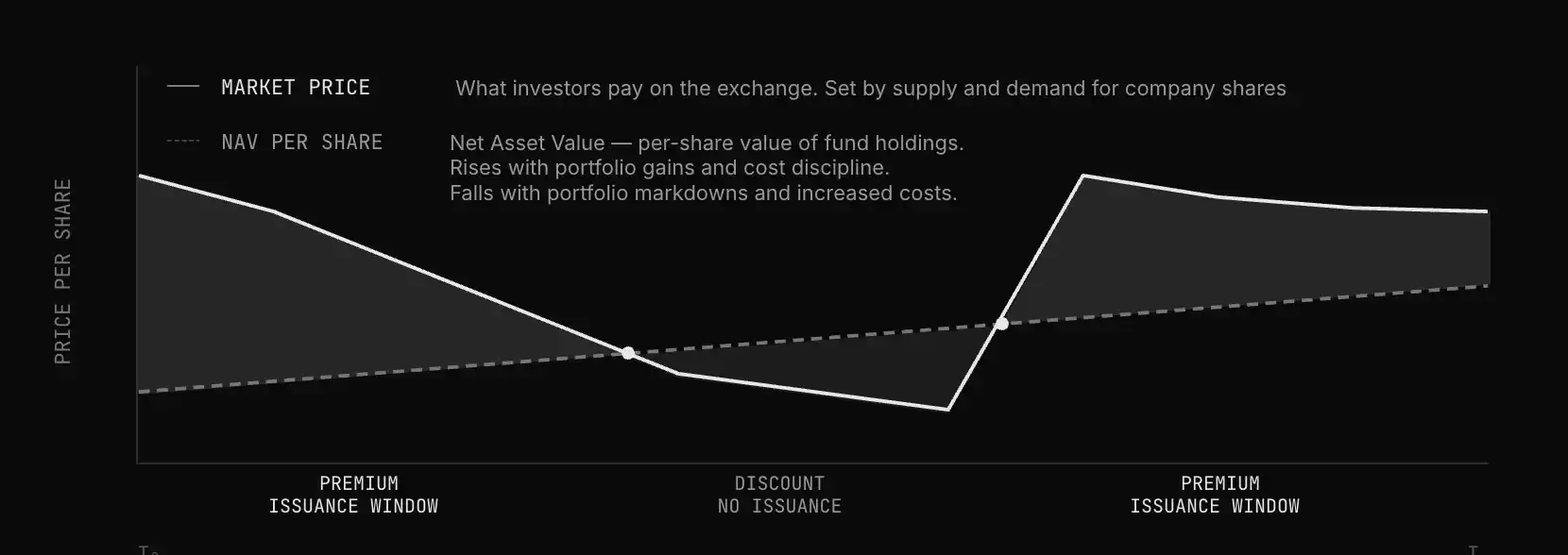
The so-called R.I.S.E represents four stages:

· Raise: Issue shares at a premium when the market price is above NAV to obtain more cash.

· Invest: Through deep due diligence, allocate funds to high-conviction robotics projects.

· Scale: Portfolio companies use the new capital to accelerate expansion, driving fund NAV growth.

· Expand: As NAV increases and industry enthusiasm rises, further attract investors and new capital, expanding the fund's scale and influence.

This model essentially utilizes the dual pricing mechanism of closed-end funds (market price vs. net asset value), aiming to achieve compound growth in NAV per share over the long term, while replacing the multi-layered fee structure of traditional private equity funds with a single public fund structure.

Earlier this month, RoboStrategy signed a $20 billion Committed Equity Financing (CEF) agreement with Roth Principal Investments, a subsidiary of Roth Capital Partners, to support its strategic growth plans.

However, just as most crypto DAT companies' treasury stories are difficult to sustain, RoboStrategy also faces risks that cannot be ignored.

As of March 31, 2026, RoboStrategy's NAV was approximately $7.31 per share, with total net assets around $145.5 million. Based on the current stock price, the market's valuation premium for it is close to 3 times. But a high premium does not mean discount risk will not materialize. Meanwhile, since the fund's investment targets are mostly unlisted robotics companies, their asset valuations themselves are highly subjective and have limited liquidity. Exit paths heavily rely on IPO or M&A markets. Once the capital environment cools down, these assets may face valuation adjustment pressure.

Furthermore, the closed-end fund structure means investors cannot redeem shares at any time like with open-end funds; they can only trade on the secondary market. Therefore, price volatility is often amplified.

Whether RoboStrategy can sustain its high premium and market enthusiasm in the long term remains to be verified by the market.


Связанные с этим вопросы

QWhat is RoboStrategy, and what is its primary goal?

ARoboStrategy is a publicly traded, closed-end fund focused on robotics and embodied AI. Its primary goal is to open up early-stage investment opportunities in the robotics sector, traditionally available only to institutional investors, to the broader public market.

QWho founded RoboStrategy, and what is Andrew Kang's background?

ARoboStrategy was co-founded by Andrew Kang and Marc Weinstein in 2025. Andrew Kang is a former star investor in the crypto market and a co-founder of the crypto investment firm Mechanism Capital. He has now shifted his focus to the AI and robotics sector and serves as the CEO of RoboStrategy.

QHow is RoboStrategy's capital model inspired by MicroStrategy?

ARoboStrategy's capital model is inspired by MicroStrategy's Bitcoin treasury strategy. It aims to create a capital flywheel by issuing shares at a premium when its market price exceeds its Net Asset Value (NAV). The raised capital is then invested in high-growth private robotics companies, aiming to increase the fund's NAV and attract more capital, similar to MicroStrategy's approach with Bitcoin.

QWhat does the R.I.S.E. strategy stand for in the context of RoboStrategy?

AR.I.S.E. is RoboStrategy's four-stage capital strategy: Raise (issuing shares at a premium), Invest (allocating capital to high-conviction robotics projects), Scale (helping portfolio companies grow to increase NAV), and Expand (attracting more investors and capital as NAV and industry interest rise).

QWhat are some key risks associated with investing in RoboStrategy?

AKey risks include: 1) Potential discount to NAV if market sentiment cools. 2) Subjective and illiquid valuations of its private company investments. 3) High dependence on favorable IPO or M&A markets for exits. 4) Price volatility amplified by its closed-end fund structure, which prevents direct redemptions, forcing trades on the secondary market.

Похожее

It's Bankless That Needs Ethereum, Not Ethereum That Needs Bankless

Titled "Bankless Needs Ethereum, Not the Other Way Around," this article analyzes the significant recent news involving Bankless, a prominent crypto media outlet. Bankless co-founder David Hoffman announced the sale of all his ETH holdings, while the company also reportedly underwent major layoffs, with its founders parting ways. The news, likened to a high-profile defection, initially sent shockwaves through the Ethereum community, given Bankless's historical role as a key evangelist and "semi-official" narrative builder for Ethereum. For years, through its podcasts and writings, Bankless championed core Ethereum ideas like "ultrasound money" and the blockchain's role as a new financial settlement layer, acting as a crucial community hub and belief system during its growth phase. However, the article argues this development is not necessarily negative for Ethereum. It suggests Bankless's "first mission"—serving as Ethereum's passionate, inward-facing "propaganda department"—has largely been completed. As Ethereum matures and moves towards mainstream, institutional adoption, the narrative baton has shifted. Today, the value propositions of ETH are increasingly communicated to traditional finance by asset managers like BlackRock and VanEck, public companies adding ETH to their treasuries, and established financial figures. This represents a natural evolution towards a more decentralized, professional, and institutionally-focused narrative network. Therefore, while Bankless's retreat marks the end of an era, it signifies Ethereum's growing resilience and its reduced reliance on any single entity for belief, as its story is now carried forward by a broader and more mature ecosystem of advocates.

链捕手18 мин. назад

It's Bankless That Needs Ethereum, Not Ethereum That Needs Bankless

链捕手18 мин. назад

Google Officially Declares War

Google Declares War with AI-First I/O 2026 At its 2026 I/O developer conference, Google launched an aggressive, multi-pronged offensive, embedding AI across its ecosystem and challenging rivals on performance and price. The event showcased three major releases: Gemini 3.5 Flash, the video-centric Gemini Omni Flash, and the system-level AI assistant Spark. Gemini 3.5 Flash, despite being a smaller "Flash" model, outperforms its Pro counterpart in key benchmarks like mathematical reasoning (GSM8K) and coding (SWE-bench). Google attributes this to "extreme knowledge distillation" from a larger teacher model and a novel, highly granular MoE (Mixture of Experts) architecture with 256 experts, achieving sub-65ms response times. The native multi-modal model, Gemini Omni Flash, offers real-time video understanding with 120ms latency, enabling applications like preventing a cup from overfilling. The new Spark assistant gains deep Android system integration, allowing it to automate complex multi-app workflows based on voice commands. Complementing these, Google unveiled lightweight AI glasses featuring Micro-OLED displays and on-device Gemini chips for instant, offline translation and scene analysis. CEO Sundar Pichai announced Gemini has reached 900 million monthly active users, leveraged through integration into Chrome, Android, and Workspace. Google also slashed prices dramatically: the Gemini 3.5 Flash API is priced at a fraction of competitor rates. This price war is enabled by Google's vertically integrated TPU infrastructure. The strategy signals a shift: standalone AI models are becoming commoditized. Google's advantage lies in its "device + cloud + ecosystem + hardware" integration, aiming to reshape internet traffic from user-initiated searches to AI-driven service distribution. This move pressures pure-play AI firms like OpenAI and Anthropic on business models, and challenges Apple to respond in the next-generation, screen-less device race.

链捕手37 мин. назад

Google Officially Declares War

链捕手37 мин. назад

Top 10 Promising Emerging Hyperliquid Native Protocols to Watch

Title: A Review of 10 Emerging Native Protocols on Hyperliquid Hyperliquid is evolving beyond perpetual contracts into a comprehensive on-chain financial stack. This article highlights 10 key native protocols driving this growth: 1. **Monetrix**: A yield-optimizing protocol akin to Ethena, aggregating funding rates, HLP rewards, maker rebates, and HIP-3 into a single stablecoin yield. 2. **ROSETTA**: An automated stablecoin yield router, allocating USDC across top protocols (e.g., Felix, Aave, HLP) for optimal returns, factoring in gas and slippage. 3. **papertrade.xyz**: A fair-launched perpetuals protocol offering up to 1000x leverage, no funding rates, no slippage, and fully on-chain, oracle-based execution. 4. **alt.fun**: A launchpad where tokens are paired with leveraged perpetual positions (2x-5x), linking token price to trading activity and underlying position performance. 5. **Ventuals**: Pre-IPO perpetual contracts (built on HIP-3) allowing up to 10x leveraged speculation on valuations of private companies like SpaceX and Stripe. 6. **Liminal**: A delta-neutral yield protocol that captures funding rates via automated short positions and uses generated xTokens (xBTC, etc.) as DeFi collateral. 7. **Melt**: Brings tokenized stocks, commodities, and RWAs to Hyperliquid spot markets, enabling 24/7 trading alongside crypto assets. 8. **Chainsight**: An oracle and data infrastructure protocol providing low-latency (<3s) price feeds, volatility indices, and risk metrics for novel derivatives. 9. **rip.xyz**: Tokenized vault strategies on HyperEVM; its flagship rHYPURR offers liquidity and fractional exposure to a Hypurr NFT basket, priced hourly via NAV. 10. **Markets**: A perpetuals exchange (by Kinetiq) for trading stocks, forex, commodities, bonds, and crypto with up to 50x leverage, using USDH collateral and Kaiko oracles. These protocols form the foundational layer for generating real yield, liquidity, and innovative financial products natively on Hyperliquid.

marsbit1 ч. назад

Top 10 Promising Emerging Hyperliquid Native Protocols to Watch

marsbit1 ч. назад

Торговля

Спот
Фьючерсы

Популярные статьи

Как купить PEOPLE

Добро пожаловать на HTX.com! Мы сделали приобретение ConstitutionDAO (PEOPLE) простым и удобным. Следуйте нашему пошаговому руководству и отправляйтесь в свое крипто-путешествие.Шаг 1: Создайте аккаунт на HTXИспользуйте свой адрес электронной почты или номер телефона, чтобы зарегистрироваться и бесплатно создать аккаунт на HTX. Пройдите удобную регистрацию и откройте для себя весь функционал.Создать аккаунтШаг 2: Перейдите в Купить криптовалюту и выберите свой способ оплатыКредитная/Дебетовая Карта: Используйте свою карту Visa или Mastercard для мгновенной покупки ConstitutionDAO (PEOPLE).Баланс: Используйте средства с баланса вашего аккаунта HTX для простой торговли.Третьи Лица: Мы добавили популярные способы оплаты, такие как Google Pay и Apple Pay, для повышения удобства.P2P: Торгуйте напрямую с другими пользователями на HTX.Внебиржевая Торговля (OTC): Мы предлагаем индивидуальные услуги и конкурентоспособные обменные курсы для трейдеров.Шаг 3: Хранение ConstitutionDAO (PEOPLE)После приобретения вами ConstitutionDAO (PEOPLE) храните их в своем аккаунте на HTX. В качестве альтернативы вы можете отправить их куда-либо с помощью перевода в блокчейне или использовать для торговли с другими криптовалютами.Шаг 4: Торговля ConstitutionDAO (PEOPLE)С легкостью торгуйте ConstitutionDAO (PEOPLE) на спотовом рынке HTX. Просто зайдите в свой аккаунт, выберите торговую пару, совершайте сделки и следите за ними в режиме реального времени. Мы предлагаем удобный интерфейс как для начинающих, так и для опытных трейдеров.

745 просмотров всегоОпубликовано 2024.04.12Обновлено 2025.03.21

Как купить PEOPLE

Обсуждения

Добро пожаловать в Сообщество HTX. Здесь вы сможете быть в курсе последних новостей о развитии платформы и получить доступ к профессиональной аналитической информации о рынке. Мнения пользователей о цене на PEOPLE (PEOPLE) представлены ниже.

活动图片