Soothsayer Predicted Hantavirus 4 Years Ago, Are 'Prophets' in the Market Hidden Among the People?

Odaily星球日报Опубликовано 2026-05-08Обновлено 2026-05-08

Введение

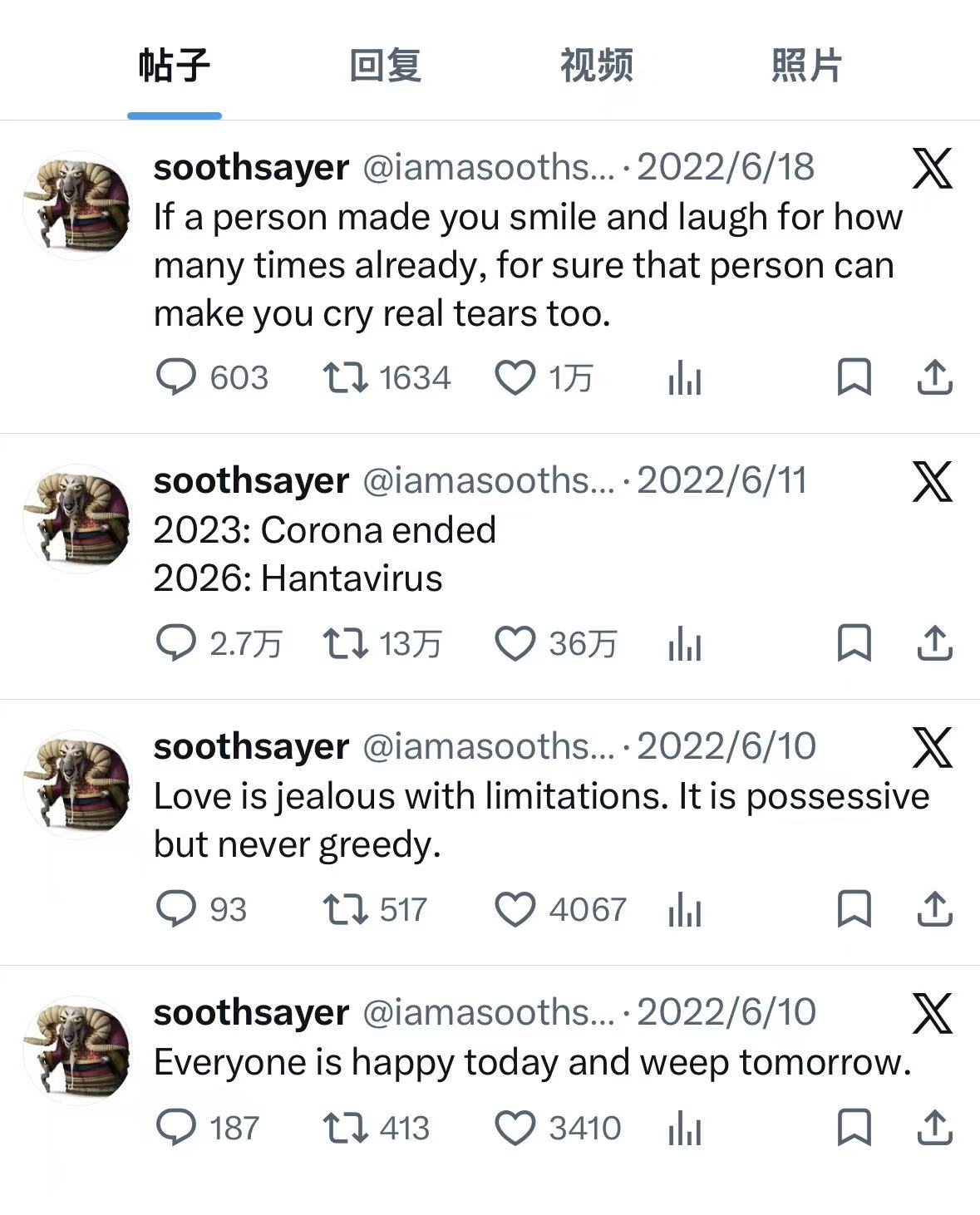
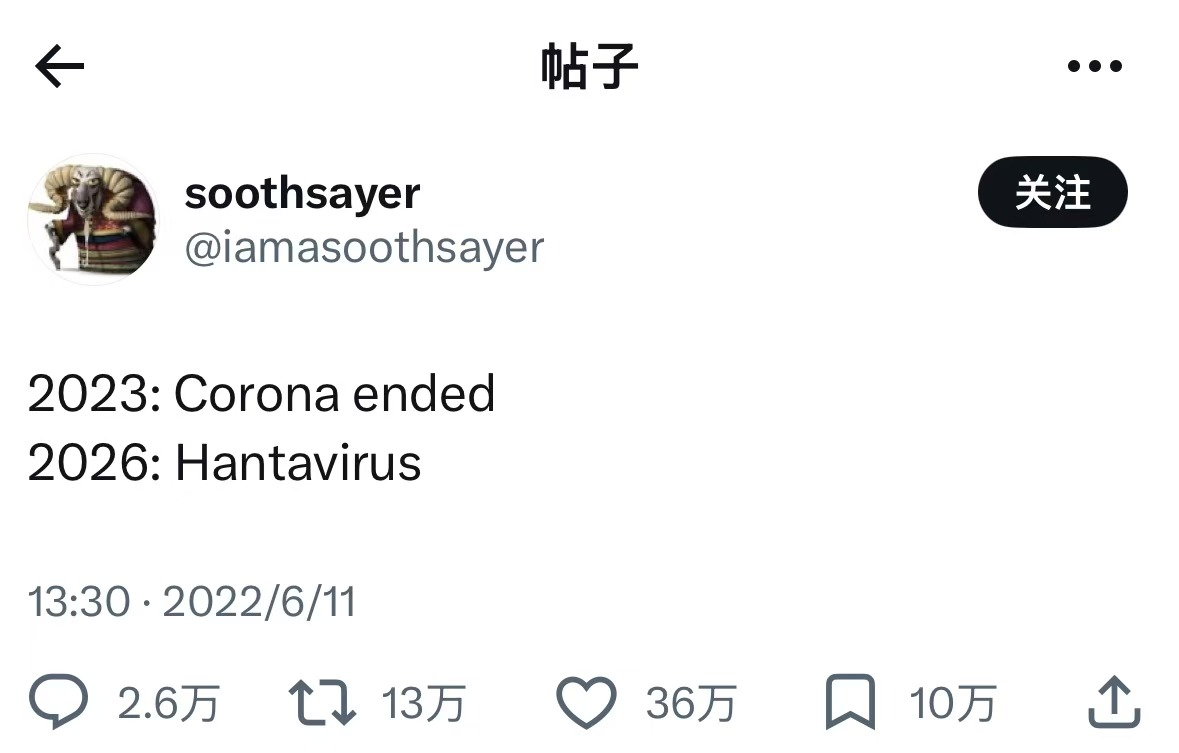
A purported "soothsayer" account on X, @soothsayer, posted a cryptic tweet in June 2022 predicting the end of COVID-19 in 2023 and the later emergence of the Hantavirus. This old post resurfaced and went viral following recent Hantavirus cases linked to a cruise ship, the "Hondius," which has resulted in 3 deaths and 8 infections. While the WHO has clarified there is no large-scale outbreak and the specific Andeans virus strain has limited human-to-human transmission, the incident has fueled public anxiety and online speculation. The crypto market quickly absorbed this narrative. A Meme token named HANTA, created a year prior, saw its market cap rise to around $12 million. Prediction markets on Polymarket and Predict.fun also launched betting pools on whether the Hantavirus would be declared a pandemic by the end of 2026, with millions of dollars in wagers reflecting public sentiment. The event highlights how cryptocurrency markets rapidly convert public attention, fear, and speculation into tradable assets. The mysterious @soothsayer account, which posted only 5 times, has since gone inactive, adding an aura of urban legend to the episode and underscoring the internet's power to blend coincidence, emotion, and narrative.

Original|Odaily Planet Daily (@OdailyChina)

Author|Wenser(@wenser 2010 )
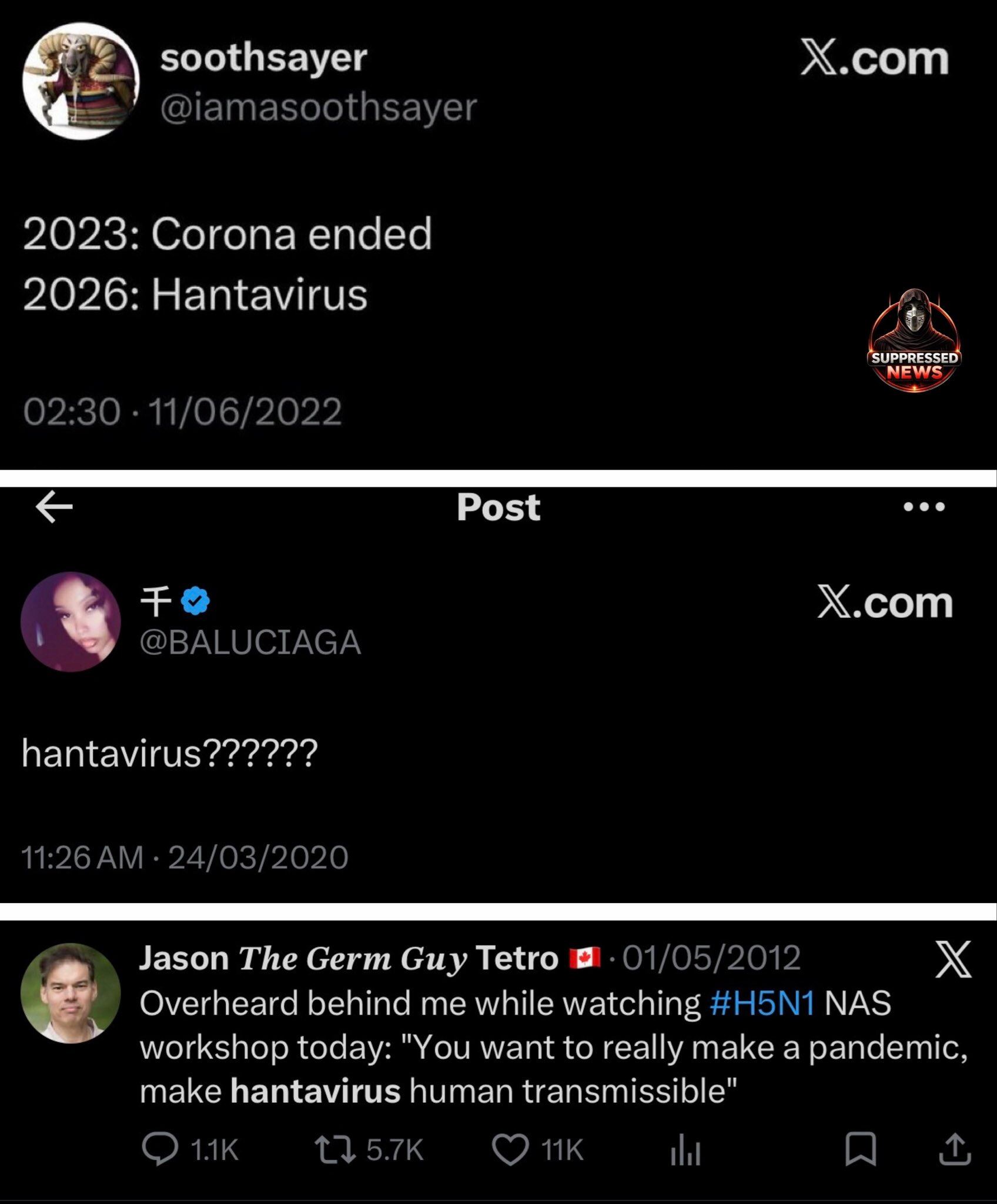
Last night, an old tweet from June 11, 2022, detonated the public opinion field on platform X like a nuclear bomb. This tweet came from a fortune-teller claiming to be able to "read the future," not only predicting the end of the COVID-19 pandemic in 2023 but also, prophetically, accurately mentioning the recent emergence of the Hantavirus.

For a moment, countless people flocked to it, leaving various comments, but the account disappeared after only 5 tweets, gone without a trace, adding a mysterious touch reminiscent of an urban legend.

In the wake of the uncertainty left by the post-pandemic era, discussions related to Hantavirus quickly spilled over from public health topics, evolving into emotional amplifiers on social media. They were also rapidly absorbed by the crypto market as a new trading narrative, from Meme coins to prediction markets—speculative funds always find the points of emotional intensity first.

Amidst the indistinguishable flow of information and the resonance of group emotions, the crypto market once again showcased its instinct: rapidly converting attention, anxiety, and expectations into tradable products and prices.

A Mysterious Tweet from 4 Years Ago Linked to the Recent Cruise Ship Virus That Killed 3

The story begins with an account named @soothsayer.

This account, which only posted 5 tweets, had received little attention before. If you ignored that "Hantavirus prophecy" tweet, you might think this account was no different from the ordinary ones on X that post "inspirational quotes" and "motivational sayings" daily.

But as Hantavirus topics kept heating up these past few days, this old tweet took on a flavor of "cyber mysticism."
In April this year, a cruise ship named "Hondius" departed from Argentina in South America, originally planning to cross the entire Atlantic to the Canary Islands in Spain. However, during the voyage, a Dutch man suddenly died on board, later confirmed to be due to Hantavirus. As of May 6, the death toll had risen to 3, with infections increasing to 8, including tourists from the Netherlands, the UK, Germany, and other places. Currently, the cruise ship is temporarily denied docking due to Hantavirus, and the WHO is closely monitoring the situation. Notably, around 30 passengers disembarked from the ship two weeks prior without tracking procedures and have dispersed to 12 countries.

Therefore, although the WHO clarified that the virus had not previously shown large-scale transmission, it inevitably caused public panic, with many exclaiming, "It reminds me of the fear of being controlled by COVID."
It is worth noting that, according to test results from the South African National Institute for Communicable Diseases and the University Hospitals of Geneva, Switzerland, the virus type in this outbreak has been confirmed as the Andes Hantavirus.

The vast majority of Hantaviruses are not transmissible from human to human, but the Andes virus is the only exception; this transmission usually occurs among close contacts like family members or healthcare workers. Additionally, Hantaviruses mostly infect humans through "rodent-borne" routes, primarily via three transmission methods: respiratory infection, i.e., inhaling aerosols contaminated by rodent excreta; contact infection, i.e., broken skin or mucous membranes directly contacting excreta from infected rodents; and digestive tract infection, i.e., consuming food contaminated by rodent excreta.

As for the concern many have about whether the virus will spread to China, reliable sources indicate that in China, diseases caused by Hantavirus are known as "epidemic hemorrhagic fever." China has achieved significant success in the prevention and treatment of this virus and its associated illnesses, and there is currently no risk of a large-scale outbreak; the Chinese Embassy in Cape Verde previously issued a notice confirming that there were no Chinese citizens on the ship.

Looking back at the "fortune-teller's" tweet, it not only directly mentioned Hantavirus but was also posted four years ago, making it indeed highly topical.

Hantavirus in Crypto: Meme Coins and Prediction Markets

Following the emergence of Hantavirus, the crypto market also experienced tremors, with Meme coins and prediction markets quickly putting on their own performances.

Community members dug up a Meme coin created a year ago, officially launched on external markets on May 4th: HANTA (Hantavirus) Meme coin (2tXpgu2DLTsPUf9zFmuZmA4xrYxXKBTpVq9wAM7hzs9y). Its current market cap is temporarily reported at $12 million, making it a veritable "OG launch."

Furthermore, in terms of prediction markets, both Polymarket and Predict.fun have listed betting events related to Hantavirus.

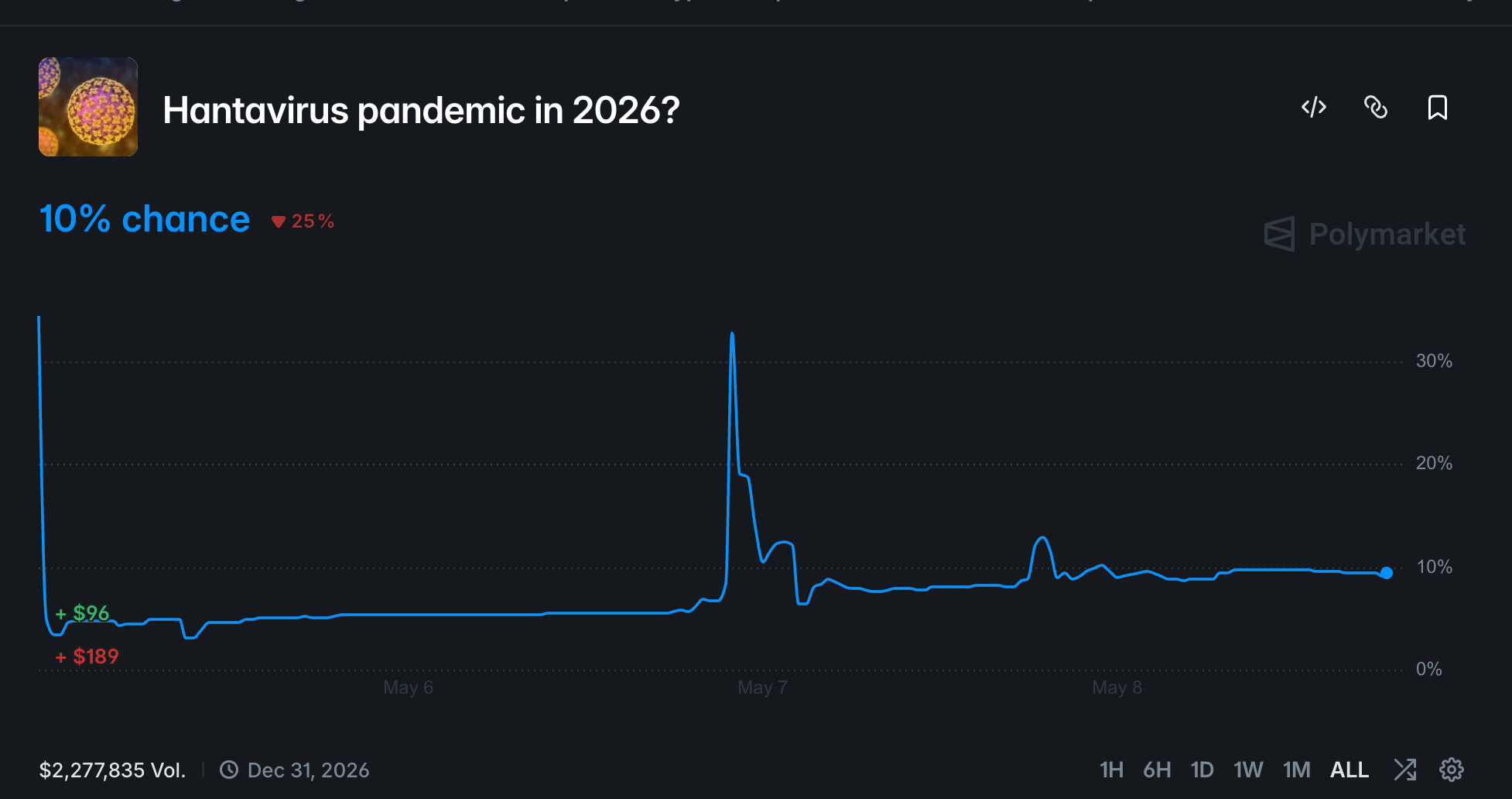
On Polymarket, the probability of the "2026 Hantavirus Pandemic" event occurring is temporarily reported at 10%, having previously surged to nearly 35%; the betting amount is currently around $2.27 million. Its settlement rule is: "If the World Health Organization, in official public communications from market creation until 11:59 PM EST on December 31, 2026, explicitly characterizes an outbreak of Hantavirus, Hantavirus Pulmonary Syndrome (HPS), Hemorrhagic Fever with Renal Syndrome (HFRS), or a Hantavirus-related outbreak as a 'pandemic,' this market will settle to 'Yes'; otherwise, this market will settle to 'No.' Explicit characterization includes official WHO statements, reports, press conferences, or publications that clearly describe the outbreak as a 'pandemic.' Declaring it a Public Health Emergency of International Concern (PHEIC) alone does not qualify unless it is also described as a pandemic. The primary settlement source for this market will be official WHO communications. Consensus from credible reporting may also serve as a source."
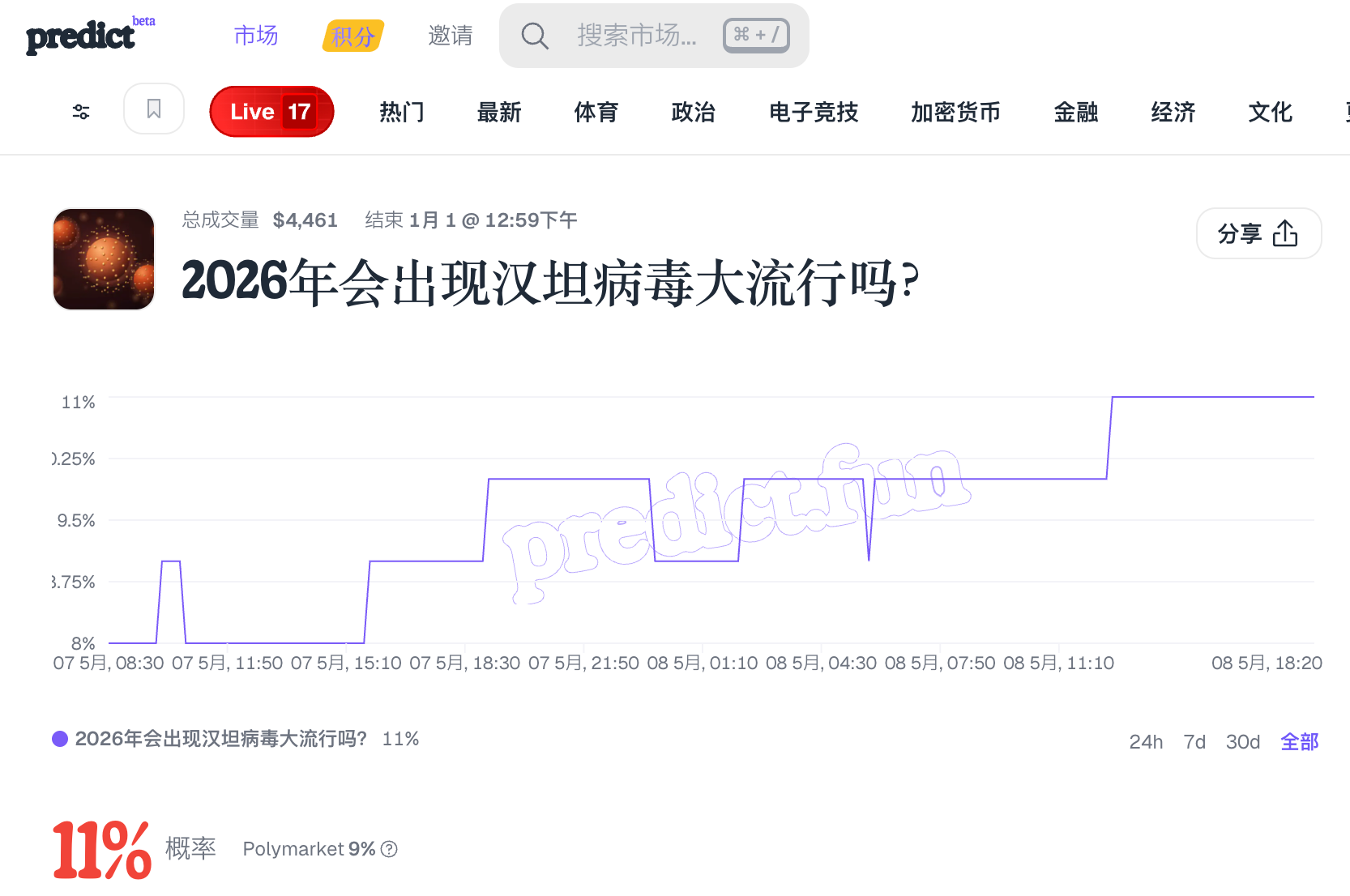
The probability for the similarly named betting event on the Predict.fun platform is temporarily reported at 11%, slightly higher than Polymarket's data; the betting volume is smaller, only around $4,400. Its settlement rules are similar to Polymarket's, also relying on the WHO's public statements.
For many people, betting real money on the future is inherently addictive. The reason prediction markets are getting hotter is essentially because they turn humanity's anxiety, curiosity, and desire for the unknown directly into tradable commodities.

Finally, let's turn our attention back to platform X. There, numerous old posts about "Hantavirus" are still scattered, some posted in 2020, some even dating back to 2012. Some people fish out fragments as "divine prophecies," some piece together blurry screenshots into complete stories, and others firmly believe everything was already pre-written.

Truth or falsehood isn't important; what's truly fascinating is how the internet always manages to mix coincidence, fear, emotion, and imagination into something between reality and urban legend, making you unable to resist clicking to take a look.

Just like the words left by that fortune-teller @soothsayer: "Today's laughter, tomorrow's tears."
Связанные с этим вопросы

QWhat event did a 2022 tweet from an account called @soothsayer supposedly predict, according to the article?

AAccording to the article, the 2022 tweet from the account @soothsayer predicted the Hantavirus. It also reportedly predicted that Covid-19 would end in 2023.

QWhat triggered the recent public discussion and market activity related to Hantavirus?

AThe recent public discussion was triggered by an outbreak of Hantavirus on the cruise ship 'Grendius,' which resulted in three deaths and eight infections among passengers from various European countries.

QAccording to the article, how has the cryptocurrency market reacted to the news about Hantavirus?

AThe cryptocurrency market has reacted by creating tradable assets and predictions related to the virus. This includes the emergence of a Hantavirus-themed meme coin (HANTA) and prediction markets on platforms like Polymarket and Predict.fun, where users can bet on whether the virus will be declared a pandemic by 2026.

QWhat is the Andean virus, and why is it specifically mentioned in relation to this Hantavirus outbreak?

AThe Andean virus is a specific type of Hantavirus. It is mentioned because it was the strain confirmed in the recent cruise ship outbreak. This strain is notable because it is the only known Hantavirus that can be transmitted from person to person, typically through close contact.

QHow do the prediction markets Polymarket and Predict.fun determine the outcome of their 'Hantavirus pandemic' bets?

AThese markets base their settlement on official statements from the World Health Organization (WHO). For a 'Yes' outcome, the WHO must explicitly characterize a Hantavirus-related outbreak as a 'pandemic' in an official public communication between the market's creation date and December 31, 2026. Merely declaring it a Public Health Emergency of International Concern (PHEIC) is not sufficient unless it is also described as a pandemic.

Похожее

Smart Money Hoards $40 Billion in Cash, Retail Bets $2.6 Trillion on Calls: The Critical Moment of the US Stock Market's AI Narrative

Title: Smart Money Hoards $40 Billion in Cash, Retail Traders Bet $2.6 Trillion on Call Options: The Tipping Point for the AI Narrative in U.S. Stocks The U.S. stock market is experiencing a striking divergence. While the S&P 500 hits new highs, the financial sector is down 6% year-to-date, underperforming more than during the 2008 and COVID crises. In contrast, a record $2.6 trillion in S&P 500 call options traded in a single day, and the Philadelphia Semiconductor Index RSI is at its highest since 1999. This reflects a clear split: "smart money" is retreating while retail traders chase gains. Key data points highlight this critical juncture in the AI-driven rally: 1. SoftBank had to cut its $10 billion loan target against its OpenAI stake to $6 billion, as lenders questioned the valuation of the private AI giant, signaling primary market skepticism. 2. The explosive $2.6 trillion daily options volume, with 60% being calls, is described by a Goldman Sachs partner as a "semi-irrational chase," drawing parallels to the 1999 tech bubble. 3. The financial sector's severe underperformance relative to the S&P 500 is a classic technical warning signal, indicating potential underlying economic stress. 4. Apollo Global Management, despite strong earnings, is building a $40 billion cash buffer in its insurance business, preparing for what its CEO calls a 30-35% probability of an exogenous shock from geopolitics, inflation, and AI's economic disruption. 5. Consumer behavior mirrors this split: while Whirlpool plunged on a worsening macro outlook for big-ticket items, DoorDash rose on strong demand for small, immediate services. Together, these conflicting signals from primary markets, secondary markets, leading sectors, and top institutions suggest market risk premia have compressed to a precarious level. The current price action may be increasingly reliant on speculative sentiment rather than fundamental support, marking a potential tipping point for the AI investment narrative.

marsbit19 мин. назад

Smart Money Hoards $40 Billion in Cash, Retail Bets $2.6 Trillion on Calls: The Critical Moment of the US Stock Market's AI Narrative

marsbit19 мин. назад

Tiger Research: AI Agents Will Now Need Identity Verification

Tiger Research: AI Agents Now Need "ID Verification" AI agents are increasingly capable of autonomously executing contracts, making payments, and conducting trades. However, a critical issue remains unresolved: how to verify the identity of the agent on the other side of a transaction. This article examines the emerging competition to establish a KYA (Know Your Agent) standard and the current state of regulatory progress. **Core Points:** 1. As AI agents operate independently in A2A (agent-to-agent) scenarios, the focus shifts from KYC (Know Your Customer) to KYA for identity verification. 2. KYA is not universally required; it's essential primarily when independently deployed agents interact with open ecosystems like DEXs, engage in A2A payments, or pay merchants, not within centralized platforms. 3. A standards battle is underway, with four key players approaching KYA from different angles: * **ERC-8004:** A blockchain-native approach, creating agent IDs as NFTs with on-chain registries for identity, reputation, and validation. * **Visa TAP:** Leverages Visa's payment network to issue verified "Agent Intent" credentials, bundling agent identity into its payment rails. * **Trulioo:** Adapts the SSL certificate model to issue dynamic "Digital Agent Passports," verifying both developer (KYB) and user (KYC) credentials. * **Sumsub:** Focuses on real-time risk detection and re-verification of the human behind an agent during suspicious transactions, rather than pre-issuing certificates. 4. Regulatory momentum is building. The EU AI Act, the U.S. NIST, and Singapore's national AI governance framework are prioritizing agent identity management. The rollout of KYA standards is likely to follow a pattern similar to the FATF Travel Rule, becoming a watershed moment for the industry. The market is unlikely to have a single winner. Different approaches will dominate specific niches: ERC-8004 for on-chain autonomous transactions, Visa TAP for payment-bound commerce, Trulioo for regulated finance, and Sumsub for fraud-prone scenarios. The key differentiator will be which players successfully integrate their identity infrastructure earliest as adoption scales.

marsbit1 ч. назад

Tiger Research: AI Agents Will Now Need Identity Verification

marsbit1 ч. назад

Perspective: The current AI supercycle will last 15 years, but most are still buying stocks in the first FOMO stage

This article outlines a 15-year AI supercycle, segmented into four investment stages. It argues that while most investors are still focused on the first stage, smart money is already moving to the third. **Stage 1: The Foundation (2023-2025) - Priced In** The semiconductor layer (e.g., NVIDIA, AMD) is complete. While growth continues, the historic entry opportunity is over as risk/reward has compressed. **Stage 2: The Build-Out (2025-2027) - In Progress** This phase involves building the necessary physical infrastructure: power/utilities (CEG), cooling (VRT), networking (ANET), and nuclear SMRs (OKLO, SMR). Significant upside remains, but obvious names have already moved. **Stage 3: The Asymmetric Bet (2026-2028) - Positioning Window** AI moves into the physical world. Key areas include robotics/autonomy (Tesla Optimus), space/defense/drones (Rocket Lab, LUNR), and critical materials. This stage presents the best asymmetric risk/reward and is where positioning should occur now. **Stage 4: The Endgame (2028+) - Software Dominance** The mega-cap cloud platforms (Microsoft, Alphabet, Amazon, Meta), with their massive capital expenditure, will build the AI software layer and AGI infrastructure, aiming to win the entire cycle. **Core Conclusion:** The cycle is confirmed in Stage 2. Stage 3 (robotics, space, defense, nuclear SMRs) is where capital is currently rotating for maximum opportunity, while the majority of investors are expected to be 12 months behind this shift.

marsbit1 ч. назад

Perspective: The current AI supercycle will last 15 years, but most are still buying stocks in the first FOMO stage

marsbit1 ч. назад

Торговля

Спот
Фьючерсы

Популярные статьи

Как купить 4

Добро пожаловать на HTX.com! Мы сделали приобретение 4 (4) простым и удобным. Следуйте нашему пошаговому руководству и отправляйтесь в свое крипто-путешествие.Шаг 1: Создайте аккаунт на HTXИспользуйте свой адрес электронной почты или номер телефона, чтобы зарегистрироваться и бесплатно создать аккаунт на HTX. Пройдите удобную регистрацию и откройте для себя весь функционал.Создать аккаунтШаг 2: Перейдите в Купить криптовалюту и выберите свой способ оплатыКредитная/Дебетовая Карта: Используйте свою карту Visa или Mastercard для мгновенной покупки 4 (4).Баланс: Используйте средства с баланса вашего аккаунта HTX для простой торговли.Третьи Лица: Мы добавили популярные способы оплаты, такие как Google Pay и Apple Pay, для повышения удобства.P2P: Торгуйте напрямую с другими пользователями на HTX.Внебиржевая Торговля (OTC): Мы предлагаем индивидуальные услуги и конкурентоспособные обменные курсы для трейдеров.Шаг 3: Хранение 4 (4)После приобретения вами 4 (4) храните их в своем аккаунте на HTX. В качестве альтернативы вы можете отправить их куда-либо с помощью перевода в блокчейне или использовать для торговли с другими криптовалютами.Шаг 4: Торговля 4 (4)С легкостью торгуйте 4 (4) на спотовом рынке HTX. Просто зайдите в свой аккаунт, выберите торговую пару, совершайте сделки и следите за ними в режиме реального времени. Мы предлагаем удобный интерфейс как для начинающих, так и для опытных трейдеров.

601 просмотров всегоОпубликовано 2025.10.20Обновлено 2025.10.20

Как купить 4

Неделя обучения по популярным токенам 4: В 2025 году экосистема TRON переживает взрывной рост, TRON укрепляет позиции лидера по переводу стейблкоинов

В 2025 году экосистема TRON быстро развивается, уделяя особое внимание взаимодействию, безопасности и практическому внедрению.

2.1k просмотров всегоОпубликовано 2025.12.30Обновлено 2025.12.30

Неделя обучения по популярным токенам 4: В 2025 году экосистема TRON переживает взрывной рост, TRON укрепляет позиции лидера по переводу стейблкоинов

Обсуждения

Добро пожаловать в Сообщество HTX. Здесь вы сможете быть в курсе последних новостей о развитии платформы и получить доступ к профессиональной аналитической информации о рынке. Мнения пользователей о цене на 4 (4) представлены ниже.

活动图片