By | TingtongTech (ID:tingtongtech),Author | Yang Lin,Editor | Rao Xiafei
The showdown between Elon Musk and Sam Altman is intensifying.
Their feud, which has been brewing for a decade, has escalated from public spats on platform X to direct competition between their companies' product lines, and now to a courtroom confrontation.
Musk accuses Altman of "stealing a charity," arguing that OpenAI, now valued at approximately $852 billion and planning an IPO, has betrayed its founding principles.
The world's richest man believes Altman and others swindled him out of $38 million in donations and personal assistance. In his lawsuit, he has two core demands: one, seeking $130-150 billion in damages; two, requesting the court to order OpenAI to revert to a non-profit status and replace its current management.
The market defines this duel as the "AI Century Lawsuit." For the AI era, in a sense, whether discussing legal principles, capital competition, or discourse power, the essence of this game is no longer merely a personal grudge between the two men.
In the market's view, the true significance of this lawsuit lies in the fact that the judgment will essentially anchor the basic industry rules for the global AI ecosystem.
Although the final winner will not change the rules of the AI game, this is a microcosm of an era of global industry differentiation and fierce competition.
Especially, behind the scenes of frantic pursuit, there is an even more important question to ask: while Musk and Altman are tearing each other apart in court and competing fiercely outside, who will be the real "fisherman"?
A Courtroom Battle Exposing More Than Just a Personal Feud
"Without me, OpenAI would never have existed," Musk has repeatedly emphasized.
In 2015, Musk invested about $38 million in seed funding and co-authored the founding manifesto for OpenAI with Altman, pledging to "build safe, beneficial AGI (artificial general intelligence) for humanity, unconstrained by the need for financial return."
Musk poached top researchers from Google and personally contacted Nvidia CEO Jensen Huang to secure early supercomputers for the startup. However, in February 2018, he left the board due to disagreements over direction.
A decade later, OpenAI is no longer a non-profit lab. It has established a for-profit subsidiary, brought in Microsoft investment, and rapidly grown into a tech empire valued at around $852 billion and planning an IPO.
All disputes between the two revolve around that initial pledge. The core controversy is whether it was a charitable trust agreement or a legally non-binding "idealistic slogan."
In fact, from a legal interpretation perspective, if it is deemed merely a visionary statement, it holds no legal binding force. Then OpenAI's for-profit transformation would have no legal flaws, Musk's accusations would completely collapse, and the lawsuit would end immediately.
However, if the founding manifesto is deemed to constitute a legally effective "charitable trust" or an enforceable "public welfare commitment," then every subsequent step by OpenAI could constitute a fundamental violation of the original promise.
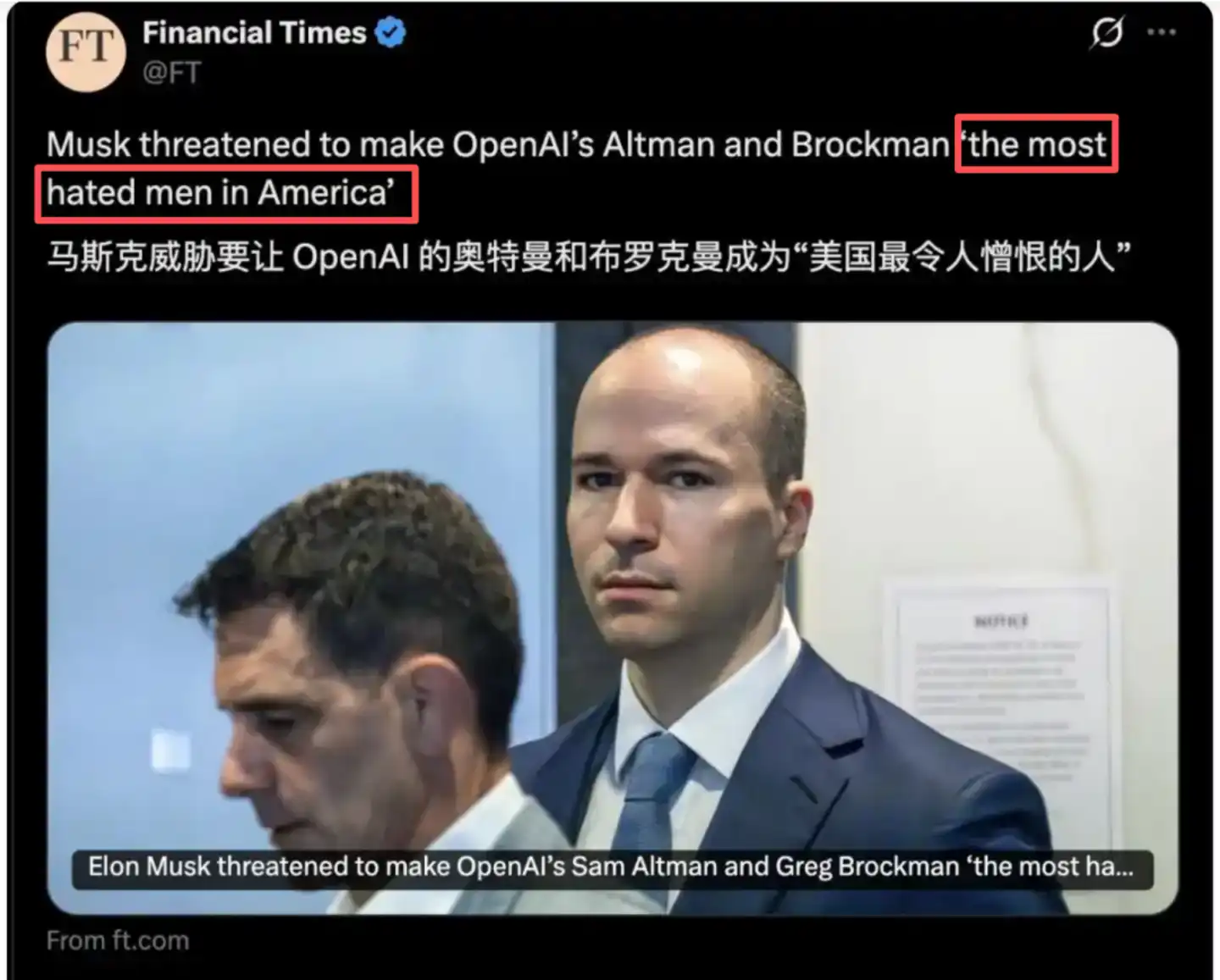
Musk's accusation is that OpenAI transformed from a "non-profit organization" into a "for-profit entity." He wants Altman and his AI empire to face the consequences: a $150 billion compensation demand, dissolution of OpenAI's for-profit structure, removal of Altman and Brockman, forced disclosure of technology, and cancellation of Microsoft's licensing agreement.
But OpenAI has presented a counter-narrative pointing in a different direction.
In their view, Musk was once a power-holder and is now a business rival. According to media reports, OpenAI lawyers also believe Musk filed the lawsuit not to guard any non-profit mission, but because "he didn't get the outcome he wanted."
For instance, court documents from OpenAI show that Musk himself had suggested establishing a for-profit entity as early as 2015, and in 2017 not only engaged in control struggles but also secretly registered a for-profit company in OpenAI's name.
OpenAI President Greg Brockman testified that in 2017, Musk himself had pushed for OpenAI to transform into a for-profit company, but with the condition that he have "complete control."
In fact, Musk also admitted that his xAI had used OpenAI's models to train its own Grok, which, in the market's view, corroborates OpenAI's assertion of "commercial rivals suppressing each other."
Some market commentary also points out: If Musk is truly fighting for the benefit of all humanity, why did he angrily exit in 2018 after failing to gain control when proposing a for-profit entity? Why publicly mock OpenAI and then found xAI in 2023?
In other words, what Musk wants—is it a "non-profit organization," or an AI enterprise/dominance he can control?
Or perhaps, Musk just wants to "defeat Altman"?
The AI Game Between Two Companies
Indeed, judging from the scope of Musk's empire, he certainly wants to "defeat Altman." After all, Musk's journey in AI has not been easy.
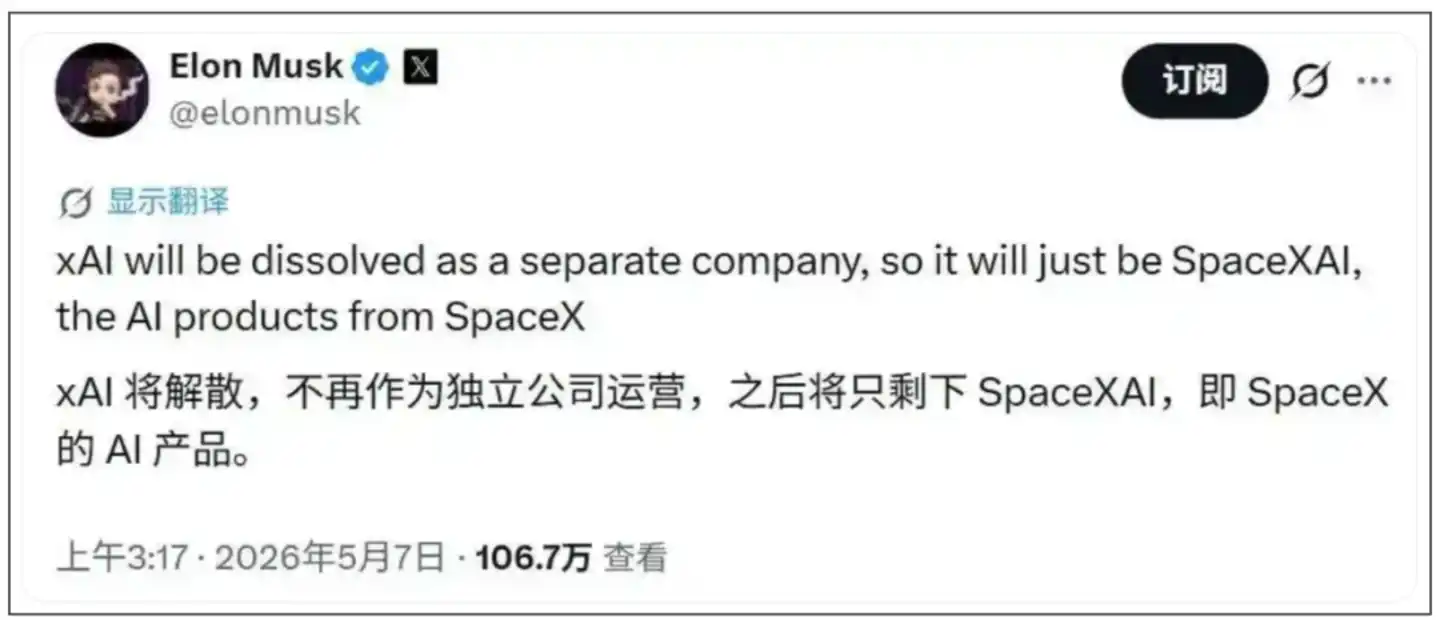
On the product side, Musk had high hopes for xAI. But during the second week of the trial, Musk dropped a bombshell on X: xAI would be fully integrated into SpaceX, renamed SpaceXAI, completely abandoning its independent identity.
"xAI will no longer exist as an independent company; it will simply be SpaceXAI, the AI product of SpaceX," Musk defined this move.
In the market's view, this move might be Musk's attempt to deeply integrate his AI business with aerospace. After all, Musk's X platform can provide over 500 million real-time data points daily to train his Grok model.
Musk's vision is: X provides usable data, Starlink provides global communications, and SpaceX rockets send computing equipment into space. In his view, Earth's energy and heat dissipation limits will soon constrain AI development; he estimates that within two to three years, the minimum cost for generative AI computation will shift to space. Thus, he aims to link AI from Earth to space, creating a closed-loop commercial ecosystem.
However, more analysis suggests this might be Musk's "smokescreen," because, on the product side, Musk's AI performance is not as "excellent" as he describes.
In fact, Grok, which Musk considers "the smartest AI on Earth," has shown increasingly mediocre market performance.
By late 2025, Grok was the runner-up globally among AI chat apps, second only to ChatGPT. But now, it has been overtaken by Claude, Gemini, and even DeepSeek.
Looking at global AI tool traffic, a year ago, Grok could still occupy the second spot in the US AI market with a 7.03% share. By early 2026, it had shrunk to 3.44%, surpassed by DeepSeek's 3.7% share.
Public data shows that in April 2026, Grok's global mobile daily active users dropped from 13.9 million to 12.2 million, a 12.5% decline. The drop was more significant in the US market, falling from 1.4 million to 1.1 million, a 15.6% reduction.
During the same period, however, Claude's daily active users surged from 16 million to 23 million, a 44% month-over-month spike, leaving Grok far behind.
Most embarrassing for xAI is its user composition. Public reports state that over the past six months, Grok's user base has been "overwhelmingly male," a gender imbalance extremely rare among mainstream AI products.
Market analysis points out this directly reflects that Grok's user scenarios primarily come from traffic diversion from social platform X, rather than establishing independent brand recognition and user ecosystems. Much analysis suggests that once the traffic红利 from platform X diminishes or user interest shifts, Grok's growth engine will face severe challenges.
Behind the user data lies the worrying operational status of xAI.
Although xAI was valued at $250 billion in its independent funding round, its core AI business scale remains relatively small, with no public independent ARR (Annual Recurring Revenue) data released yet.
Meanwhile, in Q1 2026, OpenAI's ARR had already reached $25 billion.
In March 2026, Musk himself publicly admitted that xAI would need until the end of 2026 to catch up with leading AI firms and might only achieve a significant lead by 2029.
This, perhaps, is the fundamental reason behind Musk's decision to disband xAI.
In contrast, OpenAI's market data performance is clearly better than xAI's.
Just a month before the trial, OpenAI pulled off a move significant enough to shake Silicon Valley, announcing the completion of a $122 billion financing round, with a post-money valuation of $852 billion, setting a record for the highest private financing in business history.
Moreover, OpenAI's annualized revenue exceeds $25 billion, with monthly revenue of $2 billion. ChatGPT boasts over 900 million weekly active users and over 50 million paying subscribers.
Musk has to face the fact that, despite his AI ambition lying in "space-based computing," at least on the product side, OpenAI's growth has indeed left xAI far behind.
Who Will Be the Real 'Fisherman'?
Of course, regardless of how Musk and Altman compete, and regardless of the trial's final outcome, the AI field will certainly not pause because of the feud between two individuals.
Especially, both Musk and Altman must realize that in this "two tigers fighting" war of attrition, the real "fisherman" is making an entrance.
At least for now, OpenAI's biggest challenger is not Musk's xAI, but its arch-rival Anthropic.
As is well known, Anthropic's announced annualized revenue of $30 billion in April 2026 already exceeds OpenAI's $25 billion level from February. Claude's global downloads tripled year-over-year, while ChatGPT's US weekly active users saw their first year-on-year decline.
Particularly in OpenAI's core enterprise user segment, Anthropic is catching up and might even surpass it. Data shows that in March 2026, nearly one-third of US enterprises used Anthropic's Claude tools, an increase of over 6 percentage points month-over-month, almost neck and neck with OpenAI's 35%.
On May 8th, according to media reports, Anthropic is considering raising tens of billions of dollars this summer to significantly expand computing capacity. If realized, Anthropic's valuation would approach $1 trillion, surpassing OpenAI.
More interestingly, after disbanding xAI, Musk will lease all 300 megawatts of computing power and 220,000 GPUs from the Colossus 1 supercomputer to Anthropic to support model training and inference. The market jokes that Musk has turned "the enemy of my enemy into an ally."
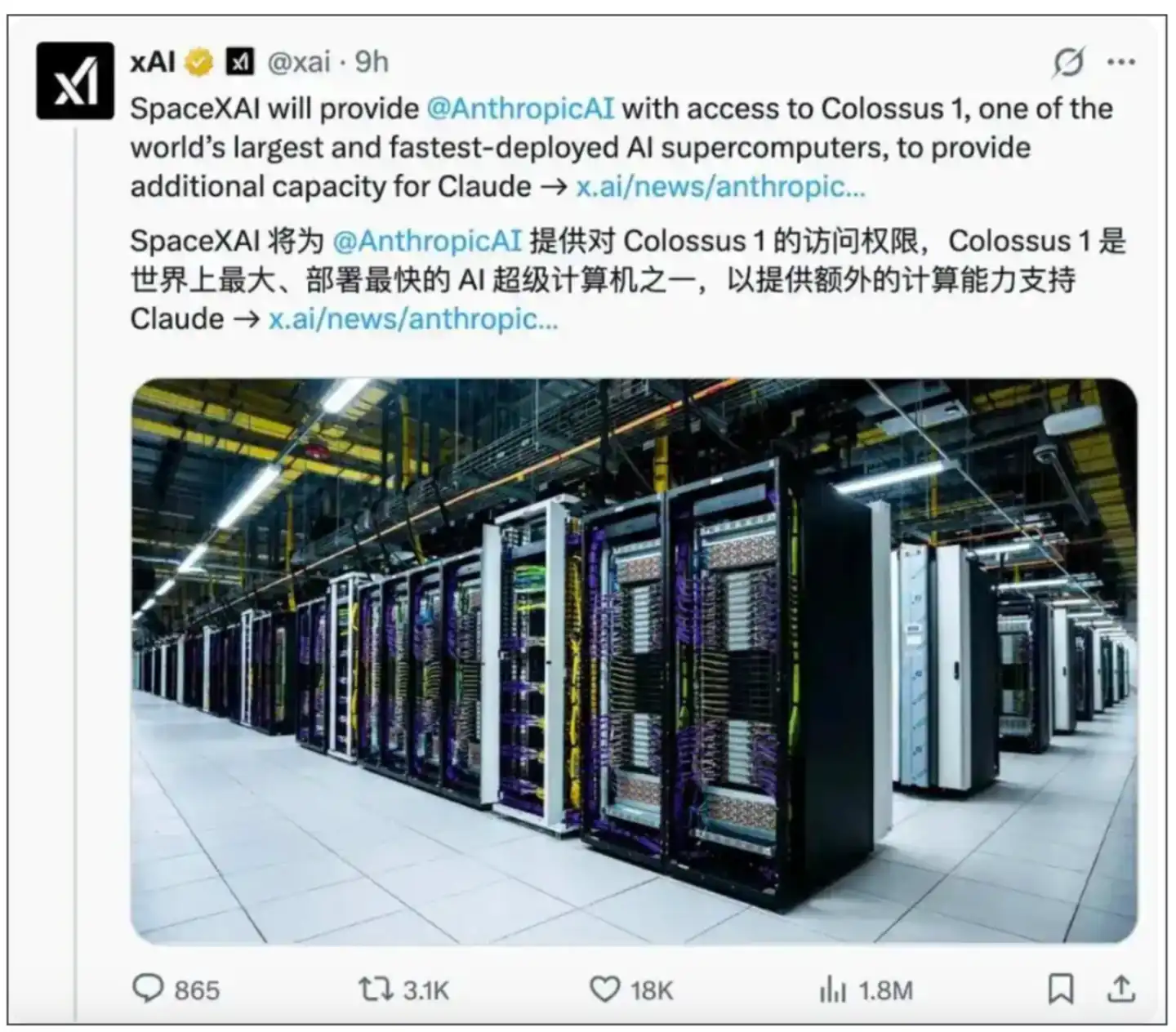
It is worth noting that Anthropic's founders also left OpenAI to start their venture. In a way, this mirrors the story of Altman breaking away from Musk.
Another reality is that China's large language models are demonstrating rapid iterative capabilities.
Public data shows that the gap between top-tier Chinese and US AI in human evaluation tests has narrowed to 2.7%, almost negligible.
Especially, DeepSeek's low-cost, high-quality model once surpassed ChatGPT in download rankings on the Apple App Store.
Although the release of DeepSeek R2 has been repeatedly delayed, in terms of foundational capabilities, Chinese AI is no longer just a "follower." Moreover, China's other large models are also rapidly catching up.
Of course, in the market's view, regardless of who wins between the two, looking back at computing power, there are more winners behind the scenes, such as Nvidia and Google.
Returning to the lawsuit itself, at least for the market, this litigation has subjected the governance structures, ethical commitments, and business logic of all AI companies to public scrutiny. Regardless of the final verdict, its symbolic significance for AI governance rules has been established.
Especially, beyond legal victory or defeat, a more thought-provoking question is: In the AI race, involving hundreds of billions of dollars and capturing the entire industry's attention, who will be the ultimate winner?
Perhaps, in the AI industry, the real "fisherman" is never a single company or individual.
The true beneficiaries might be other players who, leveraging this century-defining duel to hype the market, are quietly accumulating strength elsewhere; they might be the sellers of computing infrastructure, the "water vendors," or the rising "third forces."
When the snipe and the clam grapple, the fisherman profits. And this fisherman is quietly watching it all.
(All images are from the internet, contact for removal if infringement.)
(Disclaimer: This article is for information exchange only and does not constitute any investment advice.)