Bitcoin Price Slips Below $90K as Leverage Unwinds, But Dip Buyers Watch Key Support Levels

bitcoinistОпубликовано 2026-01-22Обновлено 2026-01-22

Введение

Bitcoin experienced a sharp pullback this week, falling below $90,000 as a wave of leveraged long positions were liquidated, resulting in over $1 billion in crypto liquidations. The decline was driven by broader market stress, including geopolitical tensions and rising bond yields, which triggered risk aversion across assets. Despite a modest rebound to around $89,000, the sell-off revealed fragility in market sentiment. Key support is seen at $87,000–$88,000; a break below could lead to further declines. Traders are monitoring macro developments to gauge whether dip buyers will re-enter, potentially helping Bitcoin reclaim higher levels.

The Bitcoin price showed a sharp pullback this week caught many traders off guard. After hovering near record highs, the world’s largest crypto slid below the $90,000 mark as a wave of leveraged positions was forced out of the market.

Related Reading: Ripple President Long Unveils Her 2026 Crypto Predictions

The drop came amid rising global uncertainty, with investors reacting to geopolitical tensions, bond market stress, and renewed risk aversion across traditional assets.

By Tuesday, the Bitcoin price had fallen to around $87,800 before staging a modest rebound to around $89,000. While the move erased recent gains, market participants say the decline reflects more than just short-term volatility. It highlights how fragile sentiment can become when macro pressures and heavy leverage collide.
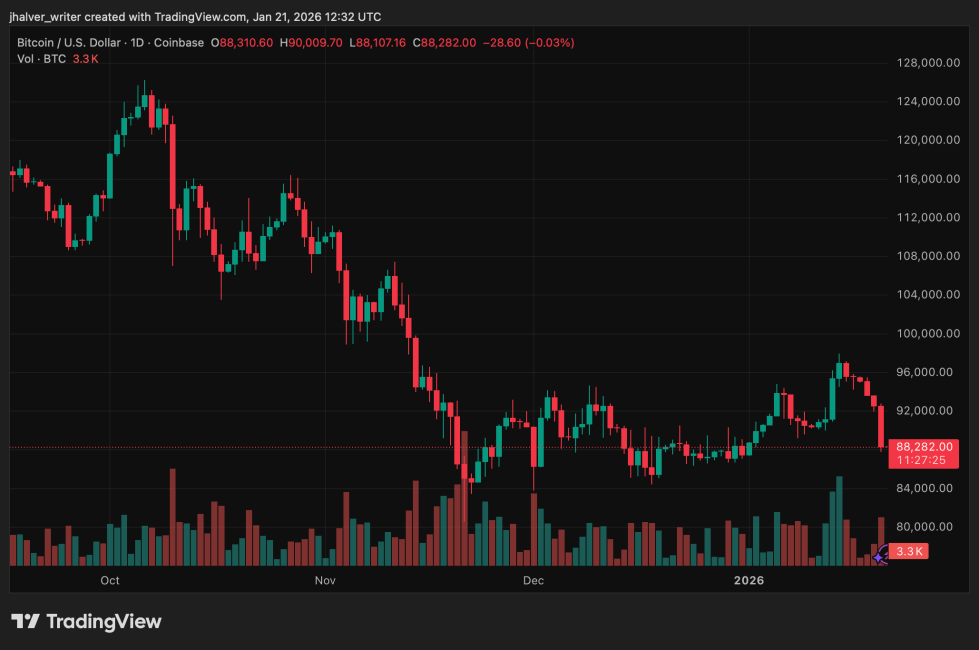
BTC's price trends to the downside on the daily chart. Source: BTCUSD on Tradingview

Leverage Unwinds Trigger Sharp Sell-Off

Data from CoinGlass showed that roughly $1.08 billion in crypto positions were liquidated over 24 hours, affecting more than 183,000 traders. Long positions made up about 92% of those liquidations, indicating that many traders had been positioned for further upside.

The largest single forced closure was a $13.52 million BTCUSDT position on Bitget, underscoring how crowded bullish bets had become. As prices slipped, automated liquidations accelerated the decline, pushing Bitcoin through key psychological levels.

This unwinding followed weeks of relative calm in crypto markets, during which the Bitcoin price had consolidated near its highs. Once selling pressure began, it quickly exposed how dependent recent price stability had been on leveraged positioning rather than fresh spot demand.

Macro Risks Weigh on Risk Assets

The crypto sell-off unfolded alongside broader market stress. U.S. President Donald Trump’s renewed tariff threats against European nations, tied to disputes over Greenland, revived fears of a trade war. Similarly, a sell-off in Japanese government bonds pushed global yields higher, tightening financial conditions.

U.S. equities also suffered their worst session since October, with major indices dropping more than 2%. Crypto-related stocks such as Coinbase, Strategy, and Circle posted steep losses, reflecting a wider shift away from risk-sensitive assets.

While the Bitcoin price and altcoins fell, gold and silver moved in the opposite direction. Gold traded near record highs above $4,800 per ounce, and silver also reached new peaks. The contrast suggested that investors were rotating into traditional safe havens as uncertainty grew.

Key Bitcoin Price Support Levels in Focus

Despite the volatility, Bitcoin has shown early signs of stabilization. Prices rebounded toward the $89,000–$90,000 area as pressure in bond markets eased and U.S. equity futures ticked higher. Still, analysts caution that the move looks more like a pause after forced selling than a clear return of risk appetite.

Technical indicators highlight the $87,000–$88,000 range as a critical support zone. A break below this level could open the door to further declines toward $85,000 or lower. On the upside, Bitcoin price faces resistance near $92,000 and $95,000.

Related Reading: XRP Holders Quietly Build Positions In A Pattern That Echoes Earlier Cycles

For now, traders are closely watching macro developments, including Trump’s speech at the World Economic Forum in Davos and ongoing signals from global bond markets. Whether dip buyers step in with conviction may determine if Bitcoin can reclaim lost ground, or if the recent slide has further to run.

Cover image from ChatGPT, BTCUSD chart on Tradingview

Связанные с этим вопросы

QWhat was the main reason for Bitcoin's sharp price pullback below $90,000?

AThe sharp pullback was primarily triggered by the unwinding of leveraged positions, with over $1 billion in crypto positions liquidated in 24 hours, forcing many long traders out of the market.

QWhich macroeconomic factors contributed to the risk aversion in crypto and traditional markets?

ARising global uncertainty due to geopolitical tensions, U.S. President Donald Trump's renewed tariff threats against European nations, and a sell-off in Japanese government bonds that pushed global yields higher all contributed to risk aversion.

QWhat key support level are traders watching for Bitcoin's price according to technical indicators?

ATechnical indicators highlight the $87,000–$88,000 range as a critical support zone. A break below this level could lead to further declines toward $85,000 or lower.

QHow did traditional safe-haven assets like gold perform during the crypto sell-off?

AIn contrast to the decline in crypto and equities, gold traded near record highs above $4,800 per ounce, and silver also reached new peaks, indicating a rotation into traditional safe havens.

QWhat percentage of the liquidated positions in the crypto market were long positions?

ALong positions made up about 92% of the $1.08 billion in liquidations, indicating that most traders had been positioned for further price upside.

Похожее

Will Quantum Computing Kill Bitcoin and Mining? Is This Alarmist?

The article addresses the recurring concern that quantum computing could break Bitcoin's encryption and disrupt mining. It references a Google Quantum AI white paper from March 2026, which suggests that the resources needed for a quantum computer to crack Bitcoin’s elliptic curve digital signature algorithm (ECDSA) have been reduced by about 20 times. Under ideal conditions, such an attack could theoretically derive a private key from a public key in roughly 9 minutes using 500,000 physical qubits. However, the threat is not immediate. Current quantum processors, like Google’s Willow (105 qubits) or IBM’s Condor (~1,121 qubits), are far from the scale required. The risk primarily targets transaction signatures—especially during the brief window when a transaction is broadcast but not yet confirmed, or when public keys have been historically exposed. It is estimated there is only a 10% probability of a “quantum break” by 2032. The impact on mining is considered negligible. Research indicates that quantum mining would require astronomically high qubit counts and energy—far exceeding entire national grids—making it economically and physically infeasible. The broader solution lies in post-quantum cryptography (PQC). Standards like ML-DSA and SLH-DSA are being developed, and Bitcoin improvement proposals such as BIP 360 aim to reduce quantum vulnerability by modifying transaction structures to avoid exposing public keys. While quantum computing poses a future risk to all public-key encryption systems—not just Bitcoin—the cryptocurrency ecosystem has time to adapt. Upgrades and migration to quantum-resistant algorithms are underway, ensuring the network evolves ahead of the threat.

marsbit51 мин. назад

Will Quantum Computing Kill Bitcoin and Mining? Is This Alarmist?

marsbit51 мин. назад

5 Minutes to Make AI Your Second Brain

This article introduces a powerful personal knowledge management system combining Claude Code and Obsidian, designed to function as an "AI second brain." Unlike traditional RAG systems that perform temporary, one-off retrievals, this system enables AI to continuously build and maintain an evolving knowledge wiki. The architecture consists of three layers: a raw data layer (notes, articles, transcripts), an AI-maintained structured knowledge base that builds cross-references, and a schema layer that governs organization and system logic. Core operations are Ingest (bringing in external information), Query (instant knowledge access), and Lint (checking consistency and fixing issues). The system's power lies in creating a "compound interest" effect for knowledge: it reduces cognitive load by offloading the tasks of connecting, organizing, and understanding information to AI, while simultaneously improving the accuracy and contextual consistency of the AI's outputs. The setup process is quick, requiring users to download Obsidian, create a vault (knowledge repository), configure Claude Code to access that vault, and apply a specific system prompt. Advanced tips include using a browser extension to easily add web content, maintaining separate vaults for work and personal life, and utilizing the "Orphans" feature to identify unlinked ideas. The main drawbacks are the need for visual thinking, a commitment to ongoing maintenance, and local storage usage. Ultimately, the system transforms scattered information into a reusable, interconnected network of knowledge.

marsbit2 ч. назад

5 Minutes to Make AI Your Second Brain

marsbit2 ч. назад

Торговля

Спот
Фьючерсы

Популярные статьи

Тест по Bitcoin Биткоина

HTX Learn: Изучите Bitcoin halving и Заработаете Токены USDT

2.9k просмотров всегоОпубликовано 2024.04.16Обновлено 2024.04.16

Тест по Bitcoin  Биткоина

Что такое $BITCOIN

ЦИФРОВОЕ ЗОЛОТО ($BITCOIN): Комплексный анализ Введение в ЦИФРОВОЕ ЗОЛОТО ($BITCOIN) ЦИФРОВОЕ ЗОЛОТО ($BITCOIN) — это проект на основе блокчейна, работающий в сети Solana, который стремится объединить характеристики традиционных драгоценных металлов с инновациями децентрализованных технологий. Хотя он носит имя Биткойн, часто называемого “цифровым золотом” из-за его восприятия как средства хранения ценности, ЦИФРОВОЕ ЗОЛОТО является отдельным токеном, предназначенным для создания уникальной экосистемы в ландшафте Web3. Его цель — позиционировать себя как жизнеспособный альтернативный цифровой актив, хотя детали его применения и функциональности все еще развиваются. Что такое ЦИФРОВОЕ ЗОЛОТО ($BITCOIN)? ЦИФРОВОЕ ЗОЛОТО ($BITCOIN) — это токен криптовалюты, специально разработанный для использования в блокчейне Solana. В отличие от Биткойна, который выполняет широко признанную роль хранения ценности, этот токен, похоже, сосредоточен на более широких приложениях и характеристиках. Примечательные аспекты включают: Инфраструктура блокчейна: Токен построен на блокчейне Solana, известном своей способностью обрабатывать высокоскоростные и недорогие транзакции. Динамика предложения: ЦИФРОВОЕ ЗОЛОТО имеет максимальное предложение, ограниченное 100 квадриллионами токенов (100P $BITCOIN), хотя детали о его обращающемся предложении в настоящее время не раскрыты. Утилита: Хотя точные функциональные возможности не описаны, есть указания на то, что токен может быть использован для различных приложений, потенциально связанных с децентрализованными приложениями (dApps) или стратегиями токенизации активов. Кто создатель ЦИФРОВОГО ЗОЛОТА ($BITCOIN)? На данный момент личность создателей и команды разработчиков, стоящих за ЦИФРОВЫМ ЗОЛОТОМ ($BITCOIN), остается неизвестной. Эта ситуация типична для многих инновационных проектов в области блокчейна, особенно тех, которые связаны с децентрализованными финансами и феноменом мем-криптовалют. Хотя такая анонимность может способствовать культуре, ориентированной на сообщество, она усиливает опасения по поводу управления и ответственности. Кто инвесторы ЦИФРОВОГО ЗОЛОТА ($BITCOIN)? Доступная информация указывает на то, что у ЦИФРОВОГО ЗОЛОТА ($BITCOIN) нет известных институциональных спонсоров или значительных венчурных капиталовложений. Проект, похоже, функционирует по модели пирингового взаимодействия, сосредоточенной на поддержке и принятии сообществом, а не на традиционных путях финансирования. Его активность и ликвидность в основном сосредоточены на децентрализованных биржах (DEX), таких как PumpSwap, а не на устоявшихся централизованных торговых платформах, что еще больше подчеркивает его подход, ориентированный на grassroots. Как работает ЦИФРОВОЕ ЗОЛОТО ($BITCOIN) Операционные механизмы ЦИФРОВОГО ЗОЛОТА ($BITCOIN) можно подробно описать на основе его дизайна блокчейна и характеристик сети: Механизм консенсуса: Используя уникальный механизм доказательства истории (PoH) Solana в сочетании с моделью доказательства доли (PoS), проект обеспечивает эффективную валидацию транзакций, что способствует высокой производительности сети. Токеномика: Хотя конкретные дефляционные механизмы не были подробно описаны, большое максимальное предложение токенов подразумевает, что оно может быть предназначено для микротранзакций или нишевых случаев использования, которые еще предстоит определить. Интероперабельность: Существует потенциал для интеграции с более широкой экосистемой Solana, включая различные платформы децентрализованных финансов (DeFi). Однако детали относительно конкретных интеграций остаются неуточненными. Хронология ключевых событий Вот хронология, которая подчеркивает значимые вехи, касающиеся ЦИФРОВОГО ЗОЛОТА ($BITCOIN): 2023: Первоначальное развертывание токена происходит в блокчейне Solana, отмеченное его адресом контракта. 2024: ЦИФРОВОЕ ЗОЛОТО приобретает видимость, когда оно становится доступным для торговли на децентрализованных биржах, таких как PumpSwap, позволяя пользователям обменивать его на SOL. 2025: Проект наблюдает спорадическую торговую активность и потенциальный интерес к инициативам, возглавляемым сообществом, хотя на данный момент не зафиксировано никаких значительных партнерств или технических достижений. Критический анализ Сильные стороны Масштабируемость: Основная инфраструктура Solana поддерживает высокие объемы транзакций, что может повысить полезность $BITCOIN в различных сценариях транзакций. Доступность: Потенциально низкая цена торговли за токен может привлечь розничных инвесторов, способствуя более широкому участию благодаря возможностям дробного владения. Риски Отсутствие прозрачности: Отсутствие публично известных спонсоров, разработчиков или процесса аудита может вызвать скептицизм относительно устойчивости и надежности проекта. Волатильность рынка: Торговая активность сильно зависит от спекулятивного поведения, что может привести к значительной волатильности цен и неопределенности для инвесторов. Заключение ЦИФРОВОЕ ЗОЛОТО ($BITCOIN) является интригующим, но неоднозначным проектом в быстро развивающейся экосистеме Solana. Хотя он пытается использовать нарратив “цифрового золота”, его отход от установленной роли Биткойна как средства хранения ценности подчеркивает необходимость более четкого различения его предполагаемой утилиты и структуры управления. Будущее принятие и усвоение, вероятно, будут зависеть от решения текущей непрозрачности и более четкого определения его операционных и экономических стратегий. Примечание: Этот отчет охватывает синтезированную информацию, доступную на октябрь 2023 года, и с тех пор могут произойти события.

99 просмотров всегоОпубликовано 2025.05.13Обновлено 2025.05.13

Что такое $BITCOIN

Fractal Bitcoin: масштабирование Биткоина с помощью рекурсивной системы

Fractal Bitcoin — масштабное Layer-1-решнение, созданное на базе кода Биткоина, позволяющего достигать бесконечного масштабирования с помощью рекурсивного подхода.

2.2k просмотров всегоОпубликовано 2025.06.30Обновлено 2025.06.30

Fractal Bitcoin: масштабирование Биткоина с помощью рекурсивной системы

Обсуждения

Добро пожаловать в Сообщество HTX. Здесь вы сможете быть в курсе последних новостей о развитии платформы и получить доступ к профессиональной аналитической информации о рынке. Мнения пользователей о цене на BTC (BTC) представлены ниже.

活动图片