Mapping Bitcoin’s liquidity slowdown as old coins re-enter circulation

ambcryptoОпубликовано 2025-12-13Обновлено 2025-12-13

Введение

Bitcoin's rally is showing signs of strain as long-held coins begin to re-enter circulation, signaling potential distribution alarms for the first time in its history. Key indicators, including the Reserve Risk metric, suggest early holders are steadily releasing BTC into the market, often through exchanges, ETFs, and institutional vehicles. This movement coincides with declining liquidity, as evidenced by the falling Inter-exchange Flow Pulse (IFP), which has dipped below its 90-day moving average—a pattern historically associated with slower or corrective market phases. Despite trading near $90,000, Bitcoin remains below key moving averages, with the RSI showing neutral momentum and on-balance volume flattening, indicating a lack of fresh demand. The market appears to be entering a consolidation stage, with thinning capital flows posing challenges for near-term upside momentum.

Bitcoin’s [BTC] rally seems strained. Long-held coins are beginning to move, liquidity is thinning, and nothing looks as straightforward as before.

The market is at a crossroads – the next move may depend on how capital flows evolve from here.

Old coins are moving again

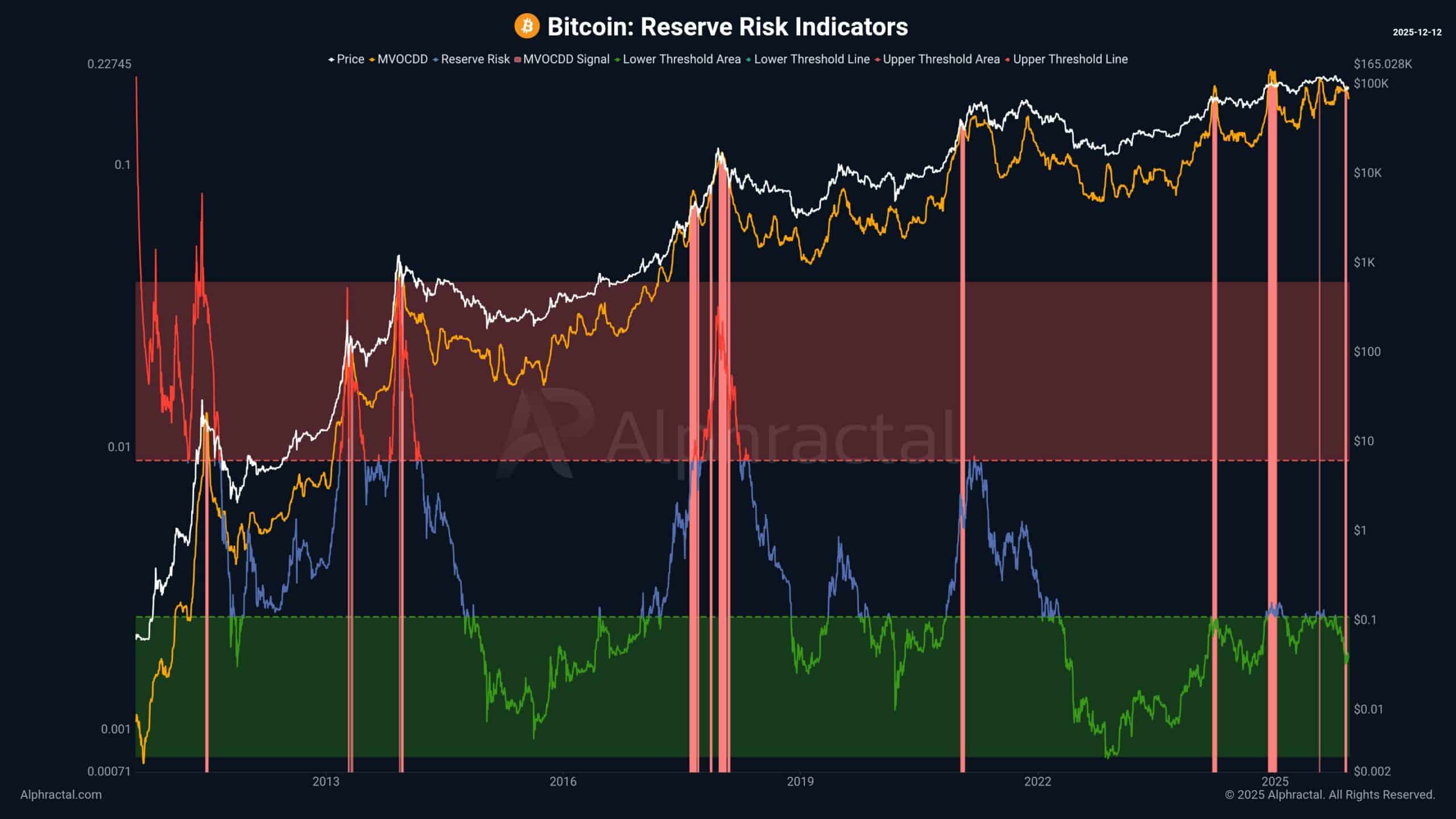
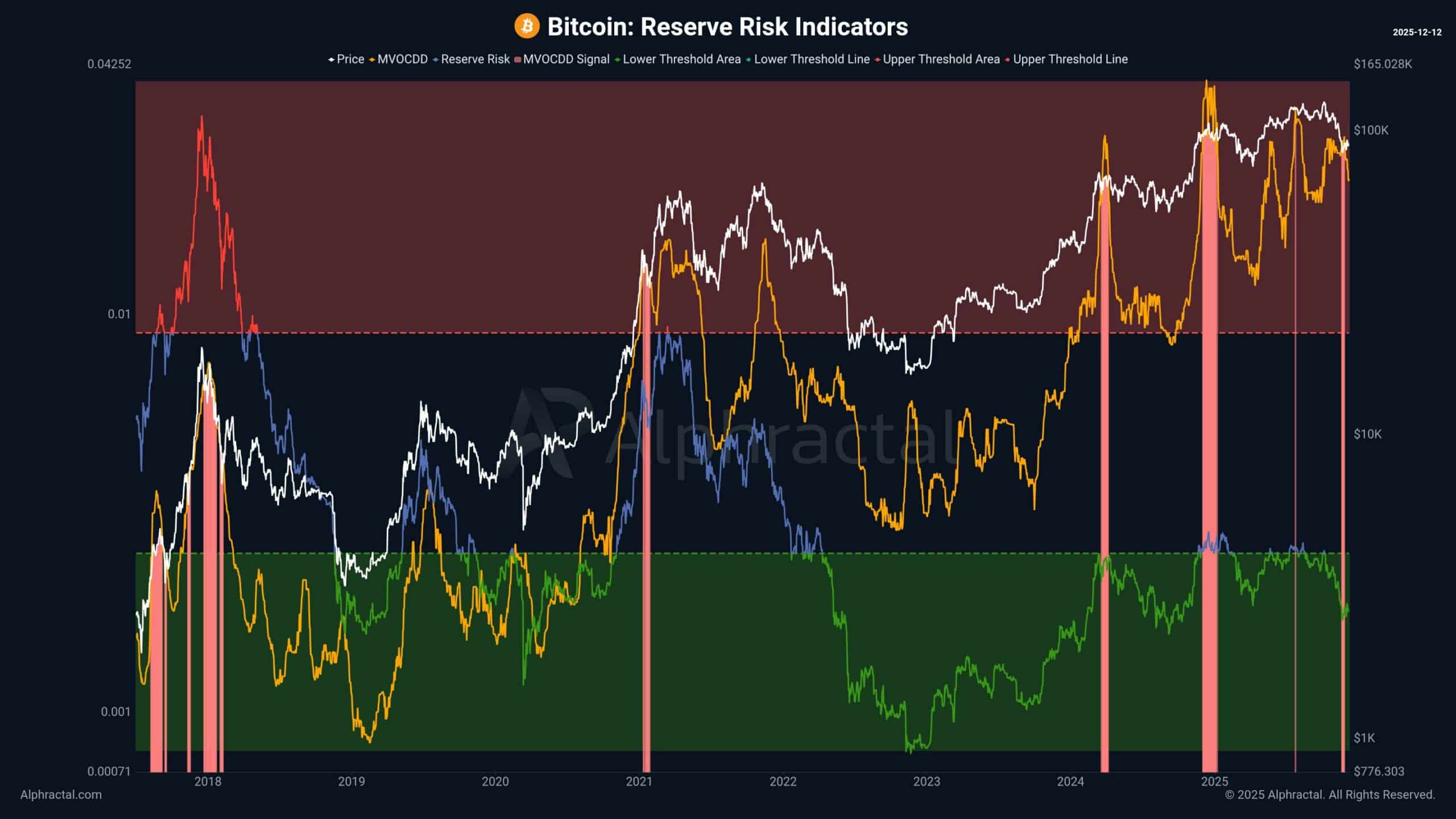
Data shared by Joao Wedson, CEO of Alphractal, showed that Bitcoin now has four clear distribution alarms – a first in its history.

Source: Alphractal

The Reserve Risk indicator, which tracks movements of older, dormant coins, has repeatedly flashed sell signs since 2024. What this means is that early holders are steadily releasing BTC back into circulation.

Source: Alphractal

Much of this supply appears to be flowing into exchanges, ETFs, and institutional vehicles, right at the peak of market attention. So far, similar patterns have come up late in previous cycles, often a change from rapid upside to a slower, more fragile time.

Liquidity lagging behind?

As old coins move back into circulation, the flow of liquidity between exchanges is losing strength.

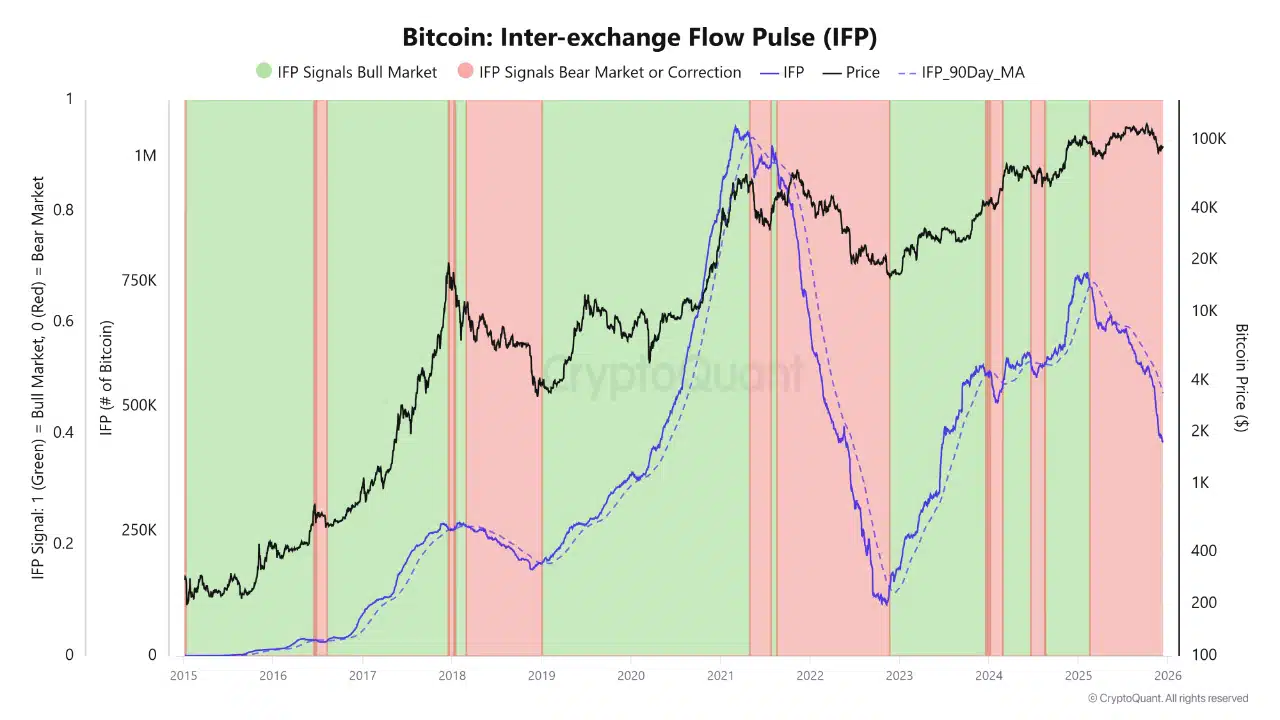
The Inter-exchange Flow Pulse (IFP) is trending lower and slipping below its 90-day moving average, a level that has often meant slower or corrective phases in past cycles.

Fewer positive flows are moving across exchanges to support the rally.

Source: CryptoQuant

What’s interesting is that Bitcoin’s price is still holding near cycle highs, even as this support fades. This kind of mismatch has so far meant consolidation rather than selloffs.

Unless inter-exchange flows recover, Bitcoin may struggle to sustain upside in the near term.

It’s showing up on the price chart too

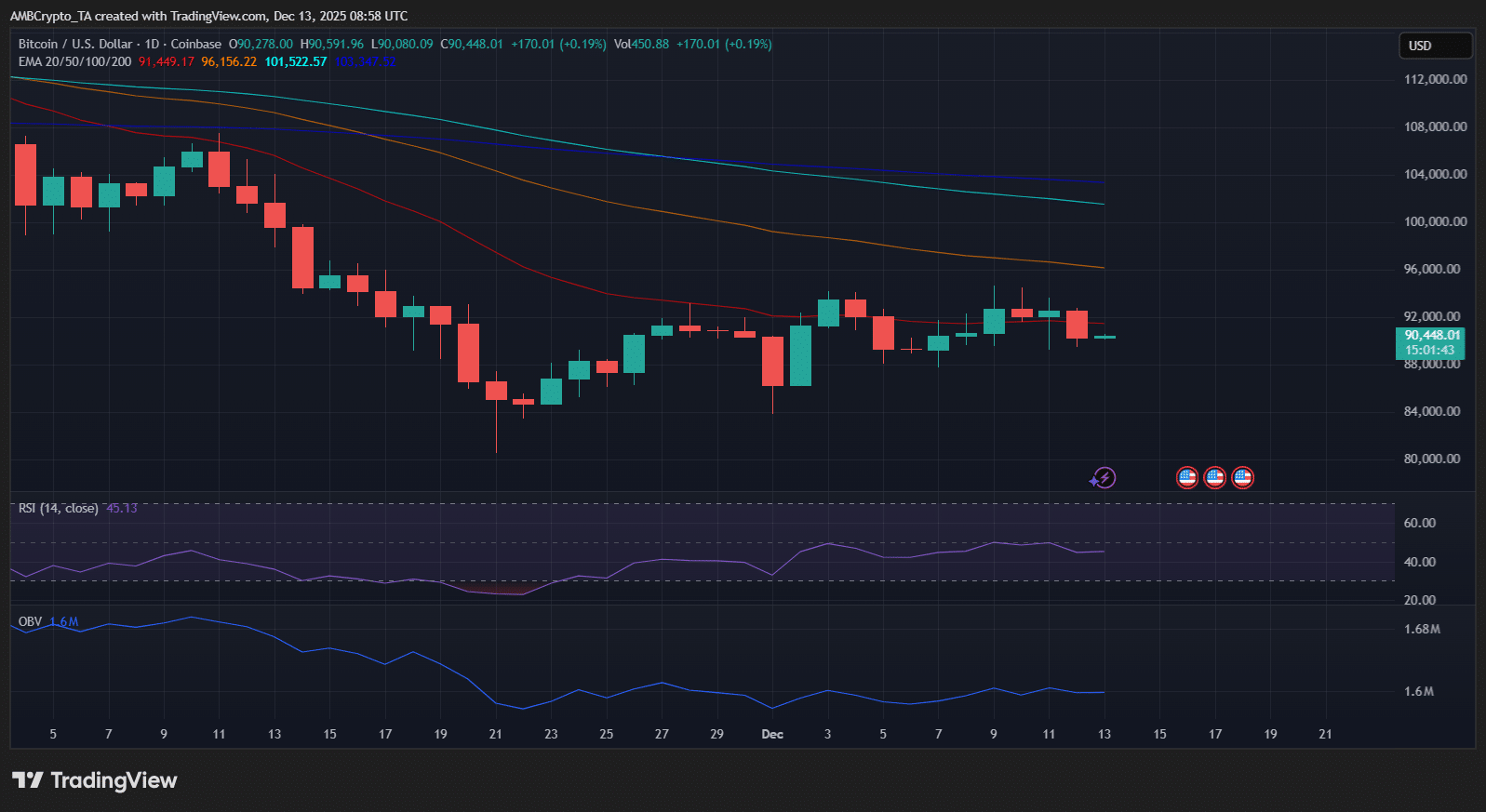
Bitcoin traded near $90,000 at press time, but remained below its key short and long-term moving averages – a loss of trend strength.

The RSI showed no strong buying or selling pressure. At the same time, on-balance volume flattened, so there’s a lack of fresh demand entering the market.

Source: TradingView

Bitcoin may be beginning a consolidation stage.


Final Thoughts

  • Bitcoin’s rally is losing structural support.
  • With BTC near $90K but flows thinning, the market may be entering consolidation.
Next: Strategy keeps Nasdaq 100 spot – Will MSCI force $2.8B in outflows?
Share
  • Share
  • Tweet

Похожее

How Did Institutions Adjust Their Crypto Asset Holdings in Q1? Who Increased and Who Exited?

The Q1 2026 13F filings reveal a sharply divided picture of institutional activity in crypto assets. Sovereign wealth funds and bank capital increased exposure, while major endowment funds notably de-risked. The most significant buying came from the Abu Dhabi sovereign wealth fund Mubadala, which expanded its position in the iShares Bitcoin Trust (IBIT). JPMorgan Chase dramatically increased its IBIT exposure by 174%, with other global banks like RBC, Scotiabank, and Barclays also adding to Bitcoin ETF holdings, while using options for asymmetric protection. Conversely, the Harvard Management Company (Harvard University's endowment), once a major academic holder, cut its IBIT position by 43% and fully exited a BlackRock Ethereum ETF. The reallocated capital flowed into traditional assets like TSMC, Microsoft, and gold. Other Ivy League endowments showed varied strategies: Brown and Dartmouth maintained Bitcoin positions, with Dartmouth making a nuanced shift by moving Ethereum exposure to a staking ETF and adding a Solana staking ETF to capture yield. Hedge fund Jane Street significantly reduced Bitcoin ETF holdings, locking in profits, while Wells Fargo increased its Ethereum stake. Overall, institutions are deploying traditional capital market tactics—buying, selling, hedging, and rotating—within crypto via spot ETFs. The Q2 reports will be crucial to determine if Harvard's retreat is an outlier or the start of a broader trend among endowments.

marsbit24 мин. назад

How Did Institutions Adjust Their Crypto Asset Holdings in Q1? Who Increased and Who Exited?

marsbit24 мин. назад

Blockchain Capital Partner: Most People Have a Narrow Understanding of the On-Chain Economy

Author Spencer Bogart, a partner at Blockchain Capital, argues that most people have a narrow view of the on-chain economy, seeing it primarily as a faster, cheaper version of existing financial systems. While this represents a significant opportunity, he believes it's only a small part of the story. Bogart compares the current state of crypto to the early internet, where email was the obvious "faster mail" application. The truly transformative categories—like search, social media, and cloud computing—were entirely new and unimaginable beforehand. Similarly, the most profound innovations in crypto will not be incremental improvements but entirely new categories enabled by the core properties of public blockchains: atomic execution, shared global state, programmable custody, and composability. He cites the "flash loan" as a prime example of a "new verb"—a financial action structurally impossible before programmable assets and atomic settlement. It allows for uncollateralized, trustless borrowing of any size, provided repayment occurs within the same transaction, enabling novel strategies like arbitrage and collateral swaps. Bogart admits the difficulty in precisely predicting these future innovations, as human imagination tends to extrapolate from the past. He posits that the most exciting applications in ten years will be things that don't exist today and have no precedent—products only possible in a global, composable, always-on environment with programmable assets. While the exploration of this vast design space will involve many failures, the potential for transformative, category-defining breakthroughs is what makes the next decade so promising.

链捕手53 мин. назад

Blockchain Capital Partner: Most People Have a Narrow Understanding of the On-Chain Economy

链捕手53 мин. назад

Cloud PC Gets a Second Chance, Google/Alibaba/Microsoft Battle for Cloud AI Dominance

Google unexpectedly announced "Android Computer," a new high-end productivity-focused PC series, positioning cloud AI as its core rather than an add-on. This move signals a potential revival for the "cloud computer" concept in the AI era. The article argues that current "AI PCs" are essentially traditional Windows machines with AI features grafted on, heavily reliant on cloud AI for complex tasks due to limited local consumer-grade hardware capabilities. This reliance raises questions about the value of premium local AI hardware. Cloud computers, which struggled with latency-sensitive applications like cloud gaming, are seen as a natural fit for AI PCs due to AI's higher tolerance for response time. Google's Android Computer deeply integrates AI (powered by its Gemini model) into the OS interface, making it contextually available. Its hardware-agnostic approach (supporting both x86 and ARM chips) further underscores the shift towards cloud-centric AI. Other players are adapting: Cloud service providers like Alibaba are enhancing their AI cloud computer offerings; chipmakers (Intel, AMD) are focusing on data center AI chips; traditional PC brands are adding AI software layers; and Apple is leveraging its ecosystem and affordable hardware. Microsoft is defining AI PC standards, embedding Copilot (powered by GPT and Bing) into Windows, and also relying on cloud AI. In conclusion, Android Computer challenges the traditional PC form factor by proposing a "light local, heavy cloud" model. This approach appears promising amid rising hardware costs and local compute bottlenecks. The future PC market will involve a multifaceted competition around cloud integration, OS-level AI, and cross-device ecosystems, potentially redefining the PC as a screen and network conduit to cloud-based AI productivity.

marsbit1 ч. назад

Cloud PC Gets a Second Chance, Google/Alibaba/Microsoft Battle for Cloud AI Dominance

marsbit1 ч. назад

Encrypted ETF Weekly Report | Last Week, US Bitcoin Spot ETF Net Outflow $9.95 Billion; US Ethereum Spot ETF Net Outflow $255 Million

Last week, U.S. Bitcoin spot ETFs saw significant net outflows totaling $995 million over three days, with a major contribution of $317 million from BlackRock's IBIT. Their total net asset value (NAV) stands at $104.2 billion. U.S. Ethereum spot ETFs also experienced net outflows of $255 million over five days, largely from BlackRock's ETHA ($186 million out), bringing their total NAV to $12.93 billion. In Hong Kong, Bitcoin spot ETFs recorded a net outflow of 24.91 BTC, reducing their NAV to $323 million. Hong Kong's Ethereum spot ETFs saw no inflows, with an NAV of $68.13 million. U.S. Bitcoin spot ETF options showed increased activity, with a total nominal trading volume of $797 million and a put/call trading ratio of 1.63, indicating a bullish market sentiment. The total open interest reached $23.08 billion. Key developments include VanEck and Grayscale simultaneously filing amended proposals for BNB ETFs, signaling potential SEC review progress. Grayscale also filed for the first U.S. privacy coin ETF (Zcash). Avenir Group remains Asia's largest institutional holder of Bitcoin ETFs. 21Shares launched an actively managed crypto ETF (TKNS), and Bitwise's Hyperliquid ETF (BHYP) is set to list on the NYSE. Institutional activity varied: JPMorgan dramatically increased its Bitcoin ETF holdings (IBIT up 174%), while Jane Street significantly reduced its exposure (IBIT down 71%). Dartmouth College disclosed holdings of $7.7M in Bitcoin ETF and $3.4M in a Solana ETF.

链捕手1 ч. назад

Encrypted ETF Weekly Report | Last Week, US Bitcoin Spot ETF Net Outflow $9.95 Billion; US Ethereum Spot ETF Net Outflow $255 Million

链捕手1 ч. назад

Торговля

Спот
Фьючерсы

Популярные статьи

Как купить S

Добро пожаловать на HTX.com! Мы сделали приобретение Sonic (S) простым и удобным. Следуйте нашему пошаговому руководству и отправляйтесь в свое крипто-путешествие.Шаг 1: Создайте аккаунт на HTXИспользуйте свой адрес электронной почты или номер телефона, чтобы зарегистрироваться и бесплатно создать аккаунт на HTX. Пройдите удобную регистрацию и откройте для себя весь функционал.Создать аккаунтШаг 2: Перейдите в Купить криптовалюту и выберите свой способ оплатыКредитная/Дебетовая Карта: Используйте свою карту Visa или Mastercard для мгновенной покупки Sonic (S).Баланс: Используйте средства с баланса вашего аккаунта HTX для простой торговли.Третьи Лица: Мы добавили популярные способы оплаты, такие как Google Pay и Apple Pay, для повышения удобства.P2P: Торгуйте напрямую с другими пользователями на HTX.Внебиржевая Торговля (OTC): Мы предлагаем индивидуальные услуги и конкурентоспособные обменные курсы для трейдеров.Шаг 3: Хранение Sonic (S)После приобретения вами Sonic (S) храните их в своем аккаунте на HTX. В качестве альтернативы вы можете отправить их куда-либо с помощью перевода в блокчейне или использовать для торговли с другими криптовалютами.Шаг 4: Торговля Sonic (S)С легкостью торгуйте Sonic (S) на спотовом рынке HTX. Просто зайдите в свой аккаунт, выберите торговую пару, совершайте сделки и следите за ними в режиме реального времени. Мы предлагаем удобный интерфейс как для начинающих, так и для опытных трейдеров.

1.3k просмотров всегоОпубликовано 2025.01.15Обновлено 2025.03.21

Как купить S

Sonic: Обновления под руководством Андре Кронье – новая звезда Layer-1 на фоне спада рынка

Он решает проблемы масштабируемости, совместимости между блокчейнами и стимулов для разработчиков с помощью технологических инноваций.

2.2k просмотров всегоОпубликовано 2025.04.09Обновлено 2025.04.09

Sonic: Обновления под руководством Андре Кронье – новая звезда Layer-1 на фоне спада рынка

HTX Learn: Пройдите обучение по "Sonic" и разделите 1000 USDT

HTX Learn — ваш проводник в мир перспективных проектов, и мы запускаем специальное мероприятие "Учитесь и Зарабатывайте", посвящённое этим проектам. Наше новое направление .

1.8k просмотров всегоОпубликовано 2025.04.10Обновлено 2025.04.10

HTX Learn: Пройдите обучение по "Sonic" и разделите 1000 USDT

Обсуждения

Добро пожаловать в Сообщество HTX. Здесь вы сможете быть в курсе последних новостей о развитии платформы и получить доступ к профессиональной аналитической информации о рынке. Мнения пользователей о цене на S (S) представлены ниже.

活动图片