Hedge by Buying Gold and Oil, Chase Soaring Returns with AI. ‘Dated’ Bitcoin Enters a Bear Market

华尔街日报Опубликовано 2026-06-03Обновлено 2026-06-03

Введение

Bitcoin has recently declined, hitting a two-month low near $66,123, while Ethereum fell to a three-month low around $1,837. Analysts suggest the drop is not merely due to factors like ETF outflows or MicroStrategy's selling but reflects a deeper issue: Bitcoin is losing a broader asset competition. In a near-zero interest rate environment, Bitcoin previously thrived as an outlet for investor dissatisfaction with inflation and limited options. However, the market landscape has shifted. Bitcoin now occupies an "awkward middle ground," facing competition on three fronts. For inflation hedging, investors prefer gold, energy stocks, and commodity producers—assets with tangible backing and clearer pricing power. For growth exposure, AI-related companies with actual revenues and profits are more attractive. Even within crypto, investors can choose stablecoins, exchanges, or infrastructure firms tied directly to adoption, offering clearer business models and leverage. Thus, Bitcoin is no longer the top choice for hedging, growth, or crypto exposure. This shift is evident in market reactions: despite recent warnings about persistent inflation from a Fed official, Bitcoin did not rally as it might have in the past. Instead, capital flowed to assets with direct commodity or energy exposure. The recent ETF outflows and MicroStrategy sales are symptoms, not causes, of this new reality. Investors are becoming more selective, demanding clearer value propositions beyond mere scarcity. Th...

Bitcoin has been declining recently. It once fell to $66,123 intraday, hitting a two-month low, and was last quoted at $66,620; Ethereum dropped to $1,837 during the same period, a three-month low, and was last quoted at $1,855.

There are several explanations circulating in the market: ETF outflows, tense geopolitical situations, and an unexpected reduction by Strategy (formerly MicroStrategy). According to analysis by Bloomberg analyst Sid Verma, all these statements are correct, but they might only be superficial phenomena. The real issue is deeper—Bitcoin is losing an asset competition.

For a long time in the past, interest rates were near zero, holding cash meant depreciation; stock valuations were too high; AI was just a concept; and gold's gains were limited. Analysis points out that Bitcoin's competitor back then was not a specific asset, but "investors' dissatisfaction"—fear of inflation, discontent with existing options.

But now, the market has changed.
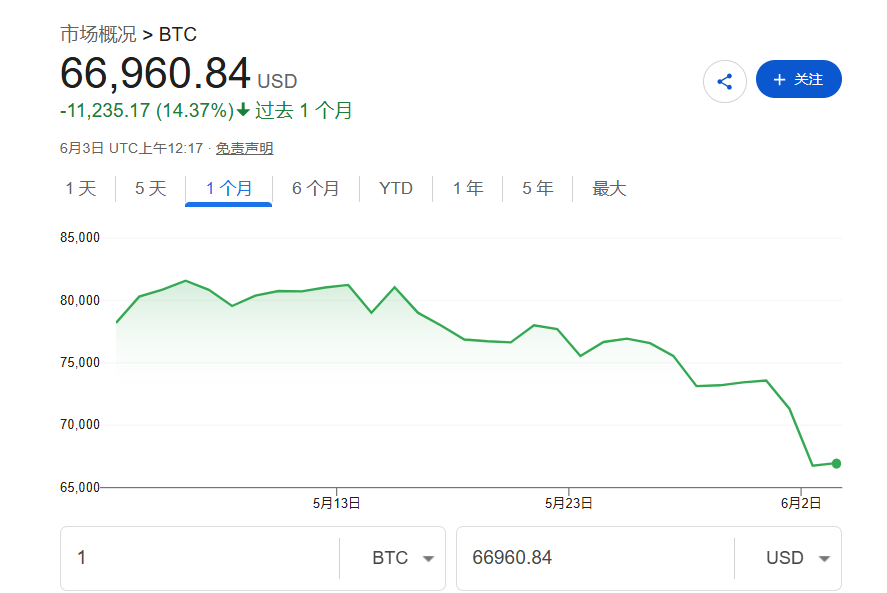
Losing Ground on Three Fronts

Analysts describe Bitcoin's current situation quite bluntly: it's stuck in an "awkward middle ground," under attack from three sides.

Hedge inflation? Gold wins. Investors worried about inflation are now more inclined to buy gold, energy stocks, and commodity producers, rather than Bitcoin. These assets have physical backing, pricing power, and a more straightforward logic.

Pursue growth? AI wins. Investors seeking high growth can now buy AI-benefiting companies with real revenue and real profits. Bitcoin doesn't generate cash flow and has no advantage in this race.

Gain crypto exposure? Stablecoins and infrastructure win. Even investors wanting crypto exposure don't necessarily have to buy Bitcoin. They can buy exchanges, stablecoin businesses, payment networks, tokenized finance companies—these targets' performance is directly linked to the actual adoption rate of the crypto industry, offering operating leverage and clearer logic.

To summarize in one sentence: Bitcoin is neither the best safe-haven asset, nor the best growth asset, nor the only crypto asset anymore.

Inflation Has Arrived, But Bitcoin Isn't Rising

One detail is quite telling.

This week, Cleveland Fed President Beth Hammack warned that inflation risks might be becoming "more persistent." A few years ago, such a statement would almost certainly have been interpreted by the market as positive for Bitcoin—high inflation, fiat depreciation, buy Bitcoin to hedge.

But this time, the market didn't react that way.

Investors' response to inflation has changed now—they are more inclined to buy assets with direct exposure to energy, commodities, and pricing power. Bitcoin's "digital gold" narrative is being eroded by actual gold and energy stocks.

ETF Outflows and Strategy's Reduction

Returning to the immediate triggers for this recent decline.

ETF outflows and Strategy's reduction—these events themselves are real. But Bloomberg's analysis believes treating them as the "cause" is a misreading—they are more like "symptoms," reflecting the same underlying reality: Capital has more places to go, and investors' demands on Bitcoin are also higher.

Investors are becoming more discerning: they don't just want "crypto exposure," they want to know what returns this exposure will bring, why Bitcoin and not something else.

The logic behind Bitcoin's bear market is no longer "it's a scam," "it's a bubble," "it's a failed technology." The new bear market logic is—Scarcity alone is no longer enough.


Связанные с этим вопросы

QAccording to the article, what is the new bear market logic for Bitcoin?

AThe new bear market logic is that scarcity itself is no longer sufficient. Investors now have more alternatives and are demanding clearer value propositions beyond just digital scarcity.

QWhat three key areas is Bitcoin losing ground in, according to the analyst's description?

ABitcoin is losing ground in three areas: 1) Hedging against inflation (to assets like gold and energy stocks), 2) Pursuing growth (to profitable AI companies), and 3) Gaining crypto exposure (to stablecoins and crypto infrastructure companies with clearer business models).

QHow did the market react to warnings about persistent inflation, and what does this indicate about Bitcoin's narrative?

AThe market did not react by buying Bitcoin, as it might have in the past. Instead, investors favored assets with direct exposure to energy, commodities, and pricing power. This indicates that Bitcoin's 'digital gold' narrative is being eroded by real gold and related assets.

QWhat does the article suggest is the real problem behind Bitcoin's recent price decline, beyond factors like ETF outflows?

AThe real, deeper problem is that Bitcoin is losing an asset competition. It is caught in an 'awkward middle ground' and is no longer seen as the best option for hedging, growth, or pure crypto exposure compared to newer, more specific alternatives.

QWhy are events like ETF outflows and Strategy's (MicroStrategy) share sale considered 'symptoms' rather than the 'cause' of Bitcoin's issues?

AThey are considered symptoms because they reflect the underlying reality that capital now has more attractive places to go. Investors are becoming more selective and demanding higher justification for holding Bitcoin over other assets.

Похожее

a16z: Why Prediction Markets Could Become the Infrastructure for 'Future Probabilities'

The article explores the concept and potential of prediction markets, arguing that they are evolving from niche trading tools into a foundational infrastructure for assessing the probability of future events. A prediction market creates tradable contracts on specific event outcomes, using market price to aggregate dispersed information and approximate a collective probability assessment. This mechanism offers advantages over polls or expert forecasts by providing a real-time, incentivized signal, as participants risk real money on their judgments. Key strengths include the ability to generate probabilistic estimates, built-in financial incentives that encourage genuine information gathering, and the capacity to address specialized questions (e.g., AI model performance, geopolitical events) not easily captured by traditional financial markets. The author emphasizes that a prediction market is essentially a market—a tool for both resource allocation and information aggregation. However, the article also outlines significant challenges for reliability and effectiveness. Success depends on participation from well-informed traders, thoughtful contract design, unambiguous outcome resolution, and robust safeguards against manipulation (e.g., by insiders or groups seeking to influence public perception). Without these, prices may be mere noise or tools for propaganda. The future of prediction markets, therefore, lies not simply in scaling up trading volume, but in building more credible and transparent infrastructure. This includes clear rules for participation, auditable settlement mechanisms, and designs that mitigate manipulation. If these challenges can be addressed, prediction markets could become a vital public utility for navigating uncertainty, providing a new class of probability signals about the future.

marsbit10 мин. назад

a16z: Why Prediction Markets Could Become the Infrastructure for 'Future Probabilities'

marsbit10 мин. назад

Optical Modules Soar, Why Is NOK the Second Leader After MRVL?

Nokia's stock has surged nearly 170% to around $16.8 since Nvidia's $1 billion investment and AI-RAN partnership in October 2025, reflecting a market re-rating from a cyclical telecom equipment provider to an AI infrastructure player. This rise, adding roughly $60 billion in market cap, is driven by AI capex expansion into telecom edge, RAN, and optical networks. The company's Q1 2026 results showed strong momentum, with AI & Cloud net sales up 49% and 10 billion euros in new orders, prompting Nokia to raise its AI & Cloud market growth forecast to a 27% CAGR (2025-2028). Optical network growth of 20% further strengthens its position in connecting AI data centers. Recent tests with operators like T-Mobile and the opening of an AI Networking Innovation Lab demonstrate progress from concept to early commercial deployment. Nokia's strategy integrates Nvidia GPUs into its network hardware, enabling concurrent AI processing and RAN tasks for real-time optimization and new edge services. However, with a trailing P/E nearing 100x and consensus price targets lagging the current stock price, significant future growth is already priced in. The key constraint now is the pace and scale of large-scale operator deployments. While execution signals remain positive and the company's position in AI edge infrastructure is established, high valuation leaves limited room for error, making tangible commercial contracts the critical factor for further stock performance.

marsbit20 мин. назад

Optical Modules Soar, Why Is NOK the Second Leader After MRVL?

marsbit20 мин. назад

Popular Interactive Projects Collection | Xeffy Launches TG Mini Program; Pod Network Testnet Event (June 3rd)

Hot Interaction Roundup | Xeffy Launches TG Mini-App; Pod Network Testnet Campaign (June 3rd) Original: Odaily Planet Daily (@OdailyChina); Author: Asher (@Asher_0210) This article highlights interactive opportunities for three crypto projects. **1. Xeffy: An RWA + DeFi Yield Project** Xeffy focuses on real-world assets (RWA) and DeFi, aiming to build a one-stop institutional multi-strategy yield and infrastructure portal. It has raised $20 million in funding. The project recently launched a Telegram mini-app. Early participants and contributors can earn token airdrops. * **Interaction Guide:** Visit the Xeffy website, join its Telegram channel via "JOIN NOW," start the app, complete social tasks, then perform daily check-ins and tasks within the app to earn points. **2. Pod Network: A High-Performance Decentralized Exchange** Pod Network is an L1 blockchain aiming to create a high-performance, decentralized market for trading all global assets (stocks, bonds, forex, etc.). It completed a $10 million seed round in January 2025 and launched its testnet in April. * **Interaction Guide:** Go to the Pod Network testnet website, log in with a Google account, link your X account, receive test tokens to participate in stock trading simulations, and join the official Discord for an early community role. **3. Blockscout: An Open-Source Block Explorer** Blockscout is an open-source block explorer for EVM-compatible chains, allowing users to view and analyze blockchain data. It raised $3 million in a seed round in August 2024. * **Interaction Guide:** Visit the Catena (associated with Blockscout ecosystem) waitlist page, connect a wallet to log in and receive initial points, then complete the daily check-in in the "Merits" dashboard to earn 10 points per day.

Odaily星球日报35 мин. назад

Popular Interactive Projects Collection | Xeffy Launches TG Mini Program; Pod Network Testnet Event (June 3rd)

Odaily星球日报35 мин. назад

Торговля

Спот
Фьючерсы

Популярные статьи

Тест по Bitcoin Биткоина

HTX Learn: Изучите Bitcoin halving и Заработаете Токены USDT

3.1k просмотров всегоОпубликовано 2024.04.16Обновлено 2024.04.16

Тест по Bitcoin  Биткоина

Что такое $BITCOIN

ЦИФРОВОЕ ЗОЛОТО ($BITCOIN): Комплексный анализ Введение в ЦИФРОВОЕ ЗОЛОТО ($BITCOIN) ЦИФРОВОЕ ЗОЛОТО ($BITCOIN) — это проект на основе блокчейна, работающий в сети Solana, который стремится объединить характеристики традиционных драгоценных металлов с инновациями децентрализованных технологий. Хотя он носит имя Биткойн, часто называемого “цифровым золотом” из-за его восприятия как средства хранения ценности, ЦИФРОВОЕ ЗОЛОТО является отдельным токеном, предназначенным для создания уникальной экосистемы в ландшафте Web3. Его цель — позиционировать себя как жизнеспособный альтернативный цифровой актив, хотя детали его применения и функциональности все еще развиваются. Что такое ЦИФРОВОЕ ЗОЛОТО ($BITCOIN)? ЦИФРОВОЕ ЗОЛОТО ($BITCOIN) — это токен криптовалюты, специально разработанный для использования в блокчейне Solana. В отличие от Биткойна, который выполняет широко признанную роль хранения ценности, этот токен, похоже, сосредоточен на более широких приложениях и характеристиках. Примечательные аспекты включают: Инфраструктура блокчейна: Токен построен на блокчейне Solana, известном своей способностью обрабатывать высокоскоростные и недорогие транзакции. Динамика предложения: ЦИФРОВОЕ ЗОЛОТО имеет максимальное предложение, ограниченное 100 квадриллионами токенов (100P $BITCOIN), хотя детали о его обращающемся предложении в настоящее время не раскрыты. Утилита: Хотя точные функциональные возможности не описаны, есть указания на то, что токен может быть использован для различных приложений, потенциально связанных с децентрализованными приложениями (dApps) или стратегиями токенизации активов. Кто создатель ЦИФРОВОГО ЗОЛОТА ($BITCOIN)? На данный момент личность создателей и команды разработчиков, стоящих за ЦИФРОВЫМ ЗОЛОТОМ ($BITCOIN), остается неизвестной. Эта ситуация типична для многих инновационных проектов в области блокчейна, особенно тех, которые связаны с децентрализованными финансами и феноменом мем-криптовалют. Хотя такая анонимность может способствовать культуре, ориентированной на сообщество, она усиливает опасения по поводу управления и ответственности. Кто инвесторы ЦИФРОВОГО ЗОЛОТА ($BITCOIN)? Доступная информация указывает на то, что у ЦИФРОВОГО ЗОЛОТА ($BITCOIN) нет известных институциональных спонсоров или значительных венчурных капиталовложений. Проект, похоже, функционирует по модели пирингового взаимодействия, сосредоточенной на поддержке и принятии сообществом, а не на традиционных путях финансирования. Его активность и ликвидность в основном сосредоточены на децентрализованных биржах (DEX), таких как PumpSwap, а не на устоявшихся централизованных торговых платформах, что еще больше подчеркивает его подход, ориентированный на grassroots. Как работает ЦИФРОВОЕ ЗОЛОТО ($BITCOIN) Операционные механизмы ЦИФРОВОГО ЗОЛОТА ($BITCOIN) можно подробно описать на основе его дизайна блокчейна и характеристик сети: Механизм консенсуса: Используя уникальный механизм доказательства истории (PoH) Solana в сочетании с моделью доказательства доли (PoS), проект обеспечивает эффективную валидацию транзакций, что способствует высокой производительности сети. Токеномика: Хотя конкретные дефляционные механизмы не были подробно описаны, большое максимальное предложение токенов подразумевает, что оно может быть предназначено для микротранзакций или нишевых случаев использования, которые еще предстоит определить. Интероперабельность: Существует потенциал для интеграции с более широкой экосистемой Solana, включая различные платформы децентрализованных финансов (DeFi). Однако детали относительно конкретных интеграций остаются неуточненными. Хронология ключевых событий Вот хронология, которая подчеркивает значимые вехи, касающиеся ЦИФРОВОГО ЗОЛОТА ($BITCOIN): 2023: Первоначальное развертывание токена происходит в блокчейне Solana, отмеченное его адресом контракта. 2024: ЦИФРОВОЕ ЗОЛОТО приобретает видимость, когда оно становится доступным для торговли на децентрализованных биржах, таких как PumpSwap, позволяя пользователям обменивать его на SOL. 2025: Проект наблюдает спорадическую торговую активность и потенциальный интерес к инициативам, возглавляемым сообществом, хотя на данный момент не зафиксировано никаких значительных партнерств или технических достижений. Критический анализ Сильные стороны Масштабируемость: Основная инфраструктура Solana поддерживает высокие объемы транзакций, что может повысить полезность $BITCOIN в различных сценариях транзакций. Доступность: Потенциально низкая цена торговли за токен может привлечь розничных инвесторов, способствуя более широкому участию благодаря возможностям дробного владения. Риски Отсутствие прозрачности: Отсутствие публично известных спонсоров, разработчиков или процесса аудита может вызвать скептицизм относительно устойчивости и надежности проекта. Волатильность рынка: Торговая активность сильно зависит от спекулятивного поведения, что может привести к значительной волатильности цен и неопределенности для инвесторов. Заключение ЦИФРОВОЕ ЗОЛОТО ($BITCOIN) является интригующим, но неоднозначным проектом в быстро развивающейся экосистеме Solana. Хотя он пытается использовать нарратив “цифрового золота”, его отход от установленной роли Биткойна как средства хранения ценности подчеркивает необходимость более четкого различения его предполагаемой утилиты и структуры управления. Будущее принятие и усвоение, вероятно, будут зависеть от решения текущей непрозрачности и более четкого определения его операционных и экономических стратегий. Примечание: Этот отчет охватывает синтезированную информацию, доступную на октябрь 2023 года, и с тех пор могут произойти события.

99 просмотров всегоОпубликовано 2025.05.13Обновлено 2025.05.13

Что такое $BITCOIN

Fractal Bitcoin: масштабирование Биткоина с помощью рекурсивной системы

Fractal Bitcoin — масштабное Layer-1-решнение, созданное на базе кода Биткоина, позволяющего достигать бесконечного масштабирования с помощью рекурсивного подхода.

2.3k просмотров всегоОпубликовано 2025.06.30Обновлено 2025.06.30

Fractal Bitcoin: масштабирование Биткоина с помощью рекурсивной системы

Обсуждения

Добро пожаловать в Сообщество HTX. Здесь вы сможете быть в курсе последних новостей о развитии платформы и получить доступ к профессиональной аналитической информации о рынке. Мнения пользователей о цене на BTC (BTC) представлены ниже.

活动图片