Price Cut Just 20%, Bill Drops 80%: GPT-5.6 Steps into Claude's Turf to Recalculate the Programming Bill

marsbitОпубликовано 2026-08-28Обновлено 2026-08-28

Введение

While the official price for GPT-5.6 Terra only dropped by 20%, developer costs for successful coding tasks have reportedly been slashed by 82% when using the model within AWS's Kiro platform. This dramatic reduction stems not from model price cuts alone, but from significant efficiency gains within the integrated "agent + model" system. By optimizing the workflow—reducing unnecessary tokens, tool calls, and failed attempts—the collaboration between OpenAI and AWS has minimized costly computational detours. Key to this efficiency is Kiro's "spec-driven" approach, which refines vague user requests into clear technical specifications before the model begins coding, preventing expensive misunderstandings and rewrites. Benchmark results highlight that the choice of AI agent framework significantly impacts cost, with different frameworks yielding vastly different bills for similar performance scores. The integration marks OpenAI's entry into Kiro, a platform previously dominated by Anthropic's Claude. AWS now offers developers a choice between GPT-5.6 models (Sol, Terra, Luna) and Claude, fostering direct competition. This shift reframes the model selection question from "cost per million tokens" to "total cost to complete the task," emphasizing end-to-end efficiency over raw benchmark scores.

For the same model, the official price is reduced by only 20%, but your bill shrinks by eighty percent.
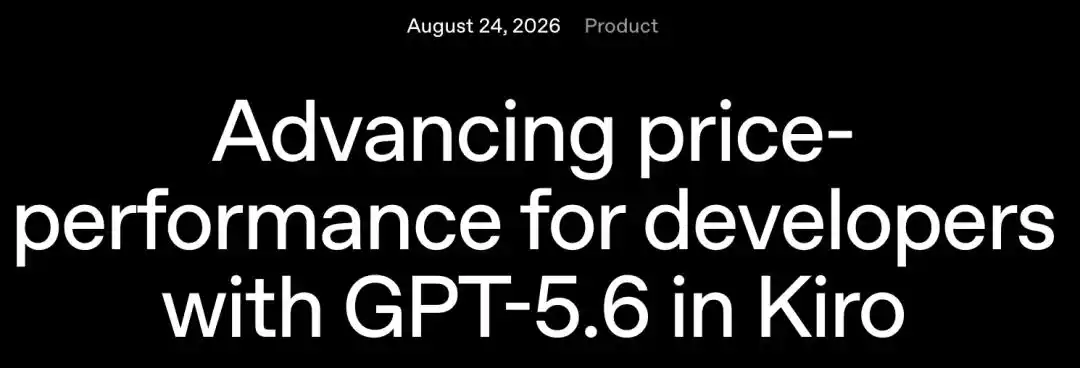
On August 24th, OpenAI announced test results conducted jointly with AWS:

On Terminal-Bench 2.1, the cost for GPT-5.6 Terra to successfully complete a task in Kiro was reduced by approximately 82%.

Kiro is AWS's intelligent software developer agent platform, covering IDE, CLI, and Web.

The three siblings of the GPT-5.6 family—Sol, Terra, and Luna—have been running inside for over a month.

This 82% reduction is not the official price cut.

Terra's last price adjustment was on July 30th, by 20%.
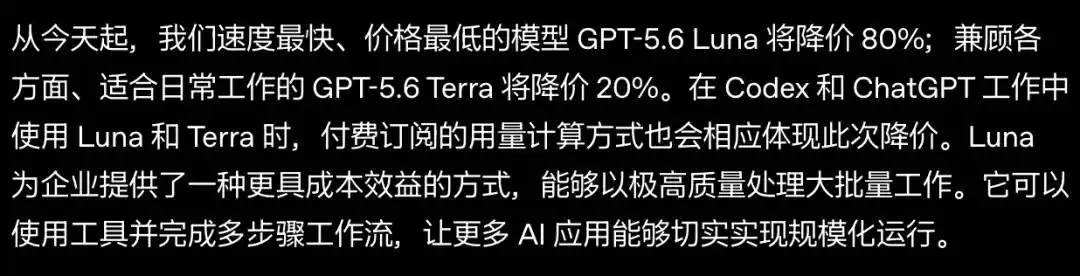
OpenAI price adjustment announcement on July 30th, Terra lowered by 20%.

The unit price dropped only 20%, but the bill could be slashed by eighty percent.

The source of the remaining sixty percentage points saved in the middle is what truly deserves our attention.

GPT-5.6 landed on Kiro in July this year.

First, on the 13th, AWS announced that GPT-5.6 Sol, Terra, and Luna were officially available on Amazon Bedrock.

The very next day, Kiro published a blog post announcing the availability of the three models on IDE, CLI, and Web.
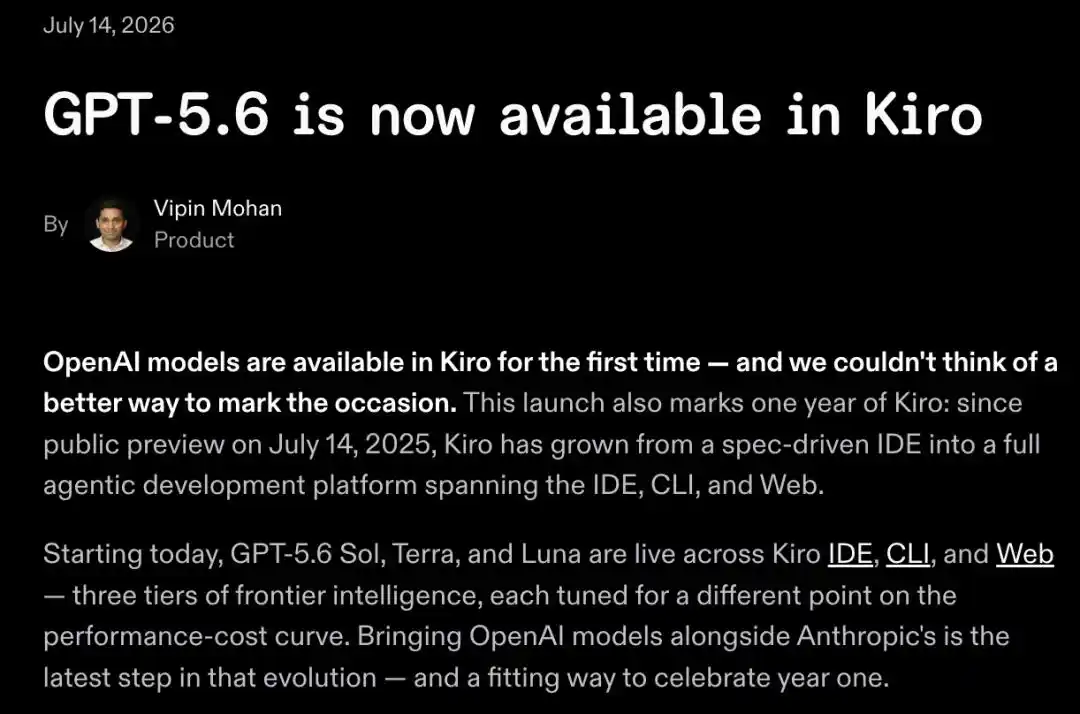
This marked the first time OpenAI models entered Kiro, coinciding with Kiro's one-year public preview anniversary.

First, put the models on the shelf, then put them to work. Over a month later, OpenAI came back with its homework:

The two companies jointly tuned the Kiro environment and OpenAI models, reducing the cost for Terra to complete a successful task by about 82%.

What's Saved

Is the Money Spent on Detours

During the price adjustment on July 30th, Terra was reduced by 20%, but in Kiro's tests, the cost per task dropped by 82%.

Where did the extra sixty percent savings come from?

The directions are limited:

The model generated fewer tokens, the number of back-and-forth tool calls decreased, and there were fewer retries and detours after failures.

Therefore, the large chunk saved is not the cost per call, but the cost of those calls that would have been wasted.

The logic is simple: if an AI agent fails a task once, the bill is still charged. If it chooses the wrong path, goes off-track three times, and then circles back, those tokens are also billed.

In real development, money often leaks out this way.

OpenAI has pointed out the same logic in its official blog: efficiency comes from three layers:

The agent framework that initiates requests and organizes context, the orchestration system that schedules requests in the middle, and finally the model itself running on GPUs.
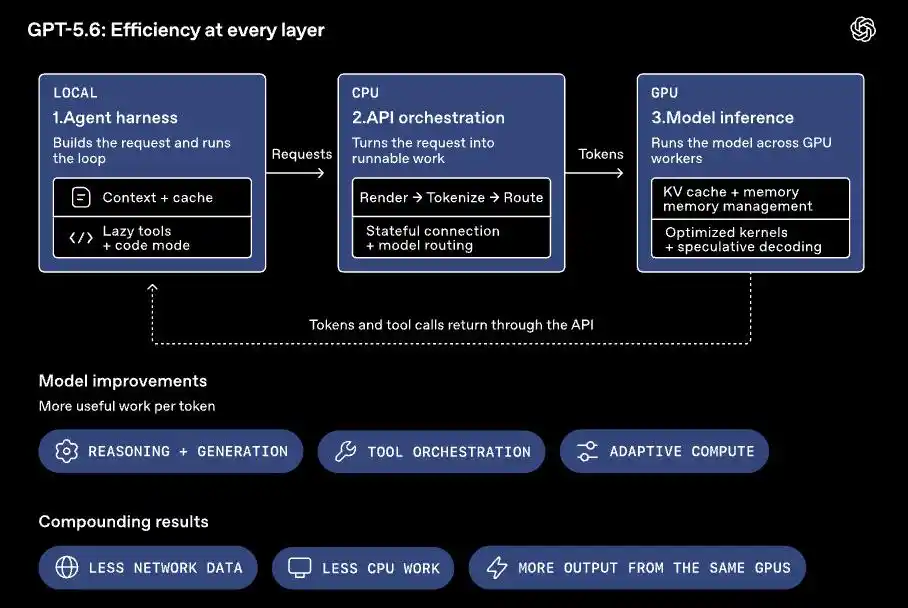
OpenAI breaks down the sources of GPT-5.6's efficiency: requests start from the agent framework, are scheduled by the orchestration system, and finally run the model on GPU, saving at every layer.

Savings can also come from model specialization.

OpenAI also gave an example of usage: a coding workflow can first use Sol to think through the problem and define the plan, then switch to Luna to implement the well-defined changes, write tests, and run evaluations.

Same pipeline, different levels of intelligence allocated to different stages.

The Model Accounts for Only Half the Bill

Change the Framework, Change the Price

The Terminal-Bench 2.1 benchmark doesn't ask the model to answer questions alone.

It places the model in a terminal environment with a vague objective, letting it plan its own path, call tools, write scripts, handle errors, and iterate repeatedly.

So the resulting score is the performance of the "agent + model" combination.
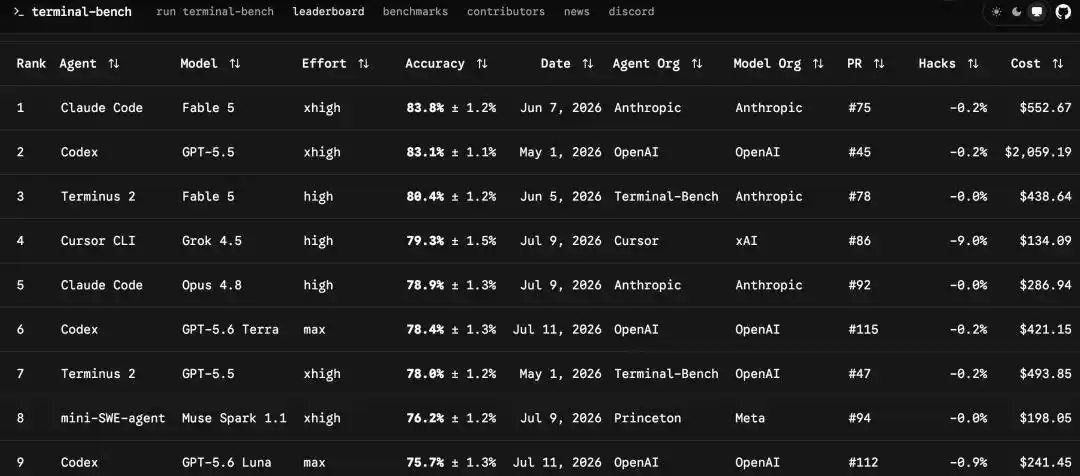
The public Terminal-Bench 2.1 leaderboard, with cost added to the right of accuracy. (Source: Terminal-Bench)

The four lines of numbers in the leaderboard illustrate the point best:

Claude Code with Fable 5, 83.8%, $552.67;

Codex with GPT-5.5, 83.1%, $2059.19;

Codex with GPT-5.6 Terra, 78.4%, $421.15;

Codex with GPT-5.6 Luna, 75.7%, $241.45.

The scores in the first two rows differ by only 0.7 percentage points, but the bills differ by nearly 4 times.

The same model, placed into different frameworks with different context organization and tool strategies, results in completely different prices.

According to data provided by Kiro, Terra scored 77.4 on the Coding Agent Index, only slightly higher than Claude Fable 5's 77.2.

Its selling point isn't the score, but the price corresponding to that score.

This is also where Kiro's spec-driven focus lies. The core approach is simple: don't start writing code immediately.

It first breaks down the user's vague goal into a formal requirements document, technical design, and executable task list before handing it over to the model.

Thus, the model receives not a vague statement, but a well-defined job.

Those familiar with Agents will immediately realize that this step saves the most expensive part of the expenditure.

Models going off-track, reworking, and starting over often burn more tokens than doing the actual work.

Kiro also includes two checkpoints in the process: pause for human review before code is actually modified; and automatically run a round of tests after the work is done to verify correctness.

Each rework stopped by these two checkpoints saves real money.

Claude in Amazon's Territory

GPT Takes Half

A year ago, Kiro was just a spec-driven IDE, and the model selector was Anthropic's domain.

A year later, AWS placed three tiers of OpenAI models into its own developer agent platform at once.

Sol, Terra, Luna listed alongside Claude in the same dropdown menu—a scene hard to imagine a year ago.

Although GPT-5.6 is "fully deployed" this time, it's not "fully open."

The three models are released progressively and experimentally, targeting Pro, Pro+, Pro Max, and Power users. Availability is limited to two regions: US North Virginia and Europe Frankfurt, supporting cross-region inference.

There's also a point many find hard to adjust to: these models in Kiro operate with a hidden chain-of-thought; you can't see its reasoning steps, only the final result.

Those accustomed to watching the Agent reason step-by-step feel like throwing work into an opaque box.

The official statement is that this is expected behavior and doesn't affect output quality.

The three model tiers are clearly priced in Kiro.

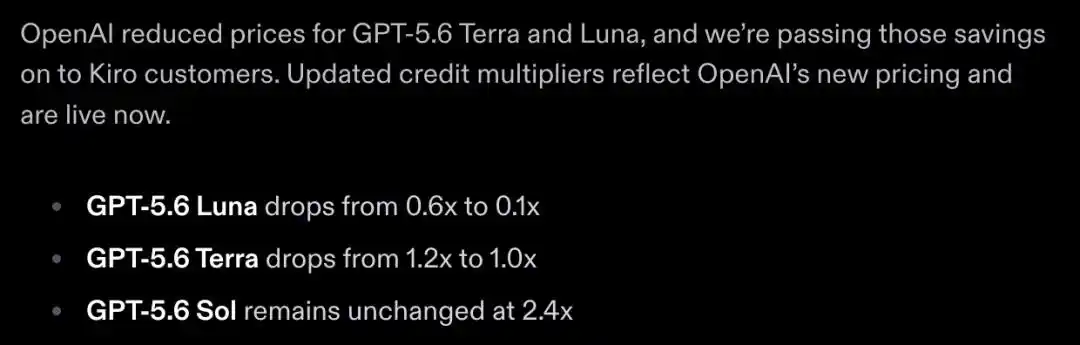
When they first launched on July 14th, the same task cost 2.4x for Sol, 1.2x for Terra, and 0.6x for Luna.

After OpenAI's price reduction on July 30th took effect, Kiro followed the next day: Luna was slashed from 0.6x all the way to 0.1x, Terra reduced from 1.2x to 1.0x, with only Sol unchanged.
AWS's stance is clear: a development platform cannot be tied to just one model.

In the same selector, two cutting-edge models are beginning to undercut each other on price.

The evaluation criteria for models is also changing: a higher score no longer guarantees a win; spending less can also win.

For developers, the question used to be "How much per million tokens for this model?" Now it must be "How much will it actually cost me to get this thing done?"

References:

https://x.com/OpenAIDevs/status/2091966982015103068

https://openai.com/index/gpt-5-6-in-kiro/

This article is from WeChat Official Account "AI_era" (ID: AI_era), author: ASI Revelation, editor: Yuanyu


Трендовые криптовалюты

Связанные с этим вопросы

QAccording to the article, the cost of completing a successful task with GPT-5.6 Terra in Kiro decreased by 82%, but the official price reduction was only 20%. Where did the additional 60% cost saving come from?

AThe additional 60% cost saving primarily came from optimizations that reduced wasted token usage. These savings were achieved by minimizing the number of tokens generated, reducing unnecessary tool calls, and decreasing the frequency of failed attempts and inefficient detours. Essentially, the savings came from avoiding the costs associated with the AI agent making mistakes, choosing wrong paths, or having to backtrack, all of which would have incurred charges.

QWhat is the primary difference in how Kiro approaches coding tasks compared to a traditional AI agent, and how does this contribute to cost savings?

AKiro uses a spec-driven approach. Instead of letting the AI write code immediately from a vague user instruction, it first breaks down the instruction into a formal requirements document, technical design, and a list of executable tasks. This provides the model with a clear and structured job description upfront. This method saves costs by significantly reducing the expensive overhead of the model going off-track, needing rework, or starting over, which consumes a large number of tokens.

QWhat was a notable change in the Kiro platform's model offerings one year after its public preview, and what does this signify?

AA notable change was the introduction of three OpenAI GPT-5.6 models (Sol, Terra, Luna) into Kiro's model selector, where previously Anthropic's Claude models were dominant. This signifies a strategic move by AWS to avoid being tied to a single model provider on its development platform. It creates direct competition between leading models, which can drive performance improvements and price reductions for developers.

QHow does the article explain the layered efficiency improvements for AI agents like GPT-5.6 in platforms such as Kiro?

AThe article explains that efficiency gains come from three layers: 1) The agent framework that initiates requests and organizes context. 2) The orchestration system that schedules and dispatches these requests. 3) The model itself running on the GPU. Cost savings are achieved through optimizations at every one of these layers, not just the model's raw processing cost.

QAccording to the Terminal-Bench 2.1 data cited, why might a developer's choice of agent framework be as important as the choice of model itself for overall cost?

AThe Terminal-Bench 2.1 data shows that different frameworks paired with the same or similar models can result in vastly different costs. For example, Claude Code with Fable 5 achieved 83.8% accuracy at a cost of $552.67, while Codex with GPT-5.5 achieved 83.1% accuracy but at a much higher cost of $2059.19. This demonstrates that the framework's context organization, tool strategies, and workflow efficiency have a massive impact on the final bill, making the framework choice critically important.

Похожее

Anthropic прицелилась на «тренировочные чипы»? Раскрыто, что компания рассматривала покупку производителя AI-чипов MatX за 70 миллиардов долларов

Крупная компания в области ИИ Anthropic рассматривала возможность приобретения стартапа по производству чипов MatX примерно за 70 миллиардов долларов. Целью сделки было ускорение разработки собственных чипов, в частности для этапа обучения больших языковых моделей. Хотя переговоры о приобретении в конечном итоге были приостановлены, и стороны перешли к обсуждению потенциального сотрудничества, этот шаг демонстрирует растущий интерес Anthropic к аппаратному обеспечению. Компания активно формирует внутреннюю команду по разработке чипов, наняв таких ветеранов отрасли, как Амир Салик, бывший руководитель проекта TPU в Google, и Клайв Чан, бывший инженер по чипам из OpenAI. Эта стратегия, включающая найм талантов, изучение архитектур и переговоры со стартапами, направлена на снижение зависимости от поставщиков, таких как Nvidia, и оптимизацию затрат на вычисления. Однако Anthropic не планирует полностью отказываться от сотрудничества с крупными поставщиками облачных услуг и чипов, признавая сложность и высокую стоимость самостоятельной разработки процессоров.

marsbit4 мин. назад

Anthropic прицелилась на «тренировочные чипы»? Раскрыто, что компания рассматривала покупку производителя AI-чипов MatX за 70 миллиардов долларов

marsbit4 мин. назад

Глава ФРС Уорш «взялся за ястреба», Goldman Sachs по-прежнему не верит в «сентябрьское повышение ставки», JPMorgan заявляет «всё зависит от августовских данных по занятости и CPI»

Председатель Федеральной резервной системы США Кевин Уорш выступил на симпозиуме в Джексон-Хоуле с более жесткой, чем в июле, позицией по инфляции, назвав ее «основной проблемой» и указав, что ФРС готова действовать, если базовые тенденции инфляции не вернутся к цели достаточно быстро. Его заявления привели к росту доходности 2-летних казначейских облигаций и увеличению рыночных ожиданий повышения ставки в сентябре до более 50%. Однако ведущие банки Уолл-стрит не изменили свои прогнозы. JPMorgan сохраняет базовый сценарий повышения ставки в декабре, подчеркивая, что решение по сентябрьскому заседанию будет зависеть от данных по занятости и ИПЦ за август. Goldman Sachs ожидает, что базовые инфляционные показатели вырастут примерно на 0,2% в месячном исчислении, и считает, что при таком раскладе ФРС, вероятно, оставит ставку без изменений. По мнению банка, повышение в сентябре возможно только в случае неожиданно высоких данных по инфляции. Уорш посвятил значительную часть выступления анализу инфляции, отметив, что доля товаров и услуг в корзине PCE с ростом цен более 3% остается высокой, хотя и снизилась с пиковых значений. Он также скорректировал два своих спорных заявления июля, подтвердив приверженность 2% цели по инфляции и ключевую роль краткосрочных ставок в политике. В оценке экономики он отметил устойчивость потребительских расходов, быстрый рост корпоративных инвестиций (более половины из которых связаны с ИИ) и стабильный рынок труда, заключив, что финансовые условия в широком смысле нельзя назвать ограничительными.

marsbit9 мин. назад

Глава ФРС Уорш «взялся за ястреба», Goldman Sachs по-прежнему не верит в «сентябрьское повышение ставки», JPMorgan заявляет «всё зависит от августовских данных по занятости и CPI»

marsbit9 мин. назад

Еженедельный выбор редактора Weekly Editor's Picks (22-28 августа)

**Еженедельный выбор редактора (22.08–28.08)** Ключевые темы недели в мире финансов и криптовалют: * **Макроэкономика:** Внимание приковано к возможным действиям Министерства финансов США для снижения давления на долгосрочные доходности казначейских облигаций. Золото, достигнув уровня $4600 за унцию, продолжает привлекать интерес инвесторов на фоне действий центральных банков и активности на рынке опционов. * **Криптовалюты и инвестиции:** * Рынок демонстрирует сильный рост: Bitcoin превысил $80 000, а общая капитализация альткойнов вернулась к отметке $1 трлн. * Эксперты обсуждают перспективы Ethereum, потенциал новых проектов (например, Flop Network) и анализируют акции компаний, связанных с криптоиндустрией (MSTR, COIN, Circle). * Дефляционные механизмы, такие как выкуп токенов за счет доходов протокола, внедряются в проектах Hyperliquid (HYPE) и Ethena (ENA), положительно влияя на настроения рынка. * **AI и хранение данных:** Несмотря на рекордные квартальные доходы, NVIDIA сталкивается с ограничениями со стороны предложения. В то же время на рынке памяти акции лидера, SK Hynix, переживают коррекцию, за которой внимательно следят инвесторы. * **DeFi и CeFi:** На фоне общего восстановления рынка выделяются DeFi-протоколы с высокой доходностью. Одновременно развиваются сервисы, такие как кредитные линии Galaxy Digital под залог криптоактивов, предлагающие альтернативу продаже активов. * **Прочее:** Продолжается активность вокруг потенциальных аирдропов, мемкойнов и обсуждение регуляторных событий. В центре внимания также оказалась деятельность компании BitMine, активно скупающей Ethereum, что вызывает вопросы о концентрации и рисках.

marsbit18 мин. назад

Еженедельный выбор редактора Weekly Editor's Picks (22-28 августа)

marsbit18 мин. назад

Высокопоставленный сотрудник Strive: Переосмысление ценового маховика Биткойна

Автор Джо Барнетт, вице-президент по биткоин-стратегии Strive, предлагает новый взгляд на динамику цены биткоина, выходя за рамки популярной модели степенного закона (power law), которая описывает долгосрочное замедление роста доходности актива. В статье проводится аналогия с усталостью металла, где процесс монетизации биткоина разделён на три фазы: 1) Открытие (высокая волатильность и доходность), 2) Созревание (снижение волатильности и доходности, описываемое степенным законом), 3) Финансово-обусловленная монетизация. Ключевой тезис: нынешнее снижение волатильности (например, максимальные просадки в циклах уменьшаются) — это не конец истории, а подготовка к третьей фазе. Более низкая волатильность улучшает соотношение риск/доходность, позволяя институциональным инвесторам увеличивать аллокацию, и, что критически важно, делает биткоин более качественным залогом. Это открывает путь для масштабного кредитного плеча: по мере снижения волатильности кредиторы могут безопасно выдавать больше средств под залог биткоина (например, через кредиты, конвертируемые облигации, привилегированные акции). Расширение кредита в долларах создаёт дополнительный спрос на биткоин с фиксированным предложением. Таким образом, формируется самоподкрепляющийся цикл: созревание → снижение волатильности → улучшение профиля залога → расширение кредита → рост цены → дальнейшее повышение стоимости залога и возможностей для кредитования. Этот цикл, движимый традиционной финансовой системой, в конечном итоге может привести к ускорению роста цены биткоина и прорыву выше траектории, предсказываемой классическим степенным законом.

marsbit38 мин. назад

Высокопоставленный сотрудник Strive: Переосмысление ценового маховика Биткойна

marsbit38 мин. назад

Срочно, OpenAI полностью прекращает поставки Cursor

По данным OpenAI, с 12 ноября полностью прекращается прямое предоставление моделей ИИ для платформы Cursor. Причиной стало приобретение Cursor компанией SpaceX Илона Маска за 60 миллиардов долларов двумя неделями ранее. OpenAI также исключила доступ Cursor к своей перспективной модели Astra, сославшись на прошлые нарушения Маском условий обслуживания. Пользователи Cursor смогут продолжить использование моделей OpenAI, но только через собственный API-ключ, что для активных пользователей фактически означает переход от подписки к почасовой оплате и рост расходов. Соучредитель Cursor заявил, что трафик через OpenAI составляет около 5% и ведутся переговоры по ситуации. Это событие стало частью общей тенденции в индустрии ИИ: крупные компании, разрабатывающие модели, постепенно ограничивают доступ к ним через сторонние платформы, укрепляя контроль над дистрибуцией. Ранее Anthropic уже прекратила сотрудничество с несколькими платформами, включая Windsurf. Эксперты отмечают, что эпоха, когда можно было создать крупный бизнес, не владея собственной моделью ИИ, подходит к концу.

marsbit1 ч. назад

Срочно, OpenAI полностью прекращает поставки Cursor

marsbit1 ч. назад

Торговля

Спот

Популярные статьи

Как купить BILL

Добро пожаловать на HTX.com! Мы сделали приобретение Billions Network (BILL) простым и удобным. Следуйте нашему пошаговому руководству и отправляйтесь в свое крипто-путешествие.Шаг 1: Создайте аккаунт на HTXИспользуйте свой адрес электронной почты или номер телефона, чтобы зарегистрироваться и бесплатно создать аккаунт на HTX. Пройдите удобную регистрацию и откройте для себя весь функционал.Создать аккаунтШаг 2: Перейдите в Купить криптовалюту и выберите свой способ оплатыКредитная/Дебетовая Карта: Используйте свою карту Visa или Mastercard для мгновенной покупки Billions Network (BILL).Баланс: Используйте средства с баланса вашего аккаунта HTX для простой торговли.Третьи Лица: Мы добавили популярные способы оплаты, такие как Google Pay и Apple Pay, для повышения удобства.P2P: Торгуйте напрямую с другими пользователями на HTX.Внебиржевая Торговля (OTC): Мы предлагаем индивидуальные услуги и конкурентоспособные обменные курсы для трейдеров.Шаг 3: Хранение Billions Network (BILL)После приобретения вами Billions Network (BILL) храните их в своем аккаунте на HTX. В качестве альтернативы вы можете отправить их куда-либо с помощью перевода в блокчейне или использовать для торговли с другими криптовалютами.Шаг 4: Торговля Billions Network (BILL)С легкостью торгуйте Billions Network (BILL) на спотовом рынке HTX. Просто зайдите в свой аккаунт, выберите торговую пару, совершайте сделки и следите за ними в режиме реального времени. Мы предлагаем удобный интерфейс как для начинающих, так и для опытных трейдеров.

792 просмотров всегоОпубликовано 2026.05.07Обновлено 2026.06.02

Как купить BILL

Обсуждения

Добро пожаловать в Сообщество HTX. Здесь вы сможете быть в курсе последних новостей о развитии платформы и получить доступ к профессиональной аналитической информации о рынке. Мнения пользователей о цене на BILL (BILL) представлены ниже.

活动图片