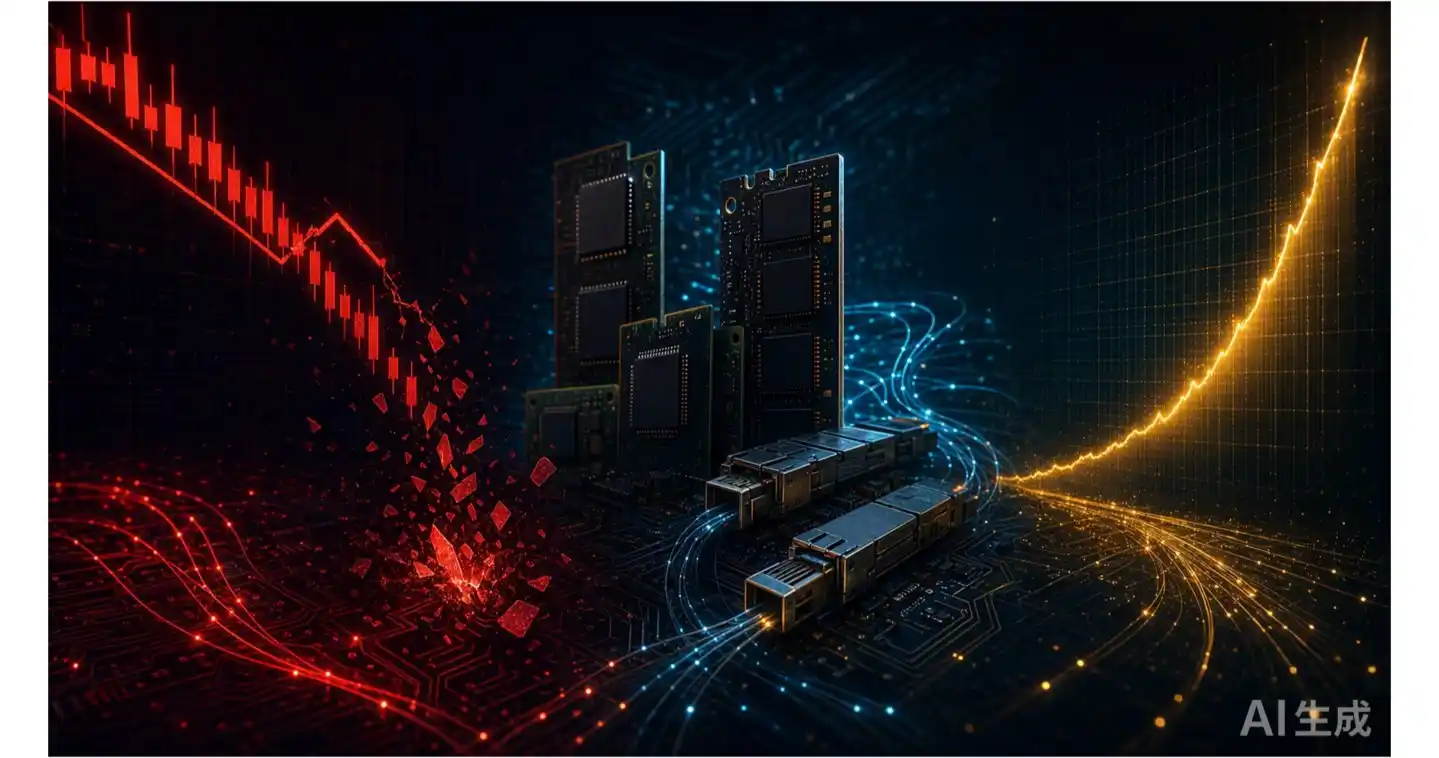
The Philadelphia Semiconductor Index Tumbles Nearly 5% in a Single Night, Optical and Memory Sectors 'Collapse' Together: Surging U.S. Bond Yields Shake AI Belief

marsbitОпубликовано 2026-08-19Обновлено 2026-08-19

Введение

On the evening of August 18th, the US stock market saw a sharp sell-off concentrated in the AI hardware sector, with the Philadelphia Semiconductor Index plummeting nearly 5%. Leading AI infrastructure and components companies in fields like optical communication and memory chips experienced some of the steepest declines, such as Fabrinet (-19.38%) and Kioxia ADR (-13%). The sell-off was not broad-based but rather targeted the long-duration, high-momentum stocks previously driven by AI narrative optimism. This market shift is primarily attributed to a significant surge in long-term US Treasury yields, with the 30-year yield hitting its highest level since 2007. Rising yields increase discount rates, disproportionately impacting the valuations of growth stocks whose profits are projected far into the future—a category that includes most AI hardware plays. Additional pressure came from climbing oil prices due to Middle East tensions, which fueled inflation concerns. The article identifies three structural reasons for the severity of the drop in these specific subsectors: excessive prior gains and crowded positioning, high sensitivity to the sustainability of AI capital expenditure narratives, and inherent high volatility within the supply chain. Importantly, the sell-off appears to be a valuation and positioning reset rather than a fundamental repudiation of AI, evidenced by the relatively modest decline in a bellwether like Nvidia (-2.34%). Looking ahead, the direction hing...

Last night (August 18th), U.S. stock market saw a rare broad sell-off in two of the sharpest spears of the AI hardware sector—optical communication and memory chips. The Philadelphia Semiconductor Index closed down 4.98%, with all 30 component stocks falling, marking its largest single-day drop since July 29th; the three major U.S. stock indices closed lower for the third consecutive session.

The market narrative is shifting focus from the "unlimited imagination of AI capital expenditures" to "how much interest must be paid on this money."

Looking at the broader picture first. The Dow Jones fell 0.22%, the S&P 500 fell 0.69%, and the Nasdaq fell 1.33%. Superficially, the declines don't seem dramatic, but zooming in on the internal dynamics of the AI hardware sector reveals a structural stampede.

The memory sector was hit hard across the board. Kioxia ADR plunged over 13%, SanDisk fell 9.01%, Seagate fell 9.16%, Western Digital fell 7.43%, Micron fell 7.02%, and SK Hynix ADR dropped over 9%. The optical communication and AI infrastructure sectors fell even deeper. Fabrinet plummeted 19.38%, Coherent fell 12.75%, CoreWeave fell 12.10%, Lumentum fell 9.87%, Marvell fell over 6%, and Corning fell over 4%.

Large-cap tech stocks couldn't escape unscathed either. Meta fell 4.45%, NVIDIA fell 2.34%; Chinese AI assets also faced pressure, with Baidu closing down 12.73% following its earnings release, and 21Vianet falling nearly 17%.

A noteworthy detail is that the steepest declines occurred precisely among the stocks that had risen the most aggressively and carried the purest AI narratives. This isn't a broad-based decline but rather a repricing within the AI narrative. The market is beginning to re-sort assets based on different risks, with the longest-duration, most crowded positions being the first to suffer.

Triple Pressures and Structural Factors

The 30-year U.S. Treasury yield touched 5.337% intraday, hitting a new high since June 2007, its highest level in 19 years. The 10-year yield also climbed to 4.75%, its highest since January 2025. This is a global rise in long-term rates; Japan's 10-year government bond yield rose to a 30-year high, Germany's 30-year hit its highest since 2011, and France's 30-year reached its highest level since 2008.

One analyst summarized it succinctly: "The required return threshold for investments is rising again. But this time, it's not because the market is revising short-term rate expectations higher, but rather due to the combined effects of oil prices, government bond supply, and the long-end term premium."

For growth stocks, this is tantamount to a simultaneous deterioration of both the numerator and denominator in the valuation formula. The essence of pricing growth stocks is discounting future cash flows; every notch higher in the discount rate inflicts greater damage on assets with profit realization further in the future. AI hardware stocks are precisely the "longest-duration" sector in the U.S. stock market, with profits priced for realization in three to five years, making them far more sensitive to interest rates than other industries. A warning from Citadel Securities is representative: the Fed's reluctance to tighten monetary policy while inflation is above target itself raises the risk of higher long-term bond yields.

The rise in long-term bond yields this round is not an isolated market event. According to Goldman Sachs data, AI-related bond supply so far this year has reached $489 billion, surpassing the $322 billion for all of 2025; additionally, over $1 trillion in annual AI capital expenditure is pouring into the bond market. The financing needs of the AI industry are now competing with traditional sovereign borrowers for funds.

A typical case study illustrates the point. Blackstone's QTS issued $3.9 billion in 5-year bonds for Microsoft data centers, with subscription demand as high as $23 billion and an issuance yield of 7.228%. This information has two readings. First, market enthusiasm for subscribing to AI assets remains strong; second, a financing cost of 7.2% means data center projects must generate returns higher than that. The bond market is doing the math for AI with real money, and the calculated interest threshold is raising the required return for every capital expenditure.

The Trump administration suspended engagement with Iran, with Trump himself stating there will be "no talks with Iran now or in the future"; the deadlock over control of the Strait of Hormuz remains unresolved; the Speaker of the Iranian parliament stated the strait "will remain closed." Brent crude rose above $91/barrel, WTI settled at $84.94/barrel, approaching the $85 mark, and the S&P 500 Energy Index rose 1.8%, hitting a new high since March.

The transmission path of rising oil prices is straightforward: oil price → inflation expectations → long-term rates. But for growth stocks, this is the worst combination, with both profit expectations and valuations under pressure. Analysts generally judge that Brent crude will continue to trade within a relatively wide range of $70 to $100, and geopolitical variables are unlikely to disappear in the short term.

Three structural reasons.

First, the biggest gains, the most crowded positions. HBM memory and 800G/1.6T optical modules are the purest narratives and most elastic plays in this round of the AI rally, having accumulated substantial momentum and leveraged funds. The unwinding of crowded trades often exhibits two characteristics: first, declines far exceeding the index, and second, longer recovery times, as both profitable positions and leveraged positions rush for the exit simultaneously, often selling off at any cost.

Second, most sensitive to the capital expenditure narrative. Demand for memory and optical communication is directly tied to the "acceleration" rather than the "absolute value" of cloud providers' capital expenditures. Any questioning of the sustainability of AI investment will first impact this segment. They are assets priced for "imagination space," not for "current profitability."

Third, amplified industry chain elasticity. The profit and valuation volatility of optical module and memory companies are inherently greater than those of platform giants. Once rising discount rates trigger valuation compression, the magnitude of a double whammy is far greater than for giants with stable profits.

However, there is an easily overlooked detail: this round of selling was not accompanied by a disproval of AI fundamentals. NVIDIA fell only 2.34%, not a crash, indicating the market is cutting valuations and crowding, not the logic itself. The real divergence lies in whether this is a sharp correction or a trend inflection point.

Three Indicators Determine Direction

The Asian session has already given the first response. South Korea's KOSPI opened down 5%, Samsung Electronics fell 6.7%, SK Hynix fell 7.4%; Japan's Nikkei 225 opened nearly 1% lower. China's A-share computing power, optical communication, and memory sectors also faced pressure. Given the extremely strong correlation between A-share optical module leaders and U.S. optical communication stocks, short-term sentiment contagion is inevitable.

For the subsequent trend, watch three indicators.

First, whether the 30-year U.S. Treasury yield can stop around 5.3%. If it continues higher and holds, the valuation compression for growth stocks is not over; if it retreats from this level, a window for an oversold rebound will open. The judgment of Peter Boockvar, Chief Investment Officer of One Point BFG Wealth Partners, represents the bearish view: "If rates continue to climb on this trend, it's not a matter of 'if' rates will have an impact on stocks, but 'when'."

Second, oil prices and the geopolitical situation. Whether Brent can stay within the $70-$100 range and how the Strait of Hormuz deadlock evolves directly determine whether the inflation narrative strengthens or weakens.

Third, pricing signals from AI bond financing. Subscription multiples and issuance yields for debt like QTS are the most direct votes by the market on the risk premium for AI assets; simultaneously, pay attention to the Fed's stance on oil price-driven inflation, which largely determines the direction of long-term rates.

For A-shares, short-term correlation is inevitable, but the medium-term logic needs separate consideration. The medium-term drivers for A-share optical modules and memory are domestic cloud provider capital expenditures and domestic computing power demand, which are not perfectly synchronized with the correlation to overseas interest rates. After a sharp decline, one must be wary of both "mis-selling" and "high-level catch-up declines." The key to distinguishing between them remains the actual realization of capital expenditures. For holders, more important than predicting the index is reviewing the profit realization schedule of their holdings. For stocks whose earnings have already materialized on the balance sheet and whose valuations remain reasonable, the pullback is more of an emotional disturbance; for high-priced stocks supported purely by narrative, they need to be measured again with the ruler of interest rates.

Last night was not the end of the AI narrative, but a shift in pricing logic, from "story" to "interest." When data center financing costs stand above 7% and the 30-year U.S. Treasury yield hits a 19-year high, every penny of capital expenditure must answer the question of return rate. The market's calculation for AI has only just begun.

(This article was first published on Titanium Media APP, Author | Silicon Valley Tech_news, Editor | Qin Conghui)


Трендовые криптовалюты

Связанные с этим вопросы

QWhat were the two hardest-hit segments within the AI hardware sector during the recent sell-off in US stocks, as mentioned in the article?

AThe two hardest-hit segments within the AI hardware sector were optical communication and memory chips, experiencing a rare, widespread sell-off.

QAccording to the article, what is the new market narrative replacing 'unlimited imagination of AI capital expenditure'?

AThe new market narrative is 'how high is the interest rate that this capital will cost', focusing on the financing costs and return requirements for AI investments.

QWhat three structural reasons does the article cite for the severe decline in the optical communication and memory storage sectors?

AThe three structural reasons are: 1) They had the largest gains and most crowded positioning, attracting momentum and leveraged funds. 2) They are most sensitive to the AI capital expenditure narrative, pricing future potential rather than current profits. 3) They have inherent high volatility in profitability and valuation, amplifying the impact of valuation contractions.

QWhat specific yield level for the 30-year US Treasury bond is highlighted as a key indicator to watch for determining the future direction of growth stocks?

AThe key yield level to watch for the 30-year US Treasury bond is around 5.3%. Whether the yield stops near this point or continues higher will determine if the valuation compression for growth stocks continues or if a rebound window opens.

QWhat does the article conclude about the nature of the recent market sell-off for AI-related assets?

AThe article concludes that the sell-off is not the end of the AI narrative, but a shift in pricing logic from 'story' to 'interest'. It represents a pricing reset for AI assets based on new financing costs and required returns, rather than a fundamental refutation of the AI story itself.

Похожее

Grayscale называет 3 причины, по которым биткоин стоит купить прямо сейчас

Согласно анализу Греяскала, представленному Заком Пандлом, текущая цена биткоина может быть выгодной точкой входа для долгосрочных инвесторов. Это мнение основано на трех ключевых факторах. Во-первых, сохраняется структурный тренд на внедрение биткоина, чему способствуют высокий государственный дефицит, рост использования блокчейна в финансах и смена поколений инвесторов. Во-вторых, биткоин находится в глубокой фазе медвежьего рынка, который длится около 10 месяцев, что близко к средней продолжительности предыдущих циклов. В-третьих, макроэкономические условия, включая политику ФРС и уровень реальных процентных ставок, в целом благоприятны, хотя будущее ужесточение монетарной политики может создать риски. Анализ подчеркивает, что биткоин, в отличие от традиционных активов, не генерирует денежный поток, поэтому его оценка зависит от этих структурных и циклических факторов. Несмотря на недавний рост курса до $79 461 и последующую коррекцию, Греяскал считает, что совокупность этих трех причин создает благоприятную возможность для инвестиций, хотя и не гарантирует, что цена достигла абсолютного дна.

cryptonews.ru58 мин. назад

Grayscale называет 3 причины, по которым биткоин стоит купить прямо сейчас

cryptonews.ru58 мин. назад

Таинственный «кит» продал биткойнов на сумму 576 млн долларов на фоне приближения курса BTC к отметке в 80 000 долларов

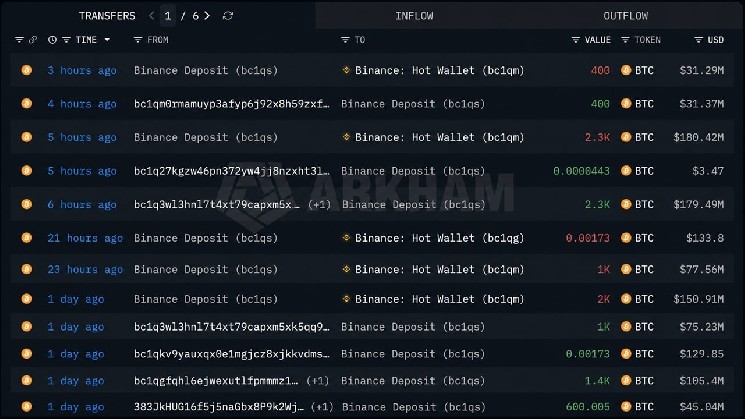
Неизвестный кошелек («кит») за три дня продал 7 700 BTC на сумму около 576,6 млн долларов, в том числе 2 700 BTC на 211,8 млн долларов одной транзакцией. Распродажа происходит на фоне того, что биткоин приближается к отметке в 80 000 долларов, недавно почти достигнув её перед откатом к 77 000 долларов. Несмотря на масштабные продажи, курс BTC демонстрирует значительный рост, завершив самую сильную недельную динамику с 2024 года. Ралли связывают с решением Минфина США с 9 сентября удвоить объём операций по выкупу долгосрочных облигаций, что снизило их доходность и подтолкнуло инвесторов к рисковым активам, включая биткоин. Эти продажи знаменуют смену тенденции: всего несколькими днями ранее крупные держатели активно накапливали BTC. Дальнейшее движение рынка будет зависеть от того, последуют ли другие «киты» примеру продавца, и сможет ли возобновившийся институциональный спрос (например, со стороны ETF) поглотить это давление предложения.

cryptonews.ru1 ч. назад

Таинственный «кит» продал биткойнов на сумму 576 млн долларов на фоне приближения курса BTC к отметке в 80 000 долларов

cryptonews.ru1 ч. назад

Galaxy заявляет, что для подтверждения окончания медвежьего рынка биткоину необходимо восстановить уровень в 82 470 долларов

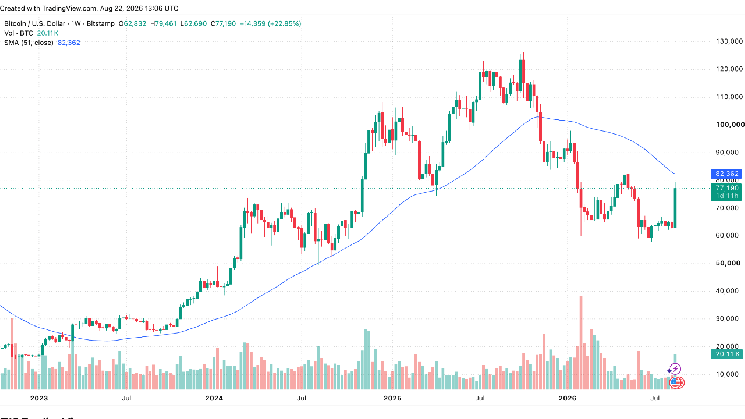
Galaxy Research проанализировала исторические медвежьи рынки биткоина и определила, что для подтверждения окончания текущего медвежьего тренда биткоину необходимо закрепиться выше 50-недельной скользящей средней, которая в настоящее время находится около уровня 82 470 долларов. Исследование шести завершившихся циклов показывает, что в 11 из 13 случаев возврат к этому уровню и его удержание знаменовали устойчивое восстановление, после которого не формировались новые минимумы. В отличие от более быстрой 50-дневной скользящей средней, которая часто давала ложные сигналы о развороте, 50-недельная средняя предоставляет более надежное, но и более позднее подтверждение. Исторически первое успешное восстановление этого недельного уровня происходило через месяцы после дна, к моменту которого цена уже могла вырасти на 60-80% и более. В текущем цикле биткоин торгуется около 77 190 долларов, что примерно на 6% ниже ключевого уровня. Таким образом, несмотря на обнадеживающий рост от июньского минимума, для уверенного объявления конца медвежьего рынка необходимо еженедельное закрытие выше 82 000 долларов. До этого восстановление остается технически неподтвержденным.

cryptonews.ru1 ч. назад

Galaxy заявляет, что для подтверждения окончания медвежьего рынка биткоину необходимо восстановить уровень в 82 470 долларов

cryptonews.ru1 ч. назад

ZachXBT называет Канаду самым опасным регионом в мире с точки зрения криптовалютного мошенничества

Криптодетектив ZackXBT назвал Канаду самой опасной юрисдикцией в мире для жертв криптовалютного мошенничества, поставив её выше Великобритании и Индии. Он критикует канадские правоохранительные органы за систематический отказ в возбуждении дел даже при наличии доказательств, в то время как в других странах по этим же материалам проводятся расследования. По словам эксперта, Торонто стал одним из глобальных центров мошенничества. Также он отметил случаи некорректных действий властей, например, конфискацию активов невиновных пользователей биржи Tradeogre. Из-за отсутствия помощи со стороны официальных органов ZackXBT объявил, что отказывается работать с жертвами из Канады и в ближайшее время заблокирует доступ к своей службе поддержки для пользователей из стран с неэффективной борьбой с киберпреступлениями.

cryptonews.ru1 ч. назад

ZachXBT называет Канаду самым опасным регионом в мире с точки зрения криптовалютного мошенничества

cryptonews.ru1 ч. назад

Налог на криптовалюту в размере 0,2 % в штате Иллинойс вызвал полномасштабную судебную тяжбу

В августе Ассоциация блокчейна и Криптосовет по инновациям подали в суд штата Иллинойс иск с требованием отменить новый Закон о налоге на цифровые активы, который должен вступить в силу с 1 января. Закон вводит налог в размере 0,2% от стоимости актива при определенных операциях через брокера, включая простой перевод или хранение, даже если сделка не приносит прибыли. Истцы утверждают, что налог не имеет аналогов для традиционных активов (акций, золота) и дискриминирует криптовалюты. Закон страдает от множества неясностей: что считается налогооблагаемым событием, как рассчитывается стоимость актива и как определить резидентство клиента. Это создает неопределенность и высокие издержки для бизнеса. Также оспаривается сам законодательный процесс: закон был принят в составе объемного пакета поправок без должного общественного обсуждения. Истцы считают, что налог нарушает как федеральные законы (например, Закон о свободе налогообложения в Интернете), так и конституцию штата. Их ближайшая цель — добиться судебного запрета до 1 января, чтобы предотвратить введение налога.

cryptonews.ru1 ч. назад

Налог на криптовалюту в размере 0,2 % в штате Иллинойс вызвал полномасштабную судебную тяжбу

cryptonews.ru1 ч. назад

Торговля

Спот

Популярные статьи

Как купить NIGHT

Добро пожаловать на HTX.com! Мы сделали приобретение Midnight (NIGHT) простым и удобным. Следуйте нашему пошаговому руководству и отправляйтесь в свое крипто-путешествие.Шаг 1: Создайте аккаунт на HTXИспользуйте свой адрес электронной почты или номер телефона, чтобы зарегистрироваться и бесплатно создать аккаунт на HTX. Пройдите удобную регистрацию и откройте для себя весь функционал.Создать аккаунтШаг 2: Перейдите в Купить криптовалюту и выберите свой способ оплатыКредитная/Дебетовая Карта: Используйте свою карту Visa или Mastercard для мгновенной покупки Midnight (NIGHT).Баланс: Используйте средства с баланса вашего аккаунта HTX для простой торговли.Третьи Лица: Мы добавили популярные способы оплаты, такие как Google Pay и Apple Pay, для повышения удобства.P2P: Торгуйте напрямую с другими пользователями на HTX.Внебиржевая Торговля (OTC): Мы предлагаем индивидуальные услуги и конкурентоспособные обменные курсы для трейдеров.Шаг 3: Хранение Midnight (NIGHT)После приобретения вами Midnight (NIGHT) храните их в своем аккаунте на HTX. В качестве альтернативы вы можете отправить их куда-либо с помощью перевода в блокчейне или использовать для торговли с другими криптовалютами.Шаг 4: Торговля Midnight (NIGHT)С легкостью торгуйте Midnight (NIGHT) на спотовом рынке HTX. Просто зайдите в свой аккаунт, выберите торговую пару, совершайте сделки и следите за ними в режиме реального времени. Мы предлагаем удобный интерфейс как для начинающих, так и для опытных трейдеров.

979 просмотров всегоОпубликовано 2025.12.08Обновлено 2026.06.02

Как купить NIGHT

Обсуждения

Добро пожаловать в Сообщество HTX. Здесь вы сможете быть в курсе последних новостей о развитии платформы и получить доступ к профессиональной аналитической информации о рынке. Мнения пользователей о цене на NIGHT (NIGHT) представлены ниже.

活动图片