Google's Q2 Free Cash Flow Turns Negative for the First Time, Raises Full-Year Capital Expenditure Forecast to as High as $205 Billion, Cloud Business Surges 82%

链捕手Опубликовано 2026-07-24Обновлено 2026-07-24

Введение

Alphabet (Google's parent) reported its Q2 2026 results. Revenue grew 24% to $119.8B, with Google Cloud revenue surging 82% to $24.8B, significantly exceeding expectations. Cloud backlog also surpassed $500B for the first time. However, the company's capital expenditures soared to $44.9B, leading to negative free cash flow (-$5.86B) for the first time in its history as a public company. Alphabet raised its full-year capex guidance to a range of $195B-$205B, its second upward revision this year. This massive spending on AI infrastructure fueled investor concerns about returns, causing the stock to fall. Despite the cash flow pressure, the results highlight a dual narrative: strong commercial returns from AI in the cloud, but significant financial strain from the ongoing investment race. CEO Sundar Pichai emphasized focus on the next-generation Gemini 4 model and stated that AI is reshaping the entire company.

Authors: Yang Chen, Long Yue
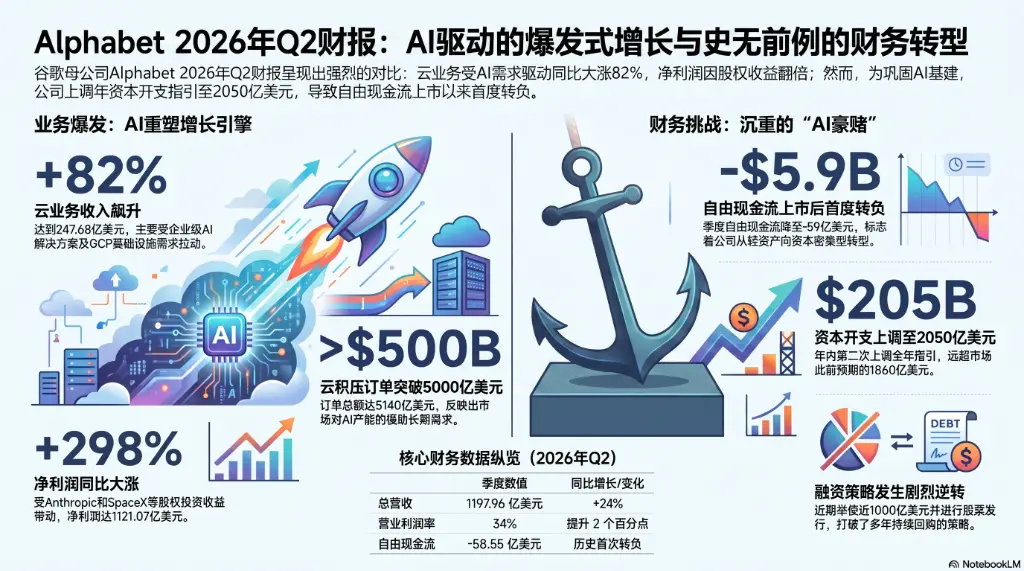
Alphabet, Google's parent company, released its second-quarter results, with cloud revenue significantly exceeding Wall Street expectations, and cloud backlog surpassing the $500 billion mark for the first time.However, market focus quickly shifted to another aspect: this marks the first time Google's free cash flow has turned negative in decades since its IPO. Simultaneously, the company raised its full-year capital expenditure guidance for the second time this year, abruptly intensifying investor concerns over whether the massive AI bet can deliver corresponding returns.

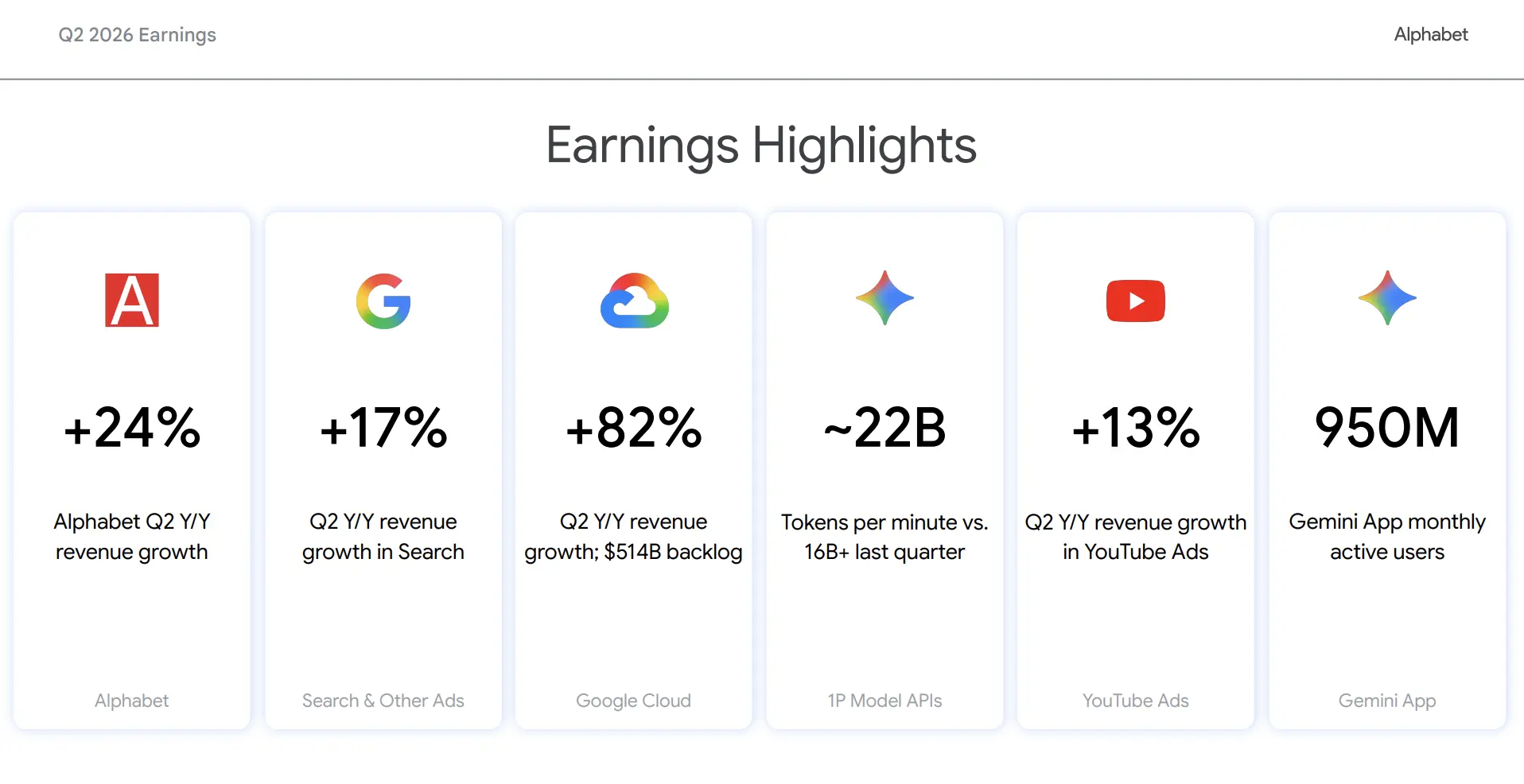
For the second quarter ended June 30, Alphabet reported revenue of $119.796 billion, a 24% year-over-year increase; growth was 23% on a constant currency basis, marking the 12th consecutive quarter of double-digit revenue growth. Operating profit rose 30% to $40.77 billion, with the operating margin improving by 2 percentage points to 34%.

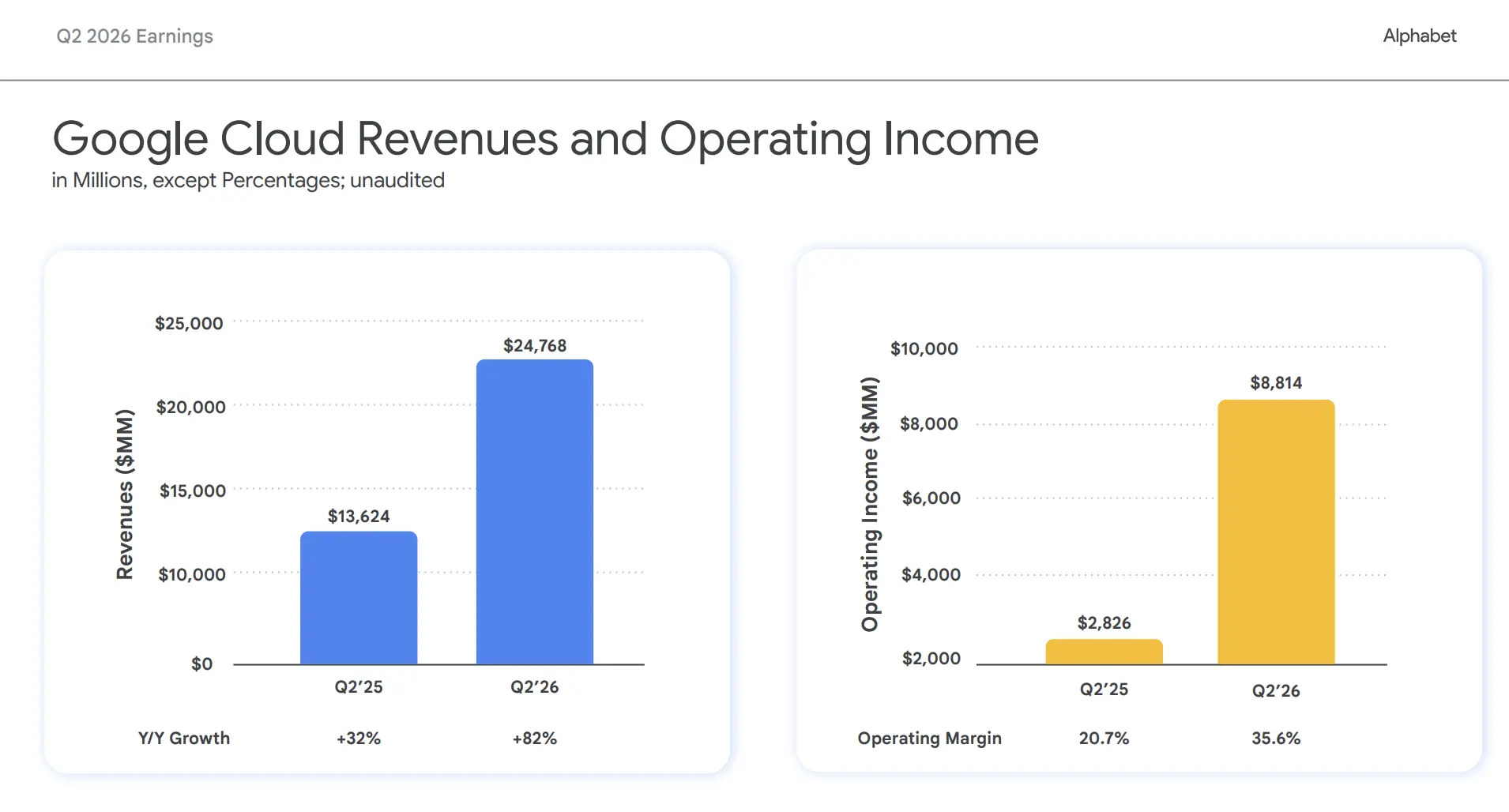
Among these,Google Cloud revenue reached $24.768 billion, surpassing market expectations of $22.46 billion, soaring 82% year-over-year, marking the fastest growth rate in recent years, indicating that AI investments are consistently translating into commercial returns. Search advertising revenue was $63.27 billion, slightly below the market expectation of $63.28 billion.

Alphabet holds stakes in several companies including Anthropic and SpaceX. Influenced by a significant increase in unrealized gains on equity securities,investment income for the quarter approached $100 billion, driving net income attributable to common stockholders to $112.107 billion, a 298% year-over-year increase.
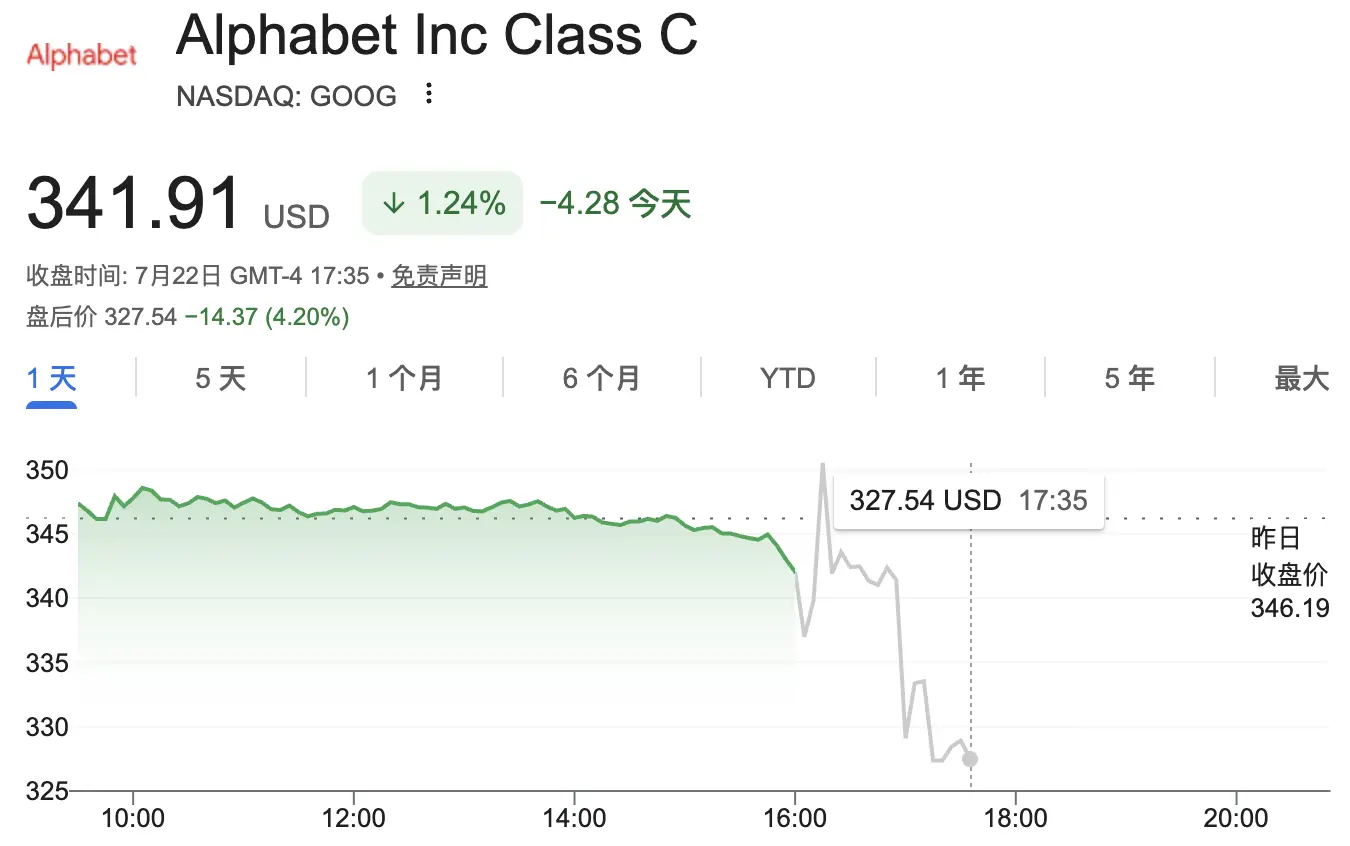
Following the earnings release, Google's stock price experienced minor fluctuations. During the earnings call, Google raised its full-year capital expenditure guidance to a range between $195 billion and $205 billion, up from the previous estimate of $180 billion to $190 billion. After the announcement, market concerns over whether massive capital expenditures can yield corresponding returns led Google's stock to drop by 4.2%.
Free Cash Flow Turns Negative for First Time, Capital Expenditure Raised Again

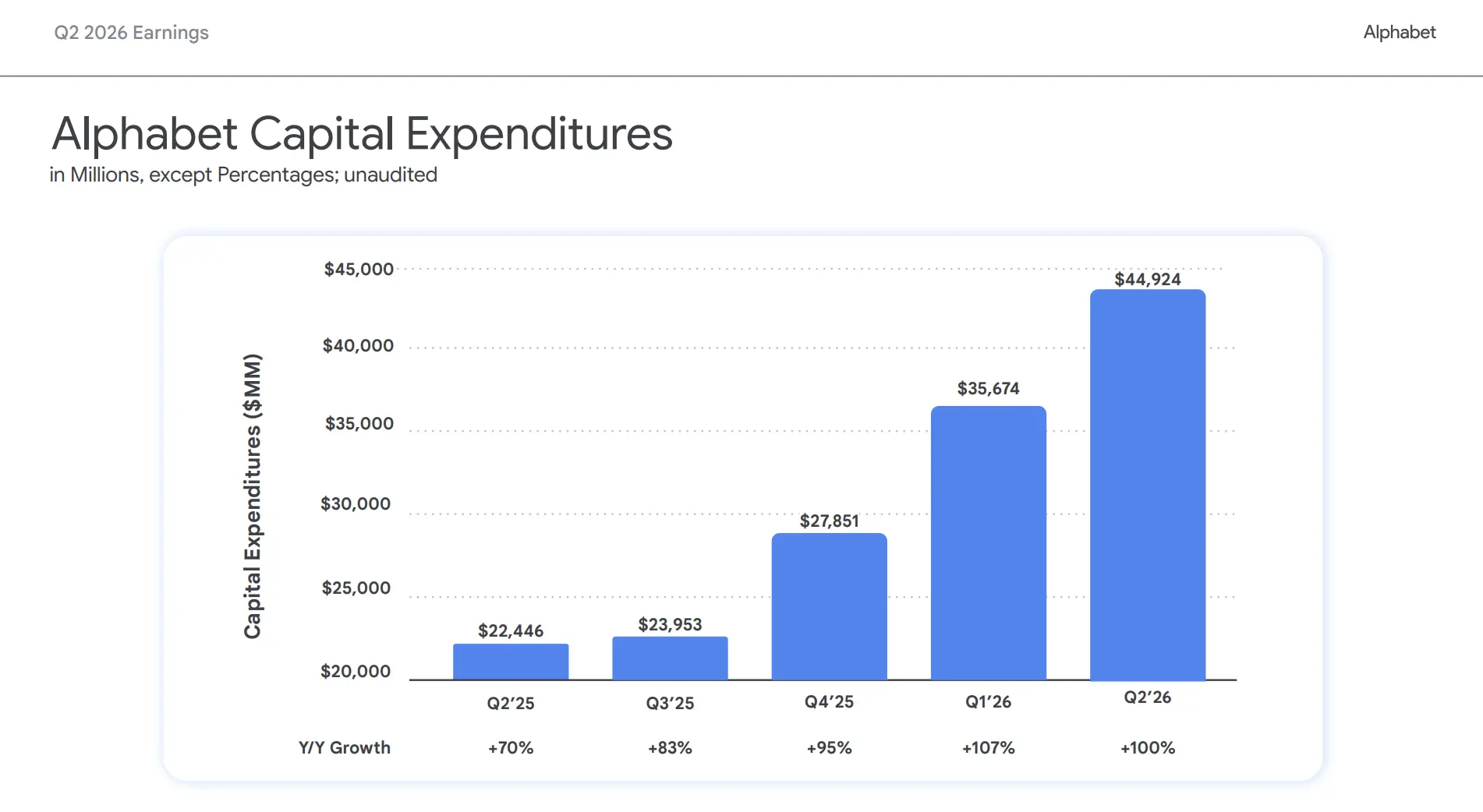
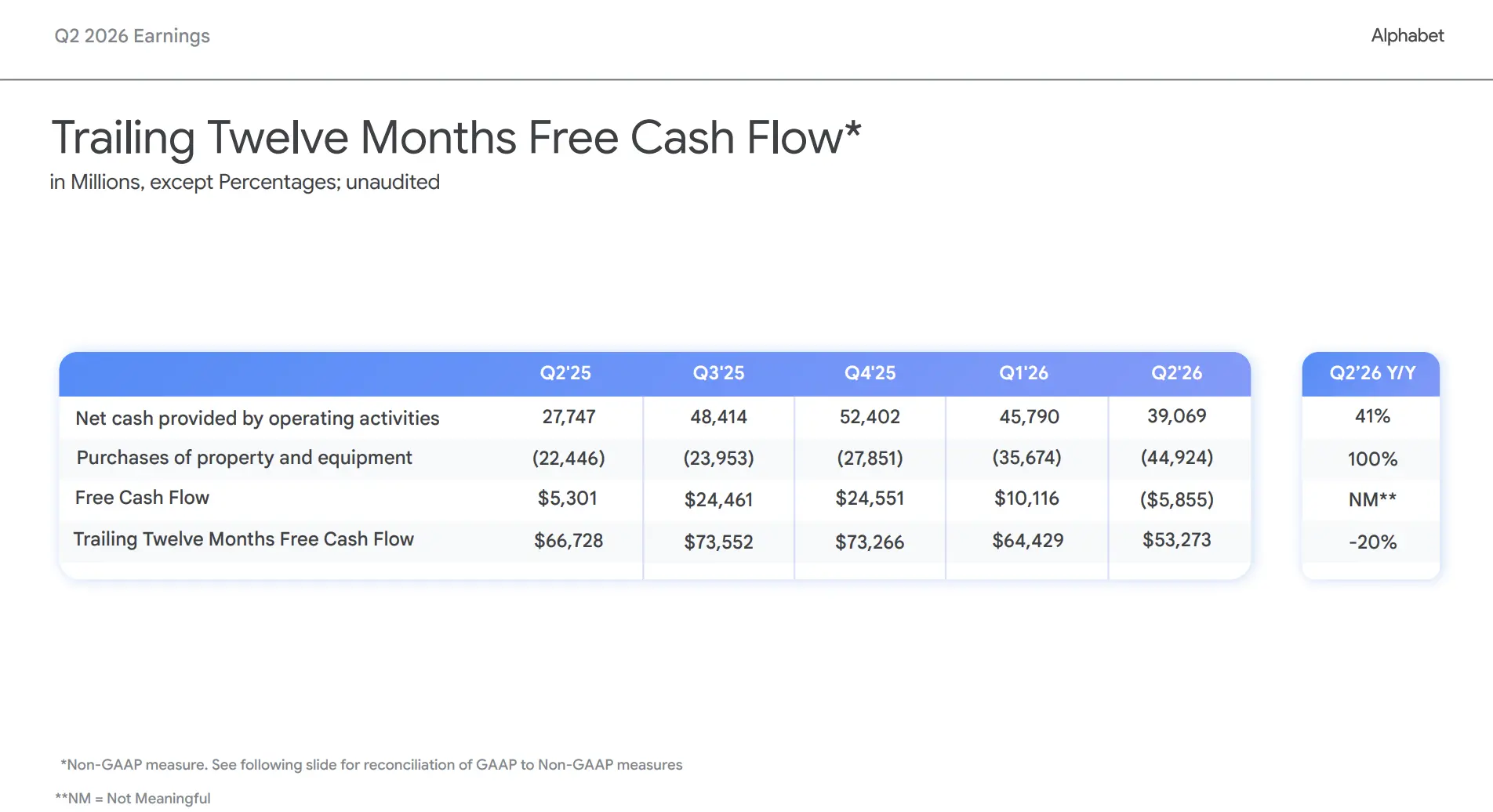
Alphabet's second-quarter capital expenditures reached $44.924 billion, significantly higher than $22.446 billion in the same period last year,directly causing the quarter's free cash flow to turn negative at -$5.855 billion (approximately -$5.9 billion) — the first time Google has reported negative quarterly free cash flow in decades since its IPO.

Free cash flow is a measure of the cash available for debt repayment or shareholder returns after covering operational costs and capital expenditures, and has long been a core metric used by Wall Street to assess the financial health of technology companies.

During the earnings call, Chief Financial Officer Anat Ashkenazi announced thatthe full-year 2026 capital expenditure guidance is being raised to $195 billion-$205 billion, higher than the previous expectation of $180 billion-$190 billion, and also exceeding analysts' previous prediction of approximately $186 billion. This marks Google's second upward revision of its capital expenditure guidance this year — in April of this year, the forecast had already been raised from previous levels to a maximum of $190 billion.

Ashkenazi stated: "We expect free cash flow to remain under pressure, driven by our investments in technical infrastructure, which enable us to seize AI opportunities and continue to deliver substantial returns."

However, the stock price fell following the announcement. Investors' concern lies in: Google is rapidly transitioning from a light-asset company to a capital-intensive one. To support massive AI infrastructure investments, Alphabet recently raised nearly $100 billion in debt and completed its first stock issuance in over twenty years since its IPO in June, netting approximately $85 billion — a stark reversal from the strategy of continuous stock buybacks pursued for many prior years.

Investing.com senior analyst Thomas Monteiro stated bluntly: "The upward revision in capital expenditure is unfavorable for Alphabet. Combined with a rising interest rate environment and ongoing tight supply and demand for AI infrastructure, the logic of 'self-sustenance through operating cash flow' is beginning to falter."

However, Dec Mullarkey, Managing Director at asset management firm SLC Management, holds a relatively optimistic view: "The market wants to see hyperscale cloud vendors fiercely competing for AI leadership, but not at the expense of eroding profitability. Alphabet is still maintaining that balance for now."

Ashkenazi added that the company will utilize a combination of operating cash flow, debt, and equity financing to support expenditures. She explicitly stated that there would be no further stock issuance beyond the announced scope, while emphasizing the maintenance of a robust balance sheet.

Google Cloud Becomes the Largest Growth Engine

By business segment, Google Cloud continues to be Alphabet's fastest-growing business.

In the second quarter, Google Cloud revenue reached $24.768 billion, an 82% year-over-year increase, accelerating further from previous rates. The company stated that growth primarily stemmed from sustained demand for Google Cloud Platform (GCP) enterprise AI solutions, enterprise AI infrastructure, and core cloud services. Concurrently, Google Cloud's operating profit reached $8.814 billion, a significant improvement from $2.826 billion in the same period last year, indicating markedly enhanced profitability.

The cloud business backlog (contracted but not yet recognized revenue) increased to $514 billion, up from approximately $460 billion last quarter, exceeding $500 billion for the first time. The company stated that over half of this is expected to be recognized as revenue within the next 24 months, with the customer base encompassing a "broad mix of customers."

Monteiro noted that the cloud business's outperformance at least clearly indicates that the company's AI investments are "translating into rapidly growing, profitable revenue, with contracts being fulfilled immediately upon capacity completion."

Although Google Cloud still trails Amazon AWS and Microsoft Azure, driven by strong demand for AI infrastructure from AI startups and enterprise customers, it has become one of Alphabet's fastest-growing businesses.
In contrast, the traditional advertising business continued steady growth:

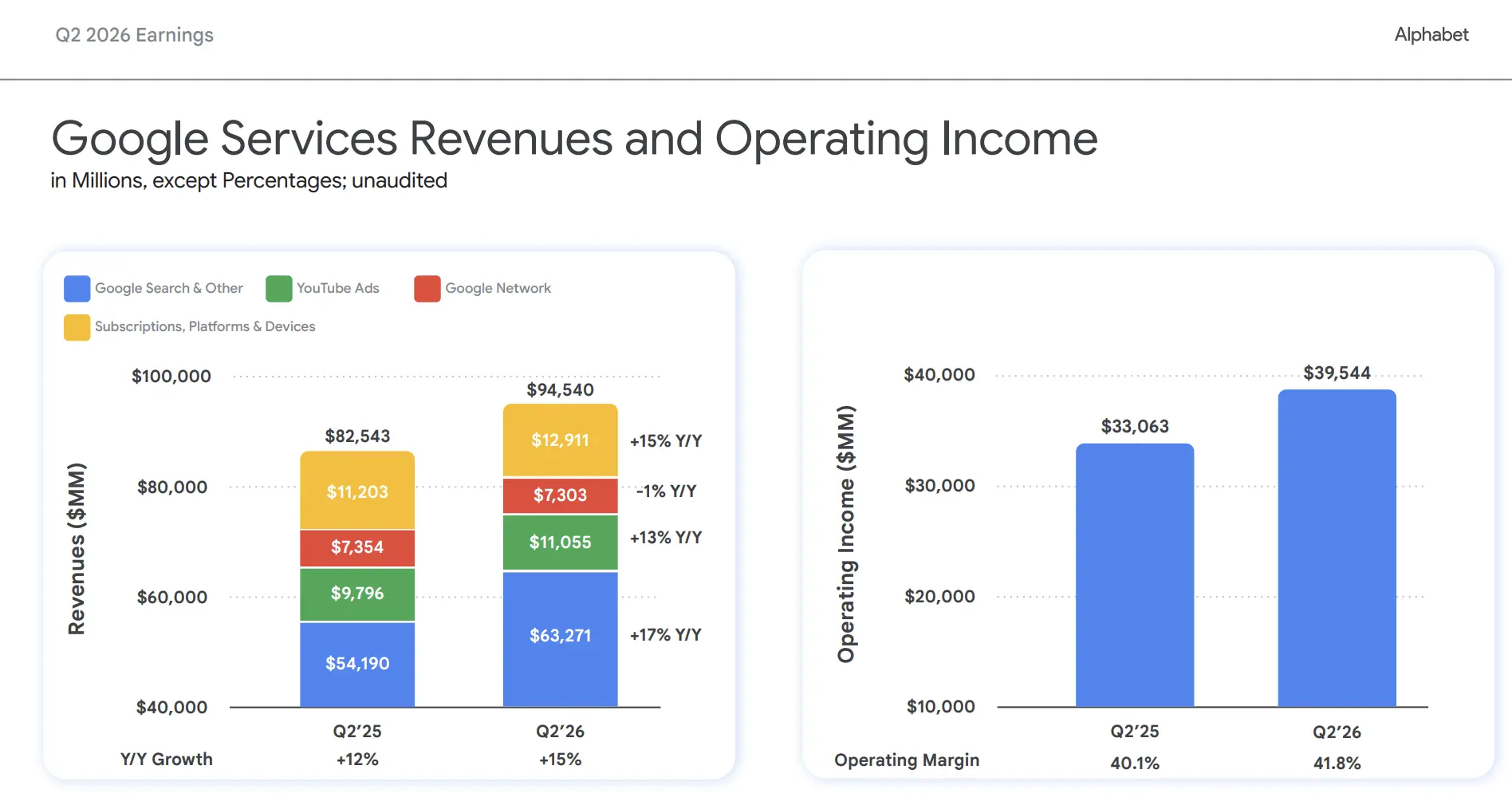
  • Google Search and other revenue was $63.271 billion, a 17% year-over-year increase;
  • YouTube ads revenue was $11.055 billion, a 13% year-over-year increase; regarding YouTube monthly unique users, during the 2026 FIFA World Cup, over 1.7 billion unique users watched related videos on the platform, further driving traffic growth;
  • Google subscriptions, platforms, and devices revenue was $12.911 billion, a 15% year-over-year increase.

Overall, Google Services revenue reached $94.54 billion, a 15% year-over-year increase.
CEO: AI Investment is Reshaping All of Google, Focus on Gemini 4

Alphabet CEO Sundar Pichai stated that the company's AI investment is redefining the entire business.He told investors: "It feels like we're at the very early stages of long-term structural shifts across multiple domains... Over the past year, we have grown increasingly optimistic about future opportunities."

He revealed that nearly 90% of Fortune 100 companies are now using Gemini Enterprise; Gemini models process 220 billion API tokens per minute, and the Gemini App monthly active users have reached 950 million. Nate Elliott, Chief Analyst at eMarketer, pointed out: "Gemini is just one step away from becoming Google's third consumer AI product with a billion users (joining AI Overviews and AI Mode)."

Regarding the model roadmap, Pichai shifted focus to the next-generation flagship model, Gemini 4, describing it as a 'larger-scale next-generation frontier model.' He stated that the company is prioritizing its training by concentrating computing power and indicated that Google's model release pace will accelerate. The delayed release of Gemini 3.5 Pro had previously raised external doubts about Google's competitiveness in areas like AI programming, where Anthropic and OpenAI have gained significant advantages among developer communities.

Simultaneously, AI features continue to drive growth in Google search query volume, demand for the company's cybersecurity products remains robust, and the newly launched Gemini 3.5 Flash Cyber shows outstanding cost efficiency. Additionally, during the 2026 FIFA World Cup, over 1.7 billion unique users watched related videos on YouTube, further driving platform traffic growth.

Pichai stated that the company's "differentiated, full-stack AI strategy" is continuously creating quantifiable commercial value for consumers, enterprise customers, and partners.

Continued Investment in AI Infrastructure

To meet the growing demand for AI computing power, Alphabet intensified its financing efforts in the second quarter.

In June, the company completed the issuance of Class A shares, Class C shares, and mandatory convertible preferred shares, netting $49.6 billion; concurrently, it issued $20.3 billion in senior unsecured bonds; additionally, it established an at-the-market (ATM) equity offering program for up to $40 billion, which had not been initiated as of the end of the second quarter. These measures have brought Alphabet's recent cumulative debt raising close to $100 billion.
Due to the substantial increase in capital expenditures, free cash flow for the quarter turned negative at -$5.855 billion, but free cash flow over the past 12 months remained at $53.273 billion. Meanwhile, the combined capital expenditures of the four hyperscale cloud providers (Google, Meta, Microsoft, Amazon) in 2026 are projected to exceed $725 billion, with the entire technology industry's free cash flow having fallen to a decade-low level.
Overall, this earnings report presents a distinct 'dual nature': the explosive growth of the cloud business and the backlog exceeding $500 billion confirm that AI investments are beginning to yield commercial returns; however, the first-ever negative free cash flow and the second upward revision of capital expenditure guidance this year have kept the market highly vigilant regarding the sustainability of this AI arms race. Whether Google can continue to walk the tightrope between competing for AI leadership and maintaining financial health will be the core proposition most closely watched by investors over the coming quarters.


Трендовые криптовалюты

Связанные с этим вопросы

QAccording to the article, what are the two major financial highlights of Alphabet's Q2 performance that have caused market concern?

AThe two major highlights causing concern are: 1) Alphabet's quarterly free cash flow turned negative for the first time since going public, at approximately -$5.9 billion. 2) The company raised its full-year 2026 capital expenditure guidance for the second time this year, now to a range of $195 billion to $205 billion.

QHow did Google Cloud perform in Q2, and what milestone did its backlog reach?

AGoogle Cloud revenue in Q2 reached $24.768 billion, surging 82% year-over-year and exceeding market expectations. Its contract backlog grew to $514 billion, surpassing the $500 billion milestone for the first time.

QWhat reasons did Alphabet's CFO Anat Ashkenazi give for the pressure on free cash flow and how does the company plan to support its expenditures?

AAnat Ashkenazi stated that the pressure on free cash flow is driven by investments in technical infrastructure to seize AI opportunities. The company plans to support these expenditures through a combination of operating cash flow, debt, and equity financing, while committing not to issue additional shares beyond announced plans and to maintain a strong balance sheet.

QWhat significant financing activities did Alphabet undertake in Q2 to support its AI infrastructure investments?

AIn Q2, Alphabet completed equity offerings (Class A, Class C, and mandatory convertible preferred shares) raising net proceeds of $49.6 billion. It also issued $20.3 billion in senior unsecured bonds and established an At-The-Market (ATM) equity offering program for up to $40 billion. These moves brought its recent cumulative debt raising close to $100 billion.

QAccording to CEO Sundar Pichai, what is the current focus of Alphabet's AI model roadmap and what user metrics did he share for the Gemini models?

ACEO Sundar Pichai indicated the roadmap focus has shifted to the next-generation flagship model, Gemini 4, described as a 'larger-scale next-generation frontier model.' He shared that Gemini models are processing 22 billion API tokens per minute and that the Gemini App has reached 950 million monthly active users.

Похожее

Свадебное дело Чхве Тхэвона закрыто: раскрывая скрытые линии наследования за триллионной империей SK Hynix

Дело о разводе главы SK Group Чхве Тхэвона завершилось, раскрывая сложные сценарии наследования в конгломерате, стоящем за SK Hynix, чья капитализация превысила 1000 трлн вон. В отличие от традиционных сценариев наследования в чеблях, где ключевую роль играют первенец, доли, брачные связи и отцовское признание, трое детей Чхве Тхэвона от бывшей жены Но Соён — дочь Чхве Юнджон (1989 г.р.), дочь Чхве Минджон (1991 г.р.) и сын Чхве Ингын (1995 г.р.) — следуют разными путями. Чхве Юнджон, названная СМИ «наиболее очевидным кандидатом», занимает руководящую должность в SK Inc. и работает над стратегией развития в области биотехнологий и точной медицины, сочетая научную подготовку с бизнес-опытом. Её брак с основателем ИИ-стартапа символизирует новый тип элитных союзов. Чхве Минджон, добровольно служившая в ВМС Республики Корея и работавшая в сфере международной политики в SK Hynix в США, сейчас является основателем ИИ-стартапа в сфере здравоохранения. Её брак с бывшим офицером морской пехоты США подчёркивает связь с геополитическим контекстом, в котором теперь существует полупроводниковый гигант. Чхве Ингын, единственный сын и, казалось бы, естественный наследник по старой логике, сохраняет молчание. Имея образование в области физики, он покинул SK E&S, чтобы присоединиться к McKinsey, что рассматривается как стандартная внешняя стажировка, но без явных сигналов о наследовании. Громкое судебное разбирательство по разводу родителей, связанное с разделом активов на триллионы вон, стало фоном для их путей. По мере того как SK Hynix становится глобальным геополитическим активом в эпоху ИИ, наследование в SK перестаёт быть семейным делом, превращаясь в публичный экзамен на легитимность в новой, сложной реальности. Наследникам предстоит найти свои собственные ответы на вызовы эпохи.

marsbit15 мин. назад

Свадебное дело Чхве Тхэвона закрыто: раскрывая скрытые линии наследования за триллионной империей SK Hynix

marsbit15 мин. назад

Банки выступают против компромисса по доходности стейблкоинов – Найдёт ли закон CLARITY 60 голосов?

Американский Банковский институт политики выступил против нового проекта закона CLARITY Act, указав на пробелы в регулировании доходности стейблкоинов и мерах по борьбе с незаконными финансами. Банковский сектор добивается полного запрета любых форм вознаграждений по стейблкоинам и лоббирует сенаторов, что снижает поддержку со стороны республиканцев. Из-за смерти сенатора Грэма и болезни Макконнелла у республиканцев стало 51 голос. Если сенаторы Кёртис и Корнин откажут в поддержке, эта цифра упадет до 49, а для принятия закона потребуется 60 голосов. Необходимость заручиться поддержкой 11 демократов осложняется тем, что некоторые про-крипто демократы также выступают против законопроекта. Сроки ограничены: до августовских каникул Сената осталось две недели. Лидер большинства Джон Тюн сомневается в успехе до перерыва. Советник Белого дома по криптовалютам Патрик Уитт призывает провести голосование, утверждая, что новые этические нормы устраняют возражения демократов. Вероятность принятия закона в 2026 году, по рыночным оценкам, упала до 32%.

ambcrypto20 мин. назад

Банки выступают против компромисса по доходности стейблкоинов – Найдёт ли закон CLARITY 60 голосов?

ambcrypto20 мин. назад

За 2 месяца оценка выросла с 8,8 до 68 млрд юаней! Крупнейший AI-хаб OpenRouter может быть куплен

Stripe ведет переговоры о приобретении стартапа OpenRouter, агрегатора API крупных языковых моделей, за сумму около 100 миллиардов долларов. Это представляет собой семикратный рост по сравнению с оценкой OpenRouter в 13 миллиардов долларов двумя месяцами ранее. OpenRouter выступает в качестве «маршрутизатора» или агрегатора для более чем 400 AI-моделей (таких как GPT, Claude и множество открытых), позволяя разработчикам через единый API выбирать наиболее подходящую модель для каждой задачи на основе стоимости, скорости и сложности. Это помогает приложениям снижать расходы, автоматически направляя простые запросы к более дешевым моделям. Компания, основанная соучредителем OpenSea Алексом Аталлой, демонстрирует быстрый рост: ее ежегодный доход достиг 50 миллионов долларов, увеличившись в пять раз за полгода. Для Stripe, крупнейшего процессора онлайн-платежей, это вторая крупная сделка в сфере AI-инфраструктуры после приобретения платформы биллинга Metronome в 2025 году. Стратегия Stripe заключается в создании комплексного предложения для AI-экономики: OpenRouter будет «выбирать модель», Metronome — «подсчитывать потребление», а существующие платежные сервисы Stripe — «обрабатывать оплату». Таким образом, Stripe стремится контролировать ключевой уровень инфраструктуры, который определяет распределение трафика между моделями и формирует счета для конечных предприятий. Сделка подчеркивает растущую важность промежуточного слоя, который управляет стоимостью и выбором моделей для миллионов пользователей AI-приложений.

链捕手23 мин. назад

За 2 месяца оценка выросла с 8,8 до 68 млрд юаней! Крупнейший AI-хаб OpenRouter может быть куплен

链捕手23 мин. назад

От OpenSea до OpenRouter: Алекс Аталлах повторяет сценарий «ухода на пике»?

Автор: Нэнси, PANews Алекс Аталла, соучредитель NFT-платформы OpenSea, покинул компанию на пике пузыря NFT четыре года назад. Сейчас он снова оказывается в центре внимания на волне бума ИИ, готовясь продать созданную им агрегирующую платформу AI-моделей OpenRouter по высокой цене. По данным The Wall Street Journal от 23 июля, платежный гигант Stripe ведет переговоры о приобретении OpenRouter, при этом потенциальная оценка сделки может приблизиться к 100 миллиардам долларов. Если сделка состоится, это станет еще одним успехом Аталлы в создании компании на уровне ста миллиардов долларов после OpenSea. Ранее в этом месяце появились сообщения о том, что OpenRouter получил предложения о покупке от нескольких крупных технологических компаний. Потенциальная сделка со Stripe рассматривается как важный шаг для инфраструктурного гиганта в сфере платежей по расширению своего присутствия в области инфраструктуры ИИ. По данным информированных источников, если сделка будет заключена, оценка OpenRouter может приблизиться к 100 миллиардам долларов, что значительно превышает его предыдущие оценки при финансировании. Всего за три года компания добилась быстрого роста благодаря буму больших моделей. Это не первая компания Аталлы стоимостью в сто миллиардов. Ранее он был соучредителем OpenSea, ведущей мировой платформы для торговли NFT, пиковая оценка которой превысила 130 миллиардов долларов. Его уход с OpenSea до серьезного спада на рынке NFT рассматривался как знаковый сигнал. OpenRouter стала крупнейшим хабом в эпоху ИИ, подключившись к более чем 400 AI-моделям, имея около 10 миллионов пользователей и обрабатывая более 200 триллионов токенов в месяц. Однако, несмотря на быстрый рост, это бизнес с большими объемами, но ограниченной рентабельностью. Его основная бизнес-модель заключается в взимании комиссии за платформу (около 5-5,5%) при вызове разработчиками AI-моделей. Конкуренция на рынке агрегации AI-моделей также обостряется. Высокая оценка OpenRouter, возможно, больше отражает его будущий потенциал, чем текущую прибыльность. Для потенциальных покупателей наиболее ценным активом могут быть не текущие доходы, а накопленные реальные данные об использовании ИИ, которые трудно быстро воспроизвести. От NFT к ИИ Алекс Аталла дважды поймал волну технологического бума. Если продажа OpenRouter состоится с оценкой в 100 миллиардов долларов, это может означать либо переоценку стоимости инфраструктуры ИИ, либо сигнал о новом пике цикла. Ответ на этот вопрос даст только время.

链捕手39 мин. назад

От OpenSea до OpenRouter: Алекс Аталлах повторяет сценарий «ухода на пике»?

链捕手39 мин. назад

Приближается ли Биткойн к очередной зоне накопления? ЭТОТ сигнал говорит «да»

Аналитики отмечают, что Bitcoin (BTC) переживает один из самых длительных медвежьих периодов, охватывающий три квартала и два календарных года, при этом его динамика отклонилась от рынка акций. Однако сохраняется корреляция с акциями Apple (AAPL). График соотношения BTC/AAPL с 2017 года движется в восходящем канале, где его нижняя граница традиционно сигнализирует о зоне недооценки (накопления) для Bitcoin, а верхняя — о перекупленности. В настоящее время соотношение приближается к линии поддержки, что, по историческим данным, может предшествовать новой фазе роста BTC. При этом в 2025 году нарушилась многолетняя корреляция годовой доходности Bitcoin с индексами S&P 500 и Nasdaq 100, что объясняется его более резкой реакцией на макроэкономические потрясения. В качестве подтверждающего сигнала для разворота рассматриваются поступления стейблкоинов на криптобиржи, которые указывают на готовность капитала к реинвестированию. За последние семь дней чистый приток составил $1,42 млрд, что значительно меньше оттока в $10 млрд за предыдущие 30 дней и пока недостаточно для уверенного старта ралли. Таким образом, соотношение BTC/AAPL указывает на возможное приближение к зоне накопления, но для подтверждения тренда необходимы более значительные притоки стейблкоинов.

ambcrypto59 мин. назад

Приближается ли Биткойн к очередной зоне накопления? ЭТОТ сигнал говорит «да»

ambcrypto59 мин. назад

Торговля

Спот

Популярные статьи

Как купить S

Добро пожаловать на HTX.com! Мы сделали приобретение Sonic (S) простым и удобным. Следуйте нашему пошаговому руководству и отправляйтесь в свое крипто-путешествие.Шаг 1: Создайте аккаунт на HTXИспользуйте свой адрес электронной почты или номер телефона, чтобы зарегистрироваться и бесплатно создать аккаунт на HTX. Пройдите удобную регистрацию и откройте для себя весь функционал.Создать аккаунтШаг 2: Перейдите в Купить криптовалюту и выберите свой способ оплатыКредитная/Дебетовая Карта: Используйте свою карту Visa или Mastercard для мгновенной покупки Sonic (S).Баланс: Используйте средства с баланса вашего аккаунта HTX для простой торговли.Третьи Лица: Мы добавили популярные способы оплаты, такие как Google Pay и Apple Pay, для повышения удобства.P2P: Торгуйте напрямую с другими пользователями на HTX.Внебиржевая Торговля (OTC): Мы предлагаем индивидуальные услуги и конкурентоспособные обменные курсы для трейдеров.Шаг 3: Хранение Sonic (S)После приобретения вами Sonic (S) храните их в своем аккаунте на HTX. В качестве альтернативы вы можете отправить их куда-либо с помощью перевода в блокчейне или использовать для торговли с другими криптовалютами.Шаг 4: Торговля Sonic (S)С легкостью торгуйте Sonic (S) на спотовом рынке HTX. Просто зайдите в свой аккаунт, выберите торговую пару, совершайте сделки и следите за ними в режиме реального времени. Мы предлагаем удобный интерфейс как для начинающих, так и для опытных трейдеров.

1.7k просмотров всегоОпубликовано 2025.01.15Обновлено 2026.06.02

Как купить S

Sonic: Обновления под руководством Андре Кронье – новая звезда Layer-1 на фоне спада рынка

Он решает проблемы масштабируемости, совместимости между блокчейнами и стимулов для разработчиков с помощью технологических инноваций.

2.4k просмотров всегоОпубликовано 2025.04.09Обновлено 2025.04.09

Sonic: Обновления под руководством Андре Кронье – новая звезда Layer-1 на фоне спада рынка

HTX Learn: Пройдите обучение по "Sonic" и разделите 1000 USDT

HTX Learn — ваш проводник в мир перспективных проектов, и мы запускаем специальное мероприятие "Учитесь и Зарабатывайте", посвящённое этим проектам. Наше новое направление .

1.9k просмотров всегоОпубликовано 2025.04.10Обновлено 2025.04.10

HTX Learn: Пройдите обучение по "Sonic" и разделите 1000 USDT

Обсуждения

Добро пожаловать в Сообщество HTX. Здесь вы сможете быть в курсе последних новостей о развитии платформы и получить доступ к профессиональной аналитической информации о рынке. Мнения пользователей о цене на S (S) представлены ниже.

活动图片