From the "National Fortune ETF" to "Bloody July": How to Defuse South Korea's Stock Market Leverage Crisis?

marsbitОпубликовано 2026-07-18Обновлено 2026-07-18

Введение

From "National Destiny ETF" to "Bloody July": How South Korea's Stock Market Leverage Crisis Unfolded In mid-July, South Korea's stock market experienced an epic "deleveraging" storm. Leveraged ETFs tied to semiconductor giants like Samsung and SK Hynix, once marketed as a shortcut to wealth, turned into financial shredders as market sentiment reversed. Over nine trading days, losses in popular leveraged ETFs exceeded 59.5 billion USD, with retail investors bearing 60% of the impact. Data shows散户 investors suffered losses of around 1.45 billion USD in a month. A severe wave of margin calls affected over 1.2 million accounts, leading to the complete liquidation of 460,000 accounts, 62% of which belonged to investors in their 20s and 30s. The crisis peaked around July 13th, with SK Hynix plunging over 15% and related 2x leveraged ETFs crashing 30%. The daily rebalancing mechanism within leveraged ETFs amplified the sell-off into a stampede. The situation was worsened by a credit crunch, as major banks neared their annual household lending caps, leaving散户 unable to borrow funds to meet margin calls. An unexpected 25-basis-point rate hike by the Bank of Korea on July 16th further intensified the panic. Facing mounting political pressure, President李在明 intervened. Financial authorities quickly announced seven stringent measures, including banning new sales of single-stock leveraged ETFs, raising investment thresholds, and strengthening risk warnings. The regulatory approach foc...

Author: Jae, PANews

On July 17th, the South Korean stock market was closed for Constitution Day, but the dust had not settled. Samsung Electronics and SK Hynix-related products continued to be sold off in other markets. At the close of the Hong Kong market, the 2x leveraged ETFs tracking Samsung and Hynix offered by CSOP Asset Management plummeted by about 20%. Undoubtedly, the South Korean capital market is experiencing an epic "deleveraging" tsunami this summer.

Over the past two weeks, the feverish myth of "everyone trading stocks" has been ruthlessly crushed by cold margin call data. Just two months ago, 2x leveraged ETFs tracking SK Hynix and Samsung Electronics were marketed as a shortcut to wealth to "share in the national fortune." With regulatory relaxation and a surge of retail investors trying to get a piece of the semiconductor bull market, these leveraged tools instantly transformed into a "meat grinder" when industry expectations shifted and the market corrected.

Facing the double squeeze of a market out of control and a bank credit "supply cut," President Lee Jae-myung intervened urgently. Regulators threw "seven heavy punches" overnight, but before that, hundreds of thousands of Korean retail investors had already fallen into the darkest moment—seeing their principal wiped out.

$1.45 Billion Vanishes, 460,000 Accounts Zeroed Out, Over 60% Are Young Investors

By mid-July, each trading day was setting a new record of pain for retail investors betting on the South Korean semiconductor sector.

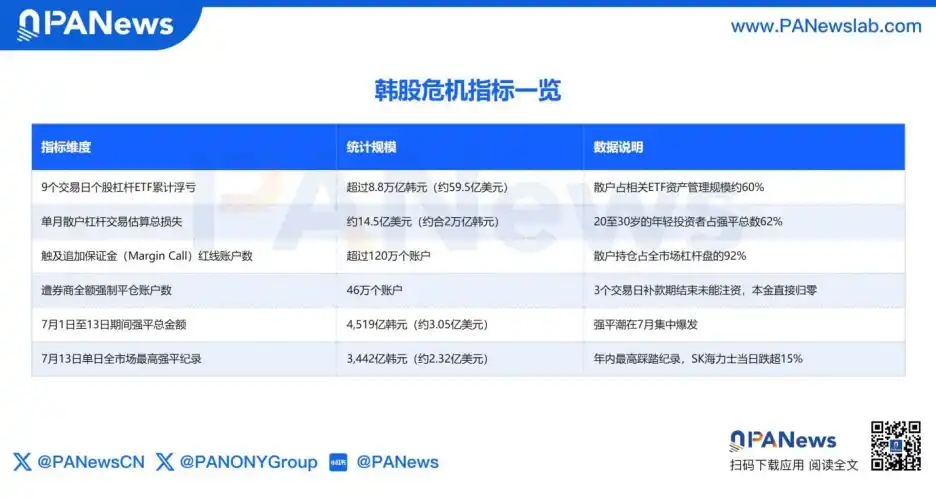
In just nine trading days, the floating losses on single-stock leveraged ETFs favored by retail investors exceeded 8.8 trillion won (approximately $5.95 billion). Among these, individual investors accounted for a staggering 60% of the holdings in leveraged products. This means the "explosive" losses detonated almost entirely within the accounts of ordinary retail investors, who have the weakest risk-bearing capacity.

According to Bloomberg statistics, over the past month, South Korean retail investors have suffered economic losses of up to $145 million (approximately 200 billion won) due to highly leveraged trading. However, an even more severe wave of forced liquidations was looming. Over 1.2 million retail leverage accounts across the market had triggered "margin call" deadlines. Unable to meet the required capital injections within the stipulated time, 460,000 accounts were liquidated by brokers at the click of a button. Investors aged 20-30 made up 62% of these liquidations. Not only was their principal directly wiped out, but the absurd tragedy of "owing money to the broker" also occurred, delivering a heavy lesson to young investors.
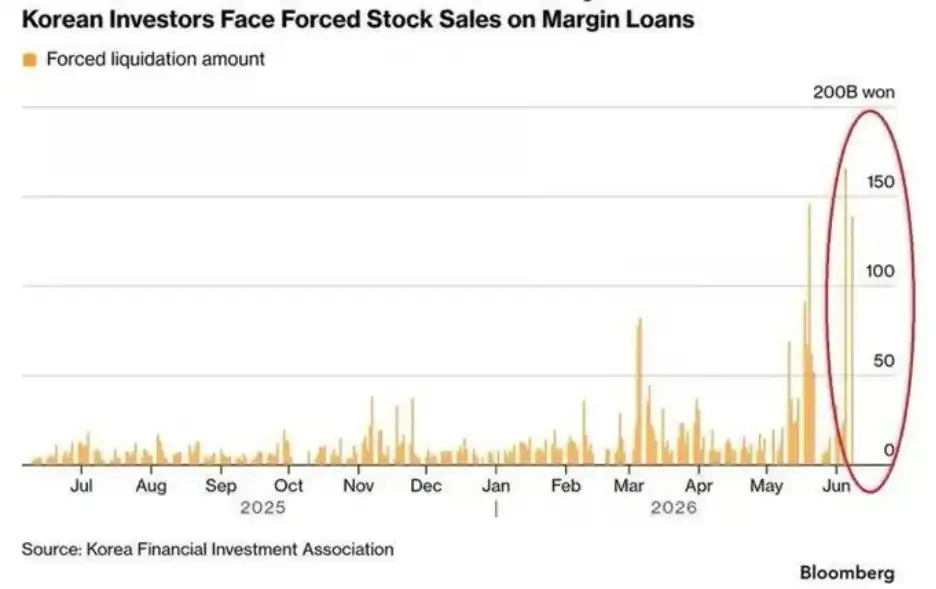
This forced liquidation wave peaked in mid-July. From July 1st to 13th, the cumulative forced liquidation amount reached 451.9 billion won (approximately $305 million). Among this, the daily forced stock liquidation amount hit 142.2 billion won (approximately $95.2 million) on July 9th, with the forced liquidation ratio soaring to 10.2%. On July 13th, the total daily forced liquidation across the entire market surged to 344.2 billion won (approximately $232 million), setting the highest record for the year.

Panic on the trading screens amplified in sync. SK Hynix, which retail investors had almost fully concentrated on, plunged over 15% on July 13th, its largest single-day drop in 18 years. The 2x leveraged ETF tracking its shares plummeted by a cliff-like 30%. The Korea Composite Stock Price Index (KOSPI) plummeted nearly 9% intraday, triggering a trading halt for the 7th time this year, and had cumulatively corrected by as much as 25% from its historical high in June.
Market panic, amplified by leverage mechanisms, snowballed. The widespread liquidation of retail investors was not solely driven by stock price declines. The daily rebalancing mechanism built into single-stock leveraged ETFs was the "disaster engine" that turned a correction into a stampede.

Related read: How leveraged products triggered a market upheaval, turning the South Korean stock market into a "casino"?

Worse still, many retail investors lacking risk control awareness chose to "hold on" during the decline, even continuously adding positions to try to average down their costs. This typical "gambler-style" operation allowed their exposure to grow larger and larger, ultimately accelerating the plunge into the abyss of liquidation.

Bank Credit Supply Cut, Central Bank Adds Insult to Injury with Rate Hike

Leveraged trading on the market was the blade of the meat grinder, while the credit drought off the market was the blood pump sucking away the last drop from retail investors.

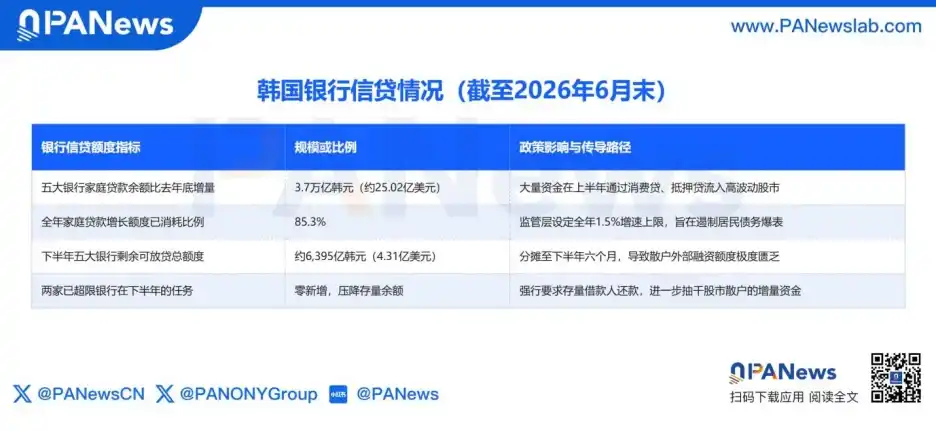
South Korean households have a long history of "borrowing money to trade stocks." During the bull market in the first half of the year, demand from retail investors to use home equity loans or cash-out refinancing for leverage was extremely strong. However, to curb the malignant expansion of household debt, South Korean regulators imposed a hard cap of 1.5% annual growth for household loans at commercial banks.

This red line turned into a tightened noose by mid-year. By the end of June, the household loan balance of South Korea's five major commercial banks had increased by 3.7 trillion won (approximately $25.02 billion) compared to the beginning of the year, already consuming 85.3% of the annual lending quota. The remaining quota was only about 639.5 billion won ($431 million). Two banks had even exceeded their quotas ahead of schedule, meaning they could not only not issue new loans in the second half but also had to recall existing loans to bring their balances back down.

This meant that when the stock market crashed in July, and 1.2 million accounts collectively triggered margin call notices, retail investors suddenly found out: they couldn't borrow money. With no fresh funds to add, forced liquidation by their brokers was their only path.
Adding insult to injury was an unexpected interest rate hike from the Bank of Korea. On July 16th, with market liquidity already extremely fragile, the Bank of Korea dropped a bombshell: it announced a 25 basis point hike in the benchmark interest rate to 2.75%, marking its first shift to tightening in three and a half years. Although the policy intent was to narrow the interest rate gap with the US, alleviate foreign capital flight, and stabilize the Korean won, raising rates amid a liquidation wave was akin to pouring salt on the deleveraging wound.

That day, the KOSPI plummeted 6.37% in response, and SK Hynix plunged 11.53%, triggering a negative feedback loop of deleveraging.

Seven Emergency Brakes: Cutting Supply, Not Defusing the Bomb

The tragedy of widespread principal wipeouts rapidly evolved into a political issue. Ahn Cheol-soo, a lawmaker from the People Power Party, had earlier angrily denounced the KOSPI on social media, saying it had "become a casino."

Facing the accusation of a "national fortune casino" and the stark reality of the wealth of hundreds of thousands of families turning to dust, President Lee Jae-myeng personally singled out the single-stock leveraged ETFs of Samsung and SK Hynix, sternly ordering financial authorities to swiftly formulate countermeasures.

On July 16th, the F4 consultative mechanism—comprising the Financial Services Commission, the Financial Supervisory Service, the Ministry of Economy and Finance, and the central bank—urgently introduced a package of iron-fisted new rules resembling "shock therapy," aimed at cooling this leverage fever.
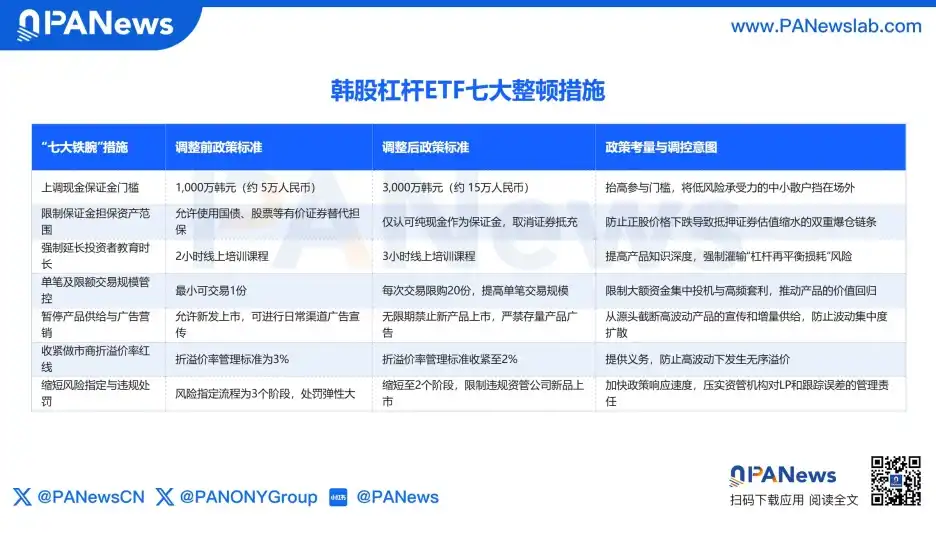
Notably, regulators did not choose to directly force the delisting of existing ETFs, as panic-driven "pulling the plug" could trigger even more severe liquidity stampedes. The regulators' true logic was: not to actively prick the existing bubble, but to force the market into a prolonged period of passive clearing by raising entry barriers and cutting off new capital inflows.

As the new regulations are set to take effect, the rules for South Korea's single-stock leveraged market are being forcibly reshaped, and the frenzy of speculative fever is expected to temporarily recede. However, the risk has not truly been resolved: currently, over 35 trillion won (approximately $23.55 billion) in margin loan balances still hangs over the South Korean stock market. Against the backdrop of credit tightening and a rising interest rate cycle, the existing leveraged accounts have essentially lost their cushion.

The financial chill from Seoul has awakened retail investors who were immersed in stock market fever. Leveraged innovations detached from investors' actual income support and strict regulatory constraints are essentially just building wealth bubbles. When a major downturn strikes, all fabricated prosperity will be cleared by the market, and the ultimate price is often borne by the most vulnerable retail investors.


Трендовые криптовалюты

Связанные с этим вопросы

QWhat was the catastrophic consequence of the leverage crisis for Korean retail investors in July, according to the article?

AThe crisis resulted in massive losses and forced liquidations. Over a 9-day period, leveraged ETFs popular with retail investors saw floating losses exceeding 59.5 billion USD. More than 120,000 accounts triggered margin calls, and 460,000 accounts were completely liquidated, with their principal wiped out. Young investors in their 20s and 30s accounted for 62% of those liquidations.

QWhat specific mechanism within the leveraged ETFs turned a market correction into a disaster, as explained in the article?

AThe article identifies the daily rebalancing mechanism built into single-stock leveraged ETFs as the 'disaster engine.' This mechanism, designed to maintain a constant leverage ratio daily, forces the ETF to sell assets as the underlying stock price falls, creating a vicious cycle of selling pressure that accelerates declines and triggers cascading liquidations.

QHow did the actions of Korean commercial banks and the central bank exacerbate the leverage crisis for investors?

ACommercial banks, adhering to a strict annual 1.5% cap on household loan growth, exhausted most of their quota by mid-year. This left investors unable to secure new loans to meet margin calls when the market fell. Simultaneously, the Bank of Korea unexpectedly raised interest rates by 25 basis points to 2.75%, tightening liquidity and further spooking the market, which crashed sharply on the news.

QWhat was the core strategy of the emergency regulations (the 'seven measures') introduced by Korean financial authorities on July 16?

AThe core strategy was not to actively 'defuse the bomb' by forcibly delisting existing leveraged ETFs (which could cause worse panic), but to implement a 'cold turkey' approach. The new regulations raised barriers to entry, such as suspending new ETF issuances and imposing trading experience requirements, effectively cutting off new speculative capital and forcing a slow, passive market clearing of the existing leverage.

QWhich two major Korean companies' stock and related leveraged ETFs were at the center of this financial turmoil?

ASamsung Electronics and SK Hynix were the two major Korean semiconductor companies at the center of the crisis. Their stocks experienced severe declines, and the 2x leveraged ETFs tracking these individual stocks, which had been heavily marketed to retail investors, saw catastrophic drops of up to 30% in a single day.

Похожее

Kalshi пообещал подать апелляцию после того, как судья в Вашингтоне признал, что рынок прогнозов, вероятно, нарушает законы штата об азартных играх

Компания Kalshi, оператор прогнозных рынков, регулируемых Комиссией по торговле товарными фьючерсами (CFTC), пообещала подать апелляцию после того, как судья в штате Вашингтон выдал предварительный судебный запрет. Суд постановил, что деятельность компании, вероятно, нарушает законы штата об азартных играх и защите прав потребителей. Иск был подан генеральным прокурором штата, который утверждает, что платформа Kalshi позволяет делать ставки на широкий круг событий, включая спорт и выборы, что представляет собой незаконный онлайн-гемблинг по местным законам. Kalshi отвергает претензии, настаивая на том, что её контракты на события регулируются федеральным Законом о товарных биржах и находятся под исключительной юрисдикцией CFTC, а не властей штатов. Компания заявила, что штаты не имеют права регулировать подобные рынки. Однако суд на предварительной стадии заключил, что федеральный закон не отменяет действие законов Вашингтона об азартных играх. Это дело является частью более широкой правовой битвы по вопросу о том, подпадают ли федерально регулируемые прогнозные рынки исключительно под федеральный надзор или также под действие законов штатов об азартных играх. Исход апелляции может оказать существенное влияние на будущее регулирование этой растущей отрасли по всей стране. Окончательное решение по судебному запрету ожидается 5 августа.

ambcrypto3 мин. назад

Kalshi пообещал подать апелляцию после того, как судья в Вашингтоне признал, что рынок прогнозов, вероятно, нарушает законы штата об азартных играх

ambcrypto3 мин. назад

Зарядка Bitcoin для $70K здесь, несмотря на слабый спрос на споте — вот как!

Рынок сигнализирует о возможной повышенной волатильности Bitcoin. Несмотря на слабый спрос на спотовом рынке (показатель упал до -170 тыс. BTC), данные Glassnode и CryptoQuant указывают на накопление крупными держателями («китами») 66,7 тыс. BTC за последние 60 дней. Это может свидетельствовать о переходе активов в «более сильные руки» (LTH). Одновременно наблюдается рост позиций с плечом: положительные funding-ставки выросли более чем на 20% за 72 часа, что создаёт риск массовых ликвидаций лонгов при отсутствии свежего покупательского спроса. Однако недавний рост цены выше $66 тыс. сопровождался ликвидацией шортов на сумму свыше $80 млн. Общая картина предполагает, что текущая ситуация может привести либо к коррекции из-за перегретых лонгов, либо, если спрос восстановится, к пробою в сторону уровня $70 тыс., что вызовет ликвидацию оставшихся медведей. Ключевым фактором станет динамика спотового спроса.

ambcrypto42 мин. назад

Зарядка Bitcoin для $70K здесь, несмотря на слабый спрос на споте — вот как!

ambcrypto42 мин. назад

Занижена ли стоимость Биткойна? Почему $66 тыс. могут не отражать всей картины о BTC

Биткоин (BTC) вновь преодолел отметку в $66 000, впервые с 17 июня, на фоне общего восстановления рынка криптовалют. Однако данные аналитической платформы CryptoQuant указывают, что BTC всё ещё может быть недооценен. Метрика MVRV Percentile, оценивающая текущую цену относительно исторических данных, находится на уровне 5-го процентиля. Это означает, что актив торгуется ниже, чем в 95% случаев за всю историю наблюдений, что традиционно сигнализирует о периоде недооценки и в прошлом предшествовало устойчивому росту. В то же время активность на спотовом рынке демонстрирует нейтралитет. Индикатор Spot Taker Cumulative Volume Delta (CVD) показывает баланс между объёмами покупок и продаж с 14 июня, что указывает на отсутствие доминирования быков или медведей. Чистый приток средств (Netflow) в спотовый рынок остаётся положительным, но недостаточно сильным: около $34,66 млн за 24 часа и $1,22 млрд за 30 дней. Это свидетельствует об осторожном накоплении, но не о мощном покупательском давлении. Таким образом, несмотря на технический сигнал недооценки по метрике MVRV, для подтверждения устойчивого бычьего тренда и продолжения роста выше $66 000 рынку требуется более значительный и уверенный приток покупательского объёма в спотовом сегменте.

ambcrypto1 ч. назад

Занижена ли стоимость Биткойна? Почему $66 тыс. могут не отражать всей картины о BTC

ambcrypto1 ч. назад

База утверждает, что «акции с обеспечением 1:1 гораздо лучше масштабируются», на фоне соперничества с Robinhood

Создатель Base Джесси Поллак признал преимущество Robinhood Chain в выпуске токенизированных акций в среде EVM, но выразил уверенность, что подход Base окажется более эффективным. Поллак заявил, что Base вскоре запустит токенизированные акции с обеспечением 1:1 при поддержке Coinbase, в отличие от производных продуктов Robinhood, что, по его мнению, обеспечит лучшее масштабирование, доверие и признание институциональными инвесторами. Несмотря на то, что Robinhood Chain, как новый Ethereum Layer 2, всего за три недели достиг сравнимых с Base показателей по количеству активных пользователей (около 1 млн в неделю) и даже обогнал по объему торгов на DEX и выручке, Поллак преуменьшает эту угрозу. Аналитики отмечают, что Robinhood, как брокер с 27 млн фондируемых счетов, имеет уникальное преимущество для распространения ончейн-решений. Таким образом, на рынке токенизированных активов формируется соперничество между моделью с полным обеспечением (Base) и моделью, основанной на деривативах и мощной дистрибуции (Robinhood Chain).

ambcrypto2 ч. назад

База утверждает, что «акции с обеспечением 1:1 гораздо лучше масштабируются», на фоне соперничества с Robinhood

ambcrypto2 ч. назад

Прогноз цены TON/GRAM – запуск кошелька Gram в Telegram поднял токен: Продолжится ли ралли?

Соучредитель Telegram Павел Дуров объявил о скором внедрении собственного некастодиального кошелька Gram во все приложения мессенджера. Это решение, которое Дуров назвал крупнейшим в истории развертыванием некастодиального криптокошелька, позволит более чем миллиарду пользователей Telegram проводить мгновенные криптовалютные транзакции без комиссий. Анонс сопровождается переименованием нативного токена TON в Gram, чтобы четче разделить блокчейн The Open Network и потребительскую цифровую валюту внутри экосистемы Telegram. Внедрение кошелька может значительно упростить использование криптовалют для широкой аудитории. На фоне этой новости цена TON/GRAM выросла более чем на 7%, достигнув примерно $1,53. Несмотря на восстановление от уровня поддержки $1,40, токен по-прежнему торгуется значительно ниже своего пика в $2,80, достигнутого в мае. Ближайшее сопротивление находится около $1,60. Успешный прорыв выше этого уровня может открыть путь к $1,80, в то время как потеря текущих позиций может привести к повторному тестированию поддержки $1,40.

ambcrypto3 ч. назад

Прогноз цены TON/GRAM – запуск кошелька Gram в Telegram поднял токен: Продолжится ли ралли?

ambcrypto3 ч. назад

Торговля

Спот

Популярные статьи

Как купить S

Добро пожаловать на HTX.com! Мы сделали приобретение Sonic (S) простым и удобным. Следуйте нашему пошаговому руководству и отправляйтесь в свое крипто-путешествие.Шаг 1: Создайте аккаунт на HTXИспользуйте свой адрес электронной почты или номер телефона, чтобы зарегистрироваться и бесплатно создать аккаунт на HTX. Пройдите удобную регистрацию и откройте для себя весь функционал.Создать аккаунтШаг 2: Перейдите в Купить криптовалюту и выберите свой способ оплатыКредитная/Дебетовая Карта: Используйте свою карту Visa или Mastercard для мгновенной покупки Sonic (S).Баланс: Используйте средства с баланса вашего аккаунта HTX для простой торговли.Третьи Лица: Мы добавили популярные способы оплаты, такие как Google Pay и Apple Pay, для повышения удобства.P2P: Торгуйте напрямую с другими пользователями на HTX.Внебиржевая Торговля (OTC): Мы предлагаем индивидуальные услуги и конкурентоспособные обменные курсы для трейдеров.Шаг 3: Хранение Sonic (S)После приобретения вами Sonic (S) храните их в своем аккаунте на HTX. В качестве альтернативы вы можете отправить их куда-либо с помощью перевода в блокчейне или использовать для торговли с другими криптовалютами.Шаг 4: Торговля Sonic (S)С легкостью торгуйте Sonic (S) на спотовом рынке HTX. Просто зайдите в свой аккаунт, выберите торговую пару, совершайте сделки и следите за ними в режиме реального времени. Мы предлагаем удобный интерфейс как для начинающих, так и для опытных трейдеров.

1.7k просмотров всегоОпубликовано 2025.01.15Обновлено 2026.06.02

Как купить S

Sonic: Обновления под руководством Андре Кронье – новая звезда Layer-1 на фоне спада рынка

Он решает проблемы масштабируемости, совместимости между блокчейнами и стимулов для разработчиков с помощью технологических инноваций.

2.4k просмотров всегоОпубликовано 2025.04.09Обновлено 2025.04.09

Sonic: Обновления под руководством Андре Кронье – новая звезда Layer-1 на фоне спада рынка

HTX Learn: Пройдите обучение по "Sonic" и разделите 1000 USDT

HTX Learn — ваш проводник в мир перспективных проектов, и мы запускаем специальное мероприятие "Учитесь и Зарабатывайте", посвящённое этим проектам. Наше новое направление .

1.9k просмотров всегоОпубликовано 2025.04.10Обновлено 2025.04.10

HTX Learn: Пройдите обучение по "Sonic" и разделите 1000 USDT

Обсуждения

Добро пожаловать в Сообщество HTX. Здесь вы сможете быть в курсе последних новостей о развитии платформы и получить доступ к профессиональной аналитической информации о рынке. Мнения пользователей о цене на S (S) представлены ниже.

活动图片