CBRS First Post-IPO Earnings Report: Revenue Doubles but Gross Margin Guidance Plummets, OpenAI's Massive Order Faces a Long Road to Realization

marsbitОпубликовано 2026-06-24Обновлено 2026-06-24

Введение

Cerebras Systems (CBRS) released its first quarterly report since going public. Q1 core revenue of $191.3M beat expectations, surging 92% YoY, with full-year revenue guidance raised to $855-$865M. However, the company's Q2 gross margin guidance of 36%-38% represents a sharp drop from Q1's 47%, sending shares down over 10% after-hours. Management attributed the margin pressure to temporary costs from leasing back hardware to deploy capacity for OpenAI, highlighting a business model shift from selling chips to selling compute power. While growth is strong, key investor debates center on valuation, customer concentration, and long-term contracts. Revenue remains heavily concentrated (86% from two UAE-linked entities in FY25), though major deals with OpenAI (a $20B+ contract) and AWS provide a long-term growth narrative. Analysts are broadly bullish, citing Cerebras's unique wafer-scale chip architecture as a potential advantage in the AI inference market. However, skeptics point to the narrow moat of its speed advantage, uncertainties around margin recovery amid its business transition, and a high valuation (~50x forward sales) that prices in the flawless execution of its large, long-dated contracts.

Author: David, Chaoxiang Research

Chaoxiang Guide: Cerebras (CBRS) delivered its first quarterly report since the IPO. Q1 core revenue was $191 million, a 92% year-over-year increase, exceeding market expectations. However, Q2 core gross margin guidance dropped sharply from 46.5% to 36%-38%, causing the stock price to fall over 10% after-hours. This company, which makes chips from an entire wafer and bets on the AI inference track, holds OpenAI contracts worth over $20 billion and an AWS cooperation framework. Full-year revenue guidance is $855-$865 million. The growth data is solid, but the valuation debate is equally significant.

Key Points of Focus

  1. Revenue beats expectations, guidance beats even more. Q1 core revenue was $191.3 million (up 92% YoY), higher than the consensus estimate of approximately $181 million. Full-year core revenue guidance of $855-$865 million (up 69% YoY) exceeds the market expectation of $828 million. On a GAAP basis, cloud and services revenue reached $82.8 million, a 178% YoY increase, making it the fastest-growing segment.
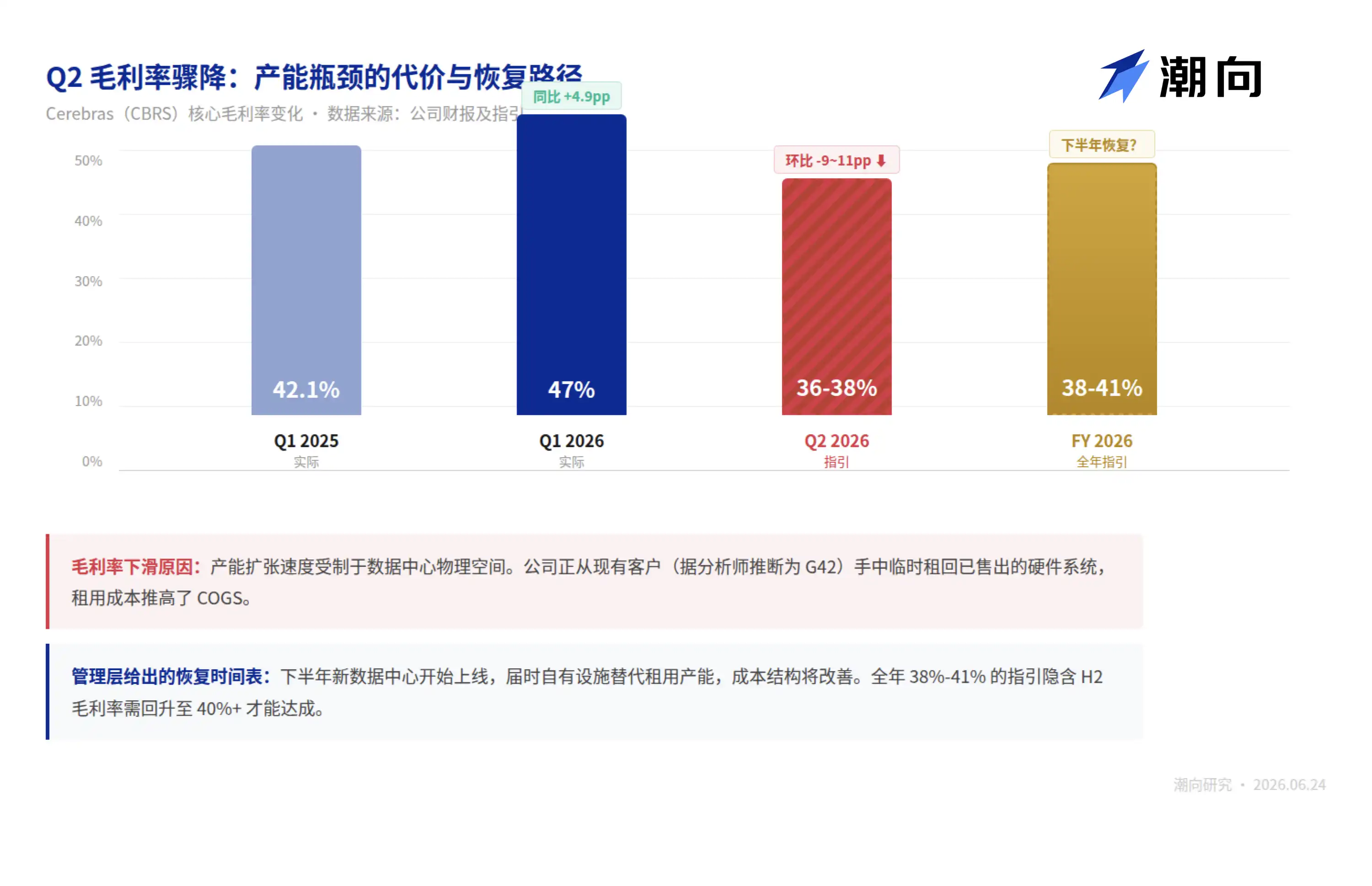
  2. The sharp drop in gross margin guidance is the biggest negative this quarter. Q1 core gross margin was 47%, up nearly 5 percentage points YoY. However, Q2 guidance fell to 36%-38%, a drop of about 10 percentage points from Q1; full-year guidance is 38%-41%. Management attributed this to insufficient data center capacity: the company is temporarily leasing back systems from existing customers who have already purchased the hardware to deploy capacity, worsening short-term costs. After-hours stock price fell over 10%.
  3. Customer concentration shows signs of improvement but is far from resolved. 86% of FY2025 revenue came from two UAE-related entities (MBZUAI accounted for 62%, G42 for 24%). OpenAI will start contributing revenue in February 2026, and the AWS cooperation is expected to reflect financially only in 2027. Genuine revenue diversification will not be verifiable until 2027.
  4. Valuation pricing extends to 2028. Based on the after-hours price of about $200, CBRS trades at about 90x trailing twelve-month revenue; even using the full-year guidance midpoint of $860 million, the forward P/S is still above 50x. The median price target from 10 covering analysts is $300 (range $250-$340), which implicitly assumes the OpenAI contract worth over $20 billion and AWS deployments are fulfilled on schedule and volume.
  5. Short-term catalysts and headwinds coexist. Catalysts: Accelerated deployment of OpenAI's 750MW computing power, AWS inference solution rollout, new data center capacity coming online in the second half. Headwinds: Lock-up period contains unconventional early release clauses (triggered if market cap exceeds $40 billion, current market cap is near that threshold), unclear path to gross margin recovery, OpenAI itself is not yet profitable and has already scaled back some computing power commitments.

Earnings Reveal Business Model Shift: From Selling Chips to Selling Computing Power

The most easily overlooked detail in the Q1 report is the change in revenue mix.

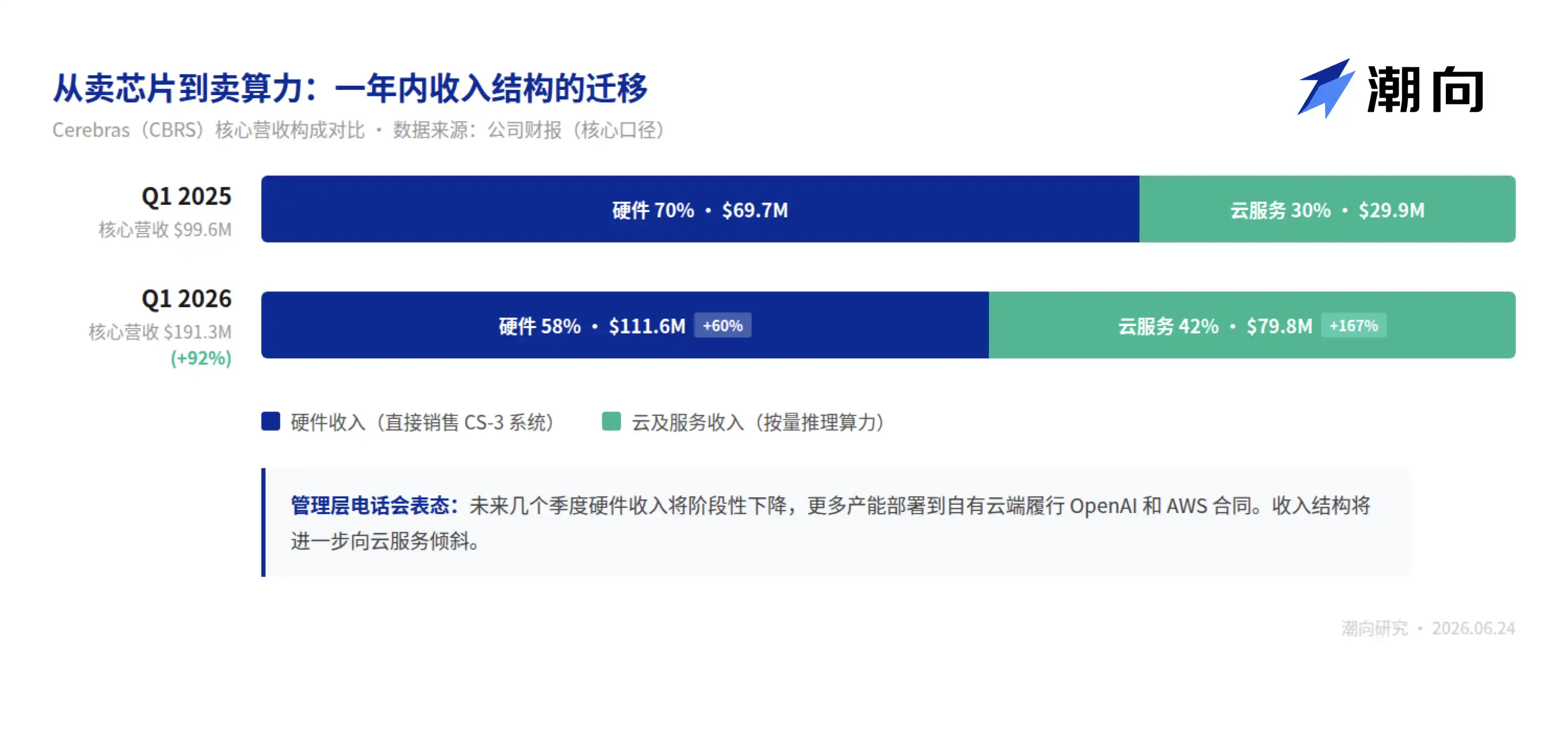
Under the core metric, hardware revenue was $111.6 million, accounting for 58% of total revenue; cloud and services revenue was $79.8 million, accounting for 42%. A year ago, this ratio was roughly 70:30. Cloud services revenue grew 167% YoY, nearly three times the growth rate of hardware.

Management made this trend clearer on the earnings call:

Hardware revenue will decline sequentially in the coming quarters because the company will deploy more hardware capacity into its own cloud to fulfill OpenAI's and AWS's inference computing power contracts, rather than selling directly to customers. Cerebras is shifting from a "chip-selling company" to a "computing power-selling company."

This transformation directly explains the sharp drop in Q2 gross margin guidance.
An analyst pressed for details on capacity deployment during the call. Management revealed:

The company's current bottleneck is not chip supply from TSMC, but the physical space in data centers. To deliver computing power to OpenAI as soon as possible, Cerebras is "temporarily leasing back" hardware systems already sold to G42 (its previous largest customer and a minority equity investor).

Deploying its own systems in leased third-party facilities worsens the cost structure in the short term, which is the main reason for the gross margin guidance drop from 47% to 36%-38%. Management's timeline indicates new data centers will start coming online in the second half of the year, easing cost pressures at that time.

The financial structure of the OpenAI contract is also worth unpacking. On the surface, it's a multi-year computing power purchase worth over $20 billion, but underneath, three relationships are layered: OpenAI provided Cerebras with a $1 billion operating capital loan (reflected on the Q1 balance sheet as $621 million in current loans and $362 million in non-current loans), while also receiving warrants for Cerebras stock.

In other words, OpenAI simultaneously plays the roles of largest customer, creditor, and potential shareholder for Cerebras. Risk disclosures in the S-1 indicate that if Cerebras fails to deliver capacity as agreed, OpenAI has the right to terminate the contract and trigger loan repayment.
The cooperation framework with AWS adopts a "split inference" architecture: AWS's Trainium 3 chip handles prompt input (prefill stage), while Cerebras's CS-3 system is dedicated to high-speed output generation (decode stage). This design allows Cerebras to handle only the part of the inference pipeline where its speed advantage is greatest. However, management declined to disclose the specific scale of the AWS cooperation during the Q&A and stated that revenue contribution would only appear on the financials in 2027.

The common feature of these two large contracts is: Contract sizes are massive, but realization paths are long, and heavily dependent on Cerebras's data center construction progress.

Full-year revenue guidance of $855-$865 million implies the next three quarters need to average around $220 million each, with sequential acceleration in growth. Management's statement is "year-over-year growth will increase each quarter in 2026, with more revenue concentrated in the second half."

The Bull Case: Nine Banks Initiate Coverage with Buy Ratings, What Are They Buying?

On June 8, the day the IPO quiet period ended, nine underwriting banks simultaneously initiated coverage, all issuing Buy or Outperform ratings. CBRS stock rose 18.3% that day. This kind of coordinated bullishness is not uncommon for US IPOs (underwriters have inherent interests), but their investment theses point to the same core proposition.

Thesis One: The battlefield for AI computing power is shifting from training to inference, and the rules of competition in inference differ from training.

Morgan Stanley analyst Joseph Moore issued an Overweight rating with a $250 price target in his June 8 initiation report. His core argument is: The training scenario competes on total computing throughput, where NVIDIA GPU clusters dominate absolutely; the inference scenario competes on the speed and latency of single responses, as models must process millions of user requests per second, and speed directly impacts service cost and user experience. Cerebras's wafer-scale chips, with their on-chip SRAM capacity far exceeding conventional GPUs (data doesn't need frequent movement to external memory), possess a structural advantage in inference latency. Moore's statement is that Cerebras is "the only company that has commercially deployed wafer-scale processors," giving it a first-mover advantage over NVIDIA.

Citi analyst Atif Malik gave the highest price target among coverages at $340. Mizuho added a technical detail in its June 8 report: The WSE-3 chip has 44GB of built-in SRAM, several times that of Google's latest TPU and Groq's LPU, a hardware gap that cannot be closed through architectural optimization in the short term.

Thesis Two: Two major contracts advance Cerebras from a "technology story" to a "revenue story."

The OpenAI contract exceeds $20 billion, covering 750MW of inference computing power, to be delivered over multiple years. Amortized over five years, this contract alone would contribute approximately $4 billion in annual revenue, nearly 5 times the midpoint of the 2026 full-year revenue guidance. Although management refused to disclose the specific amount for the AWS cooperation, the framework is confirmed: Cerebras's inference capabilities will be offered globally to enterprise customers through Amazon Bedrock.

Q1 earnings data provided early validation. OpenAI began deploying Cerebras systems in February, and cloud service revenue jumped from less than $30 million YoY to nearly $80 million in one quarter. Management's statement is "year-over-year growth will increase each quarter in 2026, with more revenue concentrated in the second half." The full-year guidance of $855-$865 million exceeds the consensus estimate of $828 million.

Thesis Three: The density of coverage right after the quiet period is itself a signal.

The median price target from 10 analysts is $300, with a low of $250 (Morgan Stanley) and a high of $340 (Citi). Based on the after-hours price of $200, the median target implies about 50% upside. Wedbush ($270 target), Needham ($300), Barclays ($280), TD Cowen ($275), and Craig-Hallum (Buy) all initiated coverage in the same week.

The underlying assumption of the bull case can be summed up in one sentence:

If AI inference becomes a larger computing power market than training (multiple institutions predict inference spending will surpass training by 2027), and Cerebras's speed advantage is real and sustainable, then it only needs to capture 3%-5% of the market where NVIDIA holds an 80%+ share to justify its current valuation.

The Bear Case: Gross Margin, Customer Concentration, and the Fragility of a $45 Billion Valuation

For each of the bull's three theses, the bears have counterarguments.

Counterargument One: The moat from inference speed advantage may be narrower than imagined.

Cerebras's speed advantage is built on on-chip SRAM capacity, but NVIDIA is not standing still. The B300 chip released by NVIDIA in March significantly increased HBM bandwidth, and Groq's LPU architecture is also iterating rapidly on the inference front.

Viewed from another angle: Cerebras's customers are currently highly concentrated in just OpenAI and AWS. OpenAI is also one of NVIDIA's largest GPU purchasing clients, and AWS's in-house Trainium chip is covering more and more inference scenarios. Cerebras's major customers are simultaneously betting on alternatives, meaning its speed premium will face continuous price negotiation pressure.

Counterargument Two: The gross margin decline might not be just "temporary."

Management attributed the Q2 gross margin drop from 47% to 36%-38% to temporary leasing costs due to insufficient data center capacity. But this explanation assumes "costs will improve when new data centers come online in the second half."

Considering that revenue scale is expected to jump in the second half (management explicitly stated revenue is back-end loaded), and new data center capacity ramp-up itself requires time and capital investment, this recovery path is not easy.

A deeper issue is the impact of the business model shift itself on gross margin. Cerebras's shift from selling hardware to selling cloud computing power means taking on data center construction, operation, and depreciation costs. As depreciation expenses for self-built data centers are accounted for, uncertainty remains over whether cloud service gross margins can stay above 50%. The profitability ceiling of this business model has yet to be tested.

Counterargument Three: Customer concentration is a problem that has "changed names but is not solved."

In 2024, G42 alone contributed 85% of Cerebras's revenue. In 2025, G42's share dropped to 24%, but MBZUAI (Mohamed bin Zayed University of Artificial Intelligence) surged from nothing to 62%. The S-1 prospectus clearly labels these two as "related parties." The two UAE-related entities combined still account for 86% of revenue. Revenue source diversification is more about a change in names rather than substantive dispersion.

Finally, CBRS's IPO lock-up period contains an unconventional clause:

If the company's market cap consistently exceeds $40 billion, insider shares can be released early. At the after-hours price of $200, the current market cap is about $45 billion, already near the trigger line. On the short side, as of May 29, the short interest was 17.15% of the float, which is on the high side. If the lock-up period triggers an early release, unleashing a large number of insider shares, combined with existing short pressure, the stock could face concentrated selling.


Трендовые криптовалюты

Связанные с этим вопросы

QWhat was the main negative surprise in Cerebras' (CBRS) Q2 guidance according to the article?

AThe main negative surprise was the sharp decline in the Q2 core gross margin guidance from 47% in Q1 to a range of 36%-38%. This triggered a more than 10% drop in the stock price after hours.

QWhat are the two major contracts that represent the 'revenue story' for Cerebras' future growth?

AThe two major contracts are: 1) The over $20 billion, multi-year contract with OpenAI for 750MW of inference compute power, with revenue contribution starting from February 2026. 2) The collaboration framework with AWS to offer inference solutions via Amazon Bedrock, with revenue expected to show up in financials from 2027.

QWhy does the article argue that Cerebras' customer concentration issue is 'not solved' despite the changing names?

AIn FY2025, 86% of Cerebras' revenue still comes from two UAE-affiliated entities: MBZUAI (62%) and G42 (24%). These are noted as related parties. Therefore, while the name of the largest contributor changed, revenue remains heavily concentrated within a related group, not genuinely diversified.

QAccording to the bullish analyst logic, what is Cerebras' key structural advantage in the AI inference market?

AIts key structural advantage is the massive on-chip SRAM capacity (44GB on the WSE-3) of its wafer-scale processors. This allows data to be processed without frequent transfers to external memory, significantly reducing latency, which is critical for real-time AI inference serving user requests.

QWhat is the primary reason given by management for the expected sharp decline in Q2 gross margins?

AManagement attributed the decline to a shortage of data center capacity. To expedite deployment for OpenAI, Cerebras is temporarily leasing back hardware systems already sold to existing customers (like G42). This short-term rental arrangement worsens the cost structure, pressuring margins. They expect pressure to ease when new data centers come online in the second half of the year.

Похожее

История серьезного мошенничества, в котором погряз криптоединорог Blockstream

В статье рассматриваются обвинения против компании Blockstream и её основателя Адама Бэка, связанные с выпуском горнодобывающих нот (BMN). Расследование аккаунта NatInfoSec указывает на возможные несоответствия между заявленной мощностью майнинга Blockstream (15 EH/s) и мощностью, необходимой для выполнения обязательств по BMN (20-45 EH/s). Вызывают вопросы источники выплат инвесторам, особенно учитывая пункт контракта, позволяющий Blockstream использовать биткоины из любого источника. Также обращается внимание на высокую фиксированную доходность нот (до ~20%) в волатильной отрасли. Особое внимание уделяется криминальному прошлению Кристофера Кука, ключевой фигуры в майнинговом подразделении Blockstream (Exacore), осужденного за мошенничество, что не было раскрыто инвесторам. Поднимаются вопросы о потенциальных рисках для связанной компании BSTR, готовящейся к выходу на биржу через SPAC. Хотя BitMEX Research отмечает, что некоторые обвинения могут быть преувеличены, а Samson Mow защищает BSTR, основные вопросы остаются: прозрачность и проверяемость реальных мощностей майнинга, источников выплат, полного объёма обязательств по BMN и раскрытия информации. Blockstream на момент публикации не дала развёрнутого ответа на эти обвинения.

marsbit47 мин. назад

История серьезного мошенничества, в котором погряз криптоединорог Blockstream

marsbit47 мин. назад

Reddit-сообщество, которое в свое время устроило шорт-сквиз на Уолл-Стрит, нашло новую GME?

24 июня акции сети быстрого питания Wendy’s (WEN) резко выросли после публикации в сообществе Reddit r/wallstreetbets поста «We need to save Wendy’s», что спровоцировало обсуждения о новом «мем-сквизе» по аналогии с GME. Хотя акции демонстрируют некоторые признаки «мем-акций» — низкая цена, высокая доля коротких позиций (31,83%) и всплеск розничных покупок — структура ситуации отличается от исторического сжатия GME 2021 года. Текущий рост больше похож на краткосрочный всплеск, вызванный вниманием розничных трейдеров, а не на системный сквиз, подпитываемый экстремальным уровнем коротких позиций или гамма-сжатием из-за массовых опционных покупок. Успех дальнейшего движения будет зависеть от того, сможет ли первоначальная волна интереса превратиться в устойчивый объем торгов, сохраняющуюся активность в сообществах и давление через опционный рынок, что вынудит маркет-мейкеров и коротких продавцов присоединиться к движению.

marsbit51 мин. назад

Reddit-сообщество, которое в свое время устроило шорт-сквиз на Уолл-Стрит, нашло новую GME?

marsbit51 мин. назад

Южная Корея нацелилась на 40 незарегистрированных операторов криптовалют в рамках усиления регулирования

Финансовая разведывательная служба Южной Кореи (FIU) передала в полицию данные о примерно 40 незарегистрированных поставщиках услуг виртуальных активов. В соответствии с законодательством страны все криптобиржи должны получить сертификат ISMS и регистрацию в FIU. В настоящее время зарегистрированы только 28 компаний. Расследование выявило, что нелегальные зарубежные платформы привлекают местных клиентов через мессенджеры, а также используют частных обменщиков и платных авторов контента для продвижения. Эти платформы не находятся под защитой корейских законов. Этот шаг является частью более широкой кампании Южной Кореи по усилению глобальных стандартов соответствия в криптосфере через меры FATF. Директор FIU Ли Хён Джу призвал страны-члены FATF отменить пороговые суммы для применения «Правила поездок» (Travel Rule) к криптовалютам. С августа Южная Корея намерена ввести проверку личности для всех криптовалютных транзакций. Власти также активизировали уголовное преследование за схемы «памп и дамп» и усилили сотрудничество с финансовыми организациями для предотвращения незаконных трансграничных операций.

TheNewsCrypto1 ч. назад

Южная Корея нацелилась на 40 незарегистрированных операторов криптовалют в рамках усиления регулирования

TheNewsCrypto1 ч. назад

История серьёзного мошенничества в недрах криптогиганта Blockstream

С начала года компания Blockstream, основанная пионером биткойна Адамом Бэком, оказывалась в центре внимания криптосообщества. В июне расследовательский аккаунт NatInfoSec выдвинул серьёзные обвинения в её адрес, поставив под сомнение легитимность её майнинговых операций и выпущенных ею майнинговых облигаций (BMN). Основные обвинения включают: 1. **Сомнения в вычислительной мощности и способности выполнять обязательства**: Согласно анализу NatInfoSec, для выполнения обязательств по BMN Blockstream необходимо иметь мощность более 20 EH/s, в то время как её собственный дашборд показывает лишь 15 EH/s. В открытых источниках (данные о подключении к сетям, импорте оборудования, долях в пулах) не найдено свидетельств, соответствующих заявленным масштабам. Условия BMN позволяют компании использовать биткойны из любых источников для выплат, что ставит вопрос о проверяемости происхождения средств. 2. **Высокая доходность и риски**: Доходность по различным выпускам облигаций достигает около 20% годовых. В высокоциклической индустрии майнинга такая фиксированная доходность требует прозрачных объяснений. 3. **Судимость ключевого сотрудника и проблемы с раскрытием информации**: Кристофер Кук, бывший руководитель майнингового подразделения Blockstream, а ныне CEO связанной компании Exacore, в 2008 году был осуждён за мошенничество с почтой. Эта информация не была раскрыта в документах по BMN. Также оспариваются некоторые детали его биографии в маркетинговых материалах. 4. **Связь с готовящимся к IPO BSTR**: Высказываются опасения, что потенциальные обязательства по BMN и судимость Кука не отражены в документах SEC для Bitcoin Standard Treasury Company (BSTR), связанной с Адамом Бэком, хотя юридическая связь между этими структурами неочевидна. BitMEX Research в своём обзоре частично подтвердил факт судимости Кука и выразил озабоченность по поводу высокой доходности, однако посчитал другие доказательства неубедительными или вводящими в заблуждение. В сообществе развернулась дискуссия, сосредоточенная на ключевом вопросе: могут ли инвесторы и наблюдатели независимо проверить заявленную вычислительную мощность, источники дохода и выплат по облигациям BMN. На момент публикации официального системного ответа от Blockstream на эти обвинения не последовало. Остаются открытыми вопросы о реальном масштабе обязательств BMN, достаточности майнинговых активов, источнике высокой доходности и степени вовлечённости Кристофера Кука.

链捕手2 ч. назад

История серьёзного мошенничества в недрах криптогиганта Blockstream

链捕手2 ч. назад

Крипто-лобби призывает Конгресс сохранить налоговый законопроект для стейкинга и майнинга без изменений

Криптоиндустрия лоббирует в Конгрессе США принятие законопроекта H.R. 9175 («Закон о налоговой ясности для майнинга и стейкинга») без изменений. Законопроект призван урегулировать ключевой вопрос налогообложения: должны ли вознаграждения майнеров и валидаторов облагаться налогом немедленно в момент получения или только при продаже актива. Индустрия выступает за отсрочку налогообложения до момента продажи, рассматривая новые токены как созданную сетью ценность, а не как обычный денежный доход. Однако банковский сектор выступает против такого подхода, считая, что отсрочка предоставит криптопродуктам несправедливое преимущество перед традиционными сберегательными инструментами и дивидендами. Исход дебатов важен не только для бухгалтерии, но и для экономики сетей безопасности блокчейнов. Четкие правила снизят операционные издержки и помогут сохранить децентрализацию, предотвратив уход мелких участников из-за высоких затрат на соблюдение сложных налоговых требований. В настоящее время законопроект остается на стадии обсуждения. Криптоиндустрия стремится закрепить благоприятные налоговые правила, расширяя свою политическую повестку за рамки вопросов регулирования рынков и бирж. Скорость принятия закона будет зависеть от того, пройдет ли он как отдельный акт или станет частью более масштабного пакета законов о налогообложении цифровых активов.

bitcoinist2 ч. назад

Крипто-лобби призывает Конгресс сохранить налоговый законопроект для стейкинга и майнинга без изменений

bitcoinist2 ч. назад

Торговля

Спот
Фьючерсы

Популярные статьи

Как купить S

Добро пожаловать на HTX.com! Мы сделали приобретение Sonic (S) простым и удобным. Следуйте нашему пошаговому руководству и отправляйтесь в свое крипто-путешествие.Шаг 1: Создайте аккаунт на HTXИспользуйте свой адрес электронной почты или номер телефона, чтобы зарегистрироваться и бесплатно создать аккаунт на HTX. Пройдите удобную регистрацию и откройте для себя весь функционал.Создать аккаунтШаг 2: Перейдите в Купить криптовалюту и выберите свой способ оплатыКредитная/Дебетовая Карта: Используйте свою карту Visa или Mastercard для мгновенной покупки Sonic (S).Баланс: Используйте средства с баланса вашего аккаунта HTX для простой торговли.Третьи Лица: Мы добавили популярные способы оплаты, такие как Google Pay и Apple Pay, для повышения удобства.P2P: Торгуйте напрямую с другими пользователями на HTX.Внебиржевая Торговля (OTC): Мы предлагаем индивидуальные услуги и конкурентоспособные обменные курсы для трейдеров.Шаг 3: Хранение Sonic (S)После приобретения вами Sonic (S) храните их в своем аккаунте на HTX. В качестве альтернативы вы можете отправить их куда-либо с помощью перевода в блокчейне или использовать для торговли с другими криптовалютами.Шаг 4: Торговля Sonic (S)С легкостью торгуйте Sonic (S) на спотовом рынке HTX. Просто зайдите в свой аккаунт, выберите торговую пару, совершайте сделки и следите за ними в режиме реального времени. Мы предлагаем удобный интерфейс как для начинающих, так и для опытных трейдеров.

1.5k просмотров всегоОпубликовано 2025.01.15Обновлено 2026.06.02

Как купить S

Sonic: Обновления под руководством Андре Кронье – новая звезда Layer-1 на фоне спада рынка

Он решает проблемы масштабируемости, совместимости между блокчейнами и стимулов для разработчиков с помощью технологических инноваций.

2.3k просмотров всегоОпубликовано 2025.04.09Обновлено 2025.04.09

Sonic: Обновления под руководством Андре Кронье – новая звезда Layer-1 на фоне спада рынка

HTX Learn: Пройдите обучение по "Sonic" и разделите 1000 USDT

HTX Learn — ваш проводник в мир перспективных проектов, и мы запускаем специальное мероприятие "Учитесь и Зарабатывайте", посвящённое этим проектам. Наше новое направление .

1.8k просмотров всегоОпубликовано 2025.04.10Обновлено 2025.04.10

HTX Learn: Пройдите обучение по "Sonic" и разделите 1000 USDT

Обсуждения

Добро пожаловать в Сообщество HTX. Здесь вы сможете быть в курсе последних новостей о развитии платформы и получить доступ к профессиональной аналитической информации о рынке. Мнения пользователей о цене на S (S) представлены ниже.

活动图片