EF's Epic Reorganization: 20% Layoffs, Budget Halved, Is Ethereum Gearing Up for a Leaner Future?

Odaily星球日报Опубликовано 2026-06-24Обновлено 2026-06-24

Введение

The Ethereum Foundation (EF) has announced a major organizational restructuring, involving a 20% staff reduction (approx. 54 employees) and a division into functional clusters like Protocol, Access, User, Community, and Institutional layers. Co-founder Vitalik Buterin further revealed plans to cut the EF's budget by around 40% over the coming years, aiming to reduce its annual spending rate from about 15% to roughly 5% by 2030, transitioning to an endowment-driven model. This overhaul is seen as a long-overdue correction to the EF's ambiguous role. As Ethereum grew, the foundation faced persistent criticism over ETH sales, perceived lack of execution, and unclear strategy, often becoming a focal point for community frustration amid ETH's price stagnation. The reform aims to redefine the EF's boundaries, narrowing its focus to core protocol research, public goods funding, and ecosystem coordination, while offloading more applied development work to the broader market. Concurrently, ecosystem forces like the newly formed Ethlabs (founded by ex-EF researchers) and other independent groups are stepping in to fill the space, signaling a shift from a centralized model to a more distributed, collaborative ecosystem structure. The move was notably praised by Solana co-founder toly, who viewed a "leaner" EF as potentially more decisive and agile.

Original | Odaily Planet Daily (@OdailyChina)

Author | Azuma (@azuma_eth)

The Ethereum Foundation (EF) has undergone its most significant organizational restructuring in recent years.

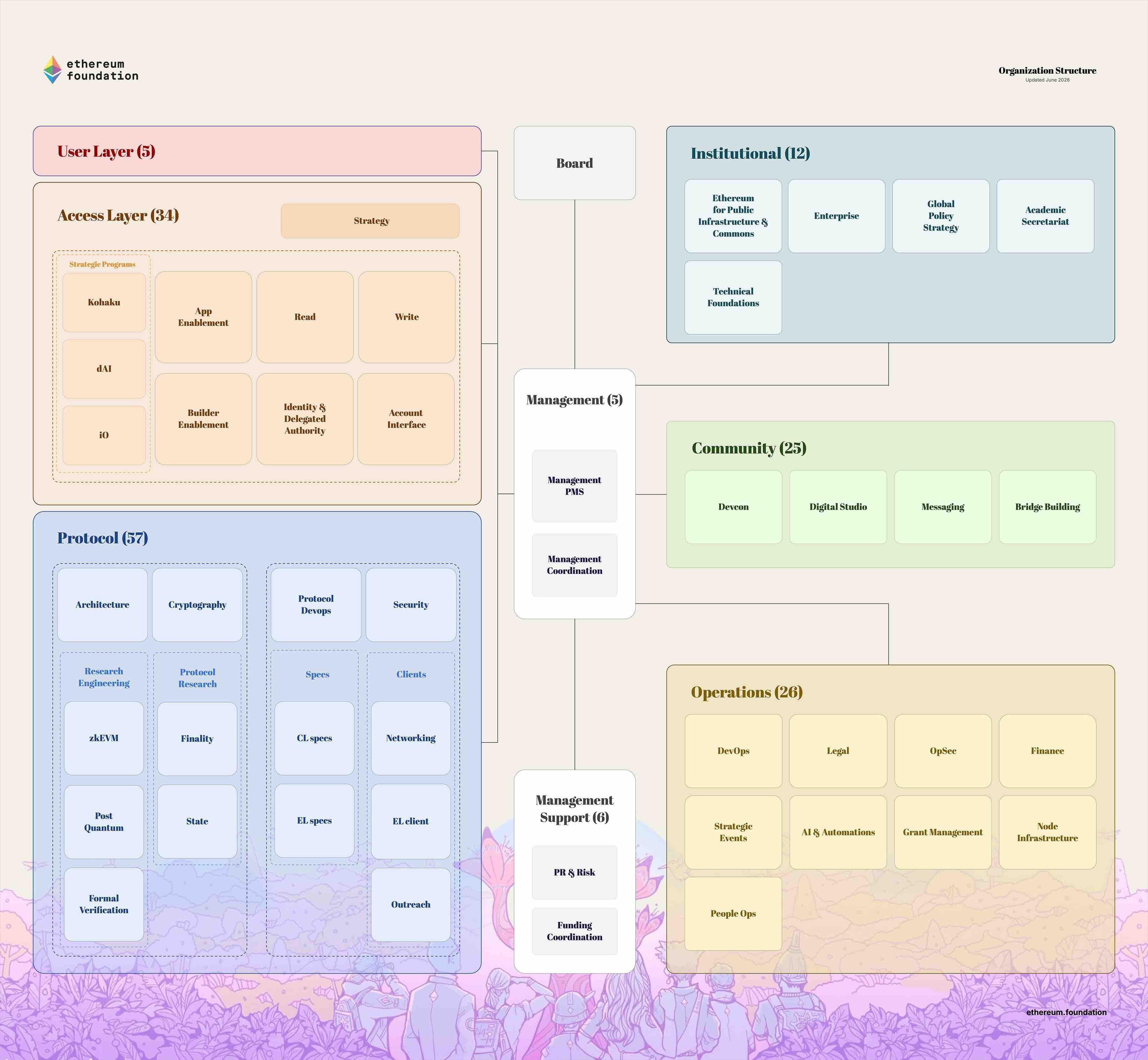
On the evening of June 23rd, EF officially announced a comprehensive internal restructuring, dividing into several functional clusters including the Protocol Layer, Access Layer, User Layer, Community Layer, and Institutional Layer. Simultaneously, the foundation laid off approximately 20% of its staff, with about 54 employees departing.
At the same time, Ethereum co-founder Vitalik Buterin also disclosed more detailed reform ideas on X: EF will gradually reduce its expenditure scale in the coming years, cutting its budget by about 40% compared to before, and plans to decrease its annual spending rate from the previous roughly 15% to about 5% post-2030, transitioning towards an endowment-driven operational model.

Clearly, this is an unconventional major organizational overhaul. Considering the controversies and challenges Ethereum has faced over the past year, this reform seems more like a long-overdue correction of its positioning.

From ETH's prolonged price slump to debates over the success or failure of scaling solutions; from the community's persistent questioning of the foundation's execution capabilities to the successive departures of core members... over the past year, criticism surrounding EF has hardly ceased. This round of layoffs, restructuring, and budget adjustments by EF is seen by many as its first systematic response to these issues.

Why is EF Always Mired in Controversy?

Over the past few years, as the most influential central entity within the entire Ethereum ecosystem, EF's every move has been accompanied by controversy.

Some criticize the foundation for selling ETH long-term, undermining community confidence; others question EF's overemphasis on public goods and long-term research, neglecting market competition and ecosystem growth; still others believe that faced with increasingly fierce industry competition, EF has consistently lacked sufficiently clear strategic articulation and execution capabilities... Whenever market dissatisfaction arises towards Ethereum, EF often becomes the most direct target of criticism.

While these controversies appear varied, they point to the same underlying reality — for over a decade, EF has played an extremely unique role. It is both a key driver of protocol research and a funder of ecosystem development; it undertakes the responsibility of coordinating diverse interests and, to a large extent, also represents the external perception of Ethereum.

In Ethereum's early development stages, such a role was crucial. However, as Ethereum has evolved into a global network with a vast developer community, hundreds of billions in asset value, and numerous institutional participants, market expectations of EF have quietly shifted.

What role should EF actually play? Is it merely a non-profit organization focused on research, or the de facto coordinating center for the entire ecosystem? Is it accountable to ETH holders? Should it also respond to market expectations for growth, adoption, and value accumulation?

To these questions, EF has long failed to provide clear answers. Consequently, controversies over token sales, execution, governance, and even personnel attrition continue to accumulate, eventually evolving into a war of words centering on the foundation itself. Coupled with ETH's persistently low price, the community needed an outlet for its frustration, and EF happened to be the most suitable target.

EF's Answer: Redefining Boundaries

If all community skepticism towards EF in recent years ultimately points to the ambiguity of the foundation's role, then the core of this reform is that EF has finally begun to redefine itself, clarifying what it should and should not do.

Judging from the newly announced organizational structure, EF has clearly delineated its future priorities into the following five areas:

  • Protocol Layer: Responsible for advancing core protocol R&D and network security.
  • Access Layer: Focuses on wallets, developer tools, and infrastructure experience.
  • User Layer: Concentrates on applications and user experience.
  • Community Layer: Undertakes developer and ecosystem coordination work.
  • Institutional Layer: Responsible for promoting adoption of Ethereum by governments, enterprises, and traditional institutions.

While clarifying functional clusters, EF is also proactively scaling back through measures like 20% layoffs and a 40% budget reduction. Notably, Vitalik did not package this reform as a simple 'efficiency improvement,' but candidly admitted it signifies real losses — some projects will end, certain capabilities will be lost, and some long-term contributors will leave.

Vitalik gave examples, stating that the PSE (Privacy and Scaling Explorations) team, long focused on cutting-edge privacy and scaling research, will gradually fade from the scene; Devcon will transition to a smaller-scale, lower-cost model in the future; the foundation's investment in large projects outside of Ethereum will decrease; and institutional cooperation efforts will also become more focused and scaled back.

However, Vitalik also emphasized that this does not mean overall ecosystem investment in these directions will decrease. On the contrary, much of the work is merely shifting from an 'exploration' phase to an 'implementation' phase, moving from within EF to the broader ecosystem.

For an organization that has long simultaneously shouldered research, funding, coordination, and even some ecosystem-driving responsibilities, this signifies a clear retreat from its role. EF no longer aims to be an all-encompassing ecosystem hub but hopes to return to its core functions: protocol research, public goods support, and ecosystem coordination. As for more specific construction work, it will gradually be undertaken by independent teams within the ecosystem and market forces.

Ecosystem Forces Are Stepping In

If EF's reform signifies a proactive step back, then another question worth noting is: who will fill the void it leaves? The answer is now apparent — the ecosystem itself.

Just before the foundation announced its restructuring, Ethlabs, founded by several former core EF researchers, was officially established and quickly gained support from ecosystem players like BitMine, SharpLink, and Joseph Lubin. (Recommended reading: "Has the Ethereum Foundation Split?! Understanding Ethlabs' 'Bright Future' in One Article")

In the past, such talent outflow might have been interpreted as a sign of the foundation's declining influence, but this time, market reaction has been the opposite. More people now view the emergence of Ethlabs as a positive development for Ethereum, as it signifies that talent, resources, and research capabilities once highly concentrated within the foundation are diffusing to more independent organizations.

Besides Ethlabs, over the past year, several other independent organizations have emerged within the Ethereum ecosystem, such as Argot Collective and Ethereum Applications Guild. Simultaneously, publicly-traded treasury companies like BitMine and SharpLink have also begun participating in ecosystem construction through funding and research grants.

Compared to a decade ago, Ethereum's power structure has fundamentally changed. Ethereum was once almost synonymous with EF. But today, Ethereum's development can no longer rely on a single institution; it increasingly requires collaboration and division of labor among different organizations within the ecosystem.

Recognition from a Competitor

Of course, EF's reform does not mean Ethereum's problems are solved.

Whether it's controversies over ETH's value capture, the pace of institutional adoption, or issues of ecosystem competitiveness and execution efficiency, none will disappear automatically due to an organizational reshuffle. But at least EF has begun acknowledging one thing — as Ethereum has grown, the foundation's capacity has become increasingly limited; it can no longer continue to play the role of "the one who solves all problems."
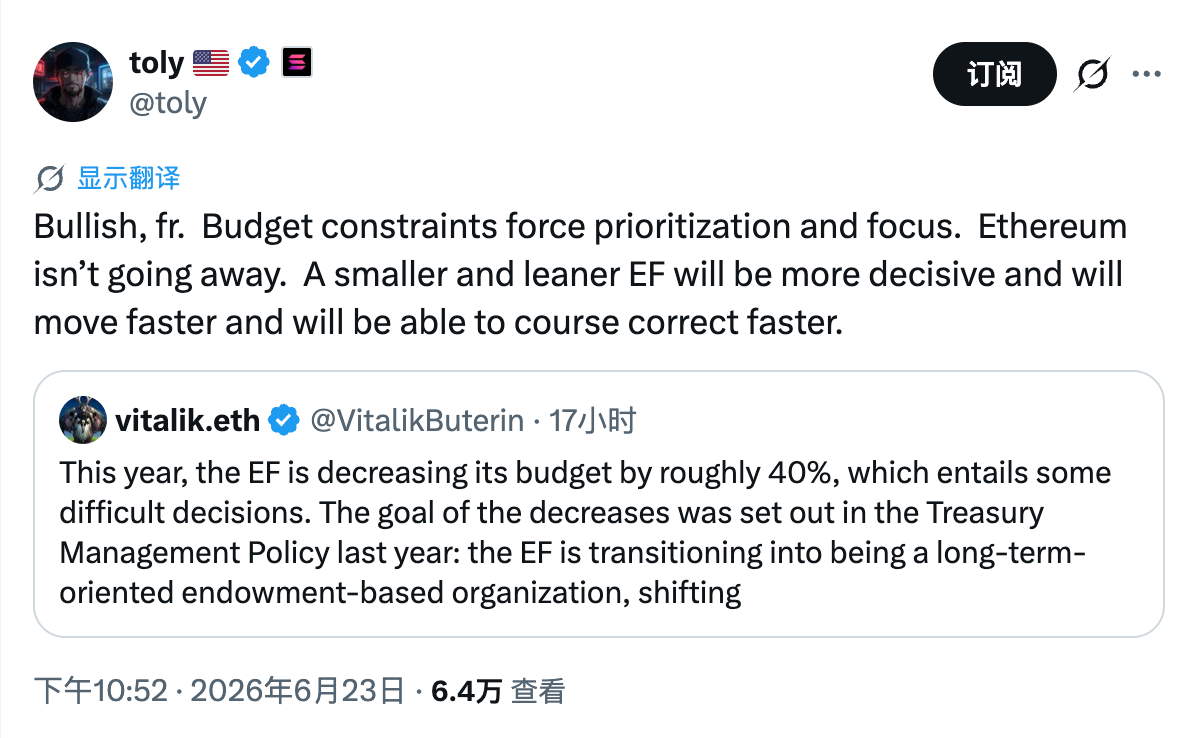
Shortly after EF announced its reform, Solana co-founder toly posted on X, stating: "Bullish. Budget constraints force us to prioritize and focus. Ethereum isn't going away. A smaller, leaner Ethereum Foundation will be more decisive, move faster, and be able to adjust direction more quickly."

Perhaps the recognition from an old rival is the highest praise for EF's current reform.

Трендовые криптовалюты

Связанные с этим вопросы

QWhat major organizational changes has the Ethereum Foundation (EF) announced?

AThe Ethereum Foundation has announced a comprehensive internal restructuring, dividing into functional clusters like the Protocol Layer, Access Layer, User Layer, Community Layer, and Institutions Layer. Accompanying this is a reduction in staff by approximately 20% (about 54 employees) and a plan to cut its budget by around 40% in the coming years.

QAccording to the article, what core issue has led to persistent controversy surrounding the Ethereum Foundation?

AThe persistent controversy stems from the EF's historically ambiguous role and unclear strategic positioning. As Ethereum grew, the market's expectations evolved, but the EF failed to definitively answer whether it was primarily a research-focused non-profit, the ecosystem's de facto coordinator, or accountable to ETH holders for market growth and value accumulation.

QHow does Vitalik Buterin characterize the impact of the EF's budget and workforce reductions?

AVitalik Buterin characterizes the impact as involving real losses. He states that the reform is not merely about 'improving quality and efficiency' but will result in the termination of some projects, the loss of certain capabilities, and the departure of long-term contributors.

QWhat is the significance of the emergence of Ethlabs and similar independent organizations, according to the article?

AThe emergence of Ethlabs and other independent organizations signifies a fundamental shift in Ethereum's power structure. It shows that talent, resources, and research capabilities, once highly concentrated within the EF, are now diffusing into the broader ecosystem. This is viewed as a positive development, indicating the ecosystem's maturation and move towards greater collaboration and division of labor among independent entities.

QWhat was Solana co-founder toly's public reaction to the EF's reorganization plan?

ASolana co-founder toly expressed a positive reaction on X, stating 'Bullish.' He commented that budget constraints force prioritization and focus, and that a smaller, leaner Ethereum Foundation would be more decisive, act faster, and adjust direction more quickly, while affirming that 'Ethereum isn't going anywhere.'

Похожее

Может ли иск Polymarket на $6,5 млн изменить подход к разрешению споров на прогнозных рынках?

Два трейдера Polymarket подали в суд на платформу прогнозных рынков за нарушение договора и введение в заблуждение, что привело к совокупным потерям в размере 6,5 млн долларов для 1868 участников. Спор связан с рынком, отслеживающим, продаст ли компания Strategy биткоины к 31 мая. Хотя компания подтвердила продажу BTC в документах SEC в указанный период, Polymarket, добавив новую "уточняющую" формулировку о публичном подтверждении сделки и после голосования UMA, решил рынок в пользу ответа "Нет". Истцы утверждают, что это нарушило условия контракта. Аналитики отмечают, что этот иск может стать одним из самых значительных в сфере прогнозных рынков, потенциально повлияв на практику разрешения споров UMA и формирующееся регулирование CFTC.

ambcrypto15 мин. назад

Может ли иск Polymarket на $6,5 млн изменить подход к разрешению споров на прогнозных рынках?

ambcrypto15 мин. назад

Blockaid отзывает предупреждение об эксплуатации моста BTTC после подтверждения операции по его отключению

Компания Blockaid по безопасности блокчейнов отозвала предупреждение о возможной эксплуатации уязвимости в мосту BitTorrent Chain (BTTC), первоначально оценив перемещение активов на $13,3 млн как потенциальную атаку. Однако позже выяснилось, что данная операция была частью авторизованного внутреннего процесса по завершению программы закрытия моста (BTTC Bridge Sunset Program). Инцидент произошел в минувший вторник, когда системы мониторинга Blockaid обнаружили подозрительную активность, напоминающую компрометацию моста. Впоследствии основатель Tron Джастин Сан разъяснил, что перемещение средств, включавших около 7285 ETH и другие токены, было финальным этапом планового отключения моста, о котором проект объявил еще 12 июня. Все средства пользователей остались в безопасности. Blockaid обновила свою оценку, подтвердив, что операции были санкционированы командой проекта. Пользователям рекомендовано использовать для кросс-чейн переводов партнерские централизованные биржи, в то время как команда BitTorrent сосредоточится на развитии децентрализованных инициатив в сфере ИИ.

ambcrypto25 мин. назад

Blockaid отзывает предупреждение об эксплуатации моста BTTC после подтверждения операции по его отключению

ambcrypto25 мин. назад

Органичен или стимулирован рост TVL Monad до $477 млн? Оценка...

Децентрализованная экосистема Monad демонстрирует резкий рост общей заблокированной стоимости (TVL) — с примерно $80 млн в ноябре до рекордных $477 млн. Этот скачок совпал с запуском Aave V3 на Monad, который привлёк почти $100 млн депозитов, а также с выбором Monad в качестве домашней сети для «Money Account» от MetaMask. Однако статья задаётся вопросом, насколько органичен этот рост, указывая, что часть ликвидности может быть обусловлена временными стимулами, а не устойчивым спросом. Ключевым для долгосрочного успеха Monad станет превращение притока ликвидности в реальное использование сети, о чём свидетельствуют рост числа кошельков, объёмы мостов и использование стейблкоинов. Параллельно в статье рассматривается ситуация в Aave, где перед запуском Aavenomics 3.0 депозиты резко выросли. Успех Aave теперь зависит от того, смогут ли эти депозиты стимулировать активность заёмщиков и стабильные доходы протокола, подкреплённые автоматическим выкупом токенов. **Итог:** Для Monad и Aave текущий рост ликвидности — это лишь первый шаг. Их долгосрочное развитие зависит от способности преобразовать этот капитал в устойчивую активность пользователей, стабильные доходы протокола и реальное использование экосистем.

ambcrypto1 ч. назад

Органичен или стимулирован рост TVL Monad до $477 млн? Оценка...

ambcrypto1 ч. назад

Сможет ли MemeCore преодолеть сопротивление на уровне $1,28? ЭТА модель намекает на...

Мемкойн MemeCore (M) за сутки упал на 11%, однако сохранил рост на 111% за последнюю неделю. Несмотря на чистый приток средств на спотовом рынке, давление продавцов усиливается на рынке перпетуальных контрактов, где объем продаж превышает объем покупок. Цена M консолидируется в рамках симметричного треугольника, и ключевым сопротивлением для роста является уровень $1,28. Прорыв выше него может открыть путь к дальнейшему укреплению. Индикатор Accumulation/Distribution (A/D) указывает на преобладание накопления (активных покупок). Кроме того, крупные держатели (киты) начали накапливать актив, в то время как мелкие розничные инвесторы фиксируют прибыль. Эта поддержка со стороны китов может стать решающим фактором для возобновления восходящего тренда M, если она сохранится на фоне позитивных сигналов на спотовом рынке.

ambcrypto2 ч. назад

Сможет ли MemeCore преодолеть сопротивление на уровне $1,28? ЭТА модель намекает на...

ambcrypto2 ч. назад

Регулярный цикл» нарушен? Хоскинсон обвиняет американскую политику в застое крипторынка

Чарльз Хоскинсон, сооснователь Cardano, раскритиковал вовлечённость администрации Трампа в криптоиндустрию, заявив, что политическая неопределённость в США нарушила обычный рыночный цикл криптовалют. По его мнению, рынок теперь чрезмерно зависит от американской политики и регуляций, а не от технологического прогресса, что отвлекло инвесторов от традиционного бычьего рынка и помешало наступлению «альтсезона» в 2025 году. Хоскинсон также выразил обеспокоенность политической поляризацией, отметив, что, несмотря на крупные личные доходы Трампа от криптопроектов, отрасль может стать объектом усиленного регулирования — «Gensler 2.0». Его точку зрения разделяет Виталик Бутерин, который ранее предупреждал об опасности поддержки политиков лишь на основании их «прокрипто» позиции. В то же время планы Трампа по созданию государственного резерва Bitcoin сталкиваются с юридическими препятствиями, связанными с полномочиями Казначейства США.

ambcrypto3 ч. назад

Регулярный цикл» нарушен? Хоскинсон обвиняет американскую политику в застое крипторынка

ambcrypto3 ч. назад

Торговля

Спот

Популярные статьи

Как купить S

Добро пожаловать на HTX.com! Мы сделали приобретение Sonic (S) простым и удобным. Следуйте нашему пошаговому руководству и отправляйтесь в свое крипто-путешествие.Шаг 1: Создайте аккаунт на HTXИспользуйте свой адрес электронной почты или номер телефона, чтобы зарегистрироваться и бесплатно создать аккаунт на HTX. Пройдите удобную регистрацию и откройте для себя весь функционал.Создать аккаунтШаг 2: Перейдите в Купить криптовалюту и выберите свой способ оплатыКредитная/Дебетовая Карта: Используйте свою карту Visa или Mastercard для мгновенной покупки Sonic (S).Баланс: Используйте средства с баланса вашего аккаунта HTX для простой торговли.Третьи Лица: Мы добавили популярные способы оплаты, такие как Google Pay и Apple Pay, для повышения удобства.P2P: Торгуйте напрямую с другими пользователями на HTX.Внебиржевая Торговля (OTC): Мы предлагаем индивидуальные услуги и конкурентоспособные обменные курсы для трейдеров.Шаг 3: Хранение Sonic (S)После приобретения вами Sonic (S) храните их в своем аккаунте на HTX. В качестве альтернативы вы можете отправить их куда-либо с помощью перевода в блокчейне или использовать для торговли с другими криптовалютами.Шаг 4: Торговля Sonic (S)С легкостью торгуйте Sonic (S) на спотовом рынке HTX. Просто зайдите в свой аккаунт, выберите торговую пару, совершайте сделки и следите за ними в режиме реального времени. Мы предлагаем удобный интерфейс как для начинающих, так и для опытных трейдеров.

1.6k просмотров всегоОпубликовано 2025.01.15Обновлено 2026.06.02

Как купить S

Sonic: Обновления под руководством Андре Кронье – новая звезда Layer-1 на фоне спада рынка

Он решает проблемы масштабируемости, совместимости между блокчейнами и стимулов для разработчиков с помощью технологических инноваций.

2.3k просмотров всегоОпубликовано 2025.04.09Обновлено 2025.04.09

Sonic: Обновления под руководством Андре Кронье – новая звезда Layer-1 на фоне спада рынка

HTX Learn: Пройдите обучение по "Sonic" и разделите 1000 USDT

HTX Learn — ваш проводник в мир перспективных проектов, и мы запускаем специальное мероприятие "Учитесь и Зарабатывайте", посвящённое этим проектам. Наше новое направление .

1.9k просмотров всегоОпубликовано 2025.04.10Обновлено 2025.04.10

HTX Learn: Пройдите обучение по "Sonic" и разделите 1000 USDT

Обсуждения

Добро пожаловать в Сообщество HTX. Здесь вы сможете быть в курсе последних новостей о развитии платформы и получить доступ к профессиональной аналитической информации о рынке. Мнения пользователей о цене на S (S) представлены ниже.

活动图片