Warsh's Debut Takes Shape: The Dot Plot Remains, but the Fed May Have Changed

Odaily星球日报Опубликовано 2026-06-18Обновлено 2026-06-18

Введение

The Federal Reserve held interest rates steady as expected in its June meeting, the first under new Chair Warsh. While the key dot plot of rate projections remained, Warsh notably did not submit his own forecast, signaling a deliberate move to weaken its forward guidance role. He emphasized a data-dependent approach, refusing to provide clear future policy signals and advocating for more restrained communication. The market interpreted this shift as heightening inflation constraints and the possibility of more aggressive tightening. Consequently, market pricing quickly adjusted: rate hike expectations for later in the year increased, U.S. stocks sold off, and the dollar strengthened. Warsh's debut suggests a fundamental change in Fed communication—moving away from "explaining the future" to merely "describing current assessments"—which could force markets to fundamentally reprice assets in a less predictable policy environment.

Original | Odaily Planet Daily (@OdailyChina)

Author | Azuma (@azuma_eth)
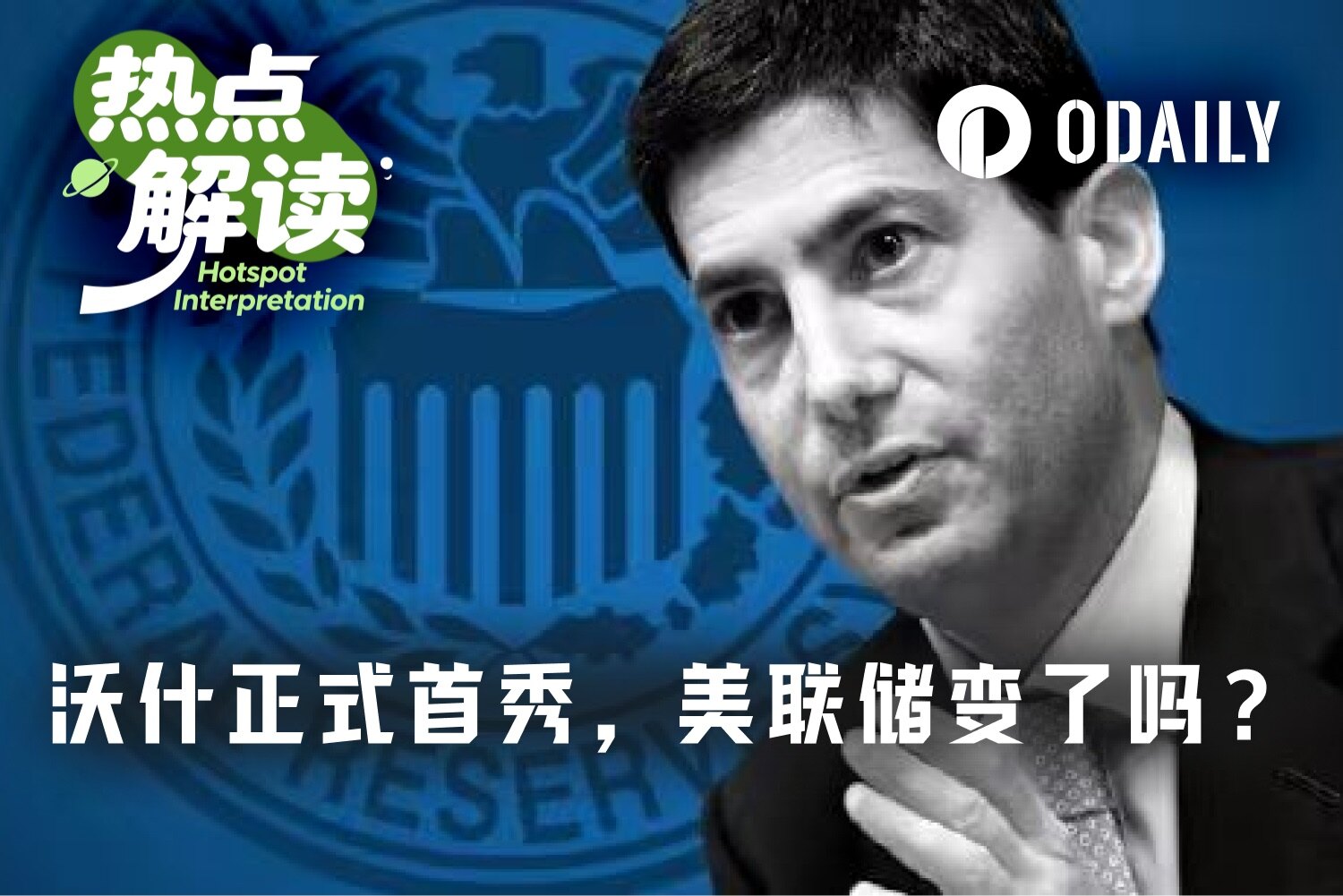
In the early morning of June 18th Beijing time, the Federal Reserve officially announced the latest interest rate decision. Without any suspense, the federal funds rate remained unchanged within the predetermined range, in line with market expectations.

In the market pricing over the past few weeks, the interest rate path was almost uncontested, and the market had already fully priced it in. Therefore, the real focus of this rate decision was not "whether to cut rates," but on how the new Fed Chair Warsh would initiate his first policy communication — this is Warsh's first FOMC meeting as Chair, and the market's first opportunity to observe how he will shape the monetary policy communication framework for the coming years.

The Dot Plot Remains, but Warsh Himself Is Absent

The change that sparked the most market discussion from this meeting came from the structure of the economic projections and the Dot Plot itself.

  • Odaily Note: The so-called "Dot Plot" is a quarterly interest rate projection tool published by the Fed, where each dot represents an FOMC member's forecast for future interest rate levels. Although these projections are not formal policy commitments, because they reflect the policymakers' overall assessment of economic and inflation prospects, the Dot Plot has long been considered by the market as an important reference for interpreting the Fed's policy direction.

In the latest FOMC economic projections, only 18 of the 19 Fed officials submitted Dot Plot forecasts. Among them, 1 person believes interest rates should be raised by a cumulative 75 basis points in the remainder of 2026, 5 believe in a cumulative 50 basis point hike, 3 believe in a cumulative 25 basis point hike, 8 believe rates should remain unchanged, 1 believes in a cumulative 25 basis point cut, and 1 was absent.
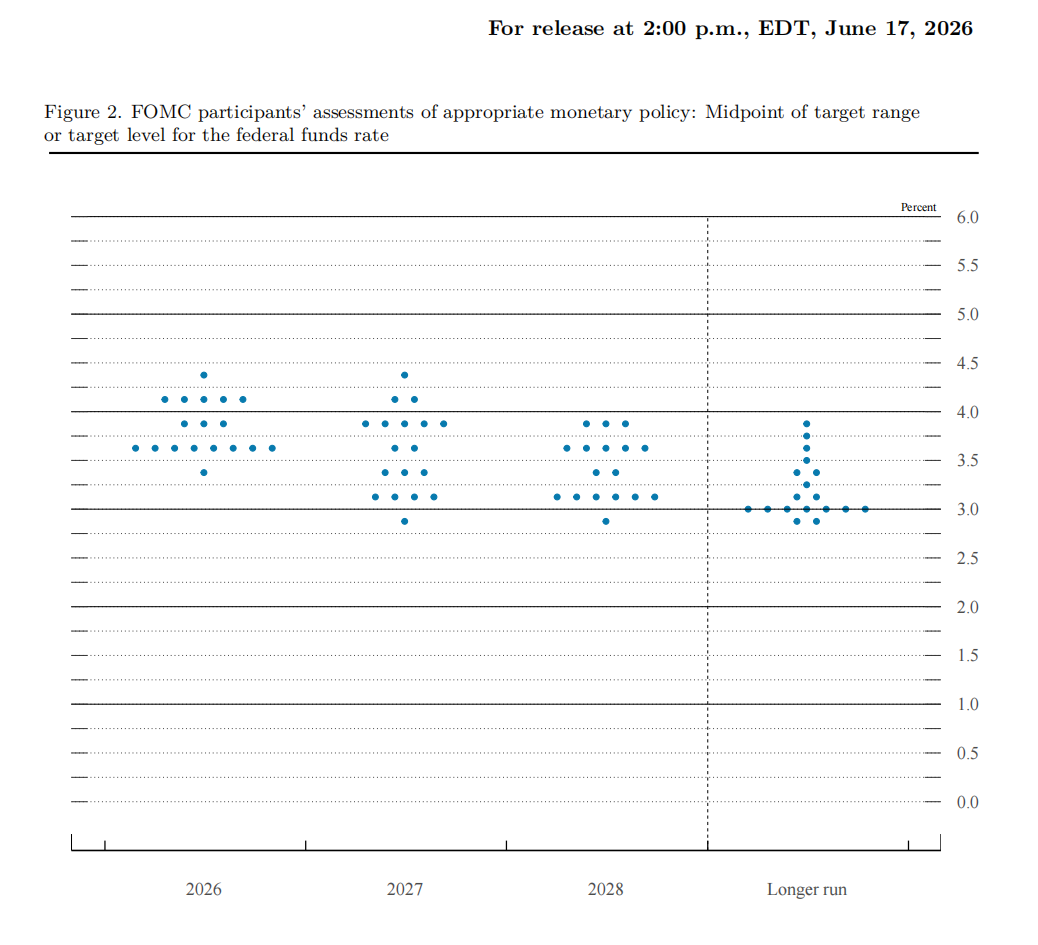
Warsh later admitted during the press conference that he was the one who did not submit an interest rate forecast. Warsh's explanation was: "I did not present any projections of my own, consistent with my longstanding views, at least about its current structure."

Compared to his predecessor Powell's highly transparent and frequent communication style, Warsh has long been a representative figure of the "say less" school. He has repeatedly expressed doubts about "the effectiveness of the Dot Plot," "excessive forward guidance," and "frequent policy signaling." In Warsh's view, the Fed does not need to tell the market exactly how it will proceed at every step in the future but should make decisions based on real-time economic data.

Although the market once speculated that Warsh might promote reforms to the Dot Plot mechanism or even abolish it outright, it was not directly canceled in this meeting. However, Warsh's own absence still sent a clear signal — the Fed is weakening the guidance significance of the Dot Plot.

A Subtle Shift in the Fed's Communication Framework

Warsh also stated during the press conference that he would promote a series of reform measures at the Fed in the future, including establishing multiple specialized working groups to explore more open data collection methods and study improvements to the Fed's existing statistical indicator system.

In the subsequent Q&A session with reporters, when repeatedly questioned about whether the next step is a rate hike and whether the current interest rate is restrictive, Warsh repeatedly declined to provide clear guidance.

Over the past decade, one of the Fed's core capabilities has been to consistently reduce market uncertainty through the Dot Plot, SEP (Summary of Economic Projections), and press conferences. The fundamental reason why the market closely watches the Fed's various activities is that it provides a "predictable path."

But Warsh's statements are changing this logic. Clearly, Warsh emphasizes data dependence, decision-making at each meeting, and consistently maintaining more restrained expressions about the future path.

If this tendency continues, the market will face a structural change — the Fed will no longer try to "explain the future," but only describe "current judgments." This will directly weaken the certainty function of forward guidance.

Rate Hike Expectations Heat Up, Market Risk Appetite Drops

After the interest rate decision was announced, market repricing of the policy path quickly unfolded.

Following Warsh's remarks emphasizing that "the central bank will not tolerate high inflation," the market began reassessing the upper bound of the Fed's policy reaction function—that is, whether there exists a possibility of more aggressive tightening than previously expected in a scenario where inflation has not declined significantly.

This change was first reflected in short-term assets.

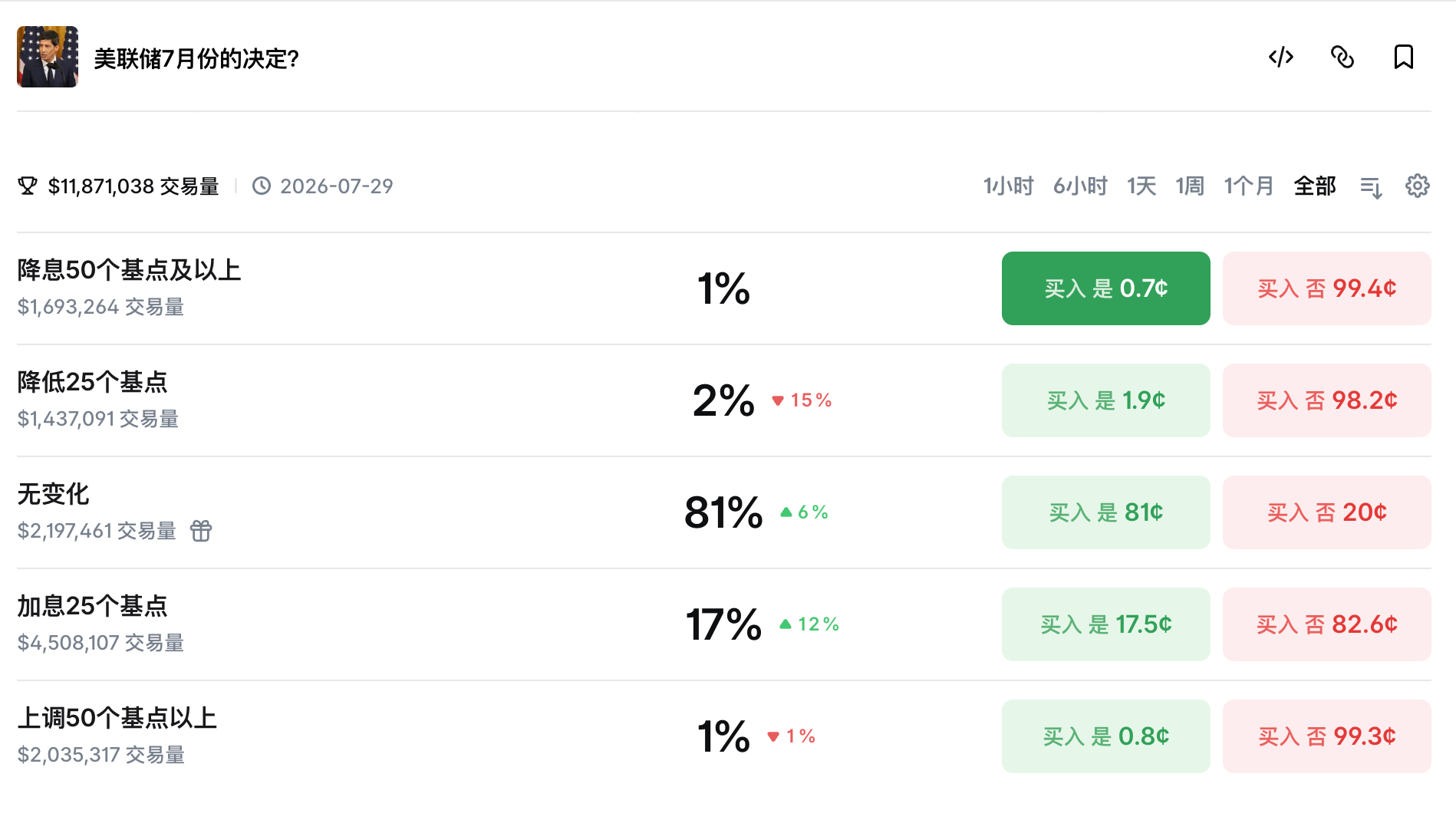
Traders began re-pricing a higher terminal rate path. Some interest rate futures contracts indicate that the market is already discussing the possibility of another rate hike as early as around October, while not ruling out tail risks of a more aggressive path. Polymarket probability data also rose in sync, reflecting that market pricing for a "reopened rate hike window" is opening up.
U.S. stocks saw a noticeable decline after the decision, with the three major indices closing lower, the S&P 500 (-1.2%) and Nasdaq (-1.3%) both falling over 1%, led by a decline in tech stocks, indicating a clear cooling of market risk appetite.

Structurally, this round of adjustment is not a single-factor-driven "interest rate shock" but rather a more typical triple repricing:

  • Short-term rates rise: The path for rate hikes is reopened;
  • Risk assets retreat: Valuation sensitivity to interest rates amplifies;
  • Dollar strengthens + yield curve volatility: Reflects rising policy uncertainty.

It is worth noting that the market is not simply trading "economic weakness" or "the disappearance of rate cut expectations," but is trading a more complex logic — under the new communication framework led by Warsh, inflation constraints are being re-elevated, and the "upside tail risk" of the policy path is becoming more real.

In other words, if inflation does not fall quickly, will the Fed turn towards tightening earlier and faster than the market originally expected?

Warsh's Pivot May Have Just Begun

In conclusion, if you look only at the outcome of this meeting, the Fed did not undergo a radical pivot. Rates are unchanged, the Dot Plot remains, and the system is still running. But if you shift the focus from "policy path" to "communication style," changes have already begun to appear.

Warsh's debut was more like a signal test. He didn't discard the old tools, but he didn't fully rely on them either. He chose to "weaken their effect, reduce their weight."

Looking at longer-term implications, the biggest question left by this debut is not "will the Fed hike next," but "how will the market reprice the world when the Fed no longer spoils the path ahead."


Трендовые криптовалюты

Связанные с этим вопросы

QWhat was the most notable change in the FOMC's economic projections (Dot Plot) during Chair Walsh's first meeting, and what did it signal?

AIn the latest FOMC economic projections, only 18 of the 19 officials submitted their Dot Plot forecasts. Notably, Chair Walsh himself was the one who did not submit a forecast. He explained this was consistent with his long-held view questioning the efficacy of the Dot Plot in its current structure. While the mechanism itself was not abolished, his absence signaled a deliberate effort to weaken the guidance significance of the Dot Plot.

QAccording to the article, how is Chair Walsh's communication style expected to differ from his predecessor Jerome Powell's?

ACompared to Jerome Powell's highly transparent and frequent communication style, Walsh represents a 'less-is-more' approach. He has been a long-time skeptic of tools like the Dot Plot, excessive forward guidance, and frequent policy signaling. Walsh emphasizes data dependence and decision-making meeting-by-meeting, preferring to describe the 'current judgment' rather than attempting to 'explain the future.' This represents a shift towards a less predictive and more reactive communication framework.

QHow did financial markets react immediately after the June 18th FOMC decision and Walsh's press conference?

AFinancial markets reacted with a clear risk-off move. The three major U.S. stock indexes all closed lower, with the S&P 500 and Nasdaq dropping more than 1%. Simultaneously, traders began repricing a higher potential path for interest rates, with some derivatives markets pricing in the possibility of another rate hike as early as October. This reflected a market reassessment of the 'upside tail risk' of more aggressive tightening under Walsh.

QWhat is the core market concern or 'complex logic' that the article suggests investors are now trading on after Walsh's first meeting?

AThe market is not simply trading on 'economic weakening' or 'disappearing rate cut hopes.' Instead, it is trading on a more complex reassessment. Under Walsh's new communication framework, the inflation constraint has been re-emphasized, and the 'upside tail risk' of the policy path is becoming more credible. The core concern is whether the Fed, led by Walsh, might pivot back to tightening earlier and faster than previously expected if inflation does not decline quickly.

QWhat broader, long-term question does the article suggest Chair Walsh's debut has raised for financial markets?

AThe article suggests the most significant long-term question raised by Walsh's debut is not 'Will the Fed hike rates next?' but rather 'How will markets reprice the world when the Fed stops spoiling the path ahead?' It highlights a potential structural shift where the central bank reduces its role in providing a predictable policy path, forcing markets to navigate with greater inherent uncertainty.

Похожее

Андре Кронье покидает совет директоров Sonic Labs на фоне падения токена

Известный разработчик DeFi Андре Кронье покинул совет директоров Sonic Labs (бывшей Fantom Foundation), вместе с ним ушли ещё два директора. Эти изменения в руководстве произошли на фоне резкого падения курса нативного токена проекта S/FTM, который торгуется примерно на 97% ниже своего исторического максимума. Отставки поднимают вопросы о корпоративном управлении в Sonic Labs, который занимается высокоскоростным масштабированием виртуальной машины Ethereum (EVM). Несмотря на кадровые перестановки, разработчики заявляют, что технические планы и сроки запуска протокола остаются без изменений. Новый генеральный директор сосредоточен на реструктуризации операционной деятельности. Для сообщества DeFi эта ситуация подчёркивает характерную волатильность и проблемы управления в быстроразвивающихся блокчейн-экосистемах. Дальнейшая стабильность и направление развития проекта будут зависеть от прозрачности и чёткой коммуникации со стороны нового руководства.

bitcoinist7 ч. назад

Андре Кронье покидает совет директоров Sonic Labs на фоне падения токена

bitcoinist7 ч. назад

Kraken интегрирует торговлю через солана-децентрализованную биржу прямо в основное приложение

Криптобиржа Kraken интегрировала в своё основное приложение возможность торговли через децентрализованные биржи (DEX) в сети Solana. Это позволяет клиентам в США и более чем 100 странах торговать более чем 2500 токенами на основе Solana, не покидая приложение Kraken. Пользователям больше не нужны отдельные кошельки или мнемонические фразы, что упрощает доступ к ликвидности Solana DEX. Ключевым преимуществом является прямой доступ к ранним активам и токенам новых проектов, которые ещё не представлены на традиционных централизованных биржах. Интеграция объединяет удобство и безопасность централизованной платформы с широким выбором токенов и децентрализованной ликвидностью. Объявление было сделано 20 июня 2026 года.

bitcoinist8 ч. назад

Kraken интегрирует торговлю через солана-децентрализованную биржу прямо в основное приложение

bitcoinist8 ч. назад

Медведи Эфириума сохраняют контроль, так как ETH отскакивает от сопротивления линии тренда

Последний отскок Ethereum не убедил аналитиков в завершении нисходящего тренда. По мнению TheSignalyst, ETH сохраняет медвежий настрой, оставаясь ниже нисходящей красной линии тренда и формируя серию более низких максимумов и минимумов. На графике видно, что цена отклонилась от зоны сопротивления, объединяющей линию тренда и горизонтальный структурный уровень, что усиливает давление продавцов. Ключевая зона поддержки находится между $1 350 и $1 500. Контролируемый откат в этот диапазон может вызвать реакцию, но уверенный прорыв ниже ослабит структуру ETH. В настоящее время ETH находится между значимой поддержкой и линией сопротивления, ограничивающей восстановление, что указывает на техническое сжатие рынка. Борьба Ethereum с сопротивлением также важна для всего альткойн-рынка, поскольку слабость ETH часто снижает аппетит к риску в DeFi и малокапитализированных активах. Для подтверждения разворота быкам необходим четкий прорыв выше сопротивления.

bitcoinist9 ч. назад

Медведи Эфириума сохраняют контроль, так как ETH отскакивает от сопротивления линии тренда

bitcoinist9 ч. назад

TechFlow Разведслужба: Шансы на IPO Anthropic превышают 80%, Иран вновь перекрывает Ормузский пролив, вызывая волатильность цен на нефть

Технологические новости: ожидается IPO Anthropic в 2026 году, рынок обсуждает сосуществование её заявленной ценности в области безопасности ИИ с потенциальной триллионной оценкой. Набирают популярность виртуальные инфлюенсеры, созданные ИИ. Маск заявляет о необходимости астрономических инвестиций в антиматерию для межзвёздных путешествий. Крипто/Web3: Иран объявил о закрытии Ормузского пролива, вызвав волатильность на нефтяном рынке, однако данные о движении судов показывают неоднозначную картину. Одновременно Иран возобновил погрузку нефти на острове Харг, что может увеличить предложение. На рынке чипов: Goldman Sachs предупреждает о возможном приближении к пределу кредитования масштабных расходов на ИИ-инфраструктуру. Корпоративные новости: Cloudflare представил функцию временных аккаунтов для ИИ-агентов. Google сообщает, что более 50% его трафика теперь использует IPv6. Hyundai Motor Group планирует полный выкуп Boston Dynamics. Рынок акций: частные инвесторы активно вкладываются в акции SpaceX. В Европе зафиксирован первый с 2008 года дефолт по акциям CLO. Макроэкономика: Украина атаковала нефтяные объекты в Крыму и Краснодарском крае. Nomura предупреждает о возможном резком ужесточении политики ФРС. Общая тенденция: глобальная ликвидность сокращается на фоне роста предельных издержек в энергетике, кредитовании и технологиях, в то время как капитал продолжает искать новые масштабные возможности для роста.

marsbit10 ч. назад

TechFlow Разведслужба: Шансы на IPO Anthropic превышают 80%, Иран вновь перекрывает Ормузский пролив, вызывая волатильность цен на нефть

marsbit10 ч. назад

Соотношение ETH/BTC упало до уровней начала 2023 года на фоне дебатов о стоимости Ethereum

Курс ETH/BTC упал до уровня начала 2023 года, достигнув отметки 0.027. По сравнению с пиком 2021 года в 0.088 это означает, что Ethereum сейчас выглядит исторически дешевым по отношению к Bitcoin. Аналитик Woetoe задается вопросом, является ли это возможностью для контрарианских инвестиций или признаком структурного снижения. Одновременно с этим график ETH/USDT указывает на риск коррекции. По данным SwallowAcademy, после агрессивного недельного открытия цена может откатиться, при этом была нарушена структура рынка. План предполагает возможную продажу при повторном тестировании зоны $1723 с целью коррекции до $1660. Таким образом, сложилась противоречивая ситуация: Ethereum кажется недооцененным относительно Bitcoin, но при этом испытывает давление на долларовой паре. Для быков ETH первоочередной задачей является не обсуждение оценки, а восстановление технической силы и возобновление роста относительно BTC.

bitcoinist10 ч. назад

Соотношение ETH/BTC упало до уровней начала 2023 года на фоне дебатов о стоимости Ethereum

bitcoinist10 ч. назад

Торговля

Спот
Фьючерсы

Популярные статьи

Как купить S

Добро пожаловать на HTX.com! Мы сделали приобретение Sonic (S) простым и удобным. Следуйте нашему пошаговому руководству и отправляйтесь в свое крипто-путешествие.Шаг 1: Создайте аккаунт на HTXИспользуйте свой адрес электронной почты или номер телефона, чтобы зарегистрироваться и бесплатно создать аккаунт на HTX. Пройдите удобную регистрацию и откройте для себя весь функционал.Создать аккаунтШаг 2: Перейдите в Купить криптовалюту и выберите свой способ оплатыКредитная/Дебетовая Карта: Используйте свою карту Visa или Mastercard для мгновенной покупки Sonic (S).Баланс: Используйте средства с баланса вашего аккаунта HTX для простой торговли.Третьи Лица: Мы добавили популярные способы оплаты, такие как Google Pay и Apple Pay, для повышения удобства.P2P: Торгуйте напрямую с другими пользователями на HTX.Внебиржевая Торговля (OTC): Мы предлагаем индивидуальные услуги и конкурентоспособные обменные курсы для трейдеров.Шаг 3: Хранение Sonic (S)После приобретения вами Sonic (S) храните их в своем аккаунте на HTX. В качестве альтернативы вы можете отправить их куда-либо с помощью перевода в блокчейне или использовать для торговли с другими криптовалютами.Шаг 4: Торговля Sonic (S)С легкостью торгуйте Sonic (S) на спотовом рынке HTX. Просто зайдите в свой аккаунт, выберите торговую пару, совершайте сделки и следите за ними в режиме реального времени. Мы предлагаем удобный интерфейс как для начинающих, так и для опытных трейдеров.

1.5k просмотров всегоОпубликовано 2025.01.15Обновлено 2026.06.02

Как купить S

Sonic: Обновления под руководством Андре Кронье – новая звезда Layer-1 на фоне спада рынка

Он решает проблемы масштабируемости, совместимости между блокчейнами и стимулов для разработчиков с помощью технологических инноваций.

2.3k просмотров всегоОпубликовано 2025.04.09Обновлено 2025.04.09

Sonic: Обновления под руководством Андре Кронье – новая звезда Layer-1 на фоне спада рынка

HTX Learn: Пройдите обучение по "Sonic" и разделите 1000 USDT

HTX Learn — ваш проводник в мир перспективных проектов, и мы запускаем специальное мероприятие "Учитесь и Зарабатывайте", посвящённое этим проектам. Наше новое направление .

1.8k просмотров всегоОпубликовано 2025.04.10Обновлено 2025.04.10

HTX Learn: Пройдите обучение по "Sonic" и разделите 1000 USDT

Обсуждения

Добро пожаловать в Сообщество HTX. Здесь вы сможете быть в курсе последних новостей о развитии платформы и получить доступ к профессиональной аналитической информации о рынке. Мнения пользователей о цене на S (S) представлены ниже.

活动图片