Bitcoin Mining Farm Transforms into AI Data Center: Sangha's 'Sell-Out' Decision

marsbitОпубликовано 2026-06-17Обновлено 2026-06-17

Введение

"Sangha, a cryptocurrency mining company, is considering selling its recently operational Genesis bitcoin mining facility in Texas. Despite being profitable due to low-cost power (approximately $32/MWh), the company is exploring a sale, joint venture, or strategic partnership, advised by Marathon Capital. The core value of the 19.9MW site lies not in the mining hardware but in its established, scalable power infrastructure—a direct connection to a 180MW solar farm with plans to expand to 110.4MW. This makes it an attractive, ready-to-use asset for AI or high-performance computing (HPC) companies seeking to avoid lengthy permitting and grid connection processes. Sangha's move reflects a broader industry trend where mining operators are pivoting towards higher-value AI compute opportunities. The decision represents a strategic shift from building a long-term 'win-win-win' mining model to capitalizing on the current premium demand for AI-ready power and data center infrastructure."

Author: The Heart of Computing Power

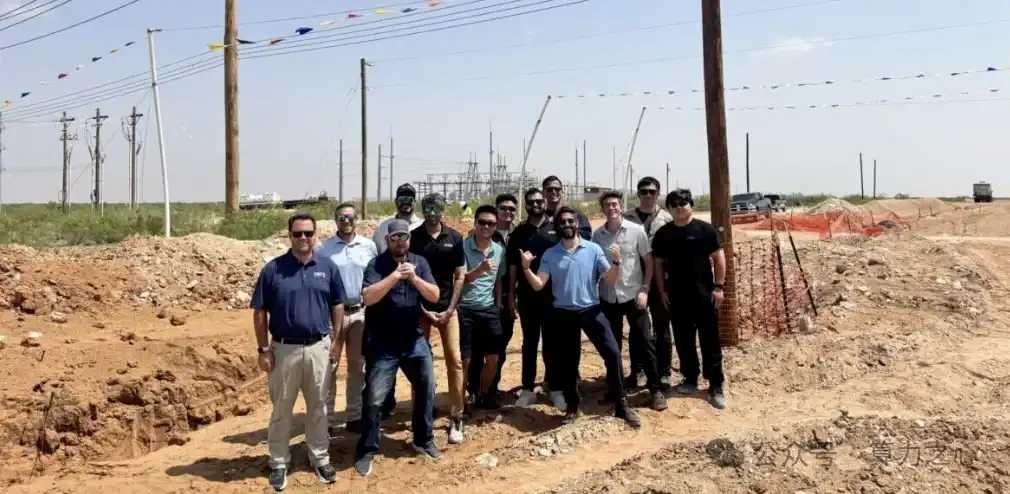
In December 2025, Spencer Marr cut a red ribbon in Ector County, Texas.

Behind the red ribbon was a Bitcoin mining farm named Genesis.

Less than six months after powering up, in June 2026, his company Sangha announced that it was considering selling it, forming a joint venture, or bringing in a strategic partner.

It's not because they couldn't continue, but because it's too valuable.

Because what's eyeing this mining farm is AI.
I. The Farm Goes Live and Immediately Lists for Sale

The Genesis farm is not large, at 19.9MW.

They didn't build their own power plant; instead, they connected to a 180MW solar farm owned by South Korea's Hanwha Group.

They use "behind-the-meter direct supply," meaning electricity generated by solar doesn't go through the public grid but is directly delivered to the farm via a dedicated line.

This saves on grid fees and avoids grid congestion, a win-win.

Additionally, the French energy giant TotalEnergies provides retail electricity services, helping them supplement electricity from the grid when solar power is insufficient.

Sangha named this model the "Triple Win."

IPP (Independent Power Producer) earns extra revenue, investors get low-cost Bitcoin, and the grid becomes more stable due to flexible load.

The project timeline is clear: groundbreaking in May 2025, power on in December 2025.

For this, Sangha also set up an SPV (a special purpose vehicle company shell for this single project), allowing investors to invest directly in the farm's machines instead of trading Bitcoin themselves, sharing profits based on Bitcoin output.

However, just six months after powering up, in June 2026, Sangha announced it was considering selling, forming a joint venture, or bringing in a strategic partner.

The deal is managed by investment bank Marathon Capital, codenamed Project Genesis, proceeding in two phases with the goal of closing in the fourth quarter.

Sangha co-founder Spencer Marr didn't hide it either, stating directly, "We're casting a wide net," talking to "all kinds of institutions," and he admitted the company is "watching the market like everyone else."

But why consider selling a profitable farm that just went live six months ago?

II. The Mining Rigs Aren't Worth Much; It's That Power Line That's Valuable

Yes, Genesis isn't being sold because it's losing money.

Marr says that although the hashprice (the revenue per unit of computing power) is declining, their farm is still profitable.

The reason is simple: their electricity price is low.

From December 2025 to the first quarter of 2026, its all-in electricity price was about $32/MWh.

For comparison, the average industrial electricity price in North America is $60-80/MWh; Genesis's price is less than half of that.

Interestingly, while Marr expresses optimism about Bitcoin and hashprice, he's simultaneously considering selling the farm, forming a joint venture, or bringing in a strategic partner.

It sounds contradictory, but it's not.

Because being optimistic about Bitcoin doesn't equal being optimistic about "continuing to mine it themselves."

When AI companies are scrambling for large power blocks, a site that's already live, has grid interconnection agreements, and has a low-cost power contract is a ready-made treasure trove in their eyes. "How many GPUs can we fit" is Genesis's value.

Not to mention, for AI companies, the most expensive cost isn't construction, but time—power access, land approval, which can take years.

And Sangha is indeed paving the way in this direction.

They modified the grid interconnection agreement, expanding the site's power capacity from 20MW all the way to 110.4MW, targeting completion by May 2028.

At 110.4MW, Sangha either needs to raise funds themselves to expand into an AI data center or sell the "power asset" at a peak valuation to a richer buyer.

Sangha is also calculating that selling the power asset at a high valuation might be more profitable than expanding themselves.

Now, when Sangha promotes Genesis externally, they're no longer just talking about Bitcoin mining; AI computing, high-performance computing (HPC), hybrid strategies—all are in the PPT.

And this isn't just Sangha's story.

III. The Entire Mining Industry is Leaning Towards AI

Looking at listed mining companies, the shift is even more apparent.

Companies like Core Scientific, TeraWulf, and Hut 8 have either secured major AI/HPC contracts or are in the process of transitioning.

Total AI/HPC related contract values have exceeded $70 billion. Among listed miners, the proportion of revenue from AI could rise from 30% to 70%.

But Sangha is different from them.

It's not a listed company, so it faces no stock price pressure or quarterly reports for Wall Street.

It operates project-by-project; one SPV is one asset package. If Genesis is sold, the team can immediately move on to the next one.

This agility makes it an attractive target for buyers.

For buyers, acquiring Genesis means directly obtaining a compliant, powered-on, power-contracted, and expandable AI-ready site.

No three-year approval queues, no haggling with the grid, no building substations from scratch.

Objectively speaking, Genesis's own model is proven.

Solar power paired with mining, electricity prices compressed to $32—the model is validated. Continuing expansion requires more capital investment, and AI buyers are willing to pay a premium.

Selling is a calculated decision.

It's just that the "Triple Win" story told to investors—more revenue for power producers, low-cost Bitcoin for investors, a more stable grid—at this point, might boil down to one sentence: whoever offers the highest price takes it.

Spencer Marr once said that what Sangha does is "building new models for Bitcoin capital flow."

Now, this "new model" might become "selling power assets to AI, then distributing the profits."

The question is, as prime power sources and land increasingly shift towards AI, where will Bitcoin miners find their next stronghold?


Связанные с этим вопросы

QWhat is the main reason Sangha is considering selling the Genesis Bitcoin mining site so soon after its launch?

AThe main reason Sangha is considering selling the Genesis site is not due to unprofitability, but because its assets are highly valuable to AI companies. The site already has a connected power grid, low-cost electricity contracts (around $32/MWh), and permits in place, making it a "shovel-ready" asset for high-demand AI data centers. Selling at a high valuation to an AI buyer is seen as more advantageous than continuing to expand the mining operation themselves.

QWhat is the 'three-win model' that Sangha proposed for the Genesis project?

ASangha's "three-win model" for the Genesis project refers to a setup where the IPP (Independent Power Producer) earns more revenue, investors receive low-cost Bitcoin, and the power grid becomes more stable due to the flexible load from the mining operation. The project was structured using a Special Purpose Vehicle (SPV) so that investors could invest directly in the mining hardware and share in the Bitcoin output, rather than trading cryptocurrency themselves.

QHow does Sangha's structure differ from publicly traded Bitcoin mining companies mentioned in the article?

AUnlike publicly traded Bitcoin mining companies like Core Scientific or Hut 8, Sangha is not a public company. It operates on a project-by-project basis using Special Purpose Vehicles (SPVs), meaning each project like Genesis is a standalone asset package. This makes Sangha 'lighter' and more flexible—it can sell one project and move on to develop the next, without the quarterly reporting pressures faced by public firms.

QWhat specific advantage does the Genesis site offer to potential AI or HPC buyers?

AThe Genesis site offers a significant time and regulatory advantage to AI or HPC buyers. It is already grid-connected, has power purchase agreements in place, and possesses permits that allow for expansion from 20MW to 110.4MW. For AI companies desperate for power and facing multi-year delays for new site approvals and grid connections, acquiring Genesis provides an immediate, 'AI-ready' solution, saving them years of development time.

QWhat broader industry trend is highlighted by Sangha's potential pivot with the Genesis project?

ASangha's potential sale of the Genesis mining site to an AI buyer reflects a broader industry trend where Bitcoin mining infrastructure is being repurposed or sold for AI and High-Performance Computing (HPC) use. Public mining companies are also pivoting, with AI/HPC contracts now representing a significant and growing portion of their revenue. This shift is driven by AI's immense demand for reliable, high-capacity power, which makes existing mining sites with power access highly valuable assets.

Похожее

Fed's Internal Doves Flock to Hawkish Stance, Warsh's Debut "Between a Rock and a Hard Place"

U.S. Federal Reserve officials who previously advocated for rate cuts, including Governor Christopher Waller, have recently shifted their stance, with many now not ruling out the possibility of future rate hikes. This sets a challenging stage for new Fed Chair Kevin Warsh's first policy meeting. Appointed by President Trump based on his dovish views, Warsh now faces a committee where the debate has pivoted from "when to cut" to "whether to hike," driven by persistent inflation above 3%, a strong labor market, and supply-side pressures from AI infrastructure demands and geopolitical tensions. Key figures illustrate the shift. Governor Waller, once concerned about employment, now says data has pushed him toward considering rate increases. Even moderate voices like Governor Lisa Cook, while expecting inflation to ease, have indicated readiness to hike if it fails to do so. Long-time hawks such as regional Fed presidents Beth Hammack, Lorie Logan, and Neel Kashkari have grown more vocal, arguing that the real policy rate is effectively falling and that action may soon be needed. The upcoming Fed meeting is expected to keep rates steady but will likely remove the "easing bias" from its statement, signaling a neutral stance between cuts and hikes. The quarterly "dot plot" is anticipated to show most officials projecting no cuts this year, with some potentially indicating hikes. Chair Warsh, a critic of the Fed's reliance on forward guidance like the dot plot, must navigate communicating this pivot using tools he has questioned, all while steering policy in a direction counter to the preferences of the president who appointed him. The consensus suggests the Fed's next move could well be a rate increase.

marsbit55 мин. назад

Fed's Internal Doves Flock to Hawkish Stance, Warsh's Debut "Between a Rock and a Hard Place"

marsbit55 мин. назад

The Trillion-Yuan Market Cap 'Yi Zhong Tian': Who is the True Value King?

The article analyzes the three leading Chinese optical module companies, collectively nicknamed "Yi Zhong Tian": Xinyisheng, Zhongji Innolight, and TFC Optical Communication. It evaluates their "cost-performance" not by current stock price, but through three lenses: PEG ratio (growth vs. valuation), earnings quality, and premium/discount for certainty. Xinyisheng shows the most attractive PEG ratio and high profitability, but its valuation reflects discounts for risks like high customer concentration and reliance on overseas markets. Zhongji Innolight, the most expensive, commands a premium for its market leadership, dominant share in key products like 800G/1.6T modules, and higher earnings certainty, though it faces geopolitical risks. TFC Optical, as an upstream component supplier ("water seller"), has the highest gross margin and bets on the long-term CPO/NPO architecture trend, but trades at a high valuation with more stable, less explosive growth. The core argument is that while these companies dominate module assembly, the true profit pool and technological moat lie upstream in laser and switch chips, currently controlled by U.S. firms like Lumentum and Coherent. The long-term "cost-performance" for these Chinese leaders hinges on whether the domestic industry, exemplified by companies like Yuanjie Technology, can successfully move up the value chain into high-power laser chips. Otherwise, their high growth may remain confined to the lower-margin assembly segment.

marsbit1 ч. назад

The Trillion-Yuan Market Cap 'Yi Zhong Tian': Who is the True Value King?

marsbit1 ч. назад

Has the Crypto Market Bottomed? Here's What Institutions Think

The crypto market is in a period of significant debate, with leading institutions offering differing views on whether a bottom has been reached. Three prominent firms have published detailed analyses: * **Galaxy Digital** argues Bitcoin has **not yet bottomed**. Their analysis of 13 historical indicators across six dimensions (valuation, profit-taking, miner pressure, etc.) shows only four are fully met. They project a potential bottom range between $30k and $54k. * **NYDIG** states a bottom is **possible but not likely**. While metrics are close to historic bear market extremes, they note the absence of a classic panic-selling event. They also suggest increased institutional adoption may have structurally altered the market cycle, potentially leading to a shallower downturn. * **Standard Chartered Bank** asserts the **bottom has already occurred** at around $59k. They cite two key factors: potential US-Iran diplomatic progress and the anticipated SpaceX IPO, which they believe absorbed capital and caused ETF selling pressure that is now subsiding. They forecast a year-end price target of $100k. Despite the surface-level disagreement, the reports share critical common ground more valuable for long-term investors: 1. All three believe the market bottom will form **within this year**. 2. All agree the current price is **closer to the bottom than to previous highs**. 3. All maintain a **bullish long-term outlook** for Bitcoin and a new cycle. The core takeaway is that while the exact bottom price ($40k, $50k, or $60k) is debated, the consensus is that a bottom is imminent. For long-term holders, the primary focus should not be pinpointing the absolute low, but on the future potential for prices to reach $100k, $200k, or higher. The fundamental thesis for Bitcoin—sovereign debt accumulation, inflation, declining trust in centralized institutions, global digitization, and improved accessibility—remains intact and is arguably strengthening. The overall landscape is viewed as more favorable than in previous crypto winters.

marsbit1 ч. назад

Has the Crypto Market Bottomed? Here's What Institutions Think

marsbit1 ч. назад

The 'Chip' Challenge and Breakthroughs in China's Optical Industry Chain

China's Photonics Industry: Bottlenecks and Breakthroughs In the global AI race, computing chips dominate the narrative, but the underlying bottleneck increasingly defining the scale of AI clusters is light—or more specifically, optical connectivity. Optical modules, which translate electrical signals to light and vice versa, are crucial for connecting thousands of GPUs in AI data centers, preventing data congestion and ensuring efficient model training. High-speed modules (800G, 1.6T) are now standard, with performance hinging on advanced DSP (Digital Signal Processor) chips. This is where a critical dependency lies. Two US giants—Marvell and Broadcom—collectively dominate over 90% of the high-end DSP chip market. Chinese optical module leaders like Zhongji Innolight and Eoptolink rely on these chips to manufacture modules for overseas AI customers, primarily in North America. While this creates a supply chain vulnerability, complete decoupling is difficult. Marvell derives over half its revenue from Greater China, and the US firms depend on Chinese partners for chip packaging and optical components. The risk from laser chips (e.g., from Lumentum), another key component, is considered more manageable due to multiple global suppliers and faster progress in domestic alternatives from companies like YOFC and Accelink. To mitigate risks, China's industry is pursuing a multi-pronged strategy: diversifying supply chains and locking in long-term orders; fostering a domestic market ecosystem to adopt homegrown DSPs from firms like Huawei HiSilicon and CETC; accelerating R&D in high-speed DSPs and advanced packaging; and investing in next-gen technologies like silicon photonics and Co-Packaged Optics (CPO) to reduce reliance on discrete DSPs. The ultimate solution lies not in short-term博弈 but in persistent advancement of domestic high-end chip R&D and manufacturing. While challenges remain in performance, certification, and ecosystem building, China's vast domestic market and manufacturing base provide a crucial buffer, buying time for the industry to achieve greater technological independence.

marsbit1 ч. назад

The 'Chip' Challenge and Breakthroughs in China's Optical Industry Chain

marsbit1 ч. назад

Торговля

Спот
Фьючерсы

Популярные статьи

Как купить S

Добро пожаловать на HTX.com! Мы сделали приобретение Sonic (S) простым и удобным. Следуйте нашему пошаговому руководству и отправляйтесь в свое крипто-путешествие.Шаг 1: Создайте аккаунт на HTXИспользуйте свой адрес электронной почты или номер телефона, чтобы зарегистрироваться и бесплатно создать аккаунт на HTX. Пройдите удобную регистрацию и откройте для себя весь функционал.Создать аккаунтШаг 2: Перейдите в Купить криптовалюту и выберите свой способ оплатыКредитная/Дебетовая Карта: Используйте свою карту Visa или Mastercard для мгновенной покупки Sonic (S).Баланс: Используйте средства с баланса вашего аккаунта HTX для простой торговли.Третьи Лица: Мы добавили популярные способы оплаты, такие как Google Pay и Apple Pay, для повышения удобства.P2P: Торгуйте напрямую с другими пользователями на HTX.Внебиржевая Торговля (OTC): Мы предлагаем индивидуальные услуги и конкурентоспособные обменные курсы для трейдеров.Шаг 3: Хранение Sonic (S)После приобретения вами Sonic (S) храните их в своем аккаунте на HTX. В качестве альтернативы вы можете отправить их куда-либо с помощью перевода в блокчейне или использовать для торговли с другими криптовалютами.Шаг 4: Торговля Sonic (S)С легкостью торгуйте Sonic (S) на спотовом рынке HTX. Просто зайдите в свой аккаунт, выберите торговую пару, совершайте сделки и следите за ними в режиме реального времени. Мы предлагаем удобный интерфейс как для начинающих, так и для опытных трейдеров.

1.5k просмотров всегоОпубликовано 2025.01.15Обновлено 2026.06.02

Как купить S

Sonic: Обновления под руководством Андре Кронье – новая звезда Layer-1 на фоне спада рынка

Он решает проблемы масштабируемости, совместимости между блокчейнами и стимулов для разработчиков с помощью технологических инноваций.

2.3k просмотров всегоОпубликовано 2025.04.09Обновлено 2025.04.09

Sonic: Обновления под руководством Андре Кронье – новая звезда Layer-1 на фоне спада рынка

HTX Learn: Пройдите обучение по "Sonic" и разделите 1000 USDT

HTX Learn — ваш проводник в мир перспективных проектов, и мы запускаем специальное мероприятие "Учитесь и Зарабатывайте", посвящённое этим проектам. Наше новое направление .

1.8k просмотров всегоОпубликовано 2025.04.10Обновлено 2025.04.10

HTX Learn: Пройдите обучение по "Sonic" и разделите 1000 USDT

Обсуждения

Добро пожаловать в Сообщество HTX. Здесь вы сможете быть в курсе последних новостей о развитии платформы и получить доступ к профессиональной аналитической информации о рынке. Мнения пользователей о цене на S (S) представлены ниже.

活动图片