Solana Real-World Assets Gain Momentum With Significant Spike In Transfer Activity

bitcoinistОпубликовано 2026-06-11Обновлено 2026-06-11

Введение

Solana's price has declined recently, breaking key support levels. However, the network's activity, especially in the Real-World Assets (RWA) sector, shows strong momentum. The ecosystem recorded its largest daily transfer volume ever, surpassing $1.49 billion—a more than 2x increase, led significantly by preSPAX. This signals growing adoption of tokenized assets on Solana. Analyst Zensei highlights Solana as the leading platform for spot trading, noting the SOL/USDC pair's 24-hour volume of over $4.9 billion far exceeds other major markets. Another analyst, Crypto Patel, points out that SOL is trading within a key Fibonacci Retracement Zone, similar to a past pattern that preceded a major rally. While an "Altcoin Season" is seen as necessary for a potential push toward $1,000, the current accumulation zone is between $40 and $60.

Solana’s price action and its network performance are exhibiting separate characteristics and moving in different trajectories. Within the past week, SOL has been on a downward trend, breaking below key support levels. Meanwhile, the leading network has continued to see a persistent uptick in momentum and activity.

Transfer Activity For Solana-Based RWAs Jumps Sharply

While its price may be rocked with downside pressure, this is not the case for the Solana network, which appears to be experiencing steady growth across its ecosystem. Amid blockchain growth, the SOL network is gaining serious momentum, especially in the broadening tokenized assets space.

What this means is that the Solana Real-World Assets (RWAs) ecosystem has experienced a significant increase in transfer volume. A DeFi expert and crypto researcher, Zensei, revealed on X that the network’s real-world assets just recorded their biggest transfer volume day in its history, putting it in the spotlight for developers once again.

This notable increase indicates that activity among users and institutions leveraging blockchain technology shift and handle tokenized representations of traditional is witnessing its largest growth yet. When crypto blockchains see robust growth in this area, it is typically considered a sign of widening adoption and market participation.
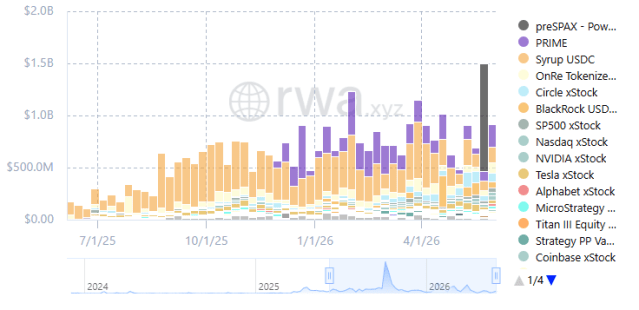
Source: Chart from Zensei on X

The development is quite significant for Solana since the RWA sector is emerging as one of the most promising use cases for blockchain technology in the current era. As shown in the chart, the daily transfer volume surged past $1.49 billion, representing a more than 2x growth from the previous day.

In the midst of this rise, preSPAX emerged as the dominant force, accounting for over $1 billion of the activity alone. Furthermore, this surge in activity only clarifies the growing demand for tokenized assets on the Solana blockchain.

Traders Are Choosing SOL For Their Operations

Zensei continues to flag SOL as the best platform for spot trading, because in his view, the altcoin always proves so. After seeing foreign assets such as Hyperliquid (HYPE) trade more efficiently on Solana, the expert stated that this is an indication of where traders are choosing to be.

At the time of this post, the SOL/UDSC pair recorded over $4.9 billion in trading volume in 24 hours. This figure is more than 6x the combined volume of the other top 9 SOL markets on major cryptocurrency exchanges. With this kind of growth, Zensei believes that it is becoming extremely hard to challenge its status as the best place to trade right now.

Crypto Patel shared that SOL’s price action is mirroring past trends that sent the altcoin sky high. Specifically, SOL is now trading inside the key Fibonacci Retracement Zone between 0.5 and 0.618. The last time the asset traded within this zone, it triggered a massive rally of over 2,200%, raising the potential for a strong rebound.

Currently, the accumulation zone is positioned between $40 and $60, but an Altcoin Season is required to trigger the anticipated upside move that could push its price to the $1,000 milestone. While it may seem too ambitious, Crypto Patel is confident in his prediction, noting that what matters is how well investors will be positioned for it.

SOL trading at $64 on the 1D chart | Source: SOLUSDT on Tradingview.com

Связанные с этим вопросы

QWhat is the main contradiction highlighted between Solana's price action and its network performance?

AWhile Solana's (SOL) price has been on a downward trend, breaking key support levels, its network performance and activity have shown a persistent uptick in momentum.

QWhat significant milestone did Solana's Real-World Assets (RWAs) ecosystem recently achieve?

ASolana's Real-World Assets (RWAs) ecosystem recorded its biggest transfer volume day in history, with daily transfer volume surging past $1.49 billion, representing more than 2x growth from the previous day.

QAccording to researcher Zensei, why is Solana considered the best platform for spot trading?

AZensei considers Solana the best platform for spot trading because assets like Hyperliquid (HYPE) trade more efficiently on it, indicating where traders are choosing to operate. The SOL/USDC pair alone recorded over $4.9 billion in 24-hour volume, significantly outpacing other top SOL markets.

QWhat historical price pattern is Crypto Patel referencing for SOL's current price action, and what potential does it suggest?

ACrypto Patel notes that SOL is trading inside the key Fibonacci Retracement Zone (between 0.5 and 0.618). The last time it traded in this zone, it triggered a massive rally of over 2,200%, raising the potential for a strong rebound.

QWhat condition does Crypto Patel state is necessary for SOL to potentially reach a $1,000 price milestone?

ACrypto Patel states that an Altcoin Season is required to trigger the anticipated upside move that could push SOL's price to the $1,000 milestone.

Похожее

M&A Deals in the Crypto Market Are Unusually Active

Title: M&A Activity in Crypto Market Becomes Unusually Active A rare signal is emerging in the crypto primary market: mergers and acquisitions (M&A) are nearing half of all financing deals. According to RootData, this month, M&A cases in the crypto industry reached 10, while financing rounds numbered only 14, meaning M&A accounts for approximately 42% of primary market transactions—the highest level in history. This does not signal a sudden industry boom. Instead, the rapid rise in M&A share primarily reflects the continued downturn in the financing market. Since November 2024, monthly crypto M&A deals have remained between 10-20, while financing deals have plummeted from around 100 to about 50, possibly hitting a new low this month. For project teams, this means the traditional path of relying on narratives, token expectations, and ecosystem subsidies to maintain valuations is narrowing. For leading companies, it presents a rare window to acquire teams, licenses, technology, liquidity, and market access at lower prices, with less competition and stronger bargaining power. Key active buyers include Coinbase, Kraken, Ripple, MoonPay, Polymarket, Kaiko, Sol Strategies, GSR, Keyrock, Jupiter, Paxos, and Ondo Finance. Their M&A logic is consistent: acquiring key capabilities at lower costs during the industry downturn. This is driven by more attractive valuations, reduced time and trial-and-error costs, the acquisition of licenses and compliance resources, and the integration of industry upstream and downstream segments. Current M&A focuses are concentrated in four areas: trading infrastructure (e.g., Coinbase acquiring Deribit, Kraken acquiring NinjaTrader), payments and stablecoins (e.g., MoonPay, Ripple expanding payment networks), compliance licenses, and asset issuance/distribution (e.g., acquisitions related to RWA and token issuance platforms like Coinbase's purchases of Liquifi and Echo). The rise in M&A is altering the primary market's exit logic. It provides an alternative path to the token-dependent model, encouraging teams to build tangible products, revenue, and strategic value that can be integrated. This could inject confidence into the market, showing that asset buyers and exit possibilities still exist, albeit with a stricter focus on real utility. However, this trend also indicates the crypto industry is becoming more centralized. As asset issuance, trading, market-making, custody, payments, and data gradually consolidate in the hands of a few major players, the industry's initial emphasis on openness and anti-monopoly is being reshaped by commercial realities. Coupled with rising compliance barriers, this signals the end of the low-barrier era for crypto entrepreneurship.

链捕手7 мин. назад

M&A Deals in the Crypto Market Are Unusually Active

链捕手7 мин. назад

M&A Deals Are Exceptionally Active in the Crypto Market

Mergers and acquisitions (M&A) activity in the cryptocurrency primary market has reached a historic high, accounting for approximately 42% of total deals in the current month, nearly matching the number of financing rounds. This shift does not signal a new boom cycle but rather reflects a severe contraction in the venture capital funding environment. As financing dwindles, established industry giants—including major exchanges, payment firms, and infrastructure providers—are seizing the opportunity to acquire strategic assets at lower valuations. Key drivers behind the surge in M&A include depressed project valuations, the need to quickly acquire talent and technology to capture short market windows, the pursuit of crucial regulatory licenses, and the strategic expansion into adjacent business verticals such as derivatives, payments, stablecoins, and real-world asset (RWA) issuance. Major acquisitions, like Coinbase's purchase of Deribit and Kraken's acquisition of NinjaTrader, exemplify the push to expand into high-margin areas like derivatives and multi-asset trading. This trend is reshaping the industry's exit landscape, offering an alternative to token-based exits and incentivizing startups to build tangible products and revenue streams with inherent strategic value for acquisition. However, it also points toward increasing centralization, as critical functions—trading, custody, payments, compliance—become concentrated within a few large, well-capitalized platforms, potentially raising barriers to entry for new ventures.

marsbit8 мин. назад

M&A Deals Are Exceptionally Active in the Crypto Market

marsbit8 мин. назад

Solana Privacy Ecosystem Panorama: A Complete Privacy Stack from Compute to AI

**Title: The Solana Privacy Ecosystem: A Full-Stack View from Compute to AI** **Summary:** This article provides a comprehensive overview of the emerging privacy landscape on the Solana blockchain, characterizing it as still in early development. It identifies two primary verticals—Neobanks and Private DeFi—as key drivers, while noting gaps in tooling and user experience. The discussion centers on two main approaches to private computation: Arcium, which utilizes Multi-Party Computation (MPC) networks (Multi-Party eXecution Environments) to process encrypted data with final settlement on Solana; and Magic Block, which leverages Trusted Execution Environments (TEEs) via its Private Ephemeral Rollup (PER). Both enable confidential applications like dark pools and private DeFi with minimal code changes. Building on this infrastructure, projects are creating privacy-focused applications. Umbra, built on Arcium, offers Encrypted Token Accounts (ETAs) for private balances, transfers, and selective disclosure for compliance. Other wallets like Privacy Cash and Hush provide mixer-like functionality for SOL. For private trading, encifherio uses TEEs to encrypt swap details routed through Jupiter, while VanishTrade and Darklake focus on shielding transaction intent and liquidity routing, with Darklake introducing a "blind slippage pool" to prevent front-running. Further applications include private prediction markets (e.g., Melee Markets using Arcium's encrypted order books) and private AI. Loyal exemplifies the latter, using both Magic Block and Arcium to enable decentralized AI agents that store user data, conversations, and transactions confidentially on-chain. The article concludes by framing privacy not as a single technology but as an evolving "ultimate privacy stack," with experts like Helius's Mert envisioning a future combination of Fully Homomorphic Encryption (FHE) and Zero-Knowledge proofs (ZK). Helius Privacy itself is developing a ZK-based UTXO privacy layer for Solana.

Foresight News14 мин. назад

Solana Privacy Ecosystem Panorama: A Complete Privacy Stack from Compute to AI

Foresight News14 мин. назад

Торговля

Спот
Фьючерсы

Популярные статьи

Обсуждения

Добро пожаловать в Сообщество HTX. Здесь вы сможете быть в курсе последних новостей о развитии платформы и получить доступ к профессиональной аналитической информации о рынке. Мнения пользователей о цене на SOL (SOL) представлены ниже.

活动图片