M&A Deals in the Crypto Market Are Unusually Active

链捕手Опубликовано 2026-06-16Обновлено 2026-06-16

Введение

Title: M&A Activity in Crypto Market Becomes Unusually Active A rare signal is emerging in the crypto primary market: mergers and acquisitions (M&A) are nearing half of all financing deals. According to RootData, this month, M&A cases in the crypto industry reached 10, while financing rounds numbered only 14, meaning M&A accounts for approximately 42% of primary market transactions—the highest level in history. This does not signal a sudden industry boom. Instead, the rapid rise in M&A share primarily reflects the continued downturn in the financing market. Since November 2024, monthly crypto M&A deals have remained between 10-20, while financing deals have plummeted from around 100 to about 50, possibly hitting a new low this month. For project teams, this means the traditional path of relying on narratives, token expectations, and ecosystem subsidies to maintain valuations is narrowing. For leading companies, it presents a rare window to acquire teams, licenses, technology, liquidity, and market access at lower prices, with less competition and stronger bargaining power. Key active buyers include Coinbase, Kraken, Ripple, MoonPay, Polymarket, Kaiko, Sol Strategies, GSR, Keyrock, Jupiter, Paxos, and Ondo Finance. Their M&A logic is consistent: acquiring key capabilities at lower costs during the industry downturn. This is driven by more attractive valuations, reduced time and trial-and-error costs, the acquisition of licenses and compliance resources, and the integration...

Author: Gu Yu, ChainCatcher

A rare signal is emerging in the crypto primary market: M&A deals are approaching half the volume of financing deals.

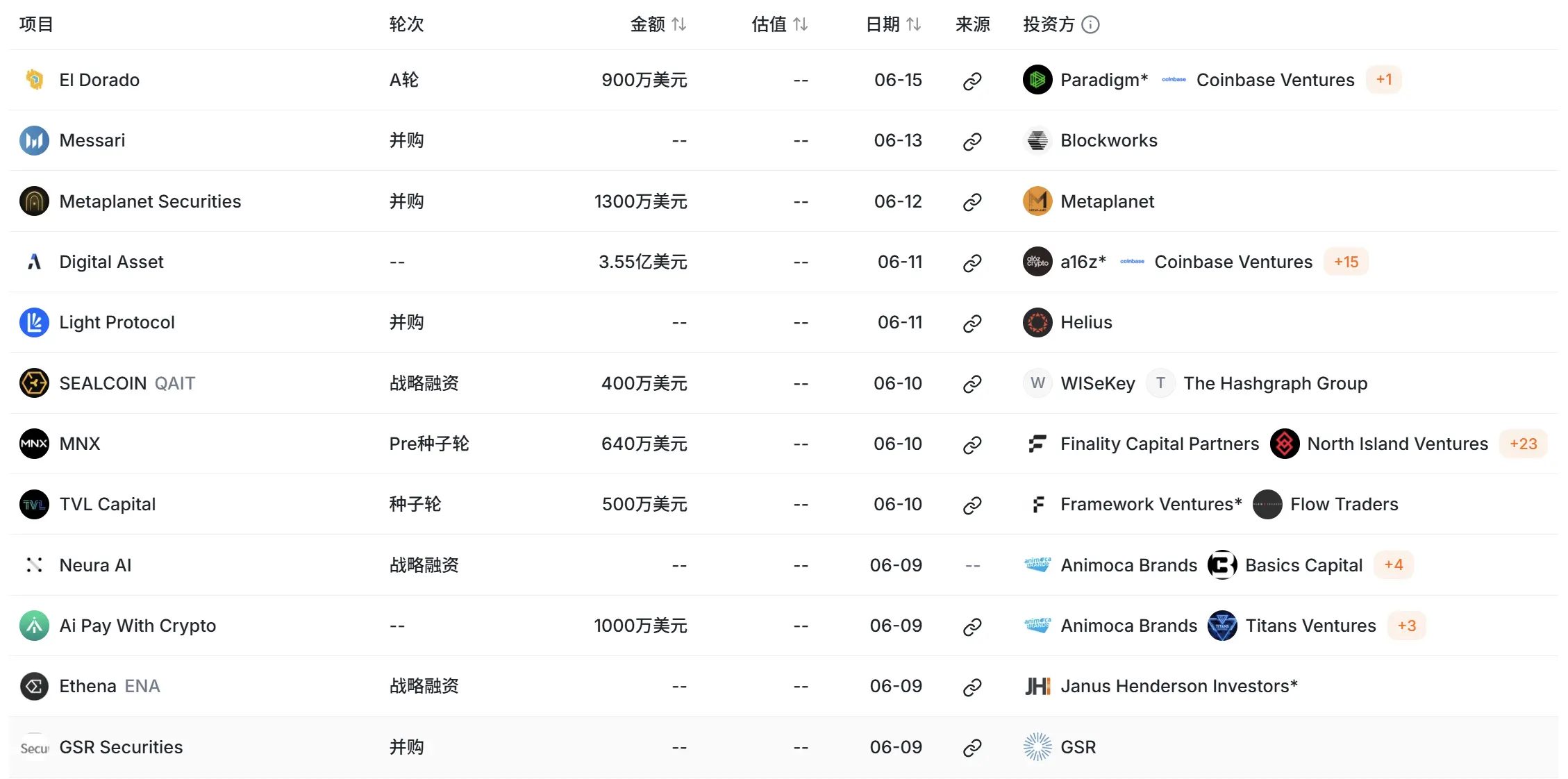
According to RootData statistics, the number of M&A cases in the crypto industry this month has reached 10, while the number of financing rounds in the same period is only 14. Calculated as a proportion of total primary market transaction volume, M&A deals now account for approximately 42%, the highest level in history.

The implication of this data is straightforward: In the past, the main driver in the crypto primary market was financing; now, more and more deals are becoming acquisitions.

This does not mean the industry has suddenly entered a boom cycle. On the contrary, the rapid rise in the proportion of M&A deals primarily reflects the continued downturn in the financing market. Since November 2024, the monthly number of M&A deals in the crypto industry has remained basically between 10 and 20, while the number of financing deals has dropped sharply from around 100 to around 50, potentially hitting a new low this month.

In other words, M&A deals have not truly replaced the heat of the financing market; rather, they have become the most stable form of transaction in the primary market after its contraction.

For projects, this means the old path of relying on narratives for financing, token expectations, and ecosystem subsidies to maintain valuations is narrowing. For leading companies, it signifies a rare window: using lower prices, less competition, and stronger bargaining power to acquire teams, licenses, technology, liquidity, and market access.

After the financing tide recedes, the crypto primary market has not stopped functioning; it's just that pricing power is shifting from the hands of VCs to those of the buyer giants.

I. Why Are M&A Numbers Consistently High?

Over the past year, frequent buyers have included Coinbase, Kraken, Ripple, MoonPay, Polymarket, Kaiko, Sol Strategies, GSR, Keyrock, Jupiter, Paxos, Ondo Finance, etc.

These companies operate in different sectors—exchanges, payment companies, market makers, data service providers, prediction markets, RWA platforms, Solana treasury companies, as well as stablecoin and financial infrastructure firms. However, their M&A logic is highly consistent: to complement key capabilities at a lower cost during the industry's downturn.

First, valuations are cheap enough.

When financing conditions tighten, many projects cannot raise further capital at their previous round valuations. For buyers, this means better acquisition prices, fewer competing bidders, and stronger bargaining power. For sellers, even if the price isn't ideal, being acquired by a leading company may offer more certainty than continued dilution, layoffs, or pivots.

Take the recently acquired Messari as an example. The project once reached a peak valuation of $300 million, with cumulative funding exceeding $70 million. However, due to severe impacts on its core research business from AI and competitors, leading to repeated layoffs and business contractions, the final acquisition price by Blockworks was only a little over ten million dollars.

Second, saving time and trial-and-error costs.

Windows of opportunity in the crypto industry are often short. When a regulatory opening emerges, a new product model proves viable, or an asset category heats up, the market doesn't give companies two to three years to build a team from scratch. Acquiring a mature team is often faster than internal incubation and avoids unnecessary trial-and-error costs.

Coinbase's acquisition of Deribit for $2.9 billion is a classic case. Deribit is one of the world's leading crypto options platforms, with trading volume reaching about $1.2 trillion in 2024. Through this deal, Coinbase directly entered the core global crypto derivatives market, instead of building an options trading platform from scratch.

Third, acquiring licenses and compliance resources.

As regulatory frameworks gradually clarify in the US, EU, Hong Kong, Singapore, and elsewhere, licenses are becoming core assets for crypto companies. Trading, custody, payments, stablecoins, brokerage, clearing, derivatives—every link requires a compliant entry point.

Kraken's acquisition of NinjaTrader follows precisely this logic. NinjaTrader is a futures trading platform for retail users, with trading volume of $1.5 billion; this deal helps Kraken expand into multi-asset trading and regulated derivatives business.

Fourth, integrating industry chain verticals.

Crypto giants are evolving from single-point products into financial groups. Exchanges don't just do matching; they want to handle derivatives, wallets, custody, payments, RWA, token issuance, data, and institutional services. Stablecoin companies don't just issue tokens; they want to build payment networks, AI Agents, and financial infrastructure. RWA platforms don't just issue assets; they need to master compliance, distribution, liquidity, and data entry points.

The M&A path of crypto payment giant MoonPay is typical. In 2025, MoonPay acquired crypto payment startup Helio for about $175 million; it subsequently announced the acquisition of stablecoin infrastructure platform Iron to expand its enterprise payment and stablecoin capabilities.

II. Which Directions Are the Focus of M&A?

Judging from recent M&A directions, the areas crypto giants are most willing to spend money on are concentrated in four categories: trading infrastructure, payments & stablecoins, compliance licenses, and asset issuance & distribution.

Trading infrastructure remains the largest battleground.

Coinbase's acquisition of Deribit and Kraken's acquisition of NinjaTrader are driven by the same judgment: growth in spot trading is limited, while derivatives, options, futures, multi-asset trading, and institutional services represent higher-value profit pools. Especially with the gradual rise of ETFs, RWA, tokenized stocks, and prediction markets, the boundaries of trading platforms are expanding from "crypto-crypto exchanges" to "global asset trading gateways."

Payments and stablecoins are the second main line.

Companies like MoonPay, Ripple, Paxos, and Tether are all expanding around payments, stablecoin clearing, merchant acquiring, enterprise settlement, and cross-border transfers. Ripple's acquisition moves in recent years have been particularly aggressive, including the $250 million acquisition of custody company Metaco in 2023, followed by expansions around stablecoin payments, prime brokerage, and enterprise treasury management.

This indicates that the stablecoin war is no longer just about issuance scale, but about payment networks, compliant channels, institutional clients, and scenario gateways.

RWA and asset issuance are also becoming new M&A hotspots.

Companies like Ondo Finance, Jupiter, Polymarket, and Coinbase are expanding their asset issuance, liquidity distribution, and trading gateways through acquisitions or integrations. Coinbase's acquisitions of Liquifi and Echo are centered on building capabilities for token issuance and on-chain financing. The Echo deal, worth $375 million, helps Coinbase expand into an on-chain capital formation platform; Liquifi provides token distribution and management tools, aligning with Coinbase's bet on compliant token issuance paths.

The strategic significance of such M&A lies in this: whoever masters asset issuance controls the source of transactions.In the past, exchanges mainly earned fees from trading existing assets. In the future, leading platforms want to profit from the entire chain: asset creation, financing, listing, distribution, market making, custody, and trading. M&A is the fastest way to connect this chain.

III. M&A is Rewriting the Primary Market Exit Logic

The warming of M&A is not necessarily bad for entrepreneurs.

In the past, the exit path for crypto projects relied too heavily on tokens. A project's success often depended on whether it could launch a token, list on exchanges, maintain market cap, and create liquidity. But this mechanism created numerous problems in recent years: projects exiting early, VCs unlocking and selling, retail investors taking the bag, high valuations with low float, while real business was held hostage by token prices.

M&A provides another path. Even if a team cannot independently grow into a giant, as long as it builds genuine capabilities in a certain link—like licensing, technology, liquidity, compliance, users, data, risk control, market making, or payment networks—it has a chance to be acquired by a larger platform.

This will change how entrepreneurs behave. In the past, many projects issued tokens just to issue tokens and crafted narratives just to raise funds; in the future, more teams may refocus on product, revenue, customers, and strategic value that can be integrated.

This is also why active M&A can, to some extent, inject a stimulant into the primary market. It shows that the crypto industry still has asset buyers, still has value re-ratings, and still has exit possibilities.

It's just that the market is screening value in a more stringent way. What can be bought is no longer the grand narrative on a PowerPoint, but the real capabilities that can be directly integrated into a business map.

IV: The Crypto Industry is Becoming More Centralized

Behind the warming of M&A lies a depressed financing market, falling project valuations, and increased exit pressure for entrepreneurial teams. But it also shows that the crypto industry has not lost capital vitality; it is just completing resource reorganization in another way.

Another issue that must be seen is: the crypto industry is becoming more centralized.

As asset issuance, trading, market making, custody, payments, and data gradually concentrate in the hands of a few companies, the openness and anti-monopoly nature initially emphasized by the crypto industry may be reshaped by real business logic.

Especially when compliance becomes a core barrier, the difficulty for new entrepreneurs to enter the market will further increase. The future crypto industry may see a landscape similar to traditional finance: a few large platforms control licenses, clients, and liquidity, while small and medium-sized teams can only become technology suppliers, ecosystem plugins, or potential acquisition targets.

Therefore, another implication of the rising proportion of M&A is: the crypto industry is bidding farewell to the era of low-barrier entrepreneurship.

Future entrepreneurs will not only face market competition but also the ecosystem boundaries and regulatory barriers of giants.

Связанные с этим вопросы

QWhat does the increased proportion of M&A deals compared to financing rounds indicate about the current state of the cryptocurrency primary market?

AThe increased proportion of M&A deals indicates that the cryptocurrency primary market is undergoing a significant shift, where acquisition is becoming a more dominant transaction form relative to financing. This does not signify a sudden industry boom, but rather reflects the ongoing downturn in the financing market. As financing activity has sharply declined, M&A has remained stable, effectively taking up a larger share of total transactions, reaching a historically high level of approximately 42% according to the article's data for the month.

QAccording to the article, what are the four main reasons why major crypto companies are actively pursuing mergers and acquisitions?

AThe four main reasons for active M&A by major crypto companies are: 1. Valuations are low enough, offering better prices and less competition. 2. To save time and trial-and-error costs, allowing faster entry into new business areas than internal development. 3. To acquire licenses and compliance resources, which are becoming core assets in a clearer regulatory landscape. 4. To integrate upstream and downstream sectors of the industry chain, transforming single-point companies into financial conglomerates.

QWhat are the four key business areas that have become the focus of M&A activity for crypto giants recently?

AThe four key areas of M&A focus for crypto giants are: 1. Trading infrastructure (e.g., derivatives platforms). 2. Payments and stablecoins. 3. Compliance and licensing. 4. Asset issuance and distribution (e.g., RWA, tokenization).

QHow might the rise of M&A activity alter the exit logic and entrepreneurial behavior in the crypto primary market?

AThe rise of M&A provides an alternative exit path beyond reliance on token launches and listings. This could change entrepreneurial behavior by encouraging teams to focus more on building tangible products, revenue, customer bases, and strategic value that can be integrated into larger platforms, rather than just packaging narratives for fundraising or token value appreciation. It signals that exits are still possible, but value is being assessed more critically based on real, integratable capabilities.

QWhat potential negative trend does the article suggest is associated with the increase in M&A activity within the crypto industry?

AThe article suggests that the increase in M&A activity could lead to greater centralization within the crypto industry. As key functions like asset issuance, trading, custody, payments, and data become concentrated in the hands of a few major companies, the industry's original emphasis on openness and anti-monopoly may be reshaped by commercial realities. Coupled with high compliance barriers, this could raise the difficulty for new entrepreneurs, potentially leading to a landscape dominated by large platforms with smaller teams serving as suppliers or acquisition targets.

Похожее

Pricing OpenAI Pre-IPO: A New, Life-or-Death Business on Hyperliquid Lasting Half a Year

Pricing OpenAI Pre-IPO: Hyperliquid's High-Stakes, Six-Month Business Venture The article analyzes the nascent market for pre-IPO perpetual contracts on the Hyperliquid blockchain, exemplified by two contrasting teams: Trade.xyz and Ventuals. Trade.xyz, an anonymous team, successfully built the largest pre-market on Hyperliquid. Its strategy focused on near-term events, like the SpaceX IPO. By listing a SpaceX contract with a known launch date and price, the market had a tangible "anchor" (the eventual Nasdaq opening price) to converge upon, which kept speculation in check. This approach fueled significant growth. In stark contrast, Ventuals, backed by Paradigm, failed despite holding coveted contracts for OpenAI and Anthropic. Its critical flaw was its pricing mechanism for these companies, which have no imminent IPO. Ventuals' oracle price was half-derived from infrequent private market transactions and half from its own contract's moving average. This created a self-reinforcing loop where buying pressure artificially inflated the price, disconnecting it from real supply and demand. The market became illiquid and structurally skewed. Ventuals shut down nine months after launch, reportedly through an acquisition. Its final settlement prices—OpenAI at ~$1,341 and Anthropic at ~$1,618—were thus partially products of its flawed model. Ironically, some company employees and late-stage VCs reportedly used these prices for valuation reference, highlighting the desperate demand for price discovery in opaque private markets. The failure of Ventuals exposes the core challenge of this business: price for illiquid, non-public assets requires a robust, self-correcting market, which is absent without a definitive public listing event. Nevertheless, demand is driving major players like Coinbase and traditional finance (e.g., Citi) to enter the space, aiming to provide 24/7 trading for coveted private company shares. The venture's ultimate viability, however, hinges on solving the fundamental pricing problem Ventuals could not.

marsbit1 ч. назад

Pricing OpenAI Pre-IPO: A New, Life-or-Death Business on Hyperliquid Lasting Half a Year

marsbit1 ч. назад

Торговля

Спот
Фьючерсы

Популярные статьи

Что такое DOGE M

Doge Matrix ($doge m): Новая порода криптовалюты, управляемой сообществом Введение В постоянно развивающемся мире криптовалют новые проекты постоянно появляются, каждый из которых стремится привлечь интерес инвесторов и энтузиастов. Одним из последних участников этой области является Doge Matrix, представленный тикером $doge m. Этот проект привлек внимание благодаря своим корням в популярной мем-культуре, окружающей Dogecoin, и занял свое место в пространстве web3. Эта статья направлена на предоставление всестороннего анализа Doge Matrix, охватывающего его обзор, создателя, инвесторов, функциональность, временную шкалу и примечательные аспекты. Что такое Doge Matrix ($doge m)? Doge Matrix — это проект криптовалюты, управляемый сообществом, который, по-видимому, основывается на широкой привлекательности Dogecoin, цифровой валюты, известной своим маскотом Шиба Ину и мем-истоками. Хотя общие цели Doge Matrix не определены в широком смысле, он характеризуется стремлением к вовлечению и поддержке сообщества. В отличие от традиционных криптовалют, которые часто подчеркивают полезность или внутреннюю ценность через базовые технологии, Doge Matrix позиционирует себя в пространстве, которое охватывает культурный феномен криптовалют, особенно привлекая тех, кто резонирует с этосом активов на основе мемов. Опираясь на сильные стороны сообщества Dogecoin, Doge Matrix функционирует как часть более широкой экосистемы, приглашая участие и вовлеченность пользователей, которые разделяют интерес к криптовалюте и цифровому пространству. Кто является создателем Doge Matrix ($doge m)? Личность создателя Doge Matrix остается неизвестной. Эта нехватка прозрачности не является редкостью в пространстве криптовалют, где некоторые проекты запускаются без раскрытия личностей своих основателей. Отсутствие информации о команде основателей может вызывать вопросы у потенциальных инвесторов о подотчетности и направлении проекта. Кто являются инвесторами Doge Matrix ($doge m)? На данный момент нет общедоступной информации, подробно описывающей инвесторов или инвестиционные фонды, поддерживающие Doge Matrix. Проект, похоже, в основном полагается на поддержку сообщества, а не на институциональные инвестиции. Эта модель соответствует управляемой сообществом природе инициативы, способствуя созданию среды, в которой направление проекта формируется его участниками, а не диктуется избранными финансовыми спонсорами. Как работает Doge Matrix ($doge m)? Специфика операционных механизмов Doge Matrix несколько расплывчата, отражая более широкую тенденцию проектов в пространстве мем-коинов, где инновационные функции не всегда четко сформулированы. Тем не менее, Doge Matrix, похоже, разработан для того, чтобы использовать существующую экосистему криптовалют, поощряя участие пользователей и опираясь на знакомые культурные ссылки, связанные с Dogecoin. Его потенциально уникальные характеристики происходят от взаимодействий сообщества, а не от технологических достижений, подчеркивая общие переживания и сотрудничество среди держателей токенов. Хотя точные инновации не были явно изложены, проект, похоже, создает пространство, где члены сообщества могут взаимодействовать, делиться идеями и продвигать потенциал проекта вперед. Временная шкала Doge Matrix ($doge m) Обзор временной шкалы проекта выявляет значимые события, которые определили его путь до сих пор: 25 ноября 2024 года: Doge Matrix достиг своего исторического максимума, что стало значительной вехой в его ранней истории. 1 января 2025 года: Напротив, Doge Matrix достиг своего исторического минимума, иллюстрируя волатильность, часто ассоциируемую с криптовалютами, особенно на ранних стадиях жизненного цикла проекта. В процессе: Проект продолжает активно торговаться и поддерживаться своим сообществом, хотя конкретные будущие вехи или цели еще не были раскрыты. Ключевые моменты о Doge Matrix ($doge m) Ориентированность на сообщество В центре Doge Matrix лежит стремление к вовлечению сообщества. Проект процветает на основе сотрудничества и общих целей среди своих участников, подчеркивая важность коллективных усилий. В отличие от централизованных проектов, которые часто имеют четкую структуру руководства, Doge Matrix в настоящее время демонстрирует более гибкий подход к управлению, где голос каждого члена сообщества имеет значение. Волатильность Криптовалютный рынок известен своей волатильностью, и Doge Matrix не является исключением. Его история цен отражает значительные колебания между высокими и низкими значениями, что типично для многих новых криптовалют, но подчеркивает риски, связанные с инвестициями в новые токены. Нехватка детальной информации Одной из самых поразительных особенностей Doge Matrix является нехватка детальной информации о его технологических основах и операционных механизмах. Эта неопределенность требует от потенциальных инвесторов проведения тщательной проверки перед взаимодействием с проектом. Заключение В заключение, Doge Matrix ($doge m) иллюстрирует новую волну проектов криптовалют, которые сильно полагаются на вовлечение сообщества и культурную значимость. Хотя проект и не хватает некоторых конкретных деталей — таких как четкое руководство, определенные цели и детальная функциональность — он сумел вызвать интерес в крипто-сообществе, используя установленную привлекательность мем-культуры. Как и в случае с любыми инвестициями в пространстве криптовалют, понимание присущих рисков и проведение комплексного исследования являются необходимыми для потенциальных участников. Doge Matrix служит напоминанием о динамичной, иногда непредсказуемой природе криптоиндустрии, отмеченной постоянной эволюцией и энтузиазмом в отношении инициатив, управляемых сообществом.

685 просмотров всегоОпубликовано 2025.02.03Обновлено 2025.02.03

Что такое DOGE M

Что такое $M

Понимание Mantis ($M): Новая эра в кросс-цепной интероперабельности В постоянно развивающемся ландшафте Web3 и криптовалют новые проекты стремятся предложить инновационные решения, направленные на улучшение пользовательского опыта и расширение функциональных возможностей в рамках децентрализованной финансовой экосистемы. Один из таких проектов, привлекающих внимание, — Mantis ($M), пионерский протокол, основанный на принципах кросс-цепной интероперабельности и расчетов на основе намерений. Эта статья углубляется в основные аспекты Mantis, включая его основную функциональность, создателей, инвестиционную поддержку, инновационные функции и ключевые вехи. Что такое Mantis ($M)? Mantis описывается как протокол расчетов по намерениям в нескольких доменах, который упрощает кросс-цепные взаимодействия, позволяя пользователям без труда выполнять сложные финансовые транзакции на различных блокчейн-платформах. Протокол работает через три основных уровня: Выражение намерений: Пользователи могут формулировать свои цели транзакций на естественном языке с помощью DISE LLM, продвинутой модели AI. Например, пользователь может выразить желание обменять Ethereum (ETH) на Solana (SOL) с определенной допустимой проскальзыванием в 1%. Исполнение: Этот уровень использует сеть решателей, которые конкурируют за выполнение намерений пользователей. Транзакции выполняются с использованием таких механизмов, как совпадение желаний (CoWs) и аукционы потока заказов (OFAs), которые обеспечивают оптимальное удовлетворение потребностей пользователей. Расчет: Используя протокол межблокчейн-коммуникации (IBC), Mantis позволяет атомарные кросс-цепные транзакции, позволяя пользователям работать на различных поддерживаемых цепях, включая Ethereum, Solana и Cosmos. Mantis разработан для введения родного генерации дохода для неактивных активов, используя криптографические доказательства для поддержания целостности транзакций на протяжении всего процесса. Создатели и команда разработки Mantis был задуман Composable Foundation, исследовательской организацией, известной своим акцентом на решениях для блокчейн-интероперабельности. Этот фонд сотрудничает с уважаемыми академическими учреждениями, включая Гарвардский университет и Университет Лиссабона, внося вклад в обширные исследования и разработки, которые информируют архитектуру и функциональность Mantis. Обязательство Composable Foundation по содействию инновациям в области блокчейна позиционирует Mantis как надежное решение для растущего спроса на интероперабельность среди множества блокчейн-сетей. Инвесторы и поддержка Хотя конкретные детали о частных инвесторах не были публично раскрыты, Mantis пользуется значительной поддержкой от различных организаций, включая: Гранты экосистемы от цепей с поддержкой IBC, которые поддерживают рост протокола и его интеграцию в экосистемы децентрализованных финансов. Стратегические партнерства с поставщиками инфраструктуры, которые усиливают сетевые возможности Mantis и стратегии развертывания. Финансирование через казну Composable Foundation, обеспечивая устойчивую финансовую поддержку для продолжающейся разработки и операционных расходов. Эти совместные усилия отражают консенсус среди заинтересованных сторон о важности улучшения кросс-цепной функциональности и потенциальной полезности инфраструктурных инноваций Mantis. Ключевые инновации Mantis выделяется благодаря нескольким пионерским инновациям, которые улучшают его функциональность и полезность: Независимые от цепи намерения: Пользователи могут инициировать транзакции с любой поддерживаемой цепи, при этом расчет происходит на другой. Эта гибкость дает пользователям больше возможностей, способствуя увеличению взаимодействия между различными платформами. Интерфейс на базе AI: Интеграция DISE LLM позволяет пользователям проводить сложные операции DeFi на естественном языке, тем самым упрощая взаимодействия и делая технологии блокчейн доступными для более широкой аудитории. Кросс-доменное захватывание MEV: Mantis создает внутренний рынок для максимальной извлекаемой ценности (MEV) через конкуренцию между решателями. Этот инновационный подход позволяет достичь большей эффективности и извлечения ценности в сложных транзакциях. Модульный уровень расчетов: Протокол поддерживает различные методы верификации, включая нулевые доказательства и оптимистичные роллапы, предоставляя универсальную структуру, которая может адаптироваться к новым технологиям блокчейна. Историческая хронология Разработка Mantis отмечена несколькими критическими вехами, которые определяют его траекторию и рост: | Год | Веха | |————|———————————————————————–| | 2022 | Начальная разработка концепции в исследовательском подразделении Composable Foundation. | | Q3 2024 | Запуск тестовой сети с возможностями мостов между Solana и Ethereum. | | Q1 2025 | Ожидаемое событие генерации токенов (TGE) наряду с запуском основной сети. | | Q2 2025 | Ожидаемая интеграция DISE LLM и расширение кросс-цепных возможностей. | | 2025 H2 | Запланированная поддержка более 15 цепей через дальнейшие обновления IBC. | Эта хронология описывает эволюцию Mantis, от концептуальных обсуждений до активной реализации и будущих этапов роста. Стратегия роста экосистемы Стратегия Mantis по росту экосистемы включает несколько инициатив, направленных на поощрение участия пользователей и вовлечения разработчиков: Система кредитов: Пользователи могут зарабатывать кредиты протокола, предоставляя ликвидность и участвуя в реферальных программах. Эти кредиты можно будет обменять на стимулы в будущем, способствуя формированию активного сообщества пользователей. Модульный комплект для разработки программного обеспечения (SDK): Этот инструмент позволяет разработчикам создавать приложения на основе моделей, управляемых намерениями, используя инфраструктуру Mantis, тем самым способствуя инновациям в его экосистеме. Модель управления: По мере взросления протокола держатели токенов $M получат возможность участвовать в управлении протоколом, позволяя им голосовать за предлагаемые обновления и изменения, тем самым усиливая вовлеченность сообщества и децентрализацию. Mantis представляет собой значительный шаг вперед в области кросс-цепной архитектуры. Путем бесшовной интеграции продвинутых алгоритмов AI с надежной расчетной структурой Mantis стремится решить проблемы фрагментации в многоцепных экосистемах. Его инновационный подход приоритизирует улучшение пользовательского опыта, соблюдая при этом основные принципы децентрализации и безопасности, устанавливая новый стандарт для будущей интероперабельности технологий блокчейн. По мере того как Mantis продолжает свой путь роста и реализации, он обещает стать проектом, за которым стоит внимательно следить в конкурентной среде Web3 и децентрализованных финансов. С акцентом на преодоление границ и повышение вовлеченности пользователей Mantis готов стать неотъемлемой частью будущих разработок в области криптовалют.

56 просмотров всегоОпубликовано 2025.03.18Обновлено 2025.03.18

Что такое $M

Как купить M

Добро пожаловать на HTX.com! Мы сделали приобретение MemeCore (M) простым и удобным. Следуйте нашему пошаговому руководству и отправляйтесь в свое крипто-путешествие.Шаг 1: Создайте аккаунт на HTXИспользуйте свой адрес электронной почты или номер телефона, чтобы зарегистрироваться и бесплатно создать аккаунт на HTX. Пройдите удобную регистрацию и откройте для себя весь функционал.Создать аккаунтШаг 2: Перейдите в Купить криптовалюту и выберите свой способ оплатыКредитная/Дебетовая Карта: Используйте свою карту Visa или Mastercard для мгновенной покупки MemeCore (M).Баланс: Используйте средства с баланса вашего аккаунта HTX для простой торговли.Третьи Лица: Мы добавили популярные способы оплаты, такие как Google Pay и Apple Pay, для повышения удобства.P2P: Торгуйте напрямую с другими пользователями на HTX.Внебиржевая Торговля (OTC): Мы предлагаем индивидуальные услуги и конкурентоспособные обменные курсы для трейдеров.Шаг 3: Хранение MemeCore (M)После приобретения вами MemeCore (M) храните их в своем аккаунте на HTX. В качестве альтернативы вы можете отправить их куда-либо с помощью перевода в блокчейне или использовать для торговли с другими криптовалютами.Шаг 4: Торговля MemeCore (M)С легкостью торгуйте MemeCore (M) на спотовом рынке HTX. Просто зайдите в свой аккаунт, выберите торговую пару, совершайте сделки и следите за ними в режиме реального времени. Мы предлагаем удобный интерфейс как для начинающих, так и для опытных трейдеров.

1.2k просмотров всегоОпубликовано 2025.07.02Обновлено 2026.06.02

Как купить M

Обсуждения

Добро пожаловать в Сообщество HTX. Здесь вы сможете быть в курсе последних новостей о развитии платформы и получить доступ к профессиональной аналитической информации о рынке. Мнения пользователей о цене на M (M) представлены ниже.

活动图片