Perlombaan Perbendaharaan Bitcoin Memanas Saat Capital B Mengamankan $18 Juta

bitcoinistОпубликовано 2026-05-12Обновлено 2026-05-12

Введение

Perusahaan perbendaharaan Bitcoin terbesar kedua di Eropa, Capital B, menerima suntikan dana segar sebesar 15,2 juta euro (sekitar $17,8 juta) melalui penempatan saham privat. Pendanaan ini didukung oleh CEO Blockstream Adam Back dan manajer aset TOBAM asal Paris. Jika seluruh opsi warrant yang melekat pada kesepakatan ini dieksekusi, perusahaan berpotensi mendapat tambahan modal hingga $116,5 juta. Modal baru ini, bersama pendapatan operasional, dapat memungkinkan Capital B membeli sekitar 182 Bitcoin lagi, sehingga total kepemilikannya mencapai sekitar 3.125 BTC. Saat ini, perusahaan telah memegang 2.943 BTC (senilai $237 juta), menjadikannya pemegang korporasi terbesar ke-25 secara global dan kedua di Eropa. Langkah Capital B ini berbeda dengan banyak perusahaan sektor Bitcoin lainnya yang justru mengurangi eksposur atau melakukan lindung nilai di tengah kondisi pasar yang lesu. Saham Capital B naik 4,25% setelah pengumuman ini, menunjukkan minat investor yang tetap ada. Keterlibatan Adam Back yang kedua kalinya dalam seminggu turut menyoroti kepercayaan terhadap strategi perusahaan ini.

Perusahaan perbendaharaan Bitcoin terbesar kedua di Eropa baru saja mendapat suntikan dana yang signifikan. Capital B, yang terdaftar di bursa saham Prancis, telah mengumpulkan 15,2 juta euro — sekitar $17,8 juta — melalui penempatan saham privat, dengan dukungan penting dari CEO Blockstream Adam Back dan manajer aset berbasis Paris, TOBAM.

Hadiah Lebih Besar Di Depan Mata

Namun, angka sebenarnya yang perlu diperhatikan mungkin jauh lebih besar. Setiap saham dalam kesepakatan tersebut dilengkapi dengan empat waran berlangganan dengan harga tetap $0,78. Jika semua waran itu dieksekusi, Capital B dapat menarik tambahan $116,5 juta melalui penerbitan sekitar 92 juta saham baru, menurut direktur dewan strategi Bitcoin, Alexandre Laizet.

Perusahaan mengatakan modal segar, dikombinasikan dengan pendapatan dari operasi berkelanjutannya, dapat memungkinkannya membeli sekitar 182 Bitcoin lagi. Itu akan mendorong total kepemilikannya menjadi kira-kira 3,125 BTC.
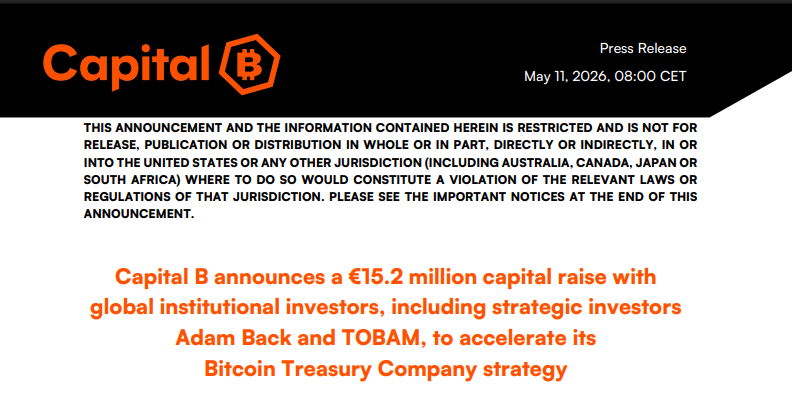
Sumber: Capital B

Kembali Dalam Gambar — Lagi

Keterlibatan Adam Back mengejutkan banyak pihak. Ini adalah kedua kalinya dalam seminggu ahli kriptografi dan kepala Blockstream ini mendukung Capital B. Baru tujuh hari sebelumnya, Back berpartisipasi dalam pengumpulan dana terpisah senilai $1,3 juta dari perusahaan yang sama.

Capital B saat ini memegang 2.943 BTC, bernilai sekitar $237 juta. Itu menjadikannya pemegang perusahaan Bitcoin terbesar ke-25 di dunia dan terbesar kedua di Eropa, hanya tertinggal dari Bitcoin Group SE Jerman, menurut data dari Bitcointreasuries.

BTCUSD diperdagangkan di $81,363 pada bagan 24 jam: TradingView

Waktu pengumpulan dana ini membedakan Capital B dari sebagian besar sektor perusahaan Bitcoin lainnya. Sementara perusahaan lain menarik mundur — menjual kepemilikan, memotong utang, atau membangun program lindung nilai setelah berbulan-bulan kondisi pasar lesu — Capital B masih membeli.

Nakamoto, sebuah perusahaan perbendaharaan Bitcoin yang terdaftar di Nasdaq, mengumumkan program derivatif pada akhir April untuk melindungi dari risiko penurunan harga. Sebelumnya, Genius Group menjual seluruh perbendaharaan 84 BTC-nya untuk melunasi utang $8,5 juta.

Saham Naik Setelah Pengumuman

Saham Capital B naik sekitar 4,25% pada hari Senin setelah berita tersebut, diperdagangkan di dekat 0,67 euro. Saham masih turun sekitar 10% untuk tahun ini.

Strategy, perusahaan yang dipimpin oleh Michael Saylor, mengumpulkan $2,5 miliar pada akhir April melalui penjualan saham dan saham preferen. Pengumpulan dana yang lebih kecil oleh XCE — $794.000, juga didukung oleh Adam Back — diumumkan sekitar waktu yang sama.

Langkah terbaru Capital B menandakan bahwa setidaknya beberapa perusahaan Eropa masih terus maju dengan akumulasi Bitcoin, bahkan ketika kondisinya masih belum pasti.

Gambar unggulan dari FinanceFeeds, bagan dari TradingView

Связанные с этим вопросы

QApa yang dilakukan perusahaan Capital B dan berapa jumlah dana yang berhasil mereka kumpulkan?

ACapital B, perusahaan perbendaharaan Bitcoin terbesar kedua di Eropa, berhasil mengumpulkan 15,2 juta euro (sekitar $17,8 juta) melalui penempatan saham privat.

QSiapa saja investor terkemuka yang mendukung pendanaan terbaru Capital B?

APendanaan ini didukung oleh CEO Blockstream, Adam Back, dan manajer aset yang berbasis di Paris, TOBAM.

QBerapa jumlah Bitcoin tambahan yang berencana dibeli Capital B dengan modal segar ini?

ADengan modal segar dan pendapatan operasionalnya, Capital B berencana membeli sekitar 182 Bitcoin lagi, sehingga total kepemilikannya menjadi sekitar 3.125 BTC.

QBagaimana peringkat Capital B dalam daftar perusahaan pemegang Bitcoin korporat di dunia dan Eropa?

ACapital B merupakan pemegang Bitcoin korporat terbesar ke-25 di dunia dan terbesar kedua di Eropa, setelah Bitcoin Group SE dari Jerman.

QBagaimana reaksi pasar saham terhadap pengumuman pendanaan ini?

ASetelah pengumuman, saham Capital B naik sekitar 4,25% pada hari Senin, diperdagangkan mendekati 0,67 euro.

Похожее

Has the 'Digital Gold' Narrative for BTC Failed?

**Title: Has the "Digital Gold" Narrative for Bitcoin Failed?** The article argues that Bitcoin's "digital gold" narrative remains valid despite a recent sharp price decline (from a peak near $126k in Oct 2025 to briefly under $61k in Feb 2026). It presents a long-term investment framework based on three core points: **1. Viewing Bitcoin as an Asset:** Bitcoin is presented as a superior potential store of value compared to gold. Key arguments are its absolute scarcity (21 million cap), superior portability, and transparent auditability via its public ledger. While acknowledging its current use in early, volatile stages (~3-4% global adoption), the author draws parallels to the early, disruptive phases of the internet and e-commerce. **2. Understanding the Recent Downturn:** The current ~50% correction is framed as a predictable, consensus-driven cycle following its post-halving peak (the 2024 halving preceded the Oct 2025 high). A crucial factor is a historic "changing of hands": the influx of new institutional buyers via ETFs allowed early, low-cost holders (miners, OG believers) to take profits. The author notes that while severe, Bitcoin's historical drawdowns (e.g., 93% in 2011, 77% in 2021-22) have been progressively smaller, suggesting maturing holder structure and decreasing volatility over time. **3. The Long-Term Perspective:** The long-term thesis hinges on Bitcoin capturing a portion of gold's market value. With Bitcoin's market cap at ~$1.4 trillion (at $70k) versus gold's ~$20 trillion, significant upside potential exists if the "digital gold" narrative is partially realized. However, the author strongly cautions that short-term risks remain, the bottom is unpredictable, and high volatility is inherent. The real risk is not Bitcoin failing but poor personal position management (over-leverage, wrong capital) and a lack of deep understanding, which can force investors out during severe downturns. The conclusion uses Amazon's 95% crash post-2000 dot-com bubble and subsequent 42x recovery as an analogy. The ultimate question is not if Bitcoin's price will rise, but if an investor's strategy and conviction can withstand the volatility to see the long-term play out. The recent divergence (gold up, Bitcoin down) is posed not as a narrative failure, but as potential evidence of this ongoing, painful transition from a speculative asset to a mainstream allocation.

marsbit3 ч. назад

Has the 'Digital Gold' Narrative for BTC Failed?

marsbit3 ч. назад

Has BTC's 'Digital Gold' Narrative Failed?

The article discusses Bitcoin's "digital gold" narrative, its recent price drop, and long-term outlook through the perspective of "Jason". It argues the narrative is not a failure but that Bitcoin represents a superior, new asset class due to its fixed supply (21 million), portability, and auditability. The piece compares its current ~3-4% global adoption rate to early internet/e-commerce, suggesting significant growth potential. Regarding the 2025-2026 price decline (from ~$126k to briefly under $61k), the author views it as a predictable, consensus-driven sell-off within Bitcoin's ~4-year cycle post-halving, exacerbated by a major "handover" from early, low-cost holders to new institutional buyers via ETFs. A key observation is that historical peak-to-trough drawdowns have lessened over time (e.g., 93% in 2011 to ~50% in 2026), indicating maturing volatility as holder structure changes. For the long term, the author uses a simple framework: Bitcoin's total market cap (~$1.4T at $70k) is only about 7% of gold's (~$20T). Even capturing 30-50% of gold's value would imply substantial upside. However, the article strongly cautions against viewing this as investment advice, emphasizing extreme volatility and the critical importance of risk management, position sizing, and deep fundamental understanding to survive severe drawdowns. It concludes by drawing a parallel to Amazon's 95% crash in 2000 and subsequent 42x recovery, stressing that the key is surviving market cycles to realize long-term potential.

链捕手3 ч. назад

Has BTC's 'Digital Gold' Narrative Failed?

链捕手3 ч. назад

From Code to Cognition: A Ten-Thousand-Word Guide to the Evolution of the Robot Brain

"From Code to Cognition: The Evolution of Robot Brains" The journey of robotic intelligence has shifted dramatically from manually coded systems to AI-driven brains. For decades, robots relied on layered software stacks—perception, state estimation, planning, control—each handcrafted. While predictable, they lacked adaptability. The 2010s saw deep learning revolutionize perception (e.g., object detection) and control (via reinforcement learning), but learned skills remained narrow. The arrival of Large Language Models (LLMs) marked a turning point. LLMs acted as high-level planners, interpreting natural language instructions and generating sequences of actions for traditional robotic systems to execute. However, true integration came with Visual-Language-Action (VLA) models, which fused vision, language, and motion prediction into a single network. Pioneered by models like RT-2 and open-source projects like OpenVLA, VLAs enable robots to reason and act directly from visual input and commands. The most advanced humanoid robots now employ a "dual-brain" architecture: a slow-thinking, large VLA (System 2) for reasoning and planning, and a fast-reacting, small network (System 1) for high-frequency motion control, sometimes with an even lower-level System 0 for balance. This split balances cognition with the physics of real-time movement. Computation is split between onboard hardware (e.g., NVIDIA Jetson) for safety-critical control loops and cloud/edge servers for non-critical tasks like learning and interfaces. A crucial driver is the open-source ecosystem—models like GR00T and OpenVLA allow startups to build upon pre-trained brains and fine-tune them with their own data, accelerating development. Despite progress, current systems struggle with recovery from errors, sample inefficiency, and long-horizon tasks. This has spurred the rise of **World Models**—neural networks that predict the consequences of actions. By simulating possible futures before acting (like NVIDIA Cosmos or Meta V-JEPA), robots can plan, recover, and generalize better. This represents the next frontier: shifting intelligence from learned reactions to an internal model of physics and cause-and-effect. The field is rapidly evolving. While not yet at its "ChatGPT moment," the convergence of cheaper hardware, scalable simulation, and world models points toward robots that are increasingly capable, adaptive, and useful. The question is shifting from "what can robots do?" to "what *should* they do?"

marsbit4 ч. назад

From Code to Cognition: A Ten-Thousand-Word Guide to the Evolution of the Robot Brain

marsbit4 ч. назад

AI Bubble Is Bursting

The AI Bubble is Bursting: A Necessary Purge on the Path to Ubiquitous Intelligence Market volatility has reignited debates about an AI bubble, with figures like Ray Dalio pointing to high valuations. However, this parallels the dot-com bubble, which, despite its crash, laid the physical infrastructure for today's internet era. The current AI investment frenzy, with tech giants planning trillions in infrastructure spending far outstripping current AI application revenues, appears similarly imbalanced. This 'bubble' is seen as an inevitable phase for a disruptive technology, paying the "innovation tax." Critically, AI inference costs have plummeted over 99.7% since 2023, making intelligence nearly free at the margin. This hasn't reduced spending but has instead unlocked massive new demand, as seen in enterprise AI cloud expenditure tripling. This follows the Jevons Paradox: efficiency gains lead to greater total consumption. The market is now entering a cleansing phase, weeding out speculative ventures lacking real moats. The deeper shift is a move from capital expenditure (CapEx) on hardware to value creation in operational expenditure (OpEx) through AI applications that solve real industry problems. While infrastructure valuations are high, rapid earnings growth from widespread AI adoption across sectors—from manufacturing and finance to law and healthcare—may digest these valuations over time. Ultimately, this creative destruction will leave behind robust infrastructure and optimized models, cheaply powering an AI-augmented future for all industries, much as the internet became indispensable after its own bubble burst. The core productive potential remains undiminished.

链捕手4 ч. назад

AI Bubble Is Bursting

链捕手4 ч. назад

Торговля

Спот
Фьючерсы

Популярные статьи

Как купить INJ

Добро пожаловать на HTX.com! Мы сделали приобретение Injective (INJ) простым и удобным. Следуйте нашему пошаговому руководству и отправляйтесь в свое крипто-путешествие.Шаг 1: Создайте аккаунт на HTXИспользуйте свой адрес электронной почты или номер телефона, чтобы зарегистрироваться и бесплатно создать аккаунт на HTX. Пройдите удобную регистрацию и откройте для себя весь функционал.Создать аккаунтШаг 2: Перейдите в Купить криптовалюту и выберите свой способ оплатыКредитная/Дебетовая Карта: Используйте свою карту Visa или Mastercard для мгновенной покупки Injective (INJ).Баланс: Используйте средства с баланса вашего аккаунта HTX для простой торговли.Третьи Лица: Мы добавили популярные способы оплаты, такие как Google Pay и Apple Pay, для повышения удобства.P2P: Торгуйте напрямую с другими пользователями на HTX.Внебиржевая Торговля (OTC): Мы предлагаем индивидуальные услуги и конкурентоспособные обменные курсы для трейдеров.Шаг 3: Хранение Injective (INJ)После приобретения вами Injective (INJ) храните их в своем аккаунте на HTX. В качестве альтернативы вы можете отправить их куда-либо с помощью перевода в блокчейне или использовать для торговли с другими криптовалютами.Шаг 4: Торговля Injective (INJ)С легкостью торгуйте Injective (INJ) на спотовом рынке HTX. Просто зайдите в свой аккаунт, выберите торговую пару, совершайте сделки и следите за ними в режиме реального времени. Мы предлагаем удобный интерфейс как для начинающих, так и для опытных трейдеров.

396 просмотров всегоОпубликовано 2024.03.29Обновлено 2026.06.02

Как купить INJ

Обсуждения

Добро пожаловать в Сообщество HTX. Здесь вы сможете быть в курсе последних новостей о развитии платформы и получить доступ к профессиональной аналитической информации о рынке. Мнения пользователей о цене на INJ (INJ) представлены ниже.

活动图片