4 Years After Terra’s Collapse, Hodlnaut’s Former CEO Faces Fraud Charges In Singapore Court

bitcoinistОпубликовано 2026-05-26Обновлено 2026-05-26

Введение

Zhu Juntao, co-founder and former CEO of the defunct Singapore crypto lender Hodlnaut, has been charged with fraud by false representation in a Singapore court. The charges relate to alleged misleading statements made to users in mid-2022, claiming the platform had no exposure or losses from the Terra (UST) collapse. Investigations later revealed Hodlnaut lost nearly $190 million from Terra, contributing to a $193 million shortfall that led to its liquidation. Zhu pleaded not guilty to all six charges, which carry potential imprisonment of up to 20 years. His case highlights ongoing legal accountability efforts stemming from the 2022 crypto market contagion.

Zhu Juntao, co-founder and former Chief Executive Officer of the now-defunct Singapore-based crypto lending platform Hodlnaut, was charged in a Singapore court on May 26, 2026 with fraud by false representation — nearly four years after the Terra/LUNA ecosystem implosion triggered a $193 million financial shortfall that ultimately ended the platform and stranded more than 30,000 users worldwide.

The charges were announced by the Commercial Affairs Department of the Singapore Police Force, which has been investigating Hodlnaut and its directors since November 2022. Zhu, 36, faces six counts in total — three under Section 424A(1)(a) read with Section 424A(3) of Singapore’s Penal Code 1871, and three under the same provision read together with Section 109 of the same code, which covers abetment. If convicted on each charge, he faces imprisonment of up to 20 years, a fine, or both, per the police statement.

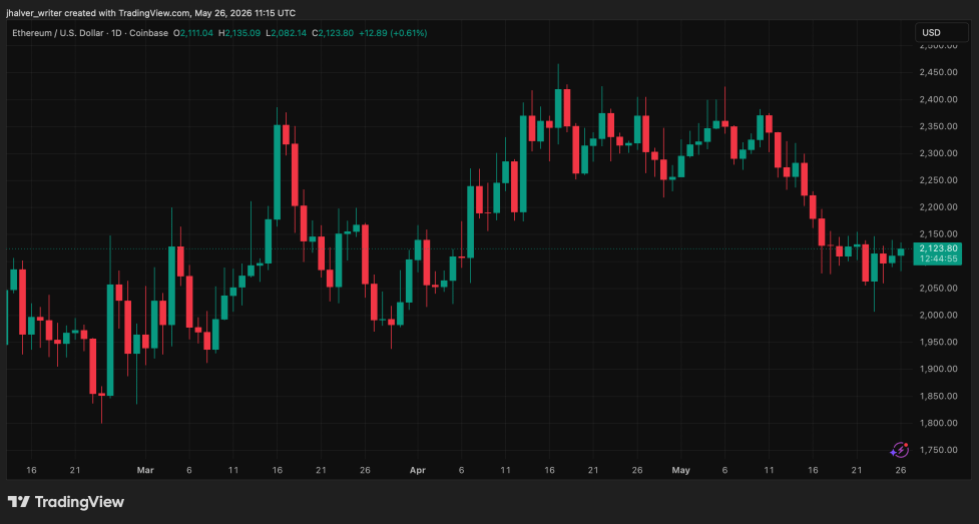
ETH's price moving sideways, per the daily chart. Source: ETHUSD on Tradingview

What The Charges Allege

The fraud charges center on a specific window: May to July 2022, the weeks immediately following TerraUSD’s catastrophic de-pegging in early May of that year. According to the Singapore Police Force’s official statement, Zhu allegedly directed Hodlnaut employees to make misleading statements on the company’s official Telegram group and in emails sent directly to users — assertions that Hodlnaut had no direct exposure to UST and had not suffered losses from the collapse.

The statements, as documented in Mothership SG’s reporting of court filings, included a post in which Hodlnaut wrote that it had “not taken any losses as a firm” and that only users who personally held UST were affected. Zhu also allegedly directed a separate employee to email 30 recipients stating the company had assumed no losses. Those statements, prosecutors now allege, were false and intended to deceive users during the most critical period of the platform’s deterioration.

What Actually Happened With Terra

The judicial record that emerged after Hodlnaut suspended withdrawals in August 2022 told a starkly different story. An interim judicial managers’ report seen by Bloomberg found that Hodlnaut had lost nearly $190 million through its exposure to the collapsed Terra ecosystem — a figure the platform had actively downplayed to users while the losses accumulated. On-chain analytics firms subsequently confirmed material exposure to UST and TerraForm Labs-linked activity that Hodlnaut had not previously acknowledged.

Court documents filed in Singapore in August 2022, when the platform sought creditor protection, disclosed a $193 million financial shortfall. Court-appointed managers later confirmed an additional $13.1 million in user assets were stranded on the collapsed FTX exchange.

Hodlnaut was subsequently ordered to liquidate by Singapore’s High Court, with EY partners appointed as joint liquidators. Zhu indicated he was not guilty and disputed all charges at his May 26 hearing — a pre-trial conference has been scheduled for June 2026, per Channel News Asia.

This development marks a significant moment for the nascent sector’s long-running accountability reckoning following the 2022 crypto contagion. The Terra collapse set off a chain of platform failures — Celsius, Voyager, Three Arrows Capital, and eventually FTX among them — that collectively cost retail users hundreds of billions of dollars.

That four years have elapsed between Hodlnaut’s collapse and its former CEO’s first day in court is itself a reflection of how slowly the legal system processes crypto’s most consequential failures — and a reminder that the cases are far from closed.

Cover image from Grok, ETHUSD chart from Tradingview

Связанные с этим вопросы

QWhat specific charges does Zhu Juntao face in the Singapore court, and under which laws?

AZhu Juntao faces six counts of fraud by false representation. Three counts are under Section 424A(1)(a) read with Section 424A(3) of Singapore's Penal Code 1871, and three counts are under the same provision read together with Section 109 of the same code, which covers abetment.

QWhat was the alleged falsehood communicated by Hodlnaut during the May-July 2022 period, according to the charges?

AAccording to the charges, Zhu Juntao allegedly directed employees to make misleading statements on Telegram and via email, asserting that Hodlnaut had no direct exposure to UST and had not suffered any losses from the Terra collapse. In reality, the platform had lost nearly $190 million from its exposure.

QWhat was the total financial shortfall and additional user asset loss reported for Hodlnaut following the Terra collapse?

ACourt documents disclosed a $193 million financial shortfall. Additionally, court-appointed managers later confirmed that an extra $13.1 million in user assets were stranded on the collapsed FTX exchange.

QWhat was the final outcome for the Hodlnaut platform as ordered by the Singapore High Court?

AHodlnaut was ordered to be liquidated by Singapore's High Court, with EY partners appointed as joint liquidators.

QHow did Zhu Juntao plead to the charges during his court hearing on May 26, 2026?

ADuring his hearing on May 26, 2026, Zhu Juntao indicated he was not guilty and disputed all charges.

Похожее

AI Relay Stations Spark Heated Debate on Zhihu: Behind Cheap Tokens, What Are Users Really Worried About?

A discussion on Zhihu about "AI relay stations" shifted the niche developer topic of "cheap tokens" into broader user awareness. Users moved beyond simply questioning the legitimacy of these services to focus on practical concerns: Where do cheap tokens truly come from? Is the model being accessed the real one? Can relay stations see prompts, code, and API keys? For occasional users, are the risks worth it? The core debate centered less on price and more on trust. A primary worry is model authenticity—the risk of "model swapping," where users paying for a premium model might be routed to a cheaper one, creating an information asymmetry. Others argued that cost comparisons matter; while cheaper than official pay-as-you-go APIs, relay stations may not be the lowest-cost option versus subscriptions, domestic models, or free tiers, making user needs assessment crucial. Speculation about token sources ranged from legitimate bulk discounts to gray-area methods like account sharing or exploiting regional pricing. This opacity makes risk assessment difficult for users. Data security emerged as a critical concern, especially for enterprise use. When processing sensitive information like code, contracts, or client data, the inability to verify a relay station's data handling, retention, or access policies poses significant compliance and confidentiality risks. The evolving consensus suggests relay stations can be used cautiously for low-sensitivity, disposable tasks (e.g., summarizing public info, simple translation). However, they should not be the default for sensitive, professional, or production workflows involving proprietary data, Agents, or automated systems. Recommendations include avoiding large prepayments, not relying on a single service, using test prompts to monitor quality, anonymizing data where possible, and keeping official channels as backups. Ultimately, the discussion framed tokens not just as a billing unit but as a measure of real cost encompassing price, model integrity, data security, and service stability. The popularity of relay stations highlights user demand for affordable access, but the debate underscores a key trade-off: the savings from cheap tokens may come at the price of trust, transparency, and control over one's data and AI experience.

marsbit19 мин. назад

AI Relay Stations Spark Heated Debate on Zhihu: Behind Cheap Tokens, What Are Users Really Worried About?

marsbit19 мин. назад

In-Depth Research Report on TradFi: The Convergence Wave of Crypto and Traditional Finance

In 2026, the crypto industry is undergoing a profound infrastructure-level transformation—TradFi assets are migrating on-chain at an unprecedented pace. According to CoinGecko's Q1 2026 report, the total value locked (TVL) of tokenized real-world assets (RWA) has surpassed $31 billion, a nearly 4x increase from $7.8 billion at the beginning of 2025, with the sector’s aggregate market capitalization reaching $19.3 billion. Among these, the market cap of tokenized stocks surged from $2 million to $486 million, with Q1 spot trading volume reaching $15.1 billion—a single quarter already surpassing the entire second half of 2025. RWA perpetual contract Q1 trading volume reached a staggering $524.8 billion, far exceeding the $313 billion for all of 2025. Meanwhile, BlackRock's BUIDL fund has reached $2.3 billion in scale and has filed for two new tokenized funds, signaling that the world's largest asset manager's tokenization strategy is evolving from pilot to product suite expansion. HTX, as a core participant in the crypto exchange sector, officially launched TradFi perpetual futures products including NVDA, AAPL, MSFT, META, and SPY in 2026, enabling crypto users to gain 24/7 trading access to core U.S. equities. Boston Consulting Group predicts that global tokenized asset scale could reach $16 trillion by 2030, while McKinsey offers a conservative estimate of approximately $2 trillion. The on-chain migration of TradFi assets is no longer a "future narrative" but a structural transformation unfolding in real time, as crypto exchanges evolve from single crypto asset trading platforms toward "multi-asset-class trading infrastructure."

HTX Learn21 мин. назад

In-Depth Research Report on TradFi: The Convergence Wave of Crypto and Traditional Finance

HTX Learn21 мин. назад

Blocked Its Own Treasure, WeChat AI Steps Up

Tencent's stock surged over 10% on June 2nd amid reports that WeChat, with 1.43 billion monthly users, is finalizing tests for a native AI Agent. The reported feature, accessible by swiping right from the main interface, allows users to issue commands in natural language. The AI then decomposes tasks and automatically calls upon relevant Mini Programs within WeChat to complete actions like ordering food, booking tickets, or making payments, creating a closed-loop service execution system. This strategic shift follows the internal conflict and subsequent "blocking" of Tencent's standalone AI app, Yuanbao, by WeChat for violating sharing rules during a 2026 Spring Festival promotion. The incident highlighted a lack of internal consensus and exposed the weakness of competing in the standalone AI assistant arena against rivals like ByteDance's Doubao (345M MAU) and Alibaba's Qianwen. The new WeChat AI Agent aims to leverage WeChat's unique assets—its massive user base, standardized Mini Program APIs, WeChat Pay, and identity system—to move from simple content generation to actual task execution. Analysts note this changes the competitive landscape from model benchmarks to which AI can connect to more real-world services. However, success depends on key variables: the capability of Tencent's underlying Hunyuan model, managing massive inference costs, and redesigning incentives for Mini Program developers whose traffic might be bypassed. The move is seen as an attempt to keep user service intent within WeChat's ecosystem as AI begins to redefine how users access services.

marsbit1 ч. назад

Blocked Its Own Treasure, WeChat AI Steps Up

marsbit1 ч. назад

ByteDance Adopts Arm CPUs, Jensen Huang: So Sad I Didn't Buy Arm

**Summary:** At Computex 2026, Arm CEO Rene Haas announced that ByteDance and Oracle have adopted Arm's self-designed Arm AGI data center CPU. The company expects significant revenue growth from this product, projecting $20 billion in demand for the 2027/2028 fiscal years. Haas noted that restricting AI-capable CPUs from the US to China is nearly impossible due to their widespread applications. Arm's stock has surged dramatically this year, notably rising 16% after NVIDIA's Arm-based Vera CPU and RTX Spark announcements. A highlight was the informal, humorous on-stage conversation between Haas and NVIDIA CEO Jensen Huang. Huang joked about NVIDIA's failed attempt to acquire Arm and playfully lamented selling his Arm shares. Both executives showed a clear sense of camaraderie and shared regret over the missed merger. Key technical topics were discussed: 1. **AI PC Design:** Huang explained NVIDIA's RTX Spark superchip (with a 20-core Arm CPU) is designed for future AI agents that will autonomously run and use tools on PCs, blending local and cloud processing. 2. **Agent vs. OS:** Huang emphasized the operating system remains crucial, as AI agents rely on its APIs and tools to function. 3. **Growth Constraints:** He identified the shift to "useful AI" that generates profitable tokens as a primary driver for immense, almost limitless, computational demand. Haas outlined Arm's strategy across PC and data centers. For PCs, Arm collaborates with partners like NVIDIA and MediaTek, offering its compute subsystem (CSS) for custom SoCs. In data centers, its Arm AGI CPU (built on TSMC's 3nm process) has gained major partners including OpenAI, Meta, and now ByteDance and Oracle. Arm presented a multi-year roadmap for its in-house CPU line. The article concludes that while GPUs dominated the AI training race, the explosion of AI agents is shifting significant focus to CPUs for inference, state management, and tool orchestration. The industry is trending towards vertical integration, with companies like cloud providers designing chips and chip/IP firms offering full solutions, all competing to deliver more efficient computing per watt.

marsbit1 ч. назад

ByteDance Adopts Arm CPUs, Jensen Huang: So Sad I Didn't Buy Arm

marsbit1 ч. назад

Торговля

Спот
Фьючерсы

Популярные статьи

Как купить S

Добро пожаловать на HTX.com! Мы сделали приобретение Sonic (S) простым и удобным. Следуйте нашему пошаговому руководству и отправляйтесь в свое крипто-путешествие.Шаг 1: Создайте аккаунт на HTXИспользуйте свой адрес электронной почты или номер телефона, чтобы зарегистрироваться и бесплатно создать аккаунт на HTX. Пройдите удобную регистрацию и откройте для себя весь функционал.Создать аккаунтШаг 2: Перейдите в Купить криптовалюту и выберите свой способ оплатыКредитная/Дебетовая Карта: Используйте свою карту Visa или Mastercard для мгновенной покупки Sonic (S).Баланс: Используйте средства с баланса вашего аккаунта HTX для простой торговли.Третьи Лица: Мы добавили популярные способы оплаты, такие как Google Pay и Apple Pay, для повышения удобства.P2P: Торгуйте напрямую с другими пользователями на HTX.Внебиржевая Торговля (OTC): Мы предлагаем индивидуальные услуги и конкурентоспособные обменные курсы для трейдеров.Шаг 3: Хранение Sonic (S)После приобретения вами Sonic (S) храните их в своем аккаунте на HTX. В качестве альтернативы вы можете отправить их куда-либо с помощью перевода в блокчейне или использовать для торговли с другими криптовалютами.Шаг 4: Торговля Sonic (S)С легкостью торгуйте Sonic (S) на спотовом рынке HTX. Просто зайдите в свой аккаунт, выберите торговую пару, совершайте сделки и следите за ними в режиме реального времени. Мы предлагаем удобный интерфейс как для начинающих, так и для опытных трейдеров.

1.4k просмотров всегоОпубликовано 2025.01.15Обновлено 2026.06.02

Как купить S

Sonic: Обновления под руководством Андре Кронье – новая звезда Layer-1 на фоне спада рынка

Он решает проблемы масштабируемости, совместимости между блокчейнами и стимулов для разработчиков с помощью технологических инноваций.

2.3k просмотров всегоОпубликовано 2025.04.09Обновлено 2025.04.09

Sonic: Обновления под руководством Андре Кронье – новая звезда Layer-1 на фоне спада рынка

HTX Learn: Пройдите обучение по "Sonic" и разделите 1000 USDT

HTX Learn — ваш проводник в мир перспективных проектов, и мы запускаем специальное мероприятие "Учитесь и Зарабатывайте", посвящённое этим проектам. Наше новое направление .

1.8k просмотров всегоОпубликовано 2025.04.10Обновлено 2025.04.10

HTX Learn: Пройдите обучение по "Sonic" и разделите 1000 USDT

Обсуждения

Добро пожаловать в Сообщество HTX. Здесь вы сможете быть в курсе последних новостей о развитии платформы и получить доступ к профессиональной аналитической информации о рынке. Мнения пользователей о цене на S (S) представлены ниже.

活动图片