"Aucun accord spécial" : Le PDG de LayerZero nie tout lien avec la baleine détenant 2,6 % des ZRO

ambcryptoОпубликовано 2026-03-19Обновлено 2026-03-19

Введение

Un investisseur inconnu, souvent qualifié de "baleine", a accumulé 2,6 % de l'offre circulante du token ZRO de LayerZero, soit 24,5 millions de jetons d'une valeur de 47,5 millions de dollars, via neuf portefeuilles financés par Coinbase Prime. Cette accumulation a commencé trois semaines après l'annonce de la chaîne Zero, ce qui a conduit à des spéculations sur un lien privilégié avec LayerZero. Le PDG de LayerZero, Bryan Pellegrino, a nié toute connaissance de cet investisseur et a réaffirmé qu'aucun accord spécial ni remise n'avait été consenti, encourageant plutôt les fonds à acheter sur le marché libre. Sur le plan technique, le prix du ZRO a atteint 2,5 dollars, un niveau de résistance majeur depuis la deuxième moitié de 2025. Bien que des pressions de vente potentielles existent à ce niveau en raison des volumes acquis, les données indiquent que les détenteurs continuent globalement d'accumuler plutôt que de vendre. Le franchissement de ce seuil pourrait propulser le cours vers 3,3 dollars, tandis qu'un échec pourrait entraîner un repli vers 1,5 dollar.

Une entité ou un individu inconnu a secrètement accumulé le jeton ZRO de LayerZero. Au moment de la rédaction, cette baleine présumée a acquis 47,5 millions de dollars de ZRO, soit environ 24,5 millions de jetons, ce qui représente un énorme 2,6 % de l'offre en circulation.

Selon la plateforme d'analyse cryptographique Nansen, cette frénésie d'accumulation s'est produite sur 9 portefeuilles, financés par une seule source : Coinbase Prime. L'entreprise a en outre souligné.

Début mars, l'accumulation commence discrètement sur Coinbase. L'accumulation a commencé exactement 3 semaines après l'annonce de la chaîne Zero.

Compte tenu de la coïncidence entre l'annonce de la chaîne et l'investissement de niveau baleine, certains observateurs du marché ont spéculé que l'investisseur pourrait faire partie du cercle restreint de LayerZero.

LayerZero nie connaître l'acheteur mystérieux

Cependant, le PDG de LayerZero, Bryan Pellegrino, a clarifié qu'il ne connaissait pas l'investisseur.

Nous avons dit à tous les fonds et institutions avec lesquels nous avons parlé que notre préférence est qu'ils achètent simplement du ZRO directement sur le marché libre, plutôt que d'acheter auprès des labs ou de la fondation. Aucun accord spécial, aucune remise.

La chaîne Zero devrait être lancée à l'automne 2026, et le projet a attiré d'importants soutiens financiers, notamment Citadel Securities, Tether, Ark Invest et Google. Pour certains, cela pourrait être un positionnement pour le trading institutionnel de marchés tokenisés.

Mais il reste incertain si le mystérieux acheteur baleine prévoyait de vendre les jetons au lancement de la chaîne.

Le ZRO atteint un mur de vente

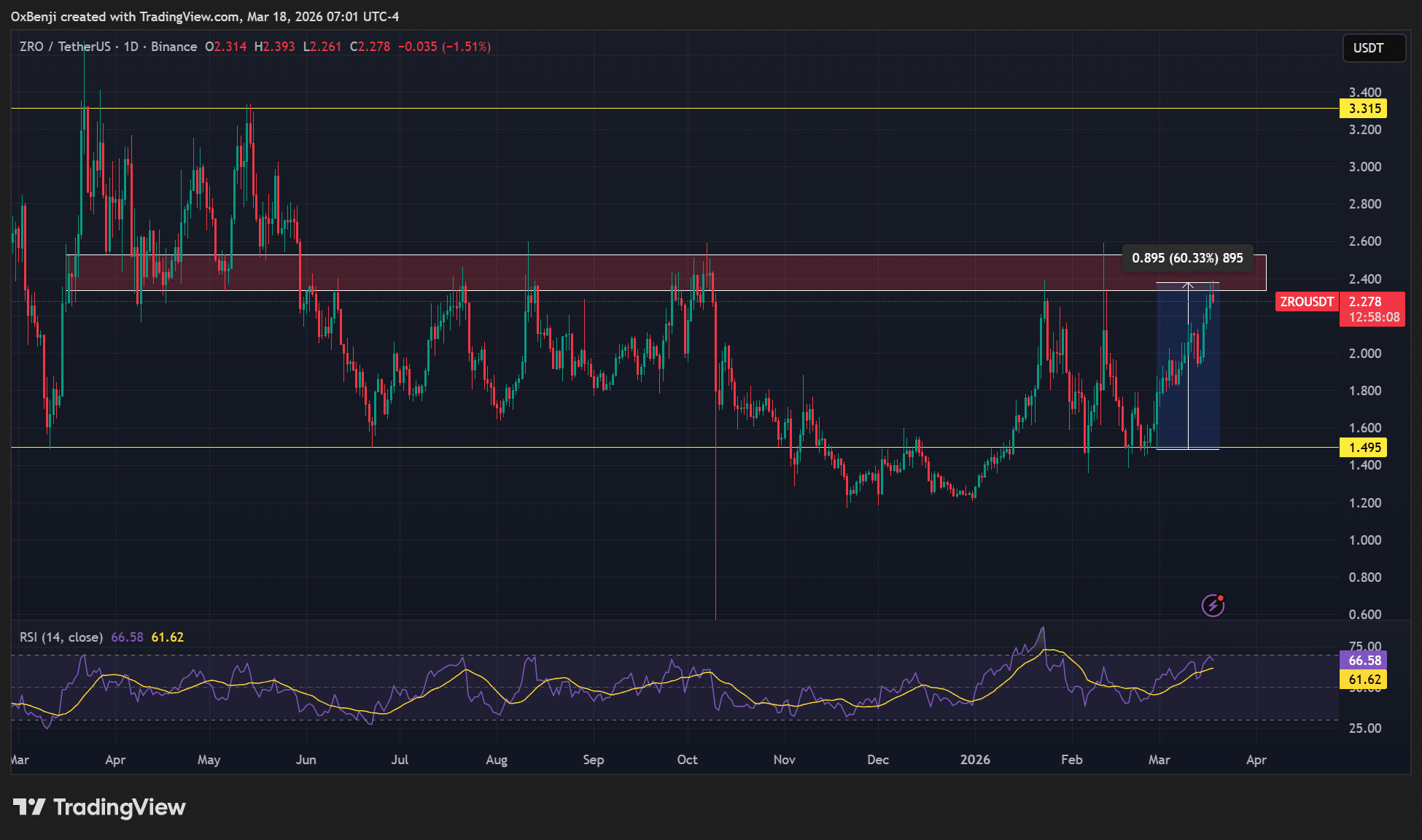
Cela dit, le ZRO avait augmenté de 60 % par rapport au plus bas de 1,49 $ et avait atteint 2,5 $, une zone de résistance clé depuis le second semestre 2025. Les récentes tentatives de reprise en janvier et février ont été rejetées à ce point de blocage (rouge).
Source : ZRO/USDT, TradingView

Si la tendance se répète, les acheteurs tardifs pourraient attendre une autre opportunité d'achat à 1,5 $. Cependant, transformer 2,5 $ en support pourrait alimenter la hausse jusqu'à 3,3 $.

Cependant, plus de 34 millions de ZRO ont été acquis dans la zone de résistance, ce qui pourrait inciter certains investisseurs qui ont atteint le seuil de rentabilité à clôturer leurs positions. Si c'est le cas, cela pourrait ajouter une pression et renforcer la zone en tant que point de blocage clé.
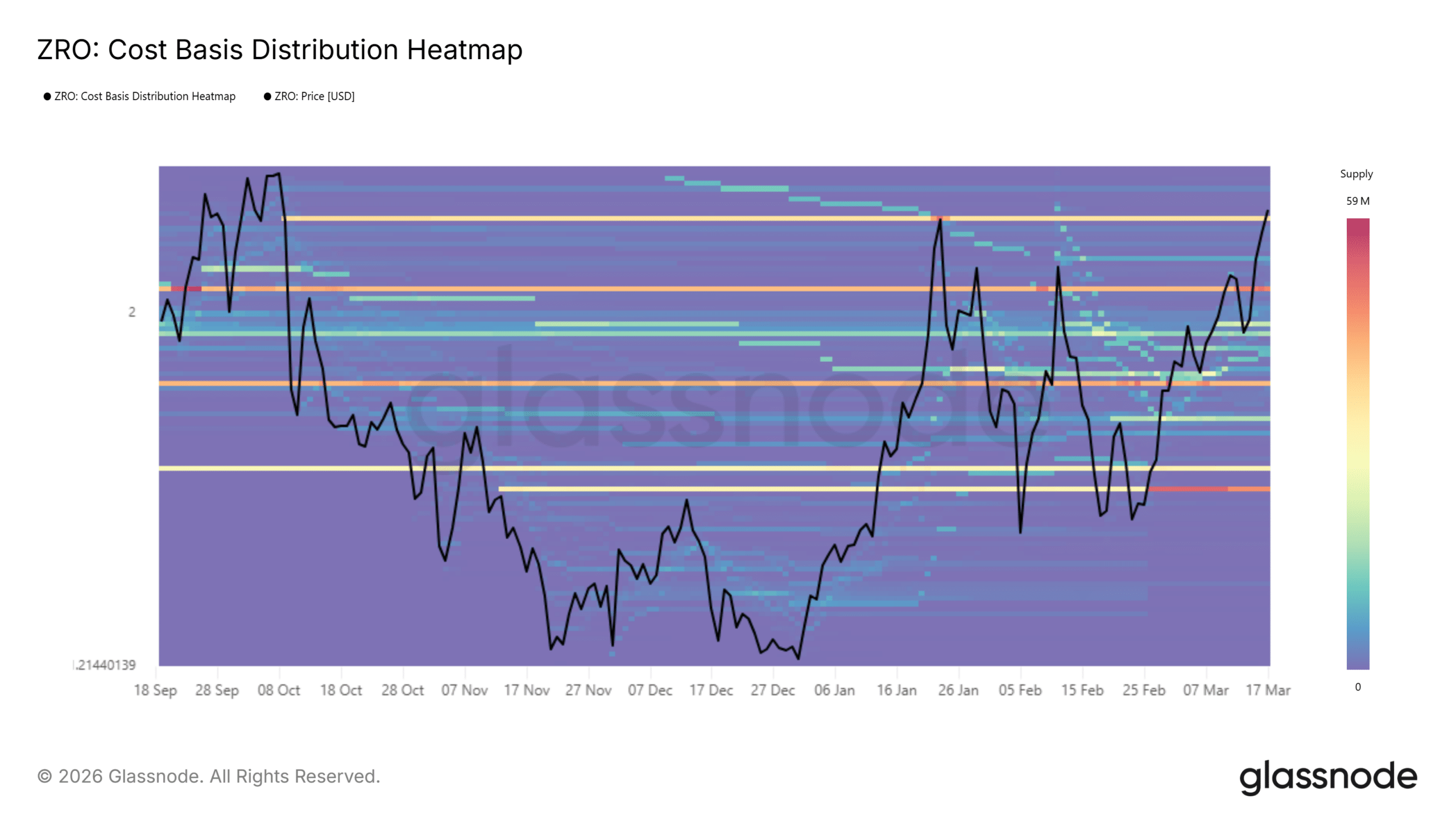
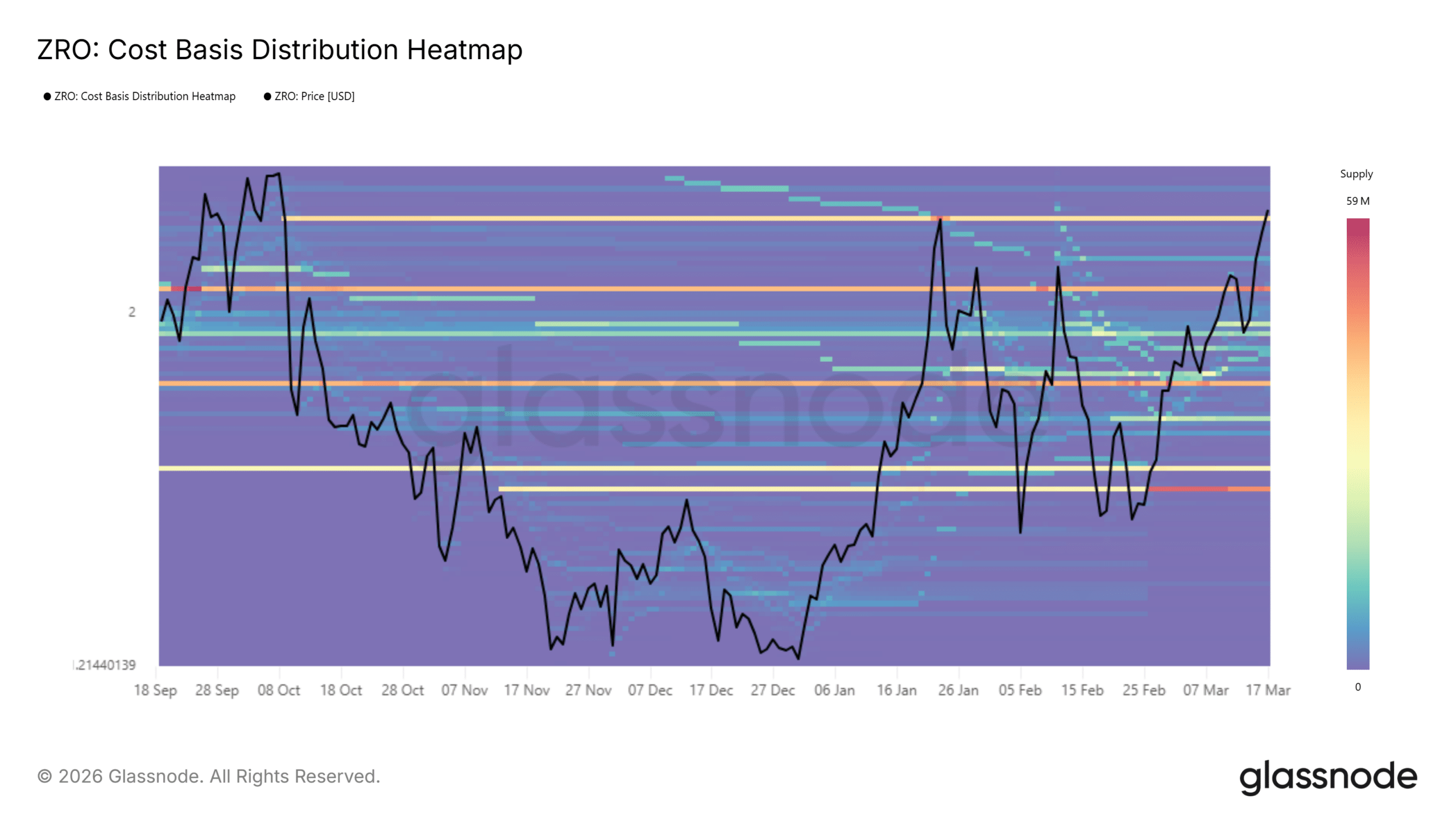
Source : Glassnode

Néanmoins, au moment de la rédaction, la pression de vente de la part des détenteurs n'était pas encore évidente.

Selon la moyenne glissante sur 14 jours du Changement Net de Position des Détenteurs, les investisseurs détenaient encore et ajoutaient à leur réserve, comme le montrent les barres vertes.
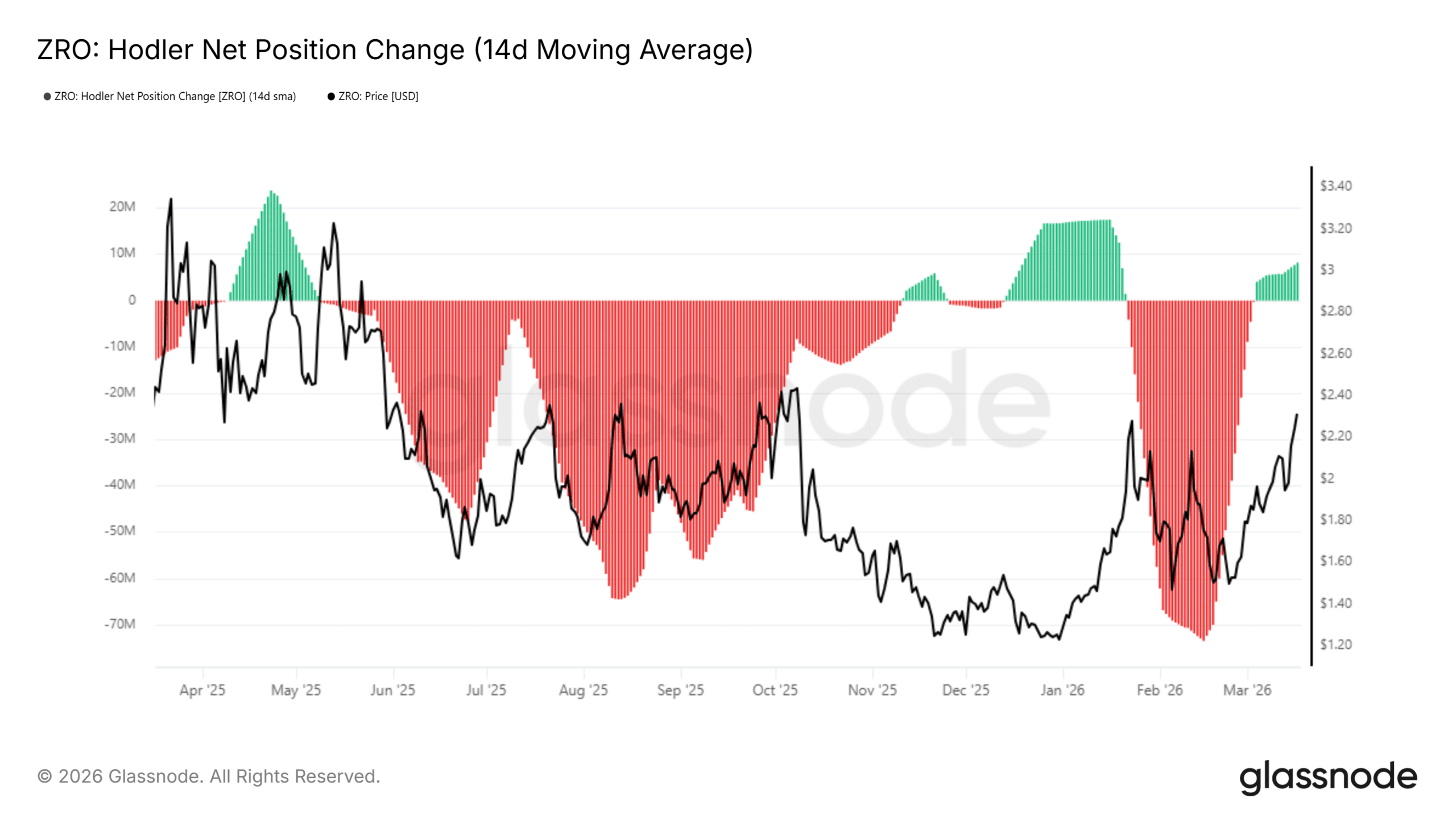
Source : Glassnode

Cependant, si la métrique devient rouge, cela suggérerait que les détenteurs ont commencé à se délester. Une telle action pourrait renforcer davantage 2,5 $ en tant qu'obstacle clé que les haussiers devront surmonter pour prolonger la hausse.


Résumé Final

  • Une baleine mystérieuse a acquis 2,6 % de l'offre totale en circulation de ZRO, mais LayerZero a nié toute affiliation avec l'investisseur.
  • Le niveau de 2,5 $ a été un point de blocage depuis 2025 et pourrait faire dérailler la reprise du ZRO s'il n'y a pas de catalyseur à court terme.


Связанные с этим вопросы

QQui a accumulé 2,6% de l'offre en circulation de ZRO et comment ?

AUne baleine mystérieuse a accumulé 24,5 millions de jetons ZRO, d'une valeur de 47,5 millions de dollars, via 9 portefeuilles financés par une seule source : Coinbase Prime.

QQuelle a été la réaction du PDG de LayerZero face aux spéculations sur un lien avec cette baleine ?

ALe PDG Bryan Pellegrino a nié connaître l'investisseur et a déclaré qu'aucun accord spécial ni remise n'avait été accordé, préférant que les fonds achètent directement sur le marché libre.

QQuel est le principal niveau de résistance pour le prix de ZRO mentionné dans l'article ?

ALe niveau de 2,5 dollars est identifié comme une zone de résistance clé, un obstacle que le prix a eu du mal à dépasser depuis le second semestre 2025.

QQuelles sont les implications possibles de l'accumulation par la baleine pour le futur lancement de la chaine Zero ?

AL'article suggère que cela pourrait être un positionnement pour le trading institutionnel des marchés tokenisés, mais il reste incertain si la baleine prévoit de vendre ses jetons au lancement de la chaine à l'automne 2026.

QQue indique le 'Holder Net Position Change' sur le comportement des investisseurs à la date de l'article ?

ALa métrique sur 14 jours montre des barres vertes, indiquant que les investisseurs détenaient toujours leurs jetons et en ajoutaient même à leur portefeuille, sans pression de vente évidente.

Похожее

Google TPU Shipments Revised Up by 50%

Recent industry research indicates a significant upward revision in the shipments of Google's TPU (Tensor Processing Unit) chips. Previous expectations for 2027 were set at around 10 million units, but new estimates now point to 15 million units, a 50% increase. This substantial boost directly translates to higher demand across the entire supporting supply chain. Google's TPU clusters utilize a standardized all-optical interconnect architecture. Consequently, key hardware components are deeply integrated and scaled in fixed ratios with the chips. The 15 million TPU target will drive corresponding demand increases for NPO optical engines (roughly a 1:1 match), 1.6T optical modules, OCS optical switches, high-end server power supplies, fiber optics & MPO connectors, and liquid cooling solutions. Among these, liquid cooling is highlighted as the sector experiencing the most significant transformation and offering the most stable potential for excess returns. As next-generation TPU chips reach power levels where traditional air cooling is insufficient, liquid cooling becomes essential. 2026 is forecasted as the first year of substantial adoption for Google's liquid cooling solutions. This shift, coupled with delivery and capacity bottlenecks faced by incumbent overseas manufacturers, is creating a prime window for domestic Chinese suppliers to enter and secure Google's core supply chain. The market size for Google-specific liquid cooling is projected to potentially triple from a baseline of hundreds of billions to around 300 billion units by 2028. The logic for the fiber optic sector is also being rewritten. Once considered a cyclical commodity tied to telecom operator procurement, fiber is now a strategic and scarce resource for AI Data Centers (AIDC). A severe supply-demand imbalance, driven by the long lead time for preform production (18-24 months) and surging demand from cloud giants, is supporting strong performance. Chinese fiber manufacturers are well-positioned to capture a significant share of global AIDC demand, with exports potentially reaching 200-300 million core kilometers in 2026. Overall, the investment focus within the AI computing industry is shifting from pure "chip performance speculation" towards the more certain incremental growth in computing infrastructure and its supporting ecosystem. The upward revision in Google TPU shipments, along with the potential for further doubling by 2028, is seen as solidifying performance visibility for the entire supporting supply chain over the next two years.

marsbit1 ч. назад

Google TPU Shipments Revised Up by 50%

marsbit1 ч. назад

What Wall Street Really Wants After the Crypto Story Recedes

The tide of speculative crypto narratives has receded, revealing Wall Street's true objective: building a controlled, yield-generating, and compliant financial pipeline on distributed ledgers. They are migrating core functions onto blockchains, not for decentralization, but for efficiency and new revenue streams. Key developments include BlackRock's BUIDL fund, a tokenized treasury fund acting as a foundational reserve asset, and the rise of Securitize, which is going public and partnering with the NYSE to build a 24/7 digital securities trading and settlement system. This signals a major shift of securities clearing to blockchain technology. To make volatile assets like Bitcoin palatable for institutional investors, firms like BlackRock and Goldman Sachs are creating "covered call" ETFs (e.g., BITA). These products systematically sell options on Bitcoin holdings, transforming price volatility into stable monthly income, effectively repackaging crypto as a yield-bearing asset. Stablecoins are being positioned not as speculative tools but as efficient payment rails. Companies like Stripe and Mastercard are integrating them for instant, low-cost merchant settlements and cross-border card payments, respectively. Critically, new legislation like the GENIUS Act shapes them as non-interest-bearing, heavily regulated extensions of the US dollar system. In summary, Wall Street is quietly constructing a parallel, blockchain-based financial infrastructure featuring tokenized traditional assets, structured crypto yields, and programmable dollar pipelines—all under its control and fully integrated with existing regulatory and credit frameworks.

marsbit1 ч. назад

What Wall Street Really Wants After the Crypto Story Recedes

marsbit1 ч. назад

Tying Itself to SpaceX: Cursor's $60 Billion Rise

This article recounts the rapid rise of AI-powered coding startup Cursor and its 25-year-old MIT graduate CEO, Michael Truell. Launched in 2023, Cursor achieved explosive growth, reaching over 10 billion USD in revenue by late 2025. However, its journey highlights a central dilemma for AI application companies: dependence on foundational model providers. Cursor initially relied heavily on Anthropic's models but faced an existential threat when Anthropic launched its own competing coding tool, Claude Code. In response, Cursor declared an internal emergency in early 2026 and accelerated development of its own model, Composer. To secure the immense computing power needed, Truell struck a pivotal deal with Elon Musk's SpaceX in April 2026. The collaboration grants Cursor access to SpaceX's supercomputing resources for Composer, while SpaceX's Grok model benefits from Cursor's programming data. The agreement includes a potential 600 billion USD acquisition of Cursor by SpaceX later in the year, though a substantial termination fee is in place if the deal falls through. The story explores Cursor's intense, sometimes controversial hiring practices involving lengthy unpaid "work trials," its complex partnership-turned-rivalry with Anthropic, and its high-stakes gamble to ensure independence through the SpaceX alliance. The core question remains: will Cursor evolve into a defining, independent "generational" software company, or become a key piece in a tech giant's AI arsenal?

marsbit1 ч. назад

Tying Itself to SpaceX: Cursor's $60 Billion Rise

marsbit1 ч. назад

Торговля

Спот
Фьючерсы

Популярные статьи

Как купить ZRO

Добро пожаловать на HTX.com! Мы сделали приобретение LayerZero (ZRO) простым и удобным. Следуйте нашему пошаговому руководству и отправляйтесь в свое крипто-путешествие.Шаг 1: Создайте аккаунт на HTXИспользуйте свой адрес электронной почты или номер телефона, чтобы зарегистрироваться и бесплатно создать аккаунт на HTX. Пройдите удобную регистрацию и откройте для себя весь функционал.Создать аккаунтШаг 2: Перейдите в Купить криптовалюту и выберите свой способ оплатыКредитная/Дебетовая Карта: Используйте свою карту Visa или Mastercard для мгновенной покупки LayerZero (ZRO).Баланс: Используйте средства с баланса вашего аккаунта HTX для простой торговли.Третьи Лица: Мы добавили популярные способы оплаты, такие как Google Pay и Apple Pay, для повышения удобства.P2P: Торгуйте напрямую с другими пользователями на HTX.Внебиржевая Торговля (OTC): Мы предлагаем индивидуальные услуги и конкурентоспособные обменные курсы для трейдеров.Шаг 3: Хранение LayerZero (ZRO)После приобретения вами LayerZero (ZRO) храните их в своем аккаунте на HTX. В качестве альтернативы вы можете отправить их куда-либо с помощью перевода в блокчейне или использовать для торговли с другими криптовалютами.Шаг 4: Торговля LayerZero (ZRO)С легкостью торгуйте LayerZero (ZRO) на спотовом рынке HTX. Просто зайдите в свой аккаунт, выберите торговую пару, совершайте сделки и следите за ними в режиме реального времени. Мы предлагаем удобный интерфейс как для начинающих, так и для опытных трейдеров.

457 просмотров всегоОпубликовано 2024.06.19Обновлено 2026.06.02

Как купить ZRO

Обсуждения

Добро пожаловать в Сообщество HTX. Здесь вы сможете быть в курсе последних новостей о развитии платформы и получить доступ к профессиональной аналитической информации о рынке. Мнения пользователей о цене на ZRO (ZRO) представлены ниже.

活动图片