A $100 Investment in Ozak AI Could Potentially Deliver Returns Comparable to Those That Would Require Tens of Thousands of Dollars Invested in Bitcoin

TheNewsCryptoОпубликовано 2026-03-07Обновлено 2026-03-07

Введение

With Bitcoin's maturity offering more limited, capital-intensive returns, investors are seeking high-growth alternatives like Ozak AI ($OZ). Currently in its seventh presale phase, Ozak AI’s token price has risen 1,300% from its initial $0.001. A $100 investment at launch could yield up to $100,000 if the token reaches its $1 target. The project leverages AI-driven predictive analytics, decentralized infrastructure (DePIN), and real-time data through partnerships with Pyth Network and others. While riskier than Bitcoin, Ozak AI represents a high-upside opportunity for those willing to invest early in emerging technology.

As Bitcoin continues to trade near cycle highs and institutional adoption pushes its market capitalization deeper into trillion-dollar territory, a growing segment of investors is looking elsewhere for asymmetric returns. One project increasingly drawing attention is Ozak AI ($OZ), an emerging AI-powered blockchain platform whose presale trajectory suggests that a relatively small investment could potentially rival gains that would otherwise require a far larger capital commitment in Bitcoin.

With Bitcoin widely projected to deliver incremental multiples in the next market cycle, early-stage assets like Ozak AI are being evaluated for their ability to produce exponential returns from far lower entry points.

Bitcoin’s Maturity Versus Early-Stage Asymmetry

Bitcoin remains the benchmark digital asset and a cornerstone of many portfolios. However, its scale naturally limits upside potential. Even optimistic projections of Bitcoin reaching $150,000–$200,000 in a future bull cycle would translate into a 2x to 3x return from current levels. For an investor, achieving a $50,000 profit under such conditions would typically require an initial investment of tens of thousands of dollars.

This dynamic has prompted investors to explore earlier-stage opportunities where smaller capital outlays could generate disproportionately larger returns if adoption accelerates.

Ozak AI’s Presale Growth Changes the Math

Ozak AI entered the market at a presale price of $0.001 and has now advanced to Phase-7 at $0.014, marking a 1,300% increase since launch. To date, more than 1.04 billion $OZ tokens have been sold, with nearly $6.37 million raised, signaling strong early demand.

If Ozak AI reaches its stated $1.00 target price, the return profile becomes striking. A $100 investment at the $0.001 presale level would have secured 100,000 tokens, potentially worth $100,000 at the $1 mark. Even at today’s Phase-7 price, a $100 allocation could grow into more than $7,000, representing gains that would be extremely difficult to achieve with Bitcoin without substantially higher capital exposure.

Technology Driving the Upside Narrative

Ozak AI’s appeal is not based on speculation alone. The project is built around AI-driven predictive intelligence, designed to analyze on-chain and off-chain data in real time. Its Prediction Agents aim to provide market insights for traders, institutions, and developers, while the Ozak Stream Network delivers decentralized, high-speed data aggregation to support those analytics.

The platform also incorporates a DePIN (Decentralized Physical Infrastructure Network) architecture, distributing computation across nodes to enhance scalability and security. Within this ecosystem, the $OZ token is used for governance, staking, and access to advanced analytics tools, positioning it as a functional asset rather than a purely speculative one.

Partnerships Strengthening Market Confidence

Recent partnerships have further reinforced confidence in the project’s roadmap. Ozak AI has aligned with data and infrastructure providers such as Pyth Network, Hive Intel, Weblume, and SINT, enhancing real-time data accuracy, cross-chain functionality, and AI agent execution. Additional collaborations with Dex3 Tech and Meganet support liquidity access and decentralized compute capacity as the ecosystem scales.

These partnerships are frequently cited by analysts as critical factors that could help sustain long-term adoption beyond the presale phase.

Conclusion

As Bitcoin continues to mature into a large-cap, institutionally driven asset, its future gains are increasingly defined by scale rather than explosiveness. Ozak AI, by contrast, remains at an early stage where growth is driven by adoption, innovation, and market discovery. This difference fundamentally reshapes the investment equation.

For investors willing to accept higher risk in exchange for greater upside potential, Ozak AI offers a scenario where a relatively small allocation could achieve returns that would typically require far more capital in established assets like Bitcoin. While outcomes will ultimately depend on execution and broader market conditions, Ozak AI’s presale momentum, expanding ecosystem, and low entry price have positioned it as a compelling high-growth alternative in the current crypto cycle.

For more information about Ozak AI, visit the links below:

  • Website: https://ozak.ai/
  • Twitter/X: https://x.com/OzakAGI
  • Telegram: https://t.me/OzakAGI

Disclaimer: TheNewsCrypto does not endorse any content on this page. The content depicted in this Press Release does not represent any investment advice. TheNewsCrypto recommends our readers to make decisions based on their own research. TheNewsCrypto is not accountable for any damage or loss related to content, products, or services stated in this Press Release.


TagsOzak AIPress Release

Связанные с этим вопросы

QWhat is the main argument presented in the article regarding an investment in Ozak AI compared to Bitcoin?

AThe article argues that a small $100 investment in Ozak AI's early presale could potentially yield returns comparable to what would require a much larger capital investment of tens of thousands of dollars in Bitcoin, due to the difference in growth potential between an established, large-cap asset and an early-stage project.

QWhat specific technology does the Ozak AI platform utilize, according to the article?

AAccording to the article, Ozak AI is built around AI-driven predictive intelligence that analyzes on-chain and off-chain data in real time. It features Prediction Agents for market insights and the Ozak Stream Network for decentralized, high-speed data aggregation. It also incorporates a DePIN (Decentralized Physical Infrastructure Network) architecture.

QWhat was Ozak AI's initial presale price and what is its price in Phase-7, representing what percentage increase?

AOzak AI entered the market at a presale price of $0.001 and has advanced to Phase-7 at $0.014, which marks a 1,300% increase since its launch.

QName two of the partnership collaborations mentioned that are strengthening confidence in the Ozak AI project.

ATwo partnership collaborations mentioned are with Pyth Network for real-time data accuracy and Meganet for decentralized compute capacity.

QWhat does the article state is required to achieve a $50,000 profit from Bitcoin if it reaches $150,000-$200,000?

AThe article states that to achieve a $50,000 profit from Bitcoin under such conditions would typically require an initial investment of tens of thousands of dollars.

Похожее

Deconstructing the Capital Game of Public Chain Pharos: A $950 Million Valuation Propped Up by Photovoltaic and Other Assets, A Shell Transaction Under Layers of Betting?

The article investigates the recent $247.3 million investment by Hong Kong-listed GCL New Energy into the Layer 1 blockchain project Pharos at a $950 million valuation. It reveals the deal is not a straightforward investment but a complex, multi-stage transaction bound by stringent performance milestones. The core of the agreement is a set of mutual, conditional investments. Pharos must first purchase up to $1.5 billion HKD worth of GCL shares. However, GCL's reciprocal investment in Pharos tokens is contingent upon a series of strict, performance-based vesting conditions. The entire deal is split into five tranches, each unlocking only if the Pharos token lists on an exchange without falling below its issue price and maintains a high fully diluted valuation (FDV) over successive three-month periods. If any condition fails, the entire agreement can be terminated. The article questions the legitimacy of the $950 million valuation, which was calculated based on a purported $250 million in Total Value Locked (TVL). Notably, over half of this TVL is claimed to be from real-world assets (RWA), specifically photovoltaic and power station assets linked to GCL—a highly unconventional method for valuing a Layer 1 blockchain. Furthermore, the mainnet is not yet live, and the TVL figure is unverified by independent data platforms. The author suggests the deal is a "capital game" designed to boost GCL's stock price, which saw suspicious pre-announcement surges, and to create hype for the upcoming Pharos token launch, ultimately passing the risk onto the market and future investors.

marsbit13 мин. назад

Deconstructing the Capital Game of Public Chain Pharos: A $950 Million Valuation Propped Up by Photovoltaic and Other Assets, A Shell Transaction Under Layers of Betting?

marsbit13 мин. назад

Comprehensive Analysis of Canton Network: Wall Street's Blockchain Ambition

Canton Network is positioned at the convergence of key crypto trends, including real-world asset tokenization, institutional blockchain adoption, privacy infrastructure, and stablecoin settlements. It has attracted major financial institutions like DTCC, Nasdaq, and Broadridge, which are deploying real workflows such as treasury tokenization, repo financing, and collateral management. The network is designed for regulated entities, offering granular transaction privacy and validator-level control while maintaining interoperability. Its architecture separates execution from coordination, using validator nodes operated by participants and synchronizers for atomic settlement. Key adoptions include DTCC tokenizing U.S. Treasuries, Broadridge processing trillions in repo transactions, and Nasdaq integrating its Calypso platform. Tokenomics are usage-driven, with weekly CC burns increasing by 216% since TGE, and the burn-to-mint ratio rising to 0.90, nearing a deflationary state. Despite generating the highest revenue among L1s in February, Canton trades at a discount to peers, possibly due to high emissions and its perception as financial infrastructure. Catalysts include regulatory clarity from the Clarity Act and DTCC’s broader tokenization platform launch in late 2026. Risks include token concentration, with 54% of CC held by a few entities, though these are largely operational holdings. Canton aims to become a core coordination layer for tokenized financial markets.

marsbit21 мин. назад

Comprehensive Analysis of Canton Network: Wall Street's Blockchain Ambition

marsbit21 мин. назад

Which Areas Still Have Moats in the AI Era?

In the AI era, certain moats remain despite rapid technological advancement. The author, a former hedge fund manager, argues that the true inflection point occurred when AI models like ChatGPT’s o1 began generating functional code—even with imperfections—enabling recursive self-optimization and fundamentally altering software development. Key short-term moats identified include: 1. **Proprietary Data**: Firms with unique, inaccessible data (e.g., multi-strategy hedge funds) can fine-tune models, creating defensible advantages. 2. **Regulatory Friction**: Industries requiring human approval (e.g., traditional finance) face slower disruption due to compliance and legal barriers. 3. **Authority-as-a-Service**: Human trust in institutional authority (e.g., legal or audit services) persists even if AI outperforms humans technically. 4. **Physical World Lag**: Hardware-dependent sectors evolve slower, delaying full AI integration. However, these moats only delay, not prevent, disruption. The author emphasizes acting on signals rather than waiting for certainty: identify directional trends, place asymmetric bets (limited downside, high upside), and iterate through action. As AI accelerates, windows of opportunity close quickly. To remain relevant, humans must excel in long-term strategy, complex system-level thinking, and collaboration—areas where AI still lags. The time to act is now, before markets price in the obvious.

marsbit27 мин. назад

Which Areas Still Have Moats in the AI Era?

marsbit27 мин. назад

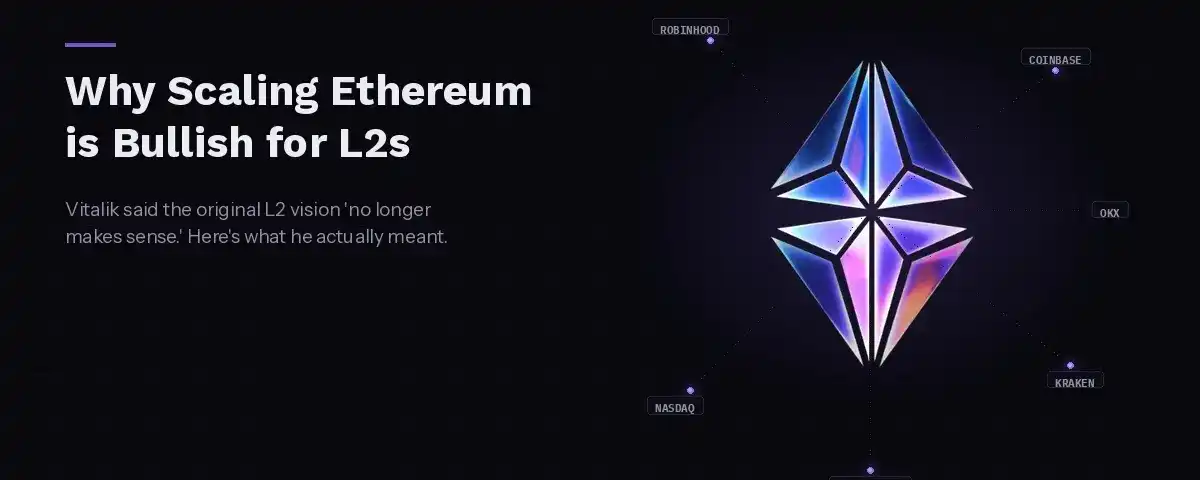
Actually, ETH Scaling is a Major Boon for L2s

Vitalik Buterin's recent comments on Ethereum scaling have been misinterpreted. He did not declare Layer 2s (L2s) a failure but rather signaled a strategic shift: Ethereum is moving from a "rollup-centric" scaling model, where L2s were seen as simple replicas of the base layer, to one where the L1 itself undergoes aggressive scaling. L2s remain crucial, but their primary value proposition has evolved to be customization, not just cheap transactions. Two key developments drove this change. First, Ethereum's base layer is scaling faster than anticipated. After years of cautious progress to preserve decentralization, an ambitious new roadmap aims to drastically increase L1 throughput through a series of upgrades, including a higher gas limit, faster block times, parallel transaction processing, and a fundamental transition to a native zero-knowledge (zkEVM) architecture. This allows Ethereum to scale while maintaining its superior decentralization. Second, L2s have found product-market fit with institutions. Companies like Robinhood, Coinbase, and Kraken are building their own L2s because they need Ethereum's security and access to its liquidity, but also require control for regulatory compliance, custom fee structures, and operational flexibility. This creates a spectrum of L2s, from highly decentralized ones to more controlled, institutionally-focused chains—a reality Vitalik acknowledges is valid as long as marketing is honest. Crucially, scaling the L1 does not compete with L2s; it makes them better. A more powerful L1 means cheaper data availability and settlement costs for L2s, faster withdrawals, and quicker finality. The main unresolved challenge is liquidity fragmentation between L2s, which the Ethereum Foundation is prioritizing with new interoperability solutions for 2026. The narrative that Ethereum is abandoning L2s is incorrect. The ecosystem is maturing into a system with a radically scaling L1 at its core, surrounded by a flourishing ecosystem of specialized L2s.

marsbit2 ч. назад

Actually, ETH Scaling is a Major Boon for L2s

marsbit2 ч. назад

Торговля

Спот
Фьючерсы

Популярные статьи

Тест по Bitcoin Биткоина

HTX Learn: Изучите Bitcoin halving и Заработаете Токены USDT

2.8k просмотров всегоОпубликовано 2024.04.16Обновлено 2024.04.16

Тест по Bitcoin  Биткоина

Что такое $BITCOIN

ЦИФРОВОЕ ЗОЛОТО ($BITCOIN): Комплексный анализ Введение в ЦИФРОВОЕ ЗОЛОТО ($BITCOIN) ЦИФРОВОЕ ЗОЛОТО ($BITCOIN) — это проект на основе блокчейна, работающий в сети Solana, который стремится объединить характеристики традиционных драгоценных металлов с инновациями децентрализованных технологий. Хотя он носит имя Биткойн, часто называемого “цифровым золотом” из-за его восприятия как средства хранения ценности, ЦИФРОВОЕ ЗОЛОТО является отдельным токеном, предназначенным для создания уникальной экосистемы в ландшафте Web3. Его цель — позиционировать себя как жизнеспособный альтернативный цифровой актив, хотя детали его применения и функциональности все еще развиваются. Что такое ЦИФРОВОЕ ЗОЛОТО ($BITCOIN)? ЦИФРОВОЕ ЗОЛОТО ($BITCOIN) — это токен криптовалюты, специально разработанный для использования в блокчейне Solana. В отличие от Биткойна, который выполняет широко признанную роль хранения ценности, этот токен, похоже, сосредоточен на более широких приложениях и характеристиках. Примечательные аспекты включают: Инфраструктура блокчейна: Токен построен на блокчейне Solana, известном своей способностью обрабатывать высокоскоростные и недорогие транзакции. Динамика предложения: ЦИФРОВОЕ ЗОЛОТО имеет максимальное предложение, ограниченное 100 квадриллионами токенов (100P $BITCOIN), хотя детали о его обращающемся предложении в настоящее время не раскрыты. Утилита: Хотя точные функциональные возможности не описаны, есть указания на то, что токен может быть использован для различных приложений, потенциально связанных с децентрализованными приложениями (dApps) или стратегиями токенизации активов. Кто создатель ЦИФРОВОГО ЗОЛОТА ($BITCOIN)? На данный момент личность создателей и команды разработчиков, стоящих за ЦИФРОВЫМ ЗОЛОТОМ ($BITCOIN), остается неизвестной. Эта ситуация типична для многих инновационных проектов в области блокчейна, особенно тех, которые связаны с децентрализованными финансами и феноменом мем-криптовалют. Хотя такая анонимность может способствовать культуре, ориентированной на сообщество, она усиливает опасения по поводу управления и ответственности. Кто инвесторы ЦИФРОВОГО ЗОЛОТА ($BITCOIN)? Доступная информация указывает на то, что у ЦИФРОВОГО ЗОЛОТА ($BITCOIN) нет известных институциональных спонсоров или значительных венчурных капиталовложений. Проект, похоже, функционирует по модели пирингового взаимодействия, сосредоточенной на поддержке и принятии сообществом, а не на традиционных путях финансирования. Его активность и ликвидность в основном сосредоточены на децентрализованных биржах (DEX), таких как PumpSwap, а не на устоявшихся централизованных торговых платформах, что еще больше подчеркивает его подход, ориентированный на grassroots. Как работает ЦИФРОВОЕ ЗОЛОТО ($BITCOIN) Операционные механизмы ЦИФРОВОГО ЗОЛОТА ($BITCOIN) можно подробно описать на основе его дизайна блокчейна и характеристик сети: Механизм консенсуса: Используя уникальный механизм доказательства истории (PoH) Solana в сочетании с моделью доказательства доли (PoS), проект обеспечивает эффективную валидацию транзакций, что способствует высокой производительности сети. Токеномика: Хотя конкретные дефляционные механизмы не были подробно описаны, большое максимальное предложение токенов подразумевает, что оно может быть предназначено для микротранзакций или нишевых случаев использования, которые еще предстоит определить. Интероперабельность: Существует потенциал для интеграции с более широкой экосистемой Solana, включая различные платформы децентрализованных финансов (DeFi). Однако детали относительно конкретных интеграций остаются неуточненными. Хронология ключевых событий Вот хронология, которая подчеркивает значимые вехи, касающиеся ЦИФРОВОГО ЗОЛОТА ($BITCOIN): 2023: Первоначальное развертывание токена происходит в блокчейне Solana, отмеченное его адресом контракта. 2024: ЦИФРОВОЕ ЗОЛОТО приобретает видимость, когда оно становится доступным для торговли на децентрализованных биржах, таких как PumpSwap, позволяя пользователям обменивать его на SOL. 2025: Проект наблюдает спорадическую торговую активность и потенциальный интерес к инициативам, возглавляемым сообществом, хотя на данный момент не зафиксировано никаких значительных партнерств или технических достижений. Критический анализ Сильные стороны Масштабируемость: Основная инфраструктура Solana поддерживает высокие объемы транзакций, что может повысить полезность $BITCOIN в различных сценариях транзакций. Доступность: Потенциально низкая цена торговли за токен может привлечь розничных инвесторов, способствуя более широкому участию благодаря возможностям дробного владения. Риски Отсутствие прозрачности: Отсутствие публично известных спонсоров, разработчиков или процесса аудита может вызвать скептицизм относительно устойчивости и надежности проекта. Волатильность рынка: Торговая активность сильно зависит от спекулятивного поведения, что может привести к значительной волатильности цен и неопределенности для инвесторов. Заключение ЦИФРОВОЕ ЗОЛОТО ($BITCOIN) является интригующим, но неоднозначным проектом в быстро развивающейся экосистеме Solana. Хотя он пытается использовать нарратив “цифрового золота”, его отход от установленной роли Биткойна как средства хранения ценности подчеркивает необходимость более четкого различения его предполагаемой утилиты и структуры управления. Будущее принятие и усвоение, вероятно, будут зависеть от решения текущей непрозрачности и более четкого определения его операционных и экономических стратегий. Примечание: Этот отчет охватывает синтезированную информацию, доступную на октябрь 2023 года, и с тех пор могут произойти события.

99 просмотров всегоОпубликовано 2025.05.13Обновлено 2025.05.13

Что такое $BITCOIN

Fractal Bitcoin: масштабирование Биткоина с помощью рекурсивной системы

Fractal Bitcoin — масштабное Layer-1-решнение, созданное на базе кода Биткоина, позволяющего достигать бесконечного масштабирования с помощью рекурсивного подхода.

2.1k просмотров всегоОпубликовано 2025.06.30Обновлено 2025.06.30

Fractal Bitcoin: масштабирование Биткоина с помощью рекурсивной системы

Обсуждения

Добро пожаловать в Сообщество HTX. Здесь вы сможете быть в курсе последних новостей о развитии платформы и получить доступ к профессиональной аналитической информации о рынке. Мнения пользователей о цене на BTC (BTC) представлены ниже.

活动图片